Power Up Testing Efficiency by 40% in just 12 weeks. Join the Pilot Program
Reliable AI API Testing for Fast Release Cycles
Keep every integration stable with AI-based API testing. ContextQA validates requests, responses, and dependencies with accurate, repeatable checks that stay aligned with your changing services.
Trusted by leading engineering and QA teams






Stronger prompts lead to stronger tests.
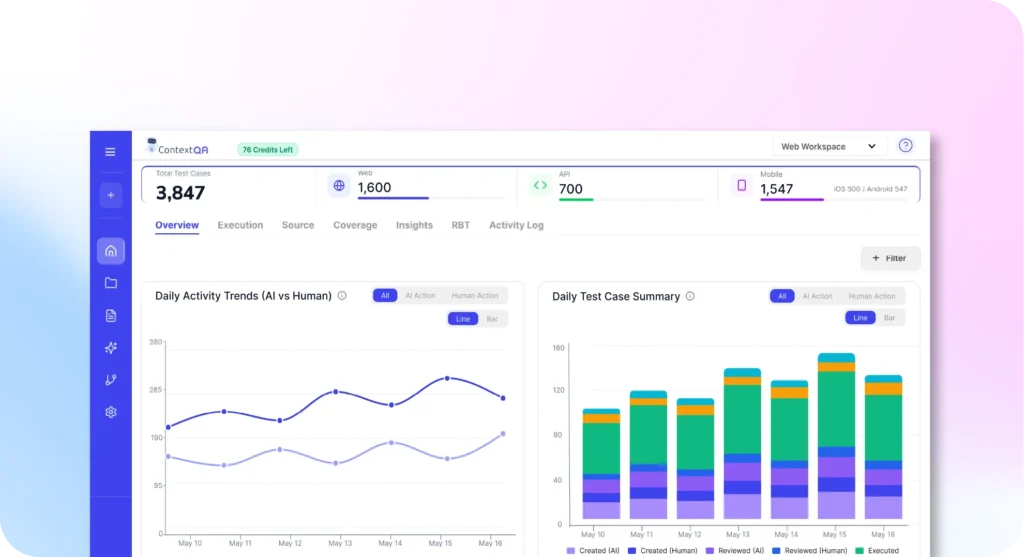
Get faster cycles, cleaner builds, and trustworthy results when you use software testing with our context-aware AI testing platform.
%
Faster triage
%
healing accuracy
%
Cut maintenance
0
%
Flake rate
Stable API Testing That Adapts to Every Release
ContextQA brings AI in API testing to the core of your delivery flow. Every request is validated, every response is checked, and every break is diagnosed with clear reasoning. Teams ship reliable services with fewer retries, fewer broken contracts, and faster regression cycles.

API Testing That Matches Your Release Speed
You know how it goes: the services your team needs to provide change often. API dependencies shift, contract rules evolve, things change. ContextQA gives teams automated checks that keep pace with fast deployments while reducing rework and instability.
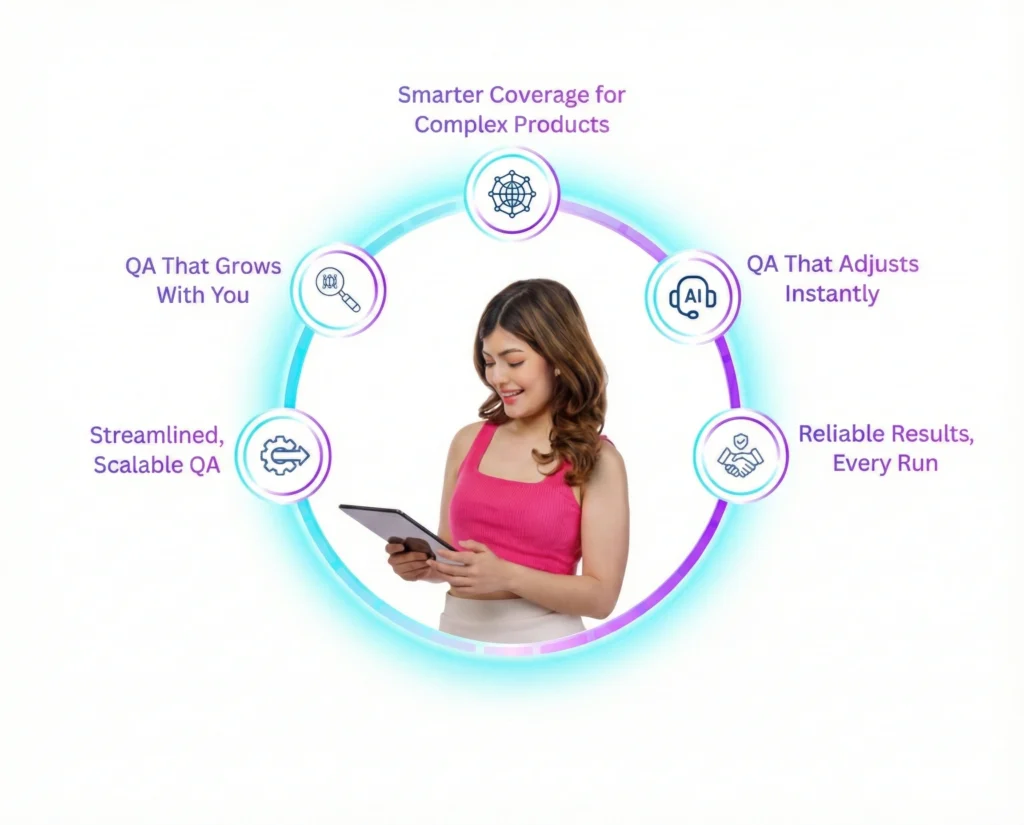
Catch API Failures Early
AI testing identifies broken schemas, mismatched fields, and service regressions before they reach production. You get earlier signals and cleaner deployments without long debugging cycles.
Fewer Broken Integrations
AI-based API testing adapts when endpoints change, delivering stable results even with frequent updates. This reduces routine patching and keeps your services connected.
Clear, Actionable Diagnostics
Every failed request includes detailed reasoning, response snapshots, timelines, and suggested fixes. No guesswork. No long review cycles.
Faster Regression for Backend Teams
Regression runs move quickly with focused checks. AI prioritises tests based on risk, past failures, and dependency impact, which shortens cycles during tight release windows.
Consistent Results Across Environments
ContextQA identifies data mismatches and drifts that usually slow down backend testing and frustrate your PMs. Switch to the platform, and you get reliable, predictable runs across local, staging, and pre-prod.
How ContextQA Automates API Testing at Scale
Backend services rely on stable, repeatable testing. ContextQA delivers this through automated request generation, schema validation, parameter reasoning, dependency checks, and unified reporting.
01
Automated Request Validation
Each request is checked for structure, required fields, parameters, and response accuracy. AI highlights where flows fail, even when logic changes.
02
Adaptive Test Selection
Tests are chosen based on code changes, API history, dependency impact, and failure patterns. This reduces noise and highlights the areas that matter during a release.
04
Dependency Reasoning Across Services
The platform studies how one service affects another and flags cascading issues that usually appear late in testing.
03
Schema and Contract Checks
ContextQA compares responses against current and historical schemas. When a field moves or a contract shifts, AI explains the change and surfaces the risk.
03
Full Diagnostics in One View
Teams see the exact request, the response snapshot, related logs, and an explanation of the issue. This shortens triage and helps teams fix problems without combing through raw data.
Reliable API Testing With AI
Teams often deal with broken flows across microservices, search endpoints, auth systems, and billing logic.
AI in API testing handles these shifts by learning patterns in your services, identifying inconsistent behaviour, and suggesting the next tests to run. It strengthens regression cycles for backend engineers, mobile teams, and integration pipelines. This covers both AI API testing and API testing using AI searches, and gives you an edge when dealing with frequent contract changes.

Testing Built to Stay Future-Proof
Keep Every API Stable Through Continuous Change
ContextQA gives backend teams a reliable layer of automated checks with clear diagnostics, stable runs, and accurate reporting. Every service is validated across releases, so teams spend less time chasing failures and more time building.
FAQs
Our Customers Also Ask
What is AI-based API testing?
AI based API testing uses automated reasoning to validate requests, responses, and service contracts. ContextQA checks structure, fields, behaviour changes, and dependency links so engineering teams see clear causes when tests fail. This reduces review cycles and gives backend teams steady test coverage during frequent releases.
How does generative AI for API testing help engineering teams?
Generative AI for API testing creates variations of requests and responses that highlight weak points in services.
ContextQA builds these checks automatically during regression, which expands test coverage without creating more scripts for engineers. This helps teams find issues earlier in the release cycle and keeps services stable.
Does ContextQA support API testing with AI for microservices?
ContextQA works with microservices by studying request patterns, dependency paths, and shared data structures. The platform highlights issues that spread across multiple services, which is often hard to see with manual checks. This gives backend teams a reliable way to keep distributed systems stable as code changes move through different services.
What are the best API testing AI tools?
The best API testing AI tools validate contracts, detect behaviour changes, generate realistic request patterns, and provide clear diagnostics. ContextQA delivers all of these with stable results across environments plus detailed reasoning to shorten triage. This helps teams reduce flakiness and maintain consistent release quality.
Does AI web automation work for complex applications?
Yes. ContextQA supports large multi-step flows, conditional logic, and heavy front-end frameworks. The system learns from repeated behaviour in the browser and stays stable even when teams ship frequent UI updates. This makes it suitable for enterprise products with constant change.