
AI prompt engineering has become part of everyday testing work as teams rely more on AI to generate test cases, flows, and datasets. In software testing, prompts are not casual inputs. They are instructions that determine whether generated tests are usable, repeatable, and aligned with real product behavior. When AI prompt engineering is handled carefully, teams reduce rework and gain more trust in the results.
ContextQA applies prompt engineering specifically to test generation. Instead of treating prompts as one-off requests, the platform helps teams write structured instructions that produce full test cases across web automation, mobile automation, and API testing. This makes prompt quality a core part of test accuracy.
The practices below focus on how teams can write stronger prompts that lead to better tests.

Write Prompts as Test Specifications
A prompt should read like a clear test description, not a question. When teams describe expected behavior in plain, direct language, the AI has less room to guess.
Good prompts describe:
- the user or system role
- the starting state
- the action being performed
- the expected outcome
In ContextQA, prompts written this way generate step-by-step test flows instead of partial or unclear output. This helps QA teams avoid rewriting tests after generation.
Keep Instructions Focused and Direct
Short prompts work best when they are specific. Long prompts filled with extra wording often introduce ambiguity. Testing teams should focus on what needs to happen, not how the AI should think.
A focused prompt leads to:
- cleaner selectors
- clearer conditions
- fewer unexpected steps
ContextQA encourages this by guiding prompt writers toward structured patterns that consistently return complete test cases.
Include Both Positive and Negative Paths
Prompts that only describe a successful flow can seriously limit coverage. Strong test prompts include failure conditions, validation errors, and alternate paths.
Examples of useful additions:
- invalid input cases
- permission failures
- missing data scenarios
- recovery steps
ContextQA supports this by allowing teams to describe edge cases directly in the prompt so the generated test includes both expected and failure behavior.
Use Structured Inputs When Possible
Prompts become more reliable when paired with structured inputs like tables, lists, or referenced requirements. Structured data reduces interpretation errors and helps the system generate predictable output.
Teams often combine prompts with:
- sample data tables
- user stories
- design notes
- API definitions
ContextQA supports these inputs so prompts can generate richer test cases without additional manual setup.
Treat Prompts as Reusable Assets
Prompts should not live in isolation. Once a prompt produces reliable output, it should be reused. Shared prompts help teams maintain consistency across contributors.
ContextQA includes a prompt library so teams can store approved prompts and reuse them across projects. This keeps output steady and avoids variation caused by different writing styles.
Reusable prompts also reduce onboarding time for new team members.
Review Output and Refine the Prompt
Prompt engineering is not about getting the perfect result on the first attempt. Teams should review generated tests, adjust the prompt, and rerun it until the output matches expectations.
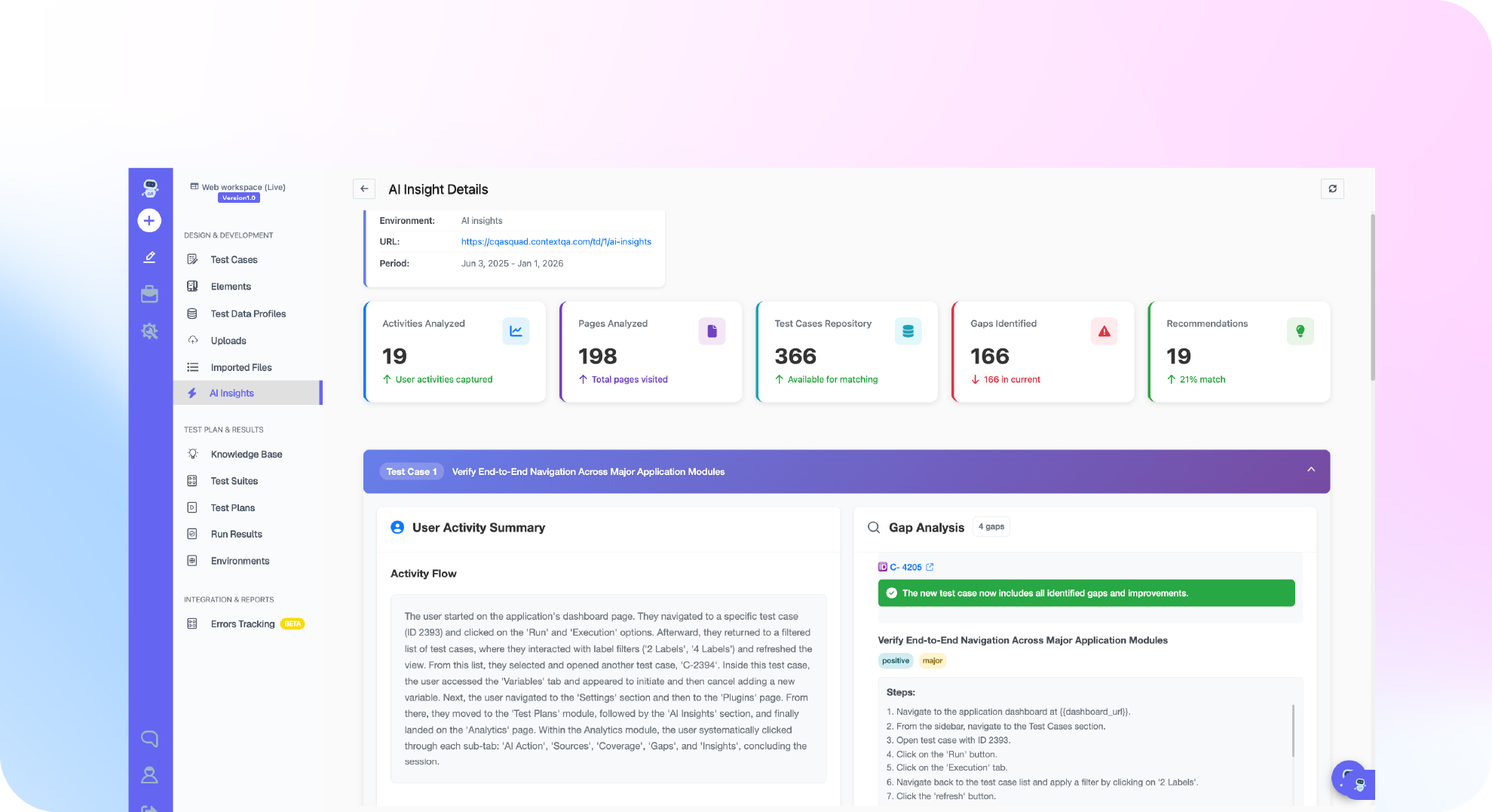
ContextQA supports this loop with a review panel that shows the generated steps clearly. Small changes to wording often lead to better results without rewriting the entire prompt.
This review cycle is especially useful when products change and tests need to adapt quickly; quick reviews can completely turn an AI testing cycle around!
Let’s get your QA moving
See how ContextQA’s agentic AI platform keeps testing clear, fast, and in sync with your releases.
Book a demoDesign Prompts for Full Workflow Coverage
Prompts should reflect real user journeys, not isolated actions. Testing teams get better coverage when prompts describe full flows such as login, onboarding, checkout, or API sequences.
ContextQA turns these prompts into multi-step tests that align with real application behavior. This supports stronger end-to-end coverage and reduces gaps between test design and actual usage.
Align Prompt Engineering With Regression Strategy

Prompts that generate stable tests support long-term regression. When prompts are clear and structured, generated tests remain usable even as the UI or backend changes.
ContextQA connects prompt-generated root cause analysis tests with auto-healing and model-based updates so changes apply across the suite instead of breaking individual tests. This helps teams expand coverage without increasing maintenance effort.
Test Prompt Behavior Across Changes
Prompt behavior can change when the product evolves. Teams should rerun prompts after updates to confirm the generated tests still reflect expected behavior.
ContextQA’s features help track which prompts produce the most stable tests and which ones need refinement. This visibility helps QA teams focus effort where it matters most.
Conclusion
AI prompt engineering best practices directly affect how reliable AI-generated tests become.
When prompts are clear, structured, and written with real product behavior in mind, the resulting tests are easier to trust, reuse, and maintain. Weak prompts create noise, confusion and unnecessary amends. Strong prompts create coverage that holds up as systems change.
ContextQA helps teams apply this discipline by turning well-written prompts into complete test cases, tracking how those prompts perform over time, and supporting consistent results across web, mobile, and API testing. This approach gives QA and development teams a practical way to improve accuracy without adding friction to their workflow.
Get started with a demo of ContextQA to start building better prompts for AI.