
Table of Contents
AI plays a growing role in fintech products, across start-ups and established players alike. From fraud detection to transaction monitoring and customer verification, AI systems help companies process large volumes of data with speed and consistency, freeing up teams for other tasks and helping to reduce human error.
For developers and QA teams, this creates new testing and security responsibilities. AI-driven decisions must behave correctly, stay consistent across updates, and meet regulatory expectations to keep data safe.
Understanding how AI is used in fintech helps software teams design better validation strategies. It also highlights why automation and structured testing matter when products handle sensitive financial data. ContextQA supports this work by helping teams test end-to-end flows, detect unusual behavior patterns, and maintain stability across releases.
Common Ways AI Is Used in Fintech Systems

AI supports many core fintech functions. These fintech AI systems rely on data accuracy, predictable behavior, and careful oversight from engineering and QA teams.
Fraud detection
AI models analyze transaction patterns to flag suspicious behavior. They look for irregular spending, unusual locations, or changes in activity. These systems reduce fraud risk but require constant testing to confirm accuracy. QA teams simulate known fraud patterns and confirm the system reacts as expected.
Risk scoring and credit decisions
Many fintech platforms use AI to evaluate credit risk for clients and internal processes alike. Models process historical data, payment behavior, and account activity. Developers and testers have to confirm that model outputs remain consistent and that changes do not introduce bias or logic errors.
Identity verification
AI assists with document checks, biometric validation, and identity matching. These flows depend on third-party services and must be tested across lots of varied conditions. Automated end-to-end tests help confirm the full verification path works correctly.
Transaction monitoring
AI reviews transactions in real time to detect anomalies. These checks must remain accurate even as transaction volume grows. QA teams rely on automated tests to validate thresholds and response behavior.
Customer support automation
Chat tools and virtual assistants handle account questions, payment issues, and onboarding guidance. Testing teams validate that responses are accurate and that sensitive data is handled correctly.
Compliance Implications for AI in Fintech

Fintech platforms operate under strict regulations. AI systems have to support transparency, auditability, and consistency. This affects how software teams design and test these systems.
Audit trails
Regulators expect clear records of how decisions are made. QA teams need to confirm that AI outputs can be traced back to inputs and system states. Web automation testing helps confirm that logs and decision records are generated correctly.
Explainability
Some AI models act as black boxes. Fintech teams must still provide explanations for decisions like credit approvals or account restrictions. Testing helps confirm that explanation layers behave correctly and stay aligned with model outputs.
Data handling
AI systems process personal and financial data. Developers and QA testers validate that data access, storage, and transfer follow compliance requirements. Automated checks help confirm these rules across environments.
Let’s get your QA moving
See how ContextQA’s agentic AI platform keeps testing clear, fast, and in sync with your releases.
Book a demoModel updates
AI models evolve. Each update introduces risk. Regression testing helps confirm that new versions do not break compliance logic or security controls.
ContextQA helps teams manage these risks by recording flows, comparing behavior across versions, and highlighting unexpected changes that may affect compliance.
Security Implications Developers and QA Teams Must Test
Security remains a major concern when AI is part of fintech systems. AI can strengthen security, but it can also introduce new attack surfaces.
Input manipulation
Attackers may attempt to exploit AI models by feeding misleading inputs. QA teams use root cause analysis and other testing for edge cases and abnormal inputs to confirm the system responds safely.
Model drift
Over time, model behavior can shift. This may affect fraud detection thresholds or risk scoring. Automated comparisons help detect when behavior changes unexpectedly.
Integration risks
Fintech systems often integrate multiple services. AI outputs may trigger downstream actions. End-to-end testing helps confirm that all connected components behave correctly under stress.
Access control
AI systems must respect user roles and permissions. QA testers validate that sensitive actions remain protected and that responses differ appropriately by role.
How QA Teams Test AI in Fintech Products
Testing AI in fintech requires a structured approach. Teams rely on automation to handle scale and complexity.
- Run end-to-end tests that cover full transaction paths
- Validate AI outputs under multiple data conditions
- Compare behavior across model versions
- Monitor logs for repeated patterns
- Confirm downstream systems react correctly
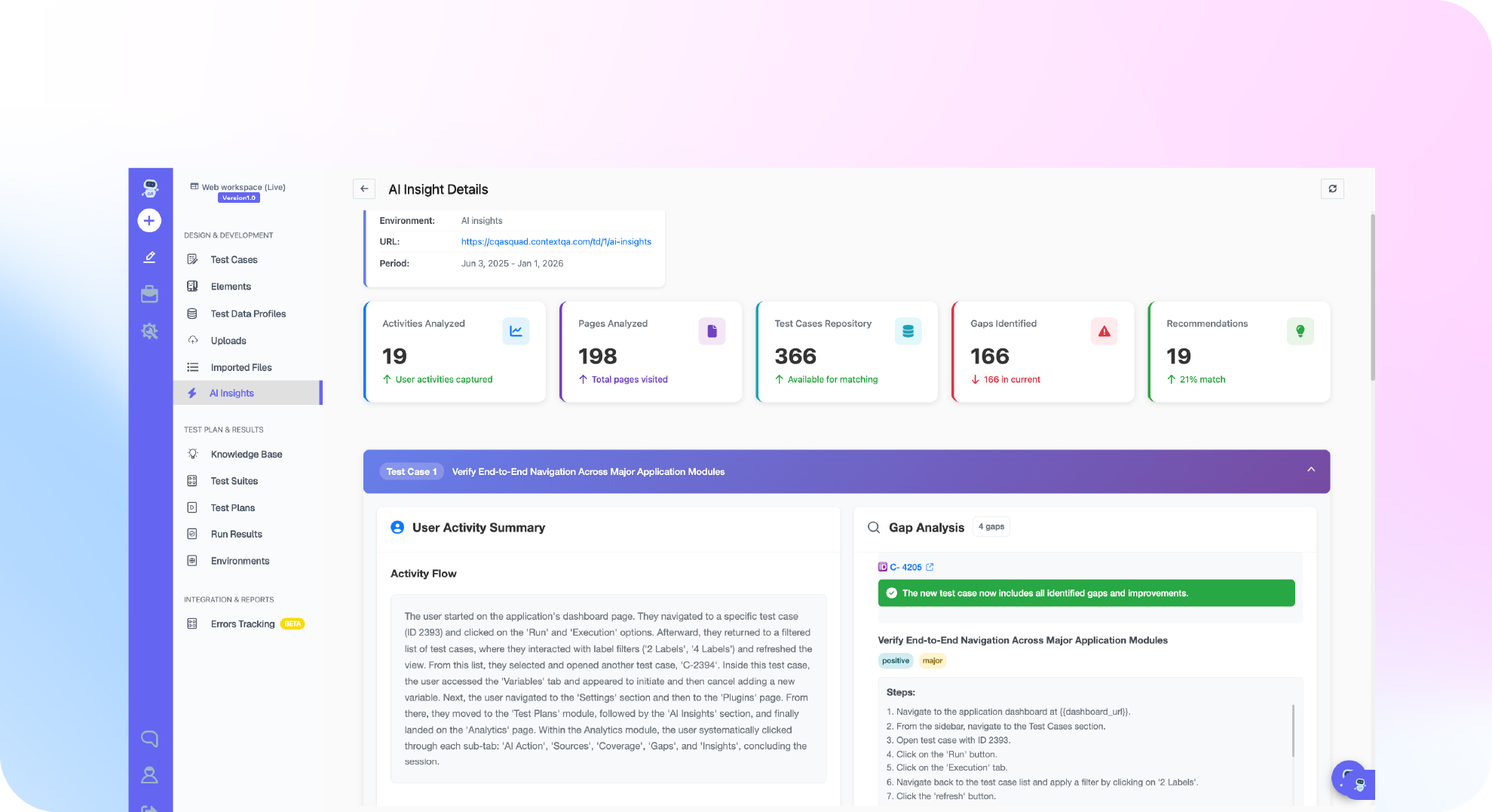
ContextQA supports this process by capturing user flows visually, modeling states that can be reused across tests, and highlighting patterns that signal deeper issues. This helps teams maintain confidence as systems grow.
How ContextQA Supports Fintech Testing Workflows
ContextQA’s core features help fintech teams test AI-driven systems without writing scripts. It records flows that include AI decisions, builds reusable models, and compares behavior across environments. When a model update changes system behavior, teams see it quickly.
This approach reduces manual effort and supports faster compliance reviews. Testers can focus on validation instead of setup, while developers gain clearer feedback during releases.
Conclusion
AI plays a central role in modern fintech systems, supporting fraud detection, transaction monitoring, identity checks, and risk assessment. These capabilities bring clear advantages, but they also raise important security and compliance concerns. AI-driven decisions must remain consistent, traceable, and protected against misuse, especially when financial data and regulatory requirements are involved.
For developers and QA teams, this means testing more than just functionality. Teams need visibility into how AI behaves across updates, how it responds to edge cases, and how changes affect downstream systems.
ContextQA helps support this work by recording AI-driven flows, comparing behavior across versions, and highlighting patterns that could point to security or compliance risks. This gives teams a clearer way to validate AI systems as fintech products grow and regulations evolve.
Get started with a demo of ContextQA to see how the tool works for fintech businesses and start-ups.