ContextQA
  • Home
  • Platform
    • Core Platform
    • At a GlanceComplete testing platform overview
    • Core FeaturesEssential testing capabilities
    • Pro FeaturesAdvanced testing features
    • Enterprise App testingEnterprise-grade capabilities
    • AI-Powered Testing
    • AI InsightsReal User Intelligence
    • AI Agents TestingEvery agent risk, covered
    • AI Root Cause AnalysisPowered by agentic AI
    • Code ExportAnalyze End-To-End Tests
    • AI Feature ExplanationHow AI enhances testing
    • AI-Based Self-HealingAutomatic test maintenance
    • AI Testing SuiteWeb, Mobile, API AI testing
    • AI Prompt EngineeringAI-driven test creation
    • AI Data Validation & ManagementAccurate, consistent test data at scale
    • Digital AI Continuous TestingAlways-on testing across every release
    • Integrations
    • All IntegrationsConnect with your tools
    • Technology PartnersIntegration partnerships
    • MCPOne prompt. Full automation.
  • Solutions
    • Testing Products
    • Web AutomationBrowser test automation
    • Mobile AutomationiOS & Android testing
    • ERP / SAP TestingEnterprise application testing
    • Salesforce TestingCRM testing automation
    • API TestingREST & GraphQL testing
    • Specialized Testing
    • CodiTOSCode to Test in Seconds
    • Visual RegressionUI change detection
    • Performance TestingLoad & stress testing
    • Database TestingData validation & integrity
    • By Industry
    • All IndustriesIndustry-specific solutions
    • VerticalsSector-specific testing
  • Resources
    • Learn & Grow
    • Learning HubEducational resources
    • PodcastThe Agentic Quality Podcast
    • Agentic Quality Ambassador ProgramA community of QA practitioners
    • TutorialsStep-by-step guides
    • Academy & CertificationsEarn testing certifications
    • Content Library
    • BlogsInsights, trends & tips in QA
    • eBooksIn-depth testing guides
    • WhitepapersResearch & analysis
    • Case StudiesSuccess stories
    • Events & Tools
    • EventsIndustry events & meetups
    • WebinarsLive & recorded sessions
    • ROI CalculatorCalculate testing ROI
    • Product ComparisonCompare testing tools
  • Company
    • About Us
    • Why ContextQA?
    • Channel Partners
    • Contact Us
Book A Demo
ContextQA
  • Home
  • Platform
    • Core Platform
    • At a GlanceComplete testing platform overview
    • Core FeaturesEssential testing capabilities
    • Pro FeaturesAdvanced testing features
    • Enterprise App testingEnterprise-grade capabilities
    • AI-Powered Testing
    • AI InsightsReal User Intelligence
    • AI Agents TestingEvery agent risk, covered
    • AI Root Cause AnalysisPowered by agentic AI
    • Code ExportAnalyze End-To-End Tests
    • AI Feature ExplanationHow AI enhances testing
    • AI-Based Self-HealingAutomatic test maintenance
    • AI Testing SuiteWeb, Mobile, API AI testing
    • AI Prompt EngineeringAI-driven test creation
    • AI Data Validation & ManagementAccurate, consistent test data at scale
    • Digital AI Continuous TestingAlways-on testing across every release
    • Integrations
    • All IntegrationsConnect with your tools
    • Technology PartnersIntegration partnerships
    • MCPOne prompt. Full automation.
  • Solutions
    • Testing Products
    • Web AutomationBrowser test automation
    • Mobile AutomationiOS & Android testing
    • ERP / SAP TestingEnterprise application testing
    • Salesforce TestingCRM testing automation
    • API TestingREST & GraphQL testing
    • Specialized Testing
    • CodiTOSCode to Test in Seconds
    • Visual RegressionUI change detection
    • Performance TestingLoad & stress testing
    • Database TestingData validation & integrity
    • By Industry
    • All IndustriesIndustry-specific solutions
    • VerticalsSector-specific testing
  • Resources
    • Learn & Grow
    • Learning HubEducational resources
    • PodcastThe Agentic Quality Podcast
    • Agentic Quality Ambassador ProgramA community of QA practitioners
    • TutorialsStep-by-step guides
    • Academy & CertificationsEarn testing certifications
    • Content Library
    • BlogsInsights, trends & tips in QA
    • eBooksIn-depth testing guides
    • WhitepapersResearch & analysis
    • Case StudiesSuccess stories
    • Events & Tools
    • EventsIndustry events & meetups
    • WebinarsLive & recorded sessions
    • ROI CalculatorCalculate testing ROI
    • Product ComparisonCompare testing tools
  • Company
    • About Us
    • Why ContextQA?
    • Channel Partners
    • Contact Us
Book A Demo
  • sales@contextqa.com
Linkedin-in Facebook-f Youtube Instagram
ContextQA
  • Home
  • Platform
    • Core Platform
    • At a GlanceComplete testing platform overview
    • Core FeaturesEssential testing capabilities
    • Pro FeaturesAdvanced testing features
    • Enterprise App testingEnterprise-grade capabilities
    • AI-Powered Testing
    • AI InsightsReal User Intelligence
    • AI Agents TestingEvery agent risk, covered
    • AI Root Cause AnalysisPowered by agentic AI
    • Code ExportAnalyze End-To-End Tests
    • AI Feature ExplanationHow AI enhances testing
    • AI-Based Self-HealingAutomatic test maintenance
    • AI Testing SuiteWeb, Mobile, API AI testing
    • AI Prompt EngineeringAI-driven test creation
    • AI Data Validation & ManagementAccurate, consistent test data at scale
    • Digital AI Continuous TestingAlways-on testing across every release
    • Integrations
    • All IntegrationsConnect with your tools
    • Technology PartnersIntegration partnerships
    • MCPOne prompt. Full automation.
  • Solutions
    • Testing Products
    • Web AutomationBrowser test automation
    • Mobile AutomationiOS & Android testing
    • ERP / SAP TestingEnterprise application testing
    • Salesforce TestingCRM testing automation
    • API TestingREST & GraphQL testing
    • Specialized Testing
    • CodiTOSCode to Test in Seconds
    • Visual RegressionUI change detection
    • Performance TestingLoad & stress testing
    • Database TestingData validation & integrity
    • By Industry
    • All IndustriesIndustry-specific solutions
    • VerticalsSector-specific testing
  • Resources
    • Learn & Grow
    • Learning HubEducational resources
    • PodcastThe Agentic Quality Podcast
    • Agentic Quality Ambassador ProgramA community of QA practitioners
    • TutorialsStep-by-step guides
    • Academy & CertificationsEarn testing certifications
    • Content Library
    • BlogsInsights, trends & tips in QA
    • eBooksIn-depth testing guides
    • WhitepapersResearch & analysis
    • Case StudiesSuccess stories
    • Events & Tools
    • EventsIndustry events & meetups
    • WebinarsLive & recorded sessions
    • ROI CalculatorCalculate testing ROI
    • Product ComparisonCompare testing tools
  • Company
    • About Us
    • Why ContextQA?
    • Channel Partners
    • Contact Us
The State of QA in 2026

The State of QA in 2026: Why Manual Testing Is Holding Your Team BackTesting Is Holding Your Team Back

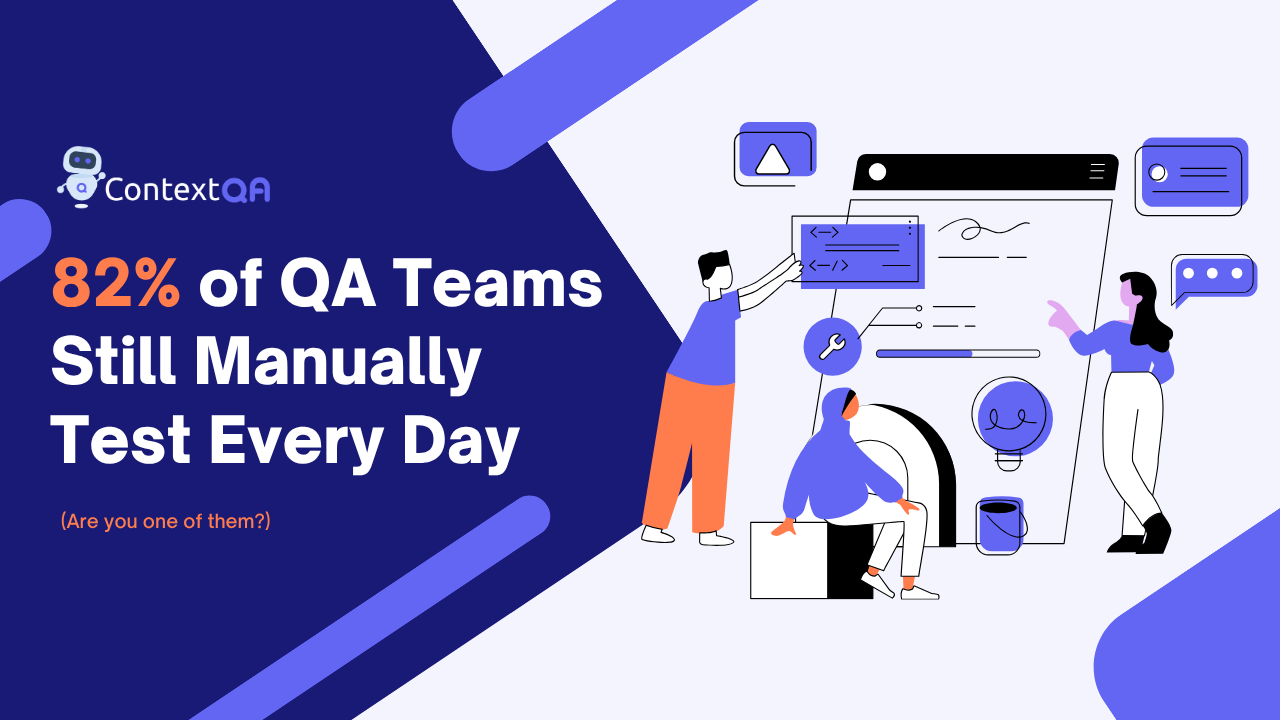
Here is a number that should bother every engineering leader: 82 percent of QA teams still use manual testing every single day. Not as a backup. Not for edge cases. As their primary method of validating software before it ships to customers.

That stat comes from the 2025 State of Software Quality Report, and it tells a bigger story than most people realize. We have moved into an era where engineering teams deploy multiple times a day, where CI/CD pipelines run on every commit, and where customers expect zero downtime. Yet the majority of QA teams are still clicking through test cases by hand, one screen at a time.

If you are running an engineering organization with 100 plus employees and you are still relying primarily on manual QA, this is not a quality problem. It is a velocity problem. And it is costing you more than you think.

The Numbers Paint a Clear Picture

The global automation testing market is projected to grow from 19.97 billion dollars in 2025 to 51.36 billion dollars by 2031. That is not speculative growth. That is the market responding to a real, measurable problem: manual testing cannot keep up with modern software development.

Here is what the industry data actually shows:

  • Time Scarcity: 55 percent of QA teams say insufficient time for thorough testing is their top challenge. Not skill gaps. Not tooling. Time. They simply cannot test fast enough to keep pace with development.
  • High Workload: 44 percent cite high workload as the second biggest barrier. Your QA engineers are not underperforming. They are drowning.
  • ROI Gap: Only 36 percent of organizations report positive ROI from their current testing approach. That means nearly two thirds of companies are spending money on QA without being able to prove it is paying off.
  • AI Adoption: 61 percent of QA teams are now adopting AI driven testing, up from less than 30 percent just two years ago. The shift is not gradual. It is accelerating.

These are not abstract industry trends. If your team has 5 to 30 QA engineers and your automated test coverage sits somewhere between 20 percent and 40 percent, you are living this reality right now.

Manual Testing Is Not Just Slow: It Is Actively Expensive

Most engineering leaders understand that manual testing is slower than automation. But the real cost is rarely calculated, and it shows up in places that do not appear on a QA budget spreadsheet.

The Maintenance Trap

QA teams that rely on manual processes spend 40 percent to 60 percent of their working hours on test maintenance. Not writing new tests. Not catching new bugs. Just keeping existing tests from breaking. Every UI change, every API update, and every design tweak sends a ripple through the test suite that requires human intervention. That is not QA work. That is janitorial work, and your most skilled engineers are doing it.

Learn how  AI based self healing eliminates this “janitorial” overhead.

The Release Velocity Tax

When testing is manual, your release cycle is gated by how fast humans can click through scenarios. A team running a 3 week release cycle because of testing bottlenecks is shipping roughly 17 times a year. A team with proper  test automation can ship daily or even multiple times per day. Over 12 months, the gap in feature delivery, bug fixes, and customer responsiveness is enormous.

The Coverage Gap

Manual teams typically achieve 20 percent to 40 percent test coverage. That is not a quality strategy. That is a hope strategy. You are hoping that the 60 percent to 80 percent of your application that goes untested on each release does not contain a regression that breaks something critical for your customers.

What AI Native QA Actually Looks Like

When I say AI native QA, I am not talking about adding a ChatGPT wrapper to your existing Selenium scripts. I am talking about a fundamentally different approach to how tests are created, maintained, and analyzed.

Here is what that looks like in practice:

  • AI Test Generation: Instead of a QA engineer spending 2 hours writing a test case for a checkout flow, AI analyzes the application, identifies the critical paths, and generates test cases in minutes. This is contextual generation that understands what matters most.
  • Auto Healing Tests: When a developer changes a button ID or moves an element on the page, traditional test scripts break. Auto healing tests detect the change and update the selector automatically.
  • Root Cause Analysis: When a test does fail, AI does not just tell you it failed. It tells you why. It traces the failure back to the specific code change and the specific condition that caused it. Your QA engineer goes from spending 45 minutes debugging a failure to spending 45 seconds reading a root cause analysis diagnosis.
  • Intelligent Test Prioritization: Not every test needs to run on every build. AI analyzes code changes and determines which tests are most likely to catch regressions, then runs those first.

The teams using this approach are reporting measurable results. We consistently see customers achieve 80 percent plus test coverage, up from 20 percent to 40 percent. Manual regression time drops by 90 percent or more. Release cycles compress by 50 percent.

One Question to Ask Your QA Lead This Week

If you manage an engineering organization and you have not had this conversation recently, ask your QA lead this question:

“What percentage of our QA team’s time is spent maintaining existing tests versus writing new ones or improving coverage?”

If the answer is above 30 percent, your team is stuck in the maintenance trap. They are working hard, but they are not making your product better. They are just keeping the lights on.

The companies that will win in 2026 and beyond are not the ones with the most QA engineers. They are the ones where QA is no longer the constraint on how fast the business can move. That shift starts with understanding what manual testing is actually costing you, and what the alternative looks like.


 

Want to know where your team stands? Take our free Test Automation Maturity Assessment. It takes 3 minutes and gives you a clear picture of where you are, where the gaps are, and what to prioritize first.

Author

gaurav@contextqa.com

Mukund Wangikar Joins ContextQA as COO and Managing Director – India
June 25, 2025
Auto Healing Tests: How AI Eliminates the Number One QA Time Sink
April 9, 2026
cqa-logo-with-text
  • San Francisco, California, USA
  • sales@contextqa.com
Ask AI for a summary of ContextQA
Linkedin Facebook Youtube Instagram
Platform
  • AI Insights
  • AI Root Cause Analysis
  • AI Feature Explanation
  • AI-Based Self-Healing
  • AI Testing Suite
  • AI Prompt Engineering
  • AI Data Validation & Management
Solutions
  • CodiTOS
  • Web Automation
  • Mobile Automation
  • Visual Regression
  • Performance Testing
  • ERP / SAP Testing
  • Database Testing
  • Email Testing
  • Salesforce Testing
  • Verticals
Resources
  • Learning Hub
  • Tutorials
  • Academy & Certifications
  • Blog
  • eBooks
  • Newsletter
  • Whitepapers
  • Case Studies
Company
  • About Us
  • Why ContextQA
  • Channel Partners
  • Agentic Quality Ambassador Program
  • Contact Us
Legal
  • Terms of Service
  • Privacy Policy
  • Data Processing Agreement
  • Data Privacy Policy
  • Cookie Policy

© 2026 ContextQA. All rights reserved.