
Automated regression testing is supposed to save you time, right? You invest all this effort into building a comprehensive suite of tests, and in return, you get a safety net that catches bugs before they make it to production. But what happens when you spend more time maintaining your tests than you do building new features?
If this sounds familiar, you’re not alone. Test maintenance is one of the biggest challenges of automated visual regression testing. But it doesn’t have to be that way. With the right automated regression testing best practices, you can cut your maintenance in half and get back to doing what you do best: building great products.
In this post, we’ll break down the automated regression testing best practices that will help you create a low-maintenance, high-impact regression suite using ContextQA’s core testing features.

The High Cost of High-Maintenance Regression Suites
A high-maintenance regression suite is more than just a nuisance. It’s a major drag on your team’s productivity and puts all those well-known QA best practices at risk. Here are just a few of the costs:
- Slower release cycles: When you’re spending all your time fixing broken tests, you have less time to test new features. This can lead to slower release cycles and a loss of competitive advantage.
- Lower team morale: No one likes spending their days fixing flaky tests. It’s frustrating, and it can lead to lower team morale and higher turnover.
- Reduced test coverage: When your tests are constantly breaking, it’s tempting to just turn them off. This can lead to reduced test coverage and a higher risk of bugs making it to production.
High-Maintenance vs. Low-Maintenance Regression Suites
So, what’s the difference between a high-maintenance and a low-maintenance regression suite? Here’s a quick comparison:
| Feature | High-Maintenance Suite | Low-Maintenance Suite |
|---|---|---|
| Code Quality | Poorly written, hard to read | Clean, well-documented, and easy to understand |
| Test Structure | Monolithic, hard to debug | Modular, easy to debug |
| Test Data | Hard-coded, brittle | Externalized, easy to update |
| Test Selection | Runs all tests, every time | Runs only the tests that are relevant to the change |
| Test Failures | Flaky, hard to diagnose | Consistent, easy to diagnose |
Automated Regression Testing Best Practices
Ready to build a low-maintenance regression suite? Here are a few automated testing best practices that can help:
1. Treat Your Test Code Like Production Code
This is the golden rule of automated regression testing and a must for good test coverage technique. Your test code is just as important as your production code, and you should treat it as such. This means:
- Use a version control system. This will help you track changes to your test code and collaborate with your team.
- Follow coding standards. This will make your test code easier to read and maintain.
- Perform code reviews. This will help you catch bugs and improve the quality of your test code.
2. Use a Page Object Model (POM)
A Page Object Model (POM) is a design pattern that helps you create a more modular and maintainable test suite. The idea is to create a separate class for each page in your application. This class contains all of the locators and methods for interacting with that page.
By using a POM, you can separate your test logic from your page logic. This makes your tests easier to read and maintain, and it makes it easier to update your tests when your UI changes.
3. Don’t Just Automate Everything
It’s tempting to try to automate every single test in your regression suite. But this is a recipe for disaster. Not all tests are created equal, and some tests are better suited for manual testing.
A good rule of thumb is to automate the tests that are repetitive, time-consuming, and high-risk. For everything else, manual testing is often a better option (especially if you automate to reduce manual regression testing time!)
4. Use a Data-Driven Approach
A data-driven approach to testing is all about separating your test data from your test logic. This means that you store your test data in an external file, like a CSV or a JSON file. Your tests then read the data from this file and use it to run the tests.
By using a data-driven approach, you can easily update your test data without having to change your test code. This can save you a lot of time and effort, and it can make your tests more robust and reliable using database testing.
5. Leverage AI-Powered Tools
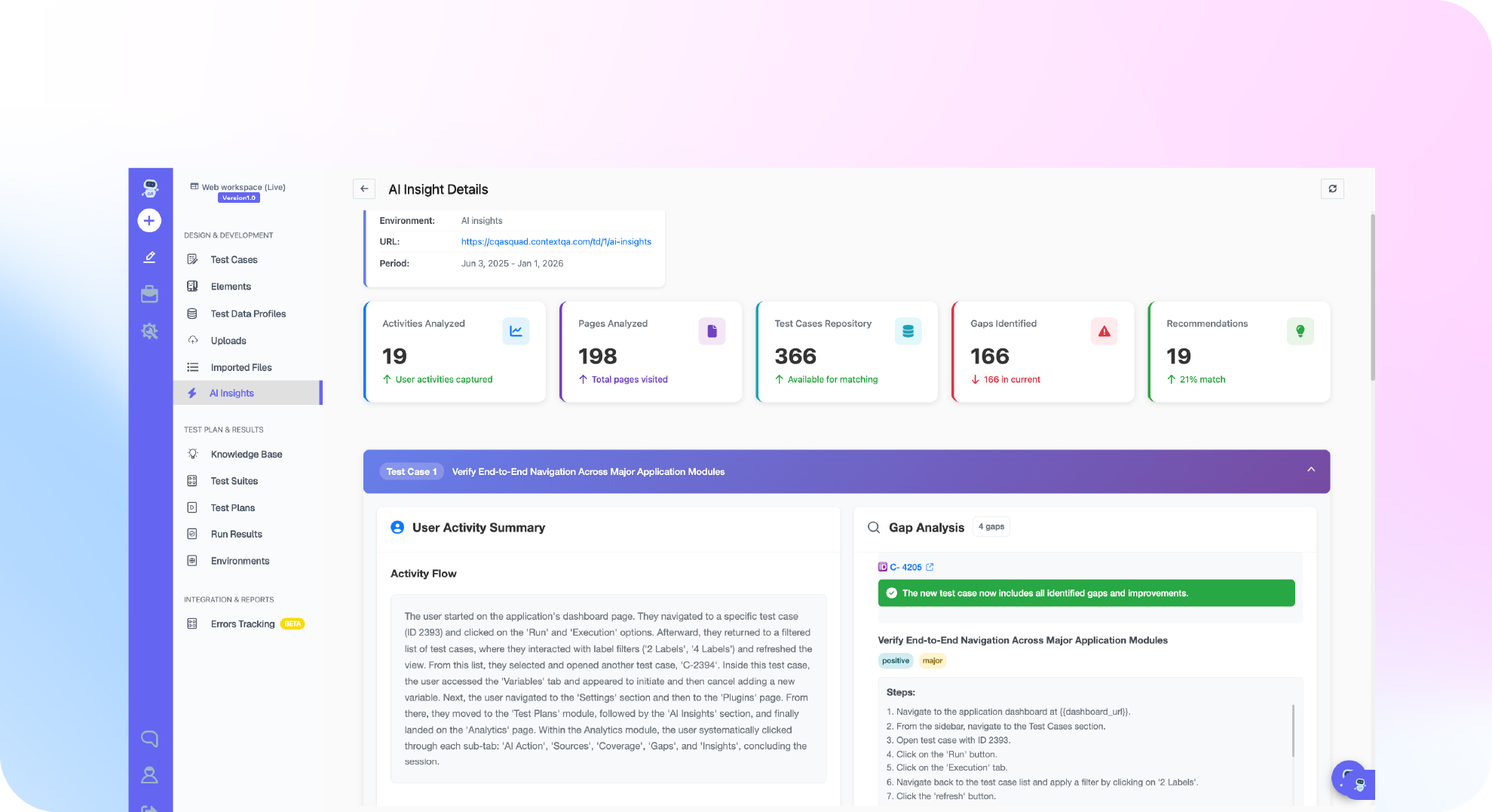
AI testing has truly changed the game when it comes to automated regression tests. An AI-powered tool can help you reduce your maintenance in a number of ways. For example, ContextQA’s AI features can be used to automatically generate tests, to identify and prioritize the most critical tests, and to even predict where regressions are most likely to occur.
One of the most powerful features of an AI-powered tool is self-healing tests. A self-healing test can automatically adapt to changes in your UI, so you don’t have to waste time updating your tests every time you make a change. This is a huge time-saver and can dramatically reduce the flakiness of your tests.
Let’s get your QA moving
See how ContextQA’s agentic AI platform keeps testing clear, fast, and in sync with your releases.
Book a demoStop Maintaining, Start Innovating
A high-maintenance regression suite is a major drag on your team’s productivity. But it doesn’t have to be that way. By following these automated regression testing best practices, you can cut your maintenance in half (or more!) and get back to doing what you do best: building great products.
Ready to get started with a low-maintenance regression suite? Book a ContextQA demo to watch automated regression testing and AI self healing in action.