
TL;DR: Playwright has overtaken Selenium as the most used automation framework for the first time. 2026 benchmark data shows Playwright at 45.1% adoption among QA professionals, Selenium declining to 22.1%, and Cypress holding at 14.4%. Playwright wins on speed (direct browser protocol vs WebDriver overhead), auto waiting (60% fewer flaky tests in benchmarks), and parallel execution without a grid. Selenium wins on language breadth (Java, Python, C#, Ruby, PHP) and legacy browser coverage (including IE via older versions). Cypress wins on developer experience for JavaScript teams but remains limited to Chromium and Firefox with incomplete Safari support. This guide covers the real comparison with benchmarks, team fit analysis, and when AI testing platforms make the framework choice less important than you think.
Definition: Test Automation Framework A structured set of tools, libraries, and conventions that enables teams to write, organize, execute, and maintain automated software tests. The three dominant web automation frameworks in 2026 are Playwright (Microsoft, released 2020, direct browser control via Chrome DevTools Protocol), Selenium (open source since 2004, browser control via WebDriver protocol), and Cypress (2017, JavaScript native, runs inside the browser). Each framework provides APIs for browser interaction (navigation, clicking, typing, assertions) but differs fundamentally in architecture, which determines speed, reliability, and maintenance burden.

Quick Answers:
Which is fastest: Playwright, Selenium, or Cypress? Playwright is fastest in most modern web testing scenarios. It communicates directly with browsers via the Chrome DevTools Protocol instead of going through WebDriver (Selenium) or running inside the browser (Cypress). In 300+ test suite benchmarks, Playwright’s built in auto waiting reduces flaky test failures by approximately 60% compared to Selenium, which requires explicit wait statements for every timing sensitive interaction.
Should I migrate from Selenium to Playwright? Not necessarily. If you have a stable Selenium suite with thousands of tests, migration cost often outweighs benefits. The practical approach: write all new tests in Playwright while maintaining existing Selenium tests. Migrate gradually by test area, starting with the flakiest Selenium tests. If you are starting a new project with no existing suite, Playwright is the default recommendation for 2026.
Where does Cypress fit in 2026? Cypress is excellent for JavaScript/TypeScript teams building modern single page applications who want fast developer feedback. It runs directly inside the browser, which gives it unique access to application internals (network interception, time travel debugging). The tradeoffs: no multi tab support, no native mobile automation, and Safari support is still limited. If your team is 100% JavaScript and tests only web UIs, Cypress remains a strong option.
The 2026 Market Shift: Playwright Takes the Lead
I want to start with the data because the framework landscape shifted significantly in the past 12 months.
TestGuild’s AG2026 survey of over 40,000 testers found Playwright usage exceeding Selenium for the first time. The Vervali benchmarks across 300+ test suites confirm the numbers: Playwright at 45.1% adoption, Selenium at 22.1%, Cypress at 14.4%.
GitHub metrics tell the same story. Playwright has over 78,600 stars. Selenium sits at approximately 32,000. Playwright npm weekly downloads peaked at 13.5 million in mid 2026, surpassing Cypress for the first time. Around 412,000 repositories use Playwright versus 354,000 for Selenium.
The broader market context: the automation testing market is projected to grow from $19.97 billion in 2025 to $51.36 billion by 2031 at a 17.05% CAGR. That growth means every team is evaluating or re evaluating their framework choice, which is why “playwright vs selenium” is one of the highest volume search queries in the entire QA space.
But market share does not tell you which framework is right for your specific team. Let me break down the actual technical differences that matter for your decision.
Head to Head Comparison: The Table That Matters
| Criteria | Playwright | Selenium | Cypress |
| Architecture | Direct browser protocol (CDP/BiDi) | WebDriver protocol (extra abstraction layer) | Runs inside the browser process |
| Speed (relative) | Fastest | Slowest (WebDriver overhead) | Fast (but single browser at a time) |
| Auto Waiting | Built in (checks attached, visible, stable, enabled) | Manual explicit waits required | Built in (automatic retry) |
| Flaky Test Rate | Lowest (~60% fewer flakes vs Selenium) | Highest (timing issues are #1 cause) | Low (but limited test scope) |
| Languages | JavaScript/TypeScript, Python, Java, C#/.NET | Java, Python, C#, Ruby, JavaScript, PHP, Perl | JavaScript/TypeScript only |
| Browsers | Chromium, Firefox, WebKit (Safari) | Chrome, Firefox, Safari, Edge, IE (legacy) | Chromium, Firefox, Edge; limited Safari |
| Parallel Execution | Native (no grid required) | Requires Selenium Grid setup | Limited (via Cypress Cloud or third party) |
| Mobile Testing | Emulation only (no native apps) | Via Appium integration (real devices) | Viewport emulation only |
| Multi Tab/Window | Full support (multiple browser contexts) | Full support | Not supported |
| GitHub Stars (2026) | 78,600+ | 32,000+ | 48,000+ |
| Adoption Rate (2026) | 45.1% | 22.1% | 14.4% |
| Best For | Modern web apps, CI/CD speed, cross browser | Legacy systems, multi language teams, mobile via Appium | JavaScript SPAs, developer inner loop testing |
This table covers the technical comparison. But in my experience, the framework choice depends more on your team’s existing context than on benchmark numbers.
When to Choose Playwright
Playwright is the right choice when your team meets three or more of these conditions:
Starting a new project. If you have no existing test suite, Playwright’s modern architecture, built in auto waiting, and native parallel execution make it the lowest friction starting point. You avoid the Selenium Grid setup overhead and the Cypress multi browser limitations.
Speed in CI/CD is a priority. Playwright runs tests faster than Selenium because it eliminates the WebDriver translation layer. For teams running tests on every pull request, this speed difference compounds. A suite that takes 15 minutes in Selenium might take 8 minutes in Playwright, and 7 minutes of saved CI time per PR adds up to hundreds of hours per month for active teams.
Cross browser testing matters. Playwright supports Chromium, Firefox, and WebKit (Safari’s engine) natively, with a consistent API across all three. You write one test and it runs identically on all browsers. Selenium can do this too, but each browser requires a separate driver, and Safari testing via Selenium has historically been unreliable.
Your team uses multiple languages. Playwright supports JavaScript/TypeScript, Python, Java, and C#/.NET. The API is consistent across all four, so a Python team and a Java team can both use Playwright without learning different paradigms.
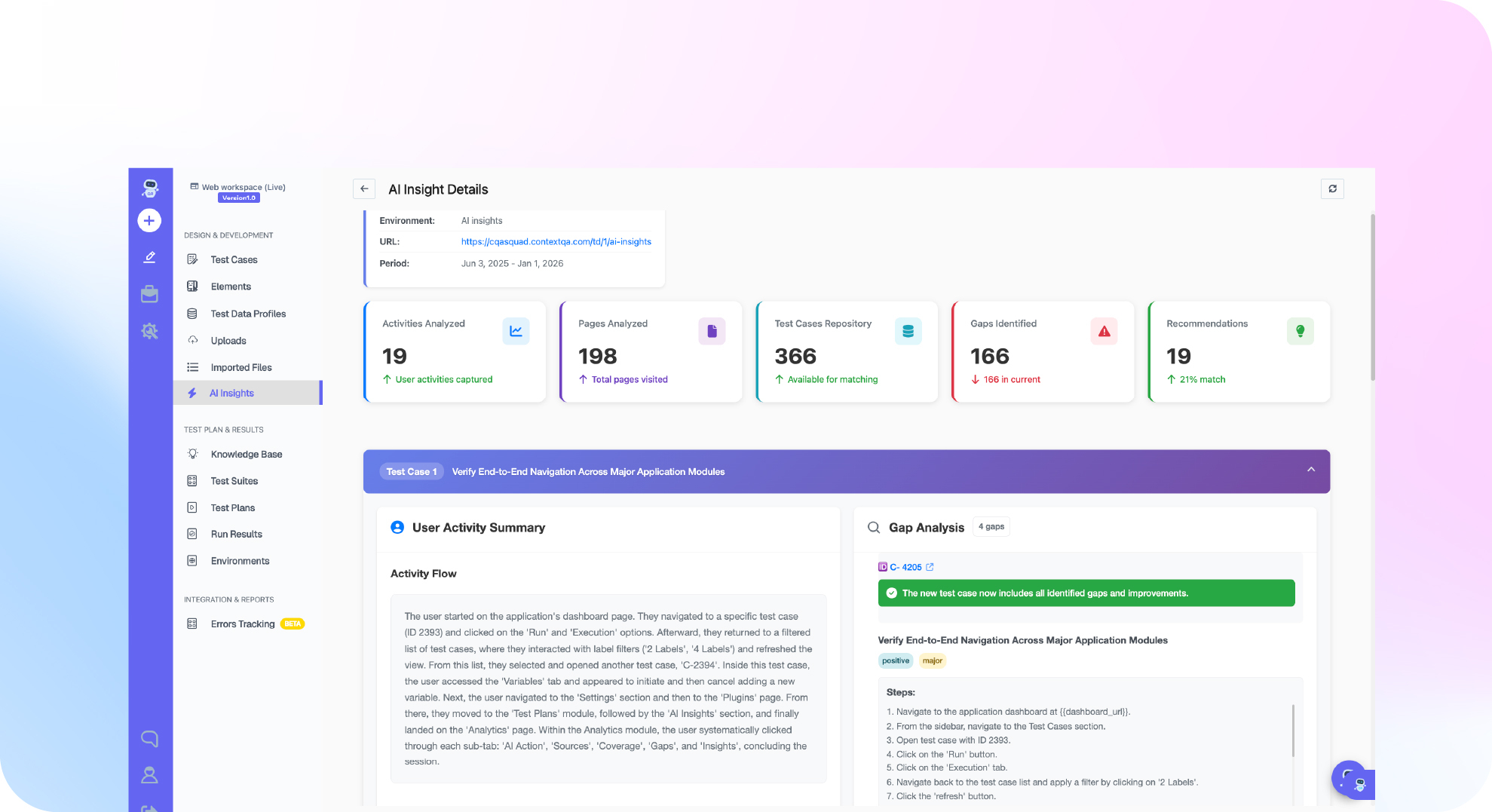
ContextQA’s web automation adds a layer above the framework choice: AI powered test creation and self healing that works regardless of the underlying automation engine. When selectors break (which they will, in any framework), the AI updates them automatically instead of failing the build.
When to Choose Selenium
Selenium is the right choice when:
You have a large existing Selenium suite. Migrating 5,000 Selenium tests to Playwright is a months long project with real risk. The pragmatic approach: maintain existing Selenium tests and write all new tests in Playwright. Migrate the flakiest Selenium tests first for immediate stability improvement.
You need Ruby, PHP, or Perl bindings. Playwright does not support these languages. If your team’s test infrastructure is built in Ruby (common in Rails shops), Selenium is your only realistic option among the big three.
You need real device mobile testing. Selenium integrates with Appium for native iOS and Android testing on real devices. Playwright can only emulate mobile viewports on desktop browsers, which does not catch real device rendering issues, touch event differences, or native app interactions.
Legacy browser support is required. Some enterprise environments still need IE testing for internal applications. Selenium (via older versions) is the only framework that supports it.
The maintenance burden of Selenium is its biggest weakness. Explicit waits, driver management, and Grid configuration consume significant engineering time. ContextQA’s AI based self healing specifically addresses Selenium’s flakiness problem: it wraps Selenium tests with intelligent element identification that survives UI changes without test modification.
When to Choose Cypress
Cypress is the right choice when:
Your team is 100% JavaScript/TypeScript. Cypress is JavaScript native, runs inside the browser, and integrates deeply with the JavaScript ecosystem (Webpack, Vite, React, Angular, Vue). For frontend developers who want to write tests alongside components, Cypress provides the smoothest workflow.
Developer inner loop speed matters most. Cypress’s time travel debugging, automatic reloading on code changes, and visual test runner make it the fastest framework for iterative test development. Developers see test results in real time as they write code.
You only test modern web UIs. If your application is a single page application without multi tab flows, without native mobile requirements, and without legacy browser needs, Cypress covers the testing surface area completely.
The tradeoffs are real. No multi tab support means you cannot test OAuth flows that open popup windows. No native mobile testing means a separate tool for iOS/Android. Limited parallel execution means slow CI for large test suites unless you pay for Cypress Cloud.
The Real Question: Does the Framework Choice Still Matter?
Here is the honest take that most comparison articles will not give you.
ThinkSys 2026 data shows 74.6% of QA teams now use two or more automation frameworks. The era of picking one framework and committing to it exclusively is ending. Most enterprise teams run Playwright for modern web tests, Selenium for legacy applications, and a specialized tool for mobile.
This multi framework reality is exactly why platforms like ContextQA exist. Instead of choosing a framework and building your entire test infrastructure around it, you use a platform that abstracts the framework layer and provides:
AI test generation through CodiTOS that produces tests based on your application’s behavior, not tied to any specific framework syntax.
Self healing maintenance through AI based self healing that works across browser automation engines, eliminating the selector maintenance burden that plagues Selenium users and occasionally affects Playwright and Cypress users too.
Cross platform coverage through web automation, mobile automation, API testing, and visual regression in a single platform, so you do not need separate tools for each testing layer.
Intelligent failure analysis through root cause analysis that classifies failures by cause (real bug, selector change, environment issue, timing flake) regardless of which framework produced the failure.
The IBM ContextQA case study documents 5,000 test cases automated across multiple testing types. G2 verified reviews show 50% regression time reduction and 80% automation rates. Those results come from the platform layer, not from picking the “right” framework.
Deep Barot, CEO and Founder of ContextQA, designed the platform with a framework agnostic philosophy. The goal is not to replace Playwright or Selenium. It is to make the framework choice a technical detail rather than a strategic decision. Your team can use whichever framework fits their language, their existing codebase, and their preferences, while ContextQA handles the AI testing, self healing, and analytics layer above it.
Migration Decision Framework
If you are considering migrating from one framework to another, use this decision tree:
| Your Current Situation | Recommended Action |
| New project, no existing tests | Start with Playwright. Lowest setup friction, fastest CI execution. |
| Small Selenium suite (under 500 tests) | Migrate to Playwright over 4 to 6 weeks. The ROI from reduced flakiness pays back the migration investment. |
| Large Selenium suite (500+ tests), mostly stable | Keep Selenium for existing tests. Write all new tests in Playwright. Migrate flakiest 20% first. |
| Large Selenium suite, high flakiness | Add ContextQA self healing to existing Selenium tests first. This fixes the flakiness problem immediately without migration. Then write new tests in Playwright. |
| Cypress only, hitting limitations (multi tab, mobile) | Add Playwright for tests that need multi tab, multi browser, or API testing. Keep Cypress for component and developer workflow tests. |
| Mixed frameworks, maintenance burden | Consolidate through ContextQA AI testing suite. The platform abstracts framework complexity while keeping tests portable. |
The Speed Benchmark That Matters
Raw execution speed comparisons are everywhere, and most are misleading because they test trivial scenarios. The speed difference that matters is not “how fast can this framework click a button?” It is “how fast does my team get reliable feedback from a full regression suite in CI?”
That metric includes test execution time, flaky test investigation time, and maintenance time when tests break due to UI changes rather than real bugs.
Playwright wins on execution speed (no WebDriver overhead). Playwright wins on flaky investigation time (auto waiting eliminates 60% of timing based flakes). But all three frameworks lose on maintenance time because selector based testing inherently breaks when the UI changes.
ContextQA’s AI based self healing eliminates maintenance time across all frameworks. When a CSS class changes, the AI finds the element using alternative identification strategies (accessibility roles, text content, visual matching, DOM context) and updates the test automatically. The G2 reviews document that this reduces test maintenance time by 70% or more.
ContextQA’s AI insights and analytics tracks the actual feedback loop time: from code push to reliable test results. This metric, not raw framework speed, determines how much your testing infrastructure actually accelerates development.
Limitations of This Comparison
Benchmarks depend on application type. Playwright’s speed advantage shrinks for simple static sites and grows for complex single page applications with heavy JavaScript and async operations. Your results will vary based on your application architecture.
Community size matters for problem solving. Selenium’s 20 year community means every problem has a Stack Overflow answer. Playwright’s community is growing fast but is smaller. If your team relies heavily on community support for debugging, factor this in.
Framework wars are a distraction. Spending 3 months debating Playwright vs Selenium is 3 months you could have spent automating tests. Pick the framework that matches your team’s existing language, start automating, and adjust later. The cost of choosing “wrong” is far lower than the cost of choosing nothing.
Do This Now Checklist
- Audit your current framework situation (10 min). Which framework(s) do you use? What is your flakiness rate? How many hours per sprint does test maintenance consume?
- Count your tests by stability (15 min). How many always pass, how many are flaky, how many are disabled? The flaky and disabled counts reveal your maintenance burden.
- Decide new vs migration (5 min). If starting fresh: Playwright. If migrating: add self healing first, then migrate the flakiest 20%.
- Enable self healing on existing tests (15 min). ContextQA’s AI based self healing wraps your existing framework and eliminates selector maintenance immediately.
- Benchmark your actual feedback loop time (10 min). Minutes from code push to reliable CI results. This is the metric that matters, not raw framework speed.
- Start a ContextQA pilot (15 min). 12 weeks to benchmark framework agnostic AI testing against your current approach. Use the ROI calculator to model the projected impact.
Conclusion
Playwright leads the 2026 framework landscape with 45.1% adoption, surpassing Selenium (22.1%) for the first time. Cypress holds at 14.4% with a strong niche in JavaScript developer workflows.
The practical answer: Playwright for new projects, Selenium maintenance for existing stable suites, and an AI testing platform above the framework layer to handle generation, self healing, and analytics regardless of which framework executes the tests.
ContextQA provides that platform layer with framework agnostic AI testing, self healing maintenance, and intelligent failure analysis.
Book a demo to see ContextQA working with your existing Playwright, Selenium, or Cypress tests.