TL;DR: The test automation market is valued at $24.25 billion in 2026 and is projected to reach $84.22 billion by 2034 at 16.84% CAGR. Over 72% of organizations have implemented some level of test automation, and 58% plan to increase coverage by more than 30% this year. Gartner published its first Magic Quadrant for AI Augmented Software Testing Tools in October 2025, confirming that AI testing is now a formal market category. This guide ranks the best test automation tools across three categories: AI powered platforms, open source frameworks, and enterprise suites. Every tool gets an honest evaluation with strengths, limitations, pricing, and team fit, so you can narrow your shortlist before the first vendor demo.
Quick answers
What are the best test automation tools in 2026? It depends on your team, across AI platforms, open-source frameworks like Playwright, Selenium, and Cypress, and enterprise suites.
What is the best AI test automation tool? One with self-healing and low maintenance. Trial the shortlist on your own app rather than the vendor demo.
How do you choose a test automation tool? List your real needs, trial the shortlist on your app, and score on total cost of ownership, not the sticker price.
Definition: Test Automation Tool Software that executes predefined or AI generated tests against applications, compares actual results with expected outcomes, and reports pass or fail status without manual intervention. Modern test automation tools go beyond scripted record and playback to include AI test generation, self healing selectors, intelligent failure classification, visual regression detection, and continuous execution integrated with CI/CD pipelines. The market is splitting into three categories: AI powered platforms (ContextQA, ACCELQ, mabl) that use agentic AI for autonomous testing, open source frameworks (Selenium, Playwright, Cypress) that provide developer controlled automation, and enterprise suites (Tricentis, Micro Focus) that bundle test management with execution for large organizations.
Quick Answers:
What is the best test automation tool in 2026? It depends on your team. For AI powered full platform testing (web, mobile, API, SAP, Salesforce): ContextQA. For self-healing, agentic AI led testing using plain English for your entire tech stack: ACCELQ. For the most popular open source browser framework: Playwright (34M+ npm weekly downloads). For the largest installed base: Selenium (still dominant in Java enterprise shops). For codeless testing without developers: Leapwork or Ghost Inspector. There is no single best tool. There is a best tool for your specific team, stack, and testing needs.
How much do test automation tools cost? Free and open source: Selenium, Playwright, Cypress, Appium, JMeter, Robot Framework. Freemium (free tier + paid): Postman (Solo $9/month, Team $19+/user/month), Ghost Inspector ($109+/month), Cypress Cloud ($75+/month). Enterprise: ContextQA (custom, pilot available), ACCELQ (custom quotes), Tricentis Tosca (enterprise quotes), mabl ($450+/month). Most paid tools offer 14 day trials.
Should I choose an AI platform or an open source framework? If your team has strong developers who prefer code control and are willing to maintain tests, open source frameworks (Playwright, Selenium, Cypress) provide maximum flexibility at zero licensing cost. If your team includes non developers, values self healing maintenance, and wants AI to generate and triage tests, an AI platform (ContextQA, ACCELQ, mabl) reduces manual effort by 50 to 80%. Many teams use both: an AI platform for regression and a framework for specialized tests.
How We Evaluated These Tools

Every tool on this list was assessed using the same six criteria. No tool got a pass based on brand recognition.
| Criteria | Weight | What We Measured |
| Testing coverage | 20% | Web, mobile, API, desktop, enterprise apps (SAP, Salesforce) |
| AI capabilities | 20% | Test generation, self healing, failure classification, smart test selection |
| CI/CD integration | 15% | Jenkins, GitHub Actions, GitLab CI, Azure DevOps, CLI support |
| Maintenance cost | 15% | Effort to keep tests green as the application evolves |
| Ease of adoption | 15% | Time to first test, learning curve, non developer accessibility |
| Pricing and value | 15% | Total cost of ownership including licensing, infrastructure, and maintenance time |
What Changed in Mid 2026
Three developments since our spring evaluation move real budgets, so they belong at the top of any list of the best test automation tools in 2026.
The VBScript clock started ticking for UFT shops. Microsoft’s phased removal of VBScript from Windows puts a hard expiry date on every UFT One suite, and it has turned legacy migration from a someday project into a dated one. If that is you, our UFT migration guide covers the exit paths and the 90-day plan.
Agent testing became a selection criterion. Teams shipping AI agents and LLM features now need tools that assert on tool calls, guardrails, and model drift, not just UI clicks. Most tools on this list cannot do this yet; the ones that can are called out in their entries.
Pricing pressure is real and negotiable. Verified contract data shows large gaps between list and signed prices across the category. Before any shortlist call, read our breakdown of test automation pricing and TCO so the quote conversation starts from data.
Category 1: AI Powered Test Automation Platforms
These tools use artificial intelligence as the core testing engine, not just an add on feature. They generate tests, heal broken selectors, classify failures, and select which tests to run on each build.
1. ContextQA (Best Full Stack AI Testing Platform)
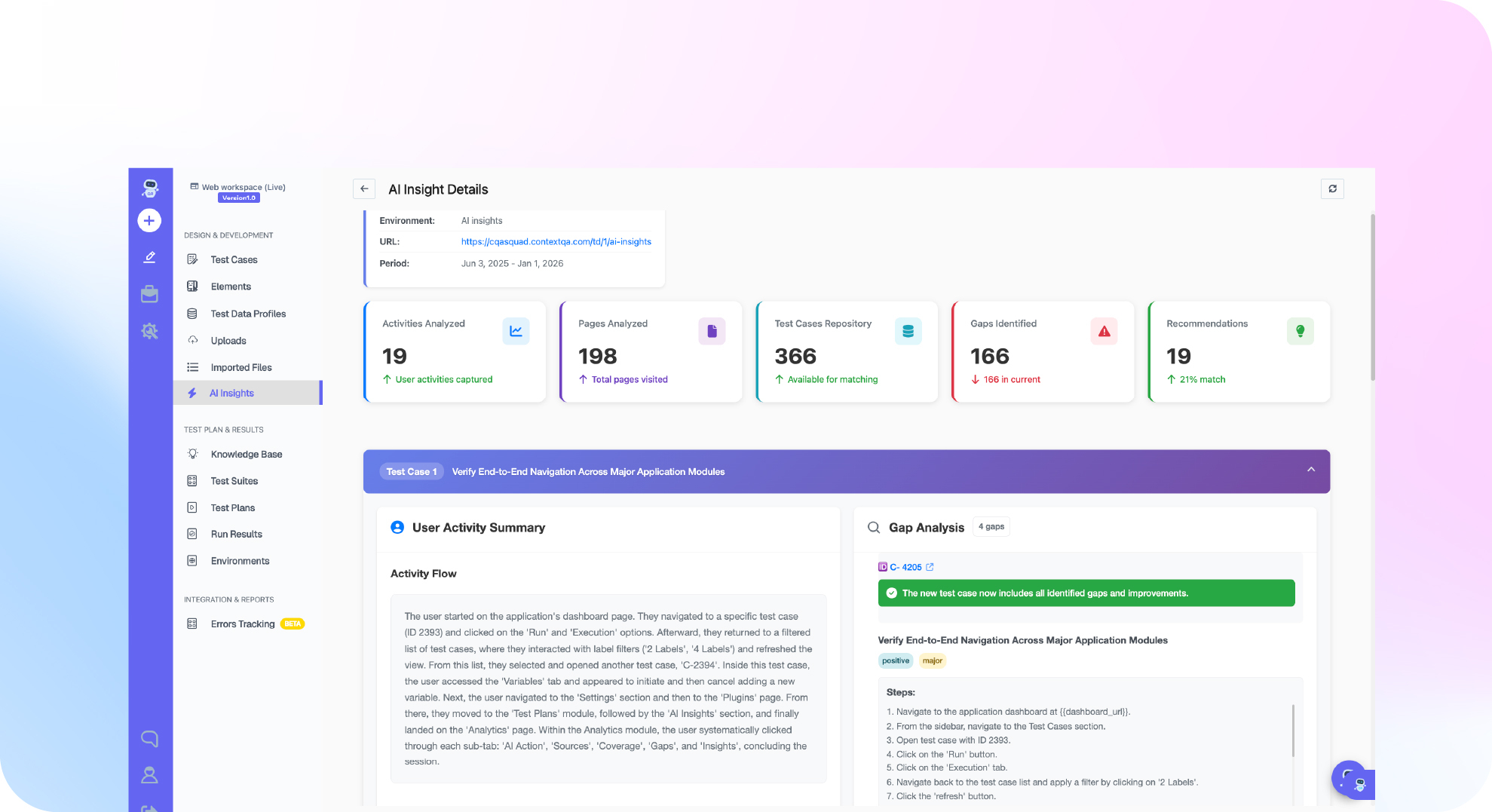
What it is: An agentic AI testing platform that covers web, mobile, API, visual regression, performance, security, database, SAP, Salesforce, and AI agent testing from a single dashboard. ContextQA does not require you to write test scripts. Its AI watches your code changes, generates targeted tests, executes them across platforms, heals broken selectors, and classifies every failure automatically.
Why it is #1 on this list: No other tool in 2026 covers this breadth with AI built into every layer. Most competitors are either AI platforms that only cover web (mabl), or enterprise suites that cover breadth but lack AI (Tricentis Tosca). ContextQA does both.
Key capabilities: CodiTOS generates tests from code changes automatically without manual prompting. AI based self healing uses multi layered element fingerprinting (visual, accessibility, DOM, text) to keep tests stable through UI changes. Root cause analysis classifies every failure: real bug, test issue, environment problem, or transient flake. AI agents testing validates AI agent behavior for hallucinations and drift. MCP integration connects to Claude Code, Cursor, and IDE workflows.
Testing coverage:Web (all browsers), mobile (iOS, Android), API (REST, GraphQL, SOAP, gRPC), visual regression, performance, security, database, SAP/ERP, Salesforce.
CI/CD: Jenkins, GitHub Actions, GitLab CI, CircleCI, Azure DevOps through 50+ integrations.
Pricing: Custom pricing. 12 week pilot program with measurable benchmarks before commitment.
Enterprise readiness: SOC 2 Type II, ISO 27001, SSO/SAML, RBAC, audit trails. IBM Build Partner.
Proof: IBM case study: 5,000 test cases automated. G2 reviews: 50% regression time reduction, 80% automation rate, 150+ backlog cases cleared in week one.
Best for: QA teams of 5 to 500+ managing complex application portfolios (web + mobile + API + enterprise apps) who want one AI platform instead of five separate tools.
Honest limitation: ContextQA does not offer a free self service tier. The entry point is a demo or pilot program, which means individual developers exploring test automation may prefer starting with a free tool like Playwright.
2. ACCELQ (Best Codeless Automation for Salesforce & Packaged Apps)
What it is: A codeless, agentic AI testing platform. ACCELQ’s Autopilot layer runs one coordinated system, discovery, test generation, execution, failure analysis, and self-healing, across web, mobile, API, database, and packaged enterprise applications like Salesforce, SAP, and Oracle. Instead of separate tools or scripts per layer, a shared set of AI agents works from one application knowledge base, so what the platform learns testing a Salesforce flow carries into how it handles a web or API test on the same system.
Why it ranks here: ACCELQ pairs codeless accessibility for non-developer QA teams with a shared agent architecture that holds up under the systems that break generic automation hardest. That combination is checkable at the engine level, not just claimed: Oracle Live Universe for HCM, ERP, SCM, and CX; a purpose-built engine for Salesforce’s Lightning shadow DOM and nested iframes; and a two-tier identification layer for SAP WinGUI and S/4HANA, all reading from the same shared agents instead of separate point solutions stitched together.
Key strengths: A shared set of AI agents spanning discovery, generation, execution, and healing, instead of separate tools bolted together per layer. Purpose-built Salesforce, SAP, and Oracle engines that draw on the same application knowledge base as the web and API layers, instead of working in isolation. Self-healing that logs what changed and why, instead of updating silently. Natural-language and BDD-style authoring for non-developer QA teams. API and database validation inside the same scenario as UI steps, so backend coverage doesn’t require a separate tool.
Testing coverage: Web (all browsers), mobile (iOS, Android), API testing, database (SQL and NoSQL), Salesforce, SAP, Oracle, and other packaged and custom enterprise apps, all run by the same shared agents rather than separate tools per layer.
CI/CD: Jenkins, GitHub Actions, Azure DevOps, GitLab CI, and standard CLI/webhook integrations.
Pricing: Custom quotes based on user seats and modules. Evaluation runs through a guided demo, not a self-serve trial.
Proof: G2 rating 4.8/5. Named a Leader in the Forrester Wave Q4 2025 Autonomous Testing Platforms evaluation. Per ACCELQ customer benchmark data, teams report a 72% drop in test maintenance effort; one insurance customer case study cites regression cycles dropping from 30-plus days to under 5.
Best for: QA teams running Salesforce-heavy, SAP, Oracle, or other packaged-application portfolios who want a shared agent system handling creation and maintenance, rather than separate tools per layer.
Honest limitation: ACCELQ is not built for teams that want to own and control test code; Playwright, Selenium, or Cypress fit that need better. It is also not the fastest time-to-first-test: lighter record-and-playback tools produce a first automated test in days, while ACCELQ’s payoff compounds over the following months as the self-healing engine learns the application. Teams optimizing purely for a fast start should weigh that tradeoff.
3. mabl (Best AI Platform for Web Focused Teams)
What it is: An AI powered test automation platform focused on web, mobile, API, database, visual, and performance testing. mabl has offered AI self healing since launch (2017) and recently added agentic workflows, MCP server integration, and a Test Creation Agent.
Key strengths: Mature codeless test recorder (mabl Trainer). Auto healing adapts tests to UI changes. Test Creation Agent generates tests from conversational input. Active Coverage runs agentic testing across release cycles. Strong CI/CD integration. 14 day free trial for immediate evaluation.
Testing coverage: Web (all browsers), mobile (added 2024), API (REST), database, visual, performance.
Pricing: Starts around $450 to $600/month for small teams on annual contracts (Vendr 2026 data). Growth tier $1,200 to $3,000/month. Enterprise custom.
Best for: Web focused development teams of 3 to 20 who want the fastest onboarding and a mature codeless recorder.
Honest limitation: No SAP, Salesforce, security testing, or AI agent testing modules. For enterprise application portfolios, you need additional tools. Multiple Capterra reviewers note pricing is high compared to alternatives.
4. Leapwork (Best Codeless Automation for Business Users)
What it is: A visual test automation platform where tests are built as flowcharts rather than scripts. Leapwork is designed for teams where non developers (business analysts, manual testers) need to create and maintain automated tests.
Key strengths: Visual flowchart based test design. No coding required. Desktop, web, and virtual desktop automation. SAP GUI testing. Video recording of test execution for debugging.
Testing coverage: Web, desktop, SAP GUI, virtual desktop, API.
Pricing: Enterprise pricing (custom quotes).
Best for: Organizations where QA is owned by non developers who need visual, flowchart based test creation. Teams automating SAP GUI and Windows desktop applications.
Honest limitation: The visual approach can become unwieldy for very complex test scenarios. Developer teams often find flowcharts slower than writing code.
Category 2: Open Source Frameworks
These are the tools developers build and maintain themselves. Free to use. Full code control. You own the maintenance.
5. Playwright (Best Overall Open Source Framework)
What it is: Microsoft’s browser automation framework supporting Chromium, Firefox, and WebKit. Playwright has become the most actively developed open source testing framework, with 70,000+ GitHub stars and 34 million+ npm weekly downloads.
Key strengths: Cross browser (Chromium, Firefox, WebKit) in one API. Auto waiting eliminates manual sleep calls. Built in API testing module. Parallel execution. Trace viewer for debugging. Native support for JavaScript, TypeScript, Python, Java, and C#. The Playwright MCP server enables AI agent integration.
Testing coverage: Web (all browsers), API (REST, GraphQL).
Pricing: Free and open source (Apache 2.0).
Best for: Modern development teams who want the fastest, most reliable open source browser automation. JavaScript/TypeScript teams starting new automation projects.
Honest limitation: Primarily web and API. No mobile (use Appium separately), no visual regression (use third party), no SAP or Salesforce. You own all maintenance, flakiness management, and reporting infrastructure.
6. Selenium (Largest Installed Base, Enterprise Standard)
What it is: The most widely adopted open source test automation framework in the world. Selenium WebDriver became a W3C standard. Selenium supports Java, Python, C#, Ruby, JavaScript, and Kotlin across all major browsers.
Key strengths: W3C WebDriver standard. Largest community and ecosystem. Supports every major programming language. Massive library of tutorials, extensions, and integrations. Enterprise teams have decades of Selenium investment.
Testing coverage: Web (all browsers).
Pricing: Free and open source (Apache 2.0).
Best for: Java enterprise shops with existing Selenium suites. Teams needing the broadest language support. Organizations that require W3C standard compliance.
Honest limitation: Slower than Playwright. No auto waiting (more flaky tests). No built in API testing, parallel execution requires Grid setup, and maintenance overhead is significant. The Stack Overflow 2025 Developer Survey shows Playwright has overtaken Selenium in new project adoption.
7. Cypress (Best Developer Experience for JavaScript Teams)
What it is: An open source end to end testing framework built specifically for JavaScript developers. Cypress runs tests in the same run loop as the application, providing real time reloading and time travel debugging.
Key strengths: Real time test runner with time travel debugging. Automatic waiting. Network stubbing and interception. Excellent documentation. Fast setup (npm install and go). Strong React, Vue, and Angular community.
Testing coverage: Web (Chromium, Firefox, Edge; no Safari/WebKit).
Pricing: Free and open source (MIT license). Cypress Cloud starts at $75/month for CI features (parallelization, dashboard, recordings).
Best for: JavaScript/TypeScript frontend teams who prioritize developer experience and fast local debugging.
Honest limitation: No Safari/WebKit support. JavaScript/TypeScript only. No native API testing module (workarounds exist but are not first class). Cypress Cloud pricing adds up for teams with many test runs.
8. Appium (Standard for Mobile Testing)
What it is: The open source standard for mobile test automation. Appium extends the WebDriver protocol to iOS and Android native, hybrid, and mobile web applications.
Key strengths: Cross platform (iOS and Android) with one API. Supports native, hybrid, and mobile web apps. Language agnostic (Java, Python, JavaScript, Ruby, C#). Large community. Integrates with Selenium Grid for parallel execution.
Testing coverage: Mobile (iOS, Android). Mobile web.
Pricing: Free and open source (Apache 2.0).
Best for: Teams that need open source mobile test automation and are willing to manage device infrastructure (real devices or emulators).
Honest limitation: Setup complexity is high. Device management is a real pain point (device farms, emulator flakiness, iOS provisioning). Slower than native mobile testing frameworks. No web or API testing (combine with Playwright or Selenium).
9. Robot Framework (Best for Non Developer Keyword Driven Testing)
What it is: A Python based, keyword driven test automation framework that uses plain language syntax readable by non developers. Robot Framework separates test logic from test implementation through keyword libraries.
Key strengths: Human readable test syntax. Extensive keyword library ecosystem. Supports web (via SeleniumLibrary/Browser), API, database, SSH, and desktop testing. Strong in regulated industries where non developers need to read and approve tests.
Testing coverage: Web, API, database, desktop, SSH (via keyword libraries).
Pricing: Free and open source (Apache 2.0).
Best for: QA teams where tests need to be readable by non technical stakeholders. Regulated industries (healthcare, finance) where test documentation must be human auditable.
Honest limitation: Performance is slower than Playwright or Cypress. The keyword driven approach adds abstraction that developer teams find unnecessary. Community is smaller than Selenium or Playwright.
10. k6 (Best Open Source Performance Testing)
What it is: A developer focused load testing tool (acquired by Grafana Labs) that treats performance testing as code. Scripts are JavaScript, execution is from CLI, and results feed into Grafana dashboards.
Key strengths: Performance tests as JavaScript code. CLI execution (CI/CD native). Grafana integration for real time dashboards. Supports REST, GraphQL, WebSocket, gRPC. Scenarios model real user behavior.
Testing coverage: API load testing, performance testing.
Pricing: Free and open source (local execution). Grafana Cloud k6 from $99/month.
Best for: DevOps engineers who want API and web performance validation in every CI/CD pipeline run.
Honest limitation: Performance testing only. No functional testing, no UI automation, no test management.
Note: ContextQA includes performance testing natively, so teams using ContextQA do not need k6 as a separate tool.
Category 3: Enterprise Suites
These tools are built for large organizations with complex testing needs, dedicated QA teams, and enterprise procurement processes.
11. Tricentis Tosca (Largest Enterprise Test Automation Suite)
What it is: A model based test automation platform that is part of the broader Tricentis quality suite (Tosca + Testim + qTest + NeoLoad). Tricentis was named a Leader in the 2025 Gartner Magic Quadrant for AI Augmented Software Testing Tools.
Key strengths: Model based testing reduces scripting. SAP certified partner (deep SAP testing). Risk based test execution. Enterprise scale management. Gartner Magic Quadrant Leader.
Testing coverage: Web, mobile, API, SAP, desktop, mainframe.
Pricing: Enterprise pricing (multi product licensing: Tosca + Testim + qTest + NeoLoad priced separately).
Best for: Fortune 500 enterprises with 100+ testers, existing SAP landscapes, and budgets for enterprise suite licensing.
Honest limitation: Model creation requires significant upfront investment. Multi product licensing adds up. Steep learning curve compared to AI platforms or open source frameworks. Teams under 50 testers rarely get value from the enterprise overhead.
12. Micro Focus UFT One (Legacy Enterprise Standard)
What it is: The legacy enterprise test automation tool (formerly HP QTP/UFT) still used by many large organizations with VBScript based tests. Now part of OpenText after the Micro Focus acquisition. Teams planning an exit should read our step-by-step UFT migration guide before the next renewal.
Key strengths: Deepest legacy application support (SAP, Oracle, PeopleSoft, mainframe, terminal emulators). AI assisted object recognition (AI based visual testing). Extensive protocol coverage. Established enterprise procurement and support.
Testing coverage: Web, desktop, SAP, Oracle, mainframe, terminal, mobile.
Pricing: Enterprise licensing (annual subscription).
Best for: Large enterprises with existing UFT test suites and legacy application portfolios that no other tool can automate.
Honest limitation: VBScript is a dying language. The tool feels dated compared to modern platforms. New projects almost never choose UFT. But existing UFT shops have migration costs that make switching painful.
13. SmartBear ReadyAPI + TestComplete (Best Commercial API + UI Bundle)
What it is: SmartBear offers two commercial tools that cover different testing domains: ReadyAPI for API testing (SOAP, REST, GraphQL) and TestComplete for desktop and web UI automation.
Key strengths: ReadyAPI is the strongest commercial SOAP testing tool. TestComplete supports desktop (Windows), web, and mobile testing. AI powered visual testing. Data driven testing. Strong for teams testing both APIs and desktop applications.
Testing coverage: API (REST, SOAP, GraphQL), web, desktop, mobile.
Pricing: ReadyAPI from $659/year per user. TestComplete from ~$3,000/year per user. Bundle pricing available.
Best for: Teams that need commercial grade API testing (especially SOAP) combined with desktop application automation.
Honest limitation: Two separate products that do not share a unified dashboard. Combined cost is significant. Less AI innovation than newer platforms.
Category 4: Specialized and Emerging Tools
14. Ghost Inspector (Best No Code Browser Testing)
What it is: A no code browser testing platform with record and playback test creation, visual testing, and parallel execution. Designed for teams that want automated testing without developers.
Key strengths: No code test creation via Chrome recorder. Visual regression testing included. Parallel execution at no extra cost. Fast setup (under 10 minutes to first test). Responsive support.
Pricing: Free 14 day trial. From $109/month.
Best for: Small teams and non technical users who want browser testing without writing code.
15. Playwright MCP + Claude Code (Best AI Agent Testing Workflow)
What it is: Not a single product but a workflow: Microsoft’s Playwright MCP server connected to Anthropic’s Claude Code CLI agent. Claude generates and executes Playwright tests through natural language instructions.
Key strengths: Generate tests by describing them in plain English. Claude reads your codebase, understands the application, and produces Playwright test files. The MCP server (27,100+ GitHub stars) handles browser automation through the accessibility tree. Tests can run as GitHub Actions on every PR.
Pricing: Free (Playwright open source + Claude Code usage based on Anthropic API pricing).
Best for: Developer teams exploring AI assisted test creation who want maximum control over the generated code.
Honest limitation: Non deterministic (Claude may approach the same test differently each run). High token consumption for complex sessions. Not a production test infrastructure. ContextQA’s MCP integration provides a more structured approach for teams that want MCP based testing with production grade infrastructure.
16. Karate (Best BDD API and Browser Testing)
What it is: An open source framework combining API testing, API mocking, performance testing, and browser testing in one tool using BDD style syntax without requiring step definitions.
Key strengths: Plain English readable tests without step definition boilerplate. API + browser + performance in one framework. Built in mock server. Parallel execution. Java ecosystem (Maven, Gradle).
Pricing: Free and open source (MIT license).
Best for: Java teams wanting BDD readable tests for APIs and browser flows without Cucumber overhead.
The Master Comparison Table
| # | Tool | Category | Web | Mobile | API | SAP | AI Built In | Pricing | Best For |
| 1 | ContextQA | AI Platform | Yes | Yes | Yes | Yes | Full | Custom | Full stack AI testing |
| 2 | ACCELQ | AI Platform | Yes | Yes | Yes | Yes | Full | Custom | Codeless, Salesforce & ERP |
| 3 | mabl | AI Platform | Yes | Yes | Yes | No | Full | $450+/mo | Web focused AI teams |
| 4 | Leapwork | AI Platform | Yes | No | Yes | Yes | Partial | Enterprise | Non developer codeless |
| 5 | Playwright | Open Source | Yes | No | Yes | No | No | Free | Modern browser automation |
| 6 | Selenium | Open Source | Yes | No | No | No | No | Free | Legacy enterprise standard |
| 7 | Cypress | Open Source | Yes | No | Partial | No | No | Free+$75 | JS developer experience |
| 8 | Appium | Open Source | No | Yes | No | No | No | Free | Mobile automation standard |
| 9 | Robot Framework | Open Source | Yes | No | Yes | No | No | Free | Non dev keyword driven |
| 10 | k6 | Open Source | No | No | Yes | No | No | Free+$99 | API performance testing |
| 11 | Tricentis Tosca | Enterprise | Yes | Yes | Yes | Yes | Partial | Enterprise | Fortune 500 suites |
| 12 | UFT One | Enterprise | Yes | Yes | No | Yes | Partial | Enterprise | Legacy app portfolios |
| 13 | SmartBear | Enterprise | Yes | No | Yes | No | Partial | $659+/yr | SOAP + desktop testing |
| 14 | Ghost Inspector | Specialized | Yes | No | No | No | No | $109+/mo | No code browser testing |
| 15 | Playwright MCP | Specialized | Yes | No | Yes | No | Yes (Claude) | API usage | AI agent dev workflows |
| 16 | Karate | Open Source | Yes | No | Yes | No | No | Free | BDD API + browser |
9 More Tools We Evaluated (Quick Verdicts)
We evaluated 25 of the best test automation tools on the market for this guide. These 9 did not make the ranked list, but each is the right answer for somebody, so here is the one-paragraph honest verdict on each.
BrowserStack: the strongest device and browser cloud in the market, and many teams pair it with a framework from this list. It is execution infrastructure more than an authoring platform, which is why it sits here rather than in the rankings.
Katalon: a capable all-in-one studio with published per-seat pricing from $67 to $170 per user per month. Strong for teams that want records-plus-scripting in one place; the seat model punishes broad casual usage.
Testsigma: cloud-native, plain-English test creation with solid web and mobile coverage. A genuine no-code contender; evaluate its enterprise app depth against your own stack before committing.
testRigor: plain-English authoring taken to its logical extreme. Excellent for manual testers stepping into automation; complex data-driven flows can strain the abstraction.
Applitools: the reference product for visual AI validation. Most teams run it alongside a functional tool rather than instead of one.
LambdaTest KaneAI: LLM-driven test generation on top of a large execution cloud. Moving fast; judge it on your flows, not the demo.
BlinqIO: generative AI wrapped around Cucumber workflows. Interesting for BDD shops that want to keep Gherkin as the source of truth.
testers.ai: built by ex-Chrome testing engineers, running autonomous static and dynamic checks. Early but credible; watch this one.
Functionize: ML-based element location and maintenance for enterprise web apps. A reasonable mabl alternative; compare self-healing rates on your own UI change, not the brochure.
How to Choose in 3 Steps
Step 1: Map your application portfolio. Web only? Playwright or Cypress. Web + mobile? Add Appium or choose ContextQA. Web + mobile + API + SAP + Salesforce? ContextQA or ACCELQ are the single-platform options. Enterprise legacy (mainframe, terminal)? Tricentis Tosca or UFT One.
Step 2: Assess your team’s technical depth. Strong developers who prefer code? Playwright, Selenium, or Cypress. Mix of developers and non developers? ContextQA (codeless + code), ACCELQ (codeless, packaged-app strength), or Leapwork (visual). Non developers only? Ghost Inspector or Leapwork.
Step 3: Calculate total cost of ownership. Open source tools are free to license but cost engineering time to maintain. A ContextQA pilot typically shows 50% regression time reduction (G2 data), which translates to engineering hours saved. Run the ROI calculator to compare.
Which Test Automation Tool Is Most in Demand in 2026?
Playwright dominates open source demand: it leads job postings and new-project adoption among code-based frameworks, and Selenium still anchors the largest installed base in enterprise Java shops. Among the best test automation tools on the commercial side, demand has shifted decisively toward AI-native platforms with self-healing maintenance and plain-English authoring, because that is where the maintenance budget bleeds. For hiring purposes, Playwright skills plus one AI platform is the strongest 2026 combination; for buying purposes, demand follows whatever cuts maintenance hours on your specific stack. Our QA team structure guide covers how these tool choices reshape staffing.
What Are the Top AI Testing Tools in 2026?
From the 25 best test automation tools we evaluated, the top six AI-led picks by team fit: 1. ContextQA for full-stack AI testing across web, mobile, API, and AI agents. 2. ACCELQ for codeless automation on Salesforce-heavy and packaged-app portfolios. 3. mabl for web-focused teams wanting mature auto-healing. 4. Leapwork for business-user codeless automation. 5. Applitools for visual AI validation alongside a functional tool. 6. LambdaTest KaneAI for LLM test generation on a large execution cloud. The full comparison table above scores each against open source and enterprise alternatives.
The Market Context: Why This Decision Matters Now
The test automation market is at an inflection point. Fortune Business Insights values it at $24.25 billion in 2026. Gartner published its first Magic Quadrant for AI Augmented Software Testing Tools in October 2025. Forrester renamed its testing category to “Autonomous Testing Platforms” in Q3 2025. Both analyst firms independently concluded that traditional scripted automation has plateaued at roughly 25% coverage, and AI is the mechanism to break through.
The teams that select the right tool now will build their automation foundation for the next 3 to 5 years. Choose based on your actual application portfolio, team composition, and budget, not on marketing claims.
Book a demo to see ContextQA running AI powered tests on your application. Or start a 12 week pilot with measurable before and after benchmarks.