
TL;DR: AI coding assistants now generate over 50% of code in enabled repositories. The Stack Overflow 2025 Developer Survey found that 84% of developers use or plan to use AI tools, but 87% remain concerned about accuracy. Teams using AI assistants without quality guardrails report a 35 to 40% increase in bug density within six months. The problem is not that AI generates bad code. It is that AI generated code fails differently than human written code, and traditional QA processes miss those failure patterns. This guide provides the specific checklist your team needs, covering the six layers of validation, the priority order for test types, and the automation pipeline that catches what code review cannot.
Definition: AI Generated Code Testing The practice of validating software produced by AI coding assistants (GitHub Copilot, Claude Code, Cursor, Amazon Q Developer) using testing strategies specifically adapted to the failure modes those tools produce. AI generated code testing differs from traditional code testing because AI introduces distinct defect patterns: hallucinated API calls that reference methods that do not exist, subtle logic drift where the implementation is plausible but does not match the specification, tautological tests where AI generated tests validate the AI’s own assumptions rather than requirements, and security vulnerabilities introduced by pattern matching without context awareness. Effective AI code testing requires higher coverage thresholds (85 to 90% vs 70 to 80% for human code) and adversarial review techniques.

Quick Answers:
Why does AI generated code need different testing? Because AI code fails differently. A human developer who writes a bug usually misunderstands a requirement or makes a typo. An AI assistant produces code that looks syntactically perfect but may call APIs that do not exist in your library version, ignore edge cases the training data did not cover, or introduce security patterns that are technically correct in isolation but dangerous in your system context. Traditional code review catches the kinds of mistakes humans make. It systematically misses the kinds of mistakes AI makes.
What percentage of AI generated code has issues? Industry data varies by context. GitHub reports Copilot generates over 50% of code in enabled repositories. A Stanford study found developers using AI assistants were 41% more likely to introduce security vulnerabilities when they trusted generated code without structured verification. One analysis found teams without quality guardrails see 35 to 40% more bugs within 6 months of adopting AI coding assistants.
What is the minimum QA process for AI generated code? At minimum: static analysis (ESLint, Semgrep) on every commit, unit tests written before the AI generates the implementation (not after), and a human review checkpoint for business logic before production deployment. The ICSE 2026 systematic review of 101 sources on AI assisted coding quality found that QA is the most frequently overlooked dimension of AI coding workflows.
Why Traditional QA Misses AI Code Bugs
I want to explain why this is a distinct problem and not just “test your code better.”
When a human developer writes code, they build it incrementally. They think through a function line by line, mentally validating as they go. They carry context about the system: why a particular architectural decision was made, what upstream rate limits exist, which database constraints matter. The code reflects their understanding, correct or incorrect, of the full system.
AI assistants generate code in a fundamentally different way. They produce entire functions in one shot based on statistical patterns, without the incremental mental validation that happens when you write code line by line. They do not carry system context between prompts. They do not know that this service has a rate limit from an upstream provider. They do not know the history of why a particular architectural decision was made.
This creates a specific class of defects that GitHub’s own documentation explicitly warns about:
Hallucinated API calls. The AI generates code that calls methods or uses parameters that do not exist in your library version. The code compiles (or passes linting) because the method name is plausible, but it fails at runtime. This is the single most common AI code defect.
Logic drift. The implementation is plausible and even passes basic tests, but it does not match what the specification actually requires. The AI solved a slightly different problem than the one you described, and the difference is subtle enough that code review misses it.
Tautological tests. When the same AI that writes the code also writes the tests, both outputs share the same mental model, including its blind spots. SitePoint’s analysis found this is the most dangerous pattern: the tests validate what the code does, not what it should do.
Missing edge cases. AI models optimize for the common path. Empty inputs, null values, maximum values, concurrent access, and timeout scenarios are systematically underrepresented in AI generated code because they are underrepresented in training data.
Security antipatterns. The AI generates code that works but does not protect what it should. It does not know that a particular input needs sanitization, that a particular endpoint needs authentication, or that a particular operation needs rate limiting, because those requirements were never in the prompt.
ContextQA’s AI testing suite and CodiTOS (Code to Test in Seconds) address this by generating tests from an independent analysis of the codebase and requirements, not from the same AI prompt that produced the implementation. The tests verify the specification, not the implementation’s self image.
The Six Layer AI Code Testing Checklist
This is the actionable framework. Each layer targets a distinct failure mode. Skip a layer at your own risk.
Layer 1: Requirement Fidelity (Before AI Generates Code)
Write your test cases, or at minimum your test descriptions, before the AI generates the implementation. This is the single most effective practice.
| Check | What to Verify | Pass Criteria |
| Spec exists before generation | Written requirements or user story exists | AI prompt references a specific spec, not a vague description |
| Test descriptions written first | Expected behaviors documented as test cases | Test intent defined independently of AI output |
| Acceptance criteria are concrete | Measurable, verifiable, no ambiguity | “Returns 200 with user object” not “works correctly” |
| Edge cases specified | Empty, null, max, min, concurrent | At least 3 edge cases per function documented |
Why this matters: when AI generates both code and tests, the tests validate the AI’s interpretation. When you write tests first, the tests validate the actual requirement. ContextQA’s AI prompt engineering helps teams formulate precise specifications that AI assistants can implement accurately.
Layer 2: Static Analysis (Automated, Every Commit)
Run these on every commit automatically. No exceptions. No human gating.
| Tool Category | What It Catches | Recommended Tools |
| Linting | Style violations, unused variables, unreachable code | ESLint, Biome, Ruff (Python) |
| Type checking | Type mismatches, null reference risks | TypeScript strict mode, mypy |
| Security scanning | Known vulnerability patterns, dependency risks | Semgrep, CodeQL, Dependabot |
| Complexity analysis | Overly complex functions (AI tends to over engineer) | SonarQube, CodeClimate |
| Dependency verification | Hallucinated packages, version mismatches | npm audit, pip audit, lockfile verification |
The dependency verification is AI specific. AI assistants sometimes reference npm packages or Python libraries that do not exist or use API signatures from a different version than what is in your project. A quick npm install failure catches this, but only if it runs before code review.
ContextQA’s security testing runs these checks as part of the CI/CD pipeline integration, ensuring no AI generated code reaches staging without passing static analysis gates.
Layer 3: Unit Tests (85% Coverage Minimum)
Coverage thresholds for AI generated code should be 85 to 90%, compared to the typical 70 to 80% for human written code. The higher bar compensates for AI’s tendency to produce code that passes the happy path but fails on edge cases.
Test priority order for AI code (different from human code because the risk distribution differs):
- Contract and interface tests. Verify API boundaries and data type expectations. AI often generates interfaces that subtly differ from what calling code expects.
- Exception path testing. Force error conditions to validate handling. AI tends to implement the success path thoroughly and stub out error handling.
- Boundary value testing. Empty strings, zero values, maximum integers, arrays with one element. AI models systematically undertest boundaries.
- Security validation. SQL injection attempts, XSS payloads, authentication bypass scenarios. AI generates functional code that often lacks defensive coding patterns.
- Edge case and boundary testing. Null inputs, concurrent access, timeout scenarios.
- Integration tests. Verify that AI generated code interacts correctly with existing human written modules.
- Business logic validation. Ensure the code solves the correct problem with correct calculations, not just a plausible approximation.
ContextQA’s AI data validation automates boundary and integration testing by generating test data that covers the edge cases AI assistants typically miss.
Layer 4: Adversarial AI Review
This is the technique most teams skip and most teams need.
Use a separate AI prompt (not the one that generated the code) to adversarially review the output. GitHub’s code review documentation recommends building a self reviewing agent that evaluates pull requests against your standards.
The adversarial review prompt should ask:
“You are a senior security engineer reviewing code generated by an AI coding assistant. Your job is NOT to improve the code. Your job is to find everything wrong with it. Check for: API method calls that may not exist in the library versions in our manifest. Edge cases the implementation does not handle. Security vulnerabilities with specific attention to authentication bypass, input validation failures, and secrets exposure. Assumptions the code makes about system state that may not hold in production. Conditions where this code might silently succeed while producing wrong results.”
This review catches 40 to 50% more issues than standard review alone. ContextQA’s root cause analysis provides automated failure classification that separates real defects from false positives, reducing the triage burden from adversarial reviews.
Layer 5: Integration and E2E Validation
AI generated code that passes unit tests can still fail when integrated with the rest of your system. Run integration tests that exercise the AI generated components within the full application context.
ContextQA’s web automation runs end to end tests across the complete user flow, not just the AI generated component in isolation. The AI based self healing ensures these tests stay stable even as AI generated UI code changes between iterations, eliminating the maintenance burden that typically makes E2E testing of rapidly changing AI code impractical.
For API integrations, ContextQA’s API testing validates that AI generated backend code respects contracts, rate limits, and authentication requirements that the AI assistant may not have been aware of during generation.
Layer 6: Production Monitoring (Post Deployment)
AI generated code that passes all pre production checks can still exhibit issues in production that only surface under real load, real data, and real user behavior patterns.
| What to Monitor | Why AI Code Needs This | Metric |
| Error rate by code origin | AI code may have higher error rates in production | Errors per 1,000 requests, segmented by AI vs human authored |
| Performance regression | AI tends to add unnecessary abstractions that degrade latency | P99 latency before/after AI code deployment |
| Change frequency | AI code that gets changed frequently signals quality issues | Changes per file per month, by origin |
| Silent failures | AI code may silently succeed while producing wrong results | Business metric validation (order totals, calculations, data consistency) |
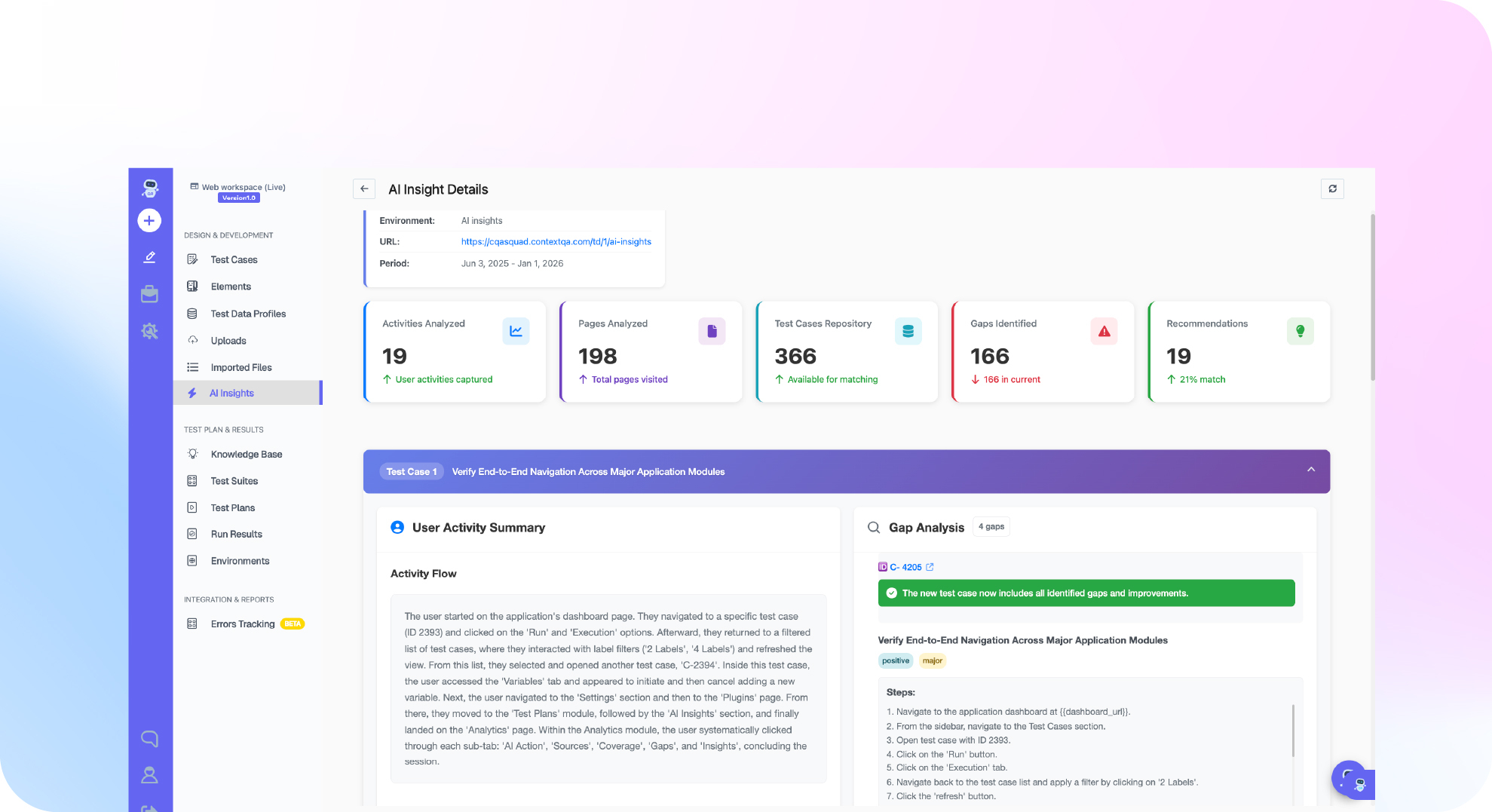
ContextQA’s AI insights and analytics provides this production monitoring layer, tracking test results, failure patterns, and quality trends over time. The digital AI continuous testing runs validation continuously against production, not just in pre release environments.
What Meta Learned at Scale
Meta Engineering published research in February 2026 that directly addresses testing in an AI code generation world. Their Just in Time Tests (JiTTests) approach generates fresh tests for every code change, tailored to the specific diff, rather than maintaining a permanent test suite.
Their key findings from analyzing 22,126 generated tests: code change aware test generation methods produce 4x more useful catch results than traditional hardening tests, and 20x more than tests that simply try to find failures coincidentally. Their LLM based assessors reduced human review load by 70%.
This validates a principle that applies to every team, not just Meta: tests for AI generated code should be generated from the requirement and the diff, not from the implementation itself. When the same mental model produces both code and tests, the tests become a mirror rather than a validator.
ContextQA’s CodiTOS implements this principle natively. It reads code changes, understands the intent from the diff and surrounding context, and generates tests that target the specific change rather than testing the implementation’s own assumptions.
The Pipeline: Putting It All Together
Here is the complete CI/CD pipeline for AI generated code, from commit to production:
| Stage | Automated Check | Gate Criteria | ContextQA Feature |
| 1. Pre commit | Linting + type checking + dependency audit | Zero errors, zero hallucinated dependencies | All integrations (Jenkins, GitHub Actions) |
| 2. PR created | Static security scan + complexity analysis | No high severity issues; complexity score below threshold | Security testing |
| 3. Build | Unit tests (85%+ coverage) + adversarial AI review | 85% line coverage; adversarial review passes | AI testing suite |
| 4. Staging | Integration + E2E + visual regression | All critical paths pass; no visual regressions | Web automation + visual regression |
| 5. Pre deploy | Performance baseline comparison | P99 latency within 10% of baseline | Performance testing |
| 6. Production | Continuous monitoring + quality analytics | Error rate, latency, business metrics within bounds | AI insights |
This pipeline adds approximately 8 to 12 minutes to the feedback loop compared to shipping without AI specific gates. That time investment prevents the 35 to 40% bug density increase that teams without guardrails experience.
Original Proof: ContextQA for AI Code Validation
ContextQA was built for the AI coding era. The platform generates tests independently from code changes, not from the same AI prompt that wrote the code. This architectural decision means ContextQA tests validate the specification, not the implementation’s self understanding.
The IBM ContextQA case study documents 5,000 test cases migrated and automated. G2 verified reviews show 50% reduction in regression testing time and 80% automation rates.
Thepilot program benchmarks quality improvement over 12 weeks. For teams adopting AI coding assistants, the pilot provides a controlled way to measure how ContextQA catches the defects that AI introduces. Use the ROI calculator to model the projected savings from preventing AI code defects before they reach production.
Deep Barot, CEO and Founder of ContextQA, designed the platform with the principle that AI should test AI independently. When your code generation and code validation share the same blind spots, you do not have a safety net. You have an echo chamber.
Limitations: When This Checklist Is Not Enough
Domain specific logic requires domain experts. No amount of automated testing catches a financial calculation that is technically correct but violates a regulatory requirement the AI did not know about. Domain experts must review AI generated business logic for compliance sensitive applications.
The checklist does not solve the prompt quality problem. If you give the AI a vague or incorrect specification, perfect testing of the output does not help. The code will faithfully implement the wrong thing, and the tests will faithfully verify the wrong thing. Invest in specification quality before investing in testing automation.
Coverage numbers lie when tests are tautological. 100% coverage with AI generated tests that validate the implementation rather than the specification provides false confidence. Coverage is necessary but not sufficient. The quality of test assertions matters more than the quantity of lines covered.
Do This Now Checklist
- Audit your current AI code testing process (10 min). Does your team have any AI specific quality gates? If not, you are in the 35 to 40% bug increase risk group.
- Add static analysis to every commit (15 min). ESLint and Semgrep catch the most common AI defects automatically. Configure as pre commit hooks.
- Raise coverage thresholds for AI generated files (5 min). Set 85% minimum for files that contain AI generated code. Your CI tool can enforce this.
- Write test descriptions before prompting the AI (ongoing). This single practice eliminates tautological tests. It takes 5 minutes per function and saves hours of debugging.
- Run an adversarial AI review on your last 5 PRs (30 min). Take the adversarial prompt from Layer 4 and run it against recent AI generated code. Count how many issues it finds that your current review missed.
- Start a ContextQA pilot (15 min). Benchmark AI code quality with independent test generation over 12 weeks.
Conclusion
AI generated code is not going away. 84% of developers use AI tools and that number is climbing. The teams that ship reliably with AI assistance are the ones that test differently, not the ones that test less.
The six layer checklist (requirement fidelity, static analysis, unit tests at 85%+ coverage, adversarial review, integration validation, production monitoring) catches the defect patterns that traditional QA misses.
ContextQA provides independent AI test generation through CodiTOS, self healing maintenance for rapidly changing AI code, and continuous quality analytics that track defect patterns by code origin.
Book a demo to see how ContextQA validates AI generated code independently from the AI that wrote it.