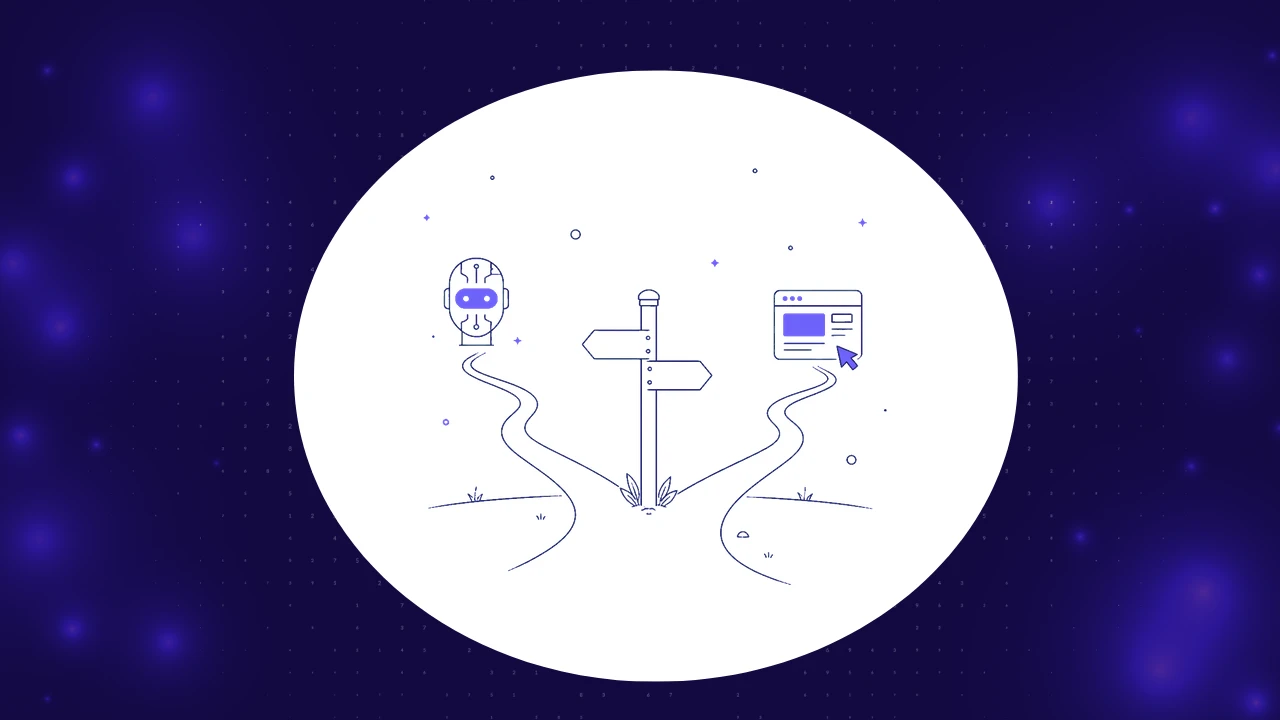

Every QA lead has been in this meeting. Someone says “we need to shift left.” Everyone nods. Three sprints later, you’re still finding the same bugs in production that you found last quarter. So someone else says “let’s shift right and test in prod.” And now you’re arguing about which direction is correct, as if quality were a steering wheel.
Here’s the thing. Shift-left versus shift-right is a fake fight.
The 16th annual Capgemini World Quality Report 2024-25, the industry’s longest-running QA benchmark, found that 68% of organizations are now using Gen AI to advance quality engineering, and 72% report faster automation processes as a result. That’s the real shift happening underneath the left vs right debate. AI agents are collapsing what used to be three separate jobs (write tests, watch production, convert incidents to tests) into one workflow. The teams shipping the cleanest software in 2026 aren’t picking a side. They’re running a loop, and AI is what finally makes that loop affordable.
This post settles the debate properly. Real definitions. Real numbers from real research firms. And a 90-day plan you can start Monday.
TL;DR: Shift-left catches predictable defects early in CI/CD. Shift-right validates real behavior in production with feature flags and observability. Research firms now agree the question has changed: generative AI is delivering measurable results across the SDLC, which is why prevention investment is back on the table. The 2026 best practice is running both as a continuous loop. AI agents handle the expensive middle, turning production failures into permanent regression tests without human babysitting. That’s the part that used to make the full loop unaffordable. Not anymore.
Quick Answers:
What is the difference between shift-left and shift-right testing? Shift-left moves testing earlier in development (unit tests, CI checks, static analysis) to prevent defects before release. Shift-right validates software in production with real users using observability, feature flags, and canary releases. Shift-left optimizes for prevention. Shift-right optimizes for learning from reality. The 2026 best practice is running both as a continuous loop, not choosing one.
Which is cheaper, shift-left or shift-right testing? Shift-left has lower per-bug fix cost because catching a defect early avoids the incident chain that follows a production bug. The downstream worst case (a defect that escapes to production and becomes a months-long incident) is documented in the cost section below, with specific 2024 breach data from IBM. Shift-right has higher per-event cost but catches what staging can’t simulate. The cheapest approach is both.
When should I shift left vs shift right? Lean shift-left when pre-launch (no production traffic yet), regulated (fintech, healthcare), or your pipeline is the bottleneck. Lean shift-right when you have real users, your failures are performance or integration issues staging can’t reproduce, or you’re shipping fast and need feature flags as a safety net. Run the full loop when quality is a competitive differentiator, which in 2026 means most software companies.
Is shift-left or shift-right better for AI-built software? Both, leaning heavily on shift-right. AI-generated code passes conventional tests while behaving unpredictably with real inputs, which is exactly the failure mode shift-right catches. The full loop, prevent on the left, observe on the right, feed failures back, is the safest approach.
How We Evaluated the Shift-Left vs Shift-Right Debate
Every claim in this guide was checked against six criteria. No hand-waving, no “balance is key” filler.
| Criteria | What We Looked For |
| Source authority | Research firms only: Gartner, Bain, IDC, Forrester, Google |
| DORA, Capgemini, IBM, NIST, ISTQB | |
| Recency | 2024 or newer; 2026 data prioritized |
| Vendor-neutral framing | No vendor blogs, no marketing pages, no point-solution claims |
| Reproducibility | Numbers verifiable on the cited source’s domain |
| Counter-evidence | Where shift-left and shift-right advocates diverge |
| Real-world fit | Does the answer change for a 6-person team vs a 600-person org |
What Is Shift-Left Testing?
Shift-left testing means moving quality checks earlier in the software development lifecycle, into design, coding, and the CI/CD pipeline, so defects are caught before they ever reach a user. Instead of QA being the last gate before release, testing starts the moment a requirement or a line of code exists.
In practice, shift-left looks like:
→ Unit and integration tests running on every commit → API and contract tests gating your pipeline before merge → Static analysis on pull requests, catching the predictable issues automatically → Test cases written alongside the feature, not after it → Quality criteria baked into the requirements doc itself → Security scanning (SAST, SCA, secret detection) in CI
The shift-left movement is not new. According to NIST research, 70% of software issues stem from specification and design flaws, and inadequate testing infrastructure costs the US economy an estimated $59.5 billion per year. Catching those flaws at the design stage costs orders of magnitude less than catching them after release.
The economic logic shows up in modern surveys too. Forrester’s research on the 2024 software development landscape projects that AI-assisted testing will deliver 15-20% productivity gains for testers and above 10% efficiency improvements across product teams. That’s the multiplier on top of shift-left’s baseline benefits.
One important nuance the textbooks skip. Shift-left does not mean “developers do all the testing now.” The principle is that quality becomes a shared responsibility, surfaced early, supported by automation. Developers contribute more, yes. QA’s job remains QA’s job. It just starts on day one instead of day forty.
What Is Shift-Right Testing?
Shift-right testing means validating software in production, under real traffic, with real users, using observability, feature flags, canary releases, and chaos engineering to learn how the system actually behaves once live.
Shift-right accepts a truth that shift-left can’t: you cannot simulate everything. Real users click in orders you never scripted. Real networks drop packets. Real third-party APIs time out at 2 a.m. Real production data has shapes your seed scripts never imagined.
Common shift-right techniques:
→ Canary releases routing 1% of traffic to a new version → Feature flags letting you turn a release off in seconds → Synthetic monitoring probing critical paths around the clock → A/B testing to validate behavior changes, not just bug-free deploys → Chaos engineering, intentionally breaking parts of prod to learn how the system recovers → Observability stacks (logs, metrics, traces) feeding real user monitoring back to engineering
The shift to shift-right is not optional anymore. The IDC MarketScape: Worldwide Observability Platforms 2025, the first IDC vendor assessment dedicated to observability, evaluated 26 vendors providing observability platforms to enterprises. That the category got its own MarketScape is itself a signal: observability is now a board-level infrastructure category, not a niche.
For teams shipping AI features the case is even sharper. Gartner’s May 2026 press release on AI observability predicts 40% of organizations deploying AI will implement dedicated AI observability tools by 2028 to monitor model performance, bias, and outputs. Padraig Byrne, VP Analyst at Gartner, put the reason plainly: “Unlike traditional software, AI’s decision making is often hidden, making it hard to explain or trust, yet errors can cause substantial financial loss, reputational damage and regulatory scrutiny.”
If you want the deep version of shift-right, ContextQA wrote a full guide on testing in production.
The Cost Argument: Why Shift-Left Exists
The cost numbers behind shift-left are genuinely brutal.
The most cited stat is the IBM Systems Sciences Institute “Rule of 100”: a defect that costs 1x to fix in design costs roughly 6.5x in coding, 15x in testing, and up to 100x in production. A fair caveat: the original data traces to IBM training material from 1981, not a modern peer-reviewed study. But every analysis since has pointed in the same direction.
The downstream multiplier is even bigger. IBM’s 2024 Cost of a Data Breach Report pegs the average data breach at $4.88M, with detection taking 258 days. For more than eight months, an attacker can operate inside an environment that shift-left could have caught at PR time. That’s not just a fix cost. That’s months of dwell-time damage.
The market data echoes the same point. Bain & Company’s 2024 Technology Report documents that technology spending has rebounded specifically because AI is now delivering measurable results across engineering workflows, which is why prevention investment is back on the table after years of cost-cutting cycles.
The logic is simple. A bug in a requirements doc is a text edit. The same bug in production means:
→ Change the code
→ Retest the surrounding flows
→ Get the patch through review again
→ Redeploy through every environment
→ Run the incident, with whatever blast radius it created
→ Tell the customer, sometimes publicly
→ Clean up the data and any downstream side effects
→ Write a postmortem so it doesn’t happen again
That’s why a 1x bug becomes a 100x bug. The fix is identical. It’s everything that has to happen around the fix that explodes the cost.
ContextQA broke down the full cost mechanics in a dedicated piece.
So shift-left wins, right? Not so fast.
Why Shift-Left Alone Keeps Failing Teams
Shift-left has a ceiling, and a lot of teams have already hit it.
You can’t pre-test reality
Your staging environment is a polite fiction. It has clean data, predictable load, and mocked dependencies. Production has a user pasting an emoji into a phone-number field while on hotel Wi-Fi, mid-transaction, on a 6-year-old Android device, behind a corporate proxy that strips cookies.
No amount of left-shifting catches that, because the bug doesn’t exist until the real world creates it.
More tests can mean slower releases
The Google DORA 2024 Accelerate State of DevOps Report, which has now run for over a decade and analyzes data from tens of thousands of professionals worldwide, introduced a new metric in 2024 called rework rate, which measures the proportion of unplanned deployments made to fix user-visible issues. Rework rate is one of the clearest signals that shift-left gates are letting the wrong things through. If your team is shipping fast but generating constant hotfix deploys, the pipeline is fast but lying.
Pile enough quality gates onto the pipeline and “shift-left” quietly becomes “shift-everything-onto-the-developer.” Builds get slow. Flaky tests get ignored. We’ve seen teams with 14-minute CI runs where developers had memorized which three tests were “the flaky ones” and just hit retry until they passed. That isn’t a quality program. That’s a ritual.
Prevention has no feedback loop
Shift-left optimizes for “did it pass the tests we thought to write.” It tells you nothing about whether users can actually complete checkout, whether your p95 latency just doubled after a deploy, or whether the new onboarding flow caused a 6% drop in trial-to-paid conversion. That signal only lives in production.
A team can have 92% code coverage and a fully green pipeline and still ship a release that quietly breaks the business. Coverage measures what your tests touched. It doesn’t measure whether the right things were tested.
The diminishing-returns problem
The first 200 tests catch the bulk of real bugs. The next 200 catch fewer. The next 2,000 catch a handful, and they cost the same to maintain as the first 2,000. Forrester’s developer experience research identifies developer experience as one of the top business investments for 2024, and one of the largest sources of friction is exactly this: tests that no longer earn their maintenance cost but nobody has authority to delete. Eventually you’re spending more engineering time keeping the suite alive than you’re saving by running it.
That’s not an argument against shift-left. It’s an argument that shift-left is half a strategy.
Shift-Left vs Shift-Right: The Comparison Table
| Dimension | Shift-Left | Shift-Right |
| Goal | Prevent defects early | Detect and learn from real behavior |
| Where it runs | Design, code, CI/CD pipeline | Production, live environment |
| Core techniques | Unit, integration, API, contract tests, | Observability, feature flags, canary |
| static analysis, SAST, quality gates | releases, A/B tests, chaos engineering | |
| Catches | Logic errors, broken contracts, | Real-user edge cases, performance under |
| regressions, OWASP Top 10 | load, integration failures, drift | |
| Feedback speed | Seconds to minutes per commit | Continuous, live, post-release |
| Main risk | False confidence (“passed staging”) | User impact if guardrails are weak |
| Authoritative data | Capgemini WQR: 68% using Gen AI in QE | IDC: 26 vendors in 2025 observability |
| for shift-left automation | MarketScape | |
| Typical payoff | 60% to 90% fewer production defects | 30% to 40% fewer production incidents |
| Maturity signal | Pipeline reliability, lint pass rate | Mean time to recovery, rework rate (DORA) |
| Who owns it | Developers and QA, together | Engineering, SRE, product analytics |
Read the table and the conclusion writes itself. These don’t compete. They cover each other’s blind spots. Shift-left shrinks the number of bugs that escape. Shift-right catches the ones that slip through anyway and feeds them back into your tests.
The Real Answer: It’s a Loop, Not a Direction
Stop thinking left and right. Think clockwise.
A modern quality loop runs like this:
- Shift-left: catch defects in the pipeline before merge.
- Ship behind a feature flag to a small slice of real users (1% or 5%).
- Shift-right: watch production, errors, latency, user paths, in real time.
- Root-cause fast when something breaks. Which release? Which user path? Which dependency?
- Turn that production failure into a new automated test.
- That test now lives on the left, so the bug never comes back.
- Periodically retire tests that no longer earn their maintenance. Your suite shouldn’t only grow.
Step 5 is the magic step, and it’s the one almost nobody does, because historically it was manual, tedious, and the first thing cut when a deadline loomed. Production taught you a lesson and the lesson evaporated by Friday. The bug came back two quarters later, and someone said “didn’t we have this issue before?” Yes. You did. Nobody wrote it down.
This is the bridge people miss between shift-left testing strategy and continuous testing in DevOps. The loop only works if production findings flow back into the pipeline automatically. Otherwise you’re just doing two disconnected things and calling it a strategy.
A Worked Example: The Loop in Action
A team ships a release on a Tuesday. Shift-left passes cleanly. 100% green build, all 1,847 tests pass in 11 minutes. They route 5% of traffic to the new version behind a feature flag.
By Wednesday morning, observability shows something off. The 5% slice has a checkout completion rate 4 percentage points lower than the 95% control group. No errors are firing. No alerts triggered. The tests had no way to catch it, because the tests didn’t measure conversion.
The team flips the flag back to 0% in 30 seconds. No customer impact beyond the affected 5% over 14 hours.
Root-cause analysis finds it. A new client-side validation rejects valid international phone numbers that include a plus sign. Tests covered US formats. International formats slipped through.
Three things happen next:
→ The bug is patched
→ A new test is added covering 12 international phone formats, including the broken case
→ The feature flag re-opens to 5%, then 25%, then 100% over 48 hours
That bug now exists in the suite forever. It can never ship again. The loop closed.
This is what running the loop actually looks like. Not a slide deck. A patched bug that taught the system something permanent.
Why AI Agents Make Running Both Affordable in 2026
Here’s the part that changed between 2023 and 2026.
The reason most teams never ran a true left-and-right loop wasn’t ignorance. It was cost. Running both meant maintaining a huge pre-release test suite, AND staffing people to watch production, AND manually converting incidents into new tests. That’s three jobs. Most teams could fund one.
AI agents collapse those three jobs into a workflow. This matches what the 2025 DORA State of AI-Assisted Software Development Report, drawing on responses from nearly 5,000 technology professionals, found: AI doesn’t fix a team. It amplifies what’s already there. Strong teams use AI to become more efficient. Struggling teams find AI highlights their existing problems. The greatest return comes from a strategic focus on platform quality, workflow clarity, and team alignment, which is exactly what an end-to-end quality loop provides.
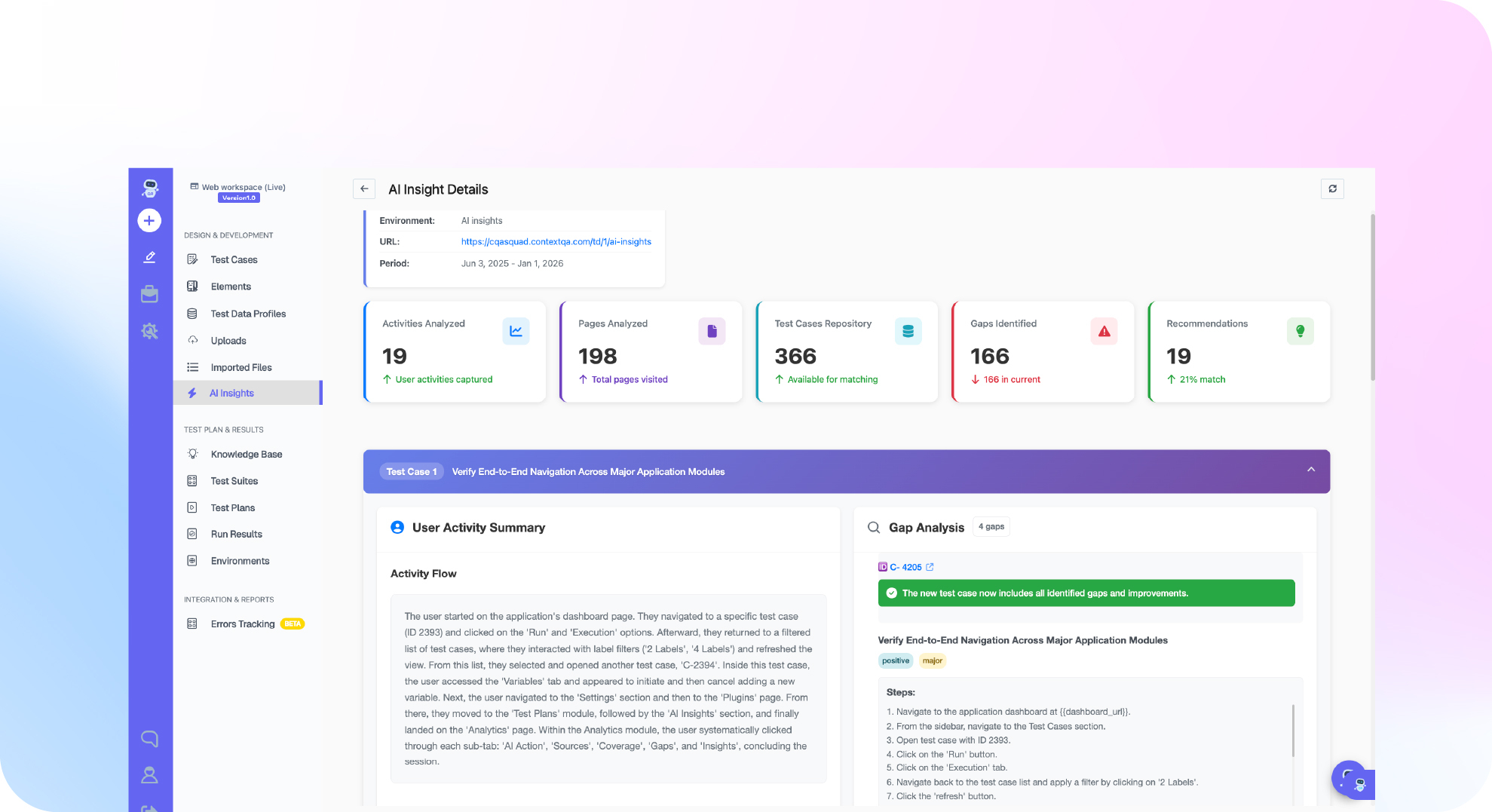
This is exactly where a platform like ContextQA is built to live, across the whole loop, not one slice of it.
On the left: agents that write and maintain tests
Instead of a person hand-coding every test, AI agents generate test cases from your app’s actual behavior, and self-healing keeps them alive when the UI changes. The number-one reason shift-left “fails,” flaky high-maintenance tests, is the exact thing AI-based self-healing is designed to kill.
When a button’s selector changes from button.checkout-btn-v2 to [data-test=”checkout”], the test adapts instead of breaking your build at 11 p.m. No 6 a.m. Slack ping. No three-engineer war room over a typo in a class name.
And because tests are real and portable, ContextQA lets you export the underlying code so you’re never locked into a black box.
On the right: agents that watch production and explain failures
When something does slip into prod, the slow part has always been the forensics. Which release? Which user path? Which dependency? Which microservice in the chain returned the unexpected payload?
ContextQA’s root-cause analysis does that triage automatically, so you’re handed the “why,” not just a red alert at 2 a.m. The agent reads the error patterns, correlates them against recent deploys and dependency changes, and surfaces the most likely cause along with the evidence.
Closing the loop: production failures become tests
This is the step that used to evaporate by Friday. When agents own both ends, a production failure can be captured and turned into a permanent regression test without a human babysitting the process.
Here’s the flow:
- Production failure detected by monitoring
- Agent identifies the user path that triggered it
- Agent generates a regression test reproducing that exact path
- Test enters the pipeline on the next build
- The same bug now blocks a merge, not a release
No tickets opened. No engineer assigned to “write the regression test.” The system does the boring part so engineers can do the interesting part.
That’s the whole point of agentic AI in software testing: not “AI writes some tests for you,” but agents running the entire left-to-right-to-left loop so a 6-person team can operate like a 40-person one.
When Should YOU Lean Left vs Right?
A simple, honest rule of thumb.
Lean shift-left when
→ You’re pre-launch or pre-product-market-fit. You don’t have production traffic to learn from yet.
→ Bugs are expensive or dangerous to ship. Fintech, healthcare, anything regulated. The cost of one production incident dwarfs the cost of the entire test suite.
→ Your pipeline is the bottleneck and regressions keep sneaking back in.
→ Your engineering org is growing fast and quality needs to scale with headcount, not lag behind it.
Lean shift-right when
→ You have real users and real traffic. The most valuable test data you own is already happening live. Use it.
→ Your failures are performance, scale, or integration issues that staging can’t reproduce.
→ You’re shipping fast and need feature flags and canaries as your safety net.
→ You’re shipping AI features. Non-deterministic behavior is invisible in staging, which is why Gartner projects 40% of AI-deploying organizations will adopt dedicated observability tools by 2028 (referenced earlier in this guide).
Run the full loop when
→ You’re past the early stage and quality is a competitive differentiator, not a checkbox.
→ Your customer base is large enough that incidents become news, not just tickets.
→ Honestly, whenever you can afford it. With AI agents, “afford it” now includes most teams of five engineers or more.
The teams that win aren’t the ones who picked the right direction. They’re the ones who stopped picking.
How to Actually Start: A 90-Day Plan
If you’re thinking “great, but where do I start,” here’s the actual sequence.
Days 1-30, fix shift-left first. Audit your pipeline. Identify your top 10 flakiest tests. Either fix them, replace them with self-healing versions, or delete them. A smaller, reliable suite beats a bigger, flaky one every time. Get your CI runtime under 10 minutes if it isn’t already.
Days 31-60, add the right-side basics. Get feature flags installed on the next release. Pick one critical user journey (checkout, signup, the most-used dashboard view) and add real user monitoring to it. One journey instrumented properly teaches you more than ten journeys instrumented poorly.
Days 61-90, close the loop. Define the workflow for turning a production incident into a regression test. Who owns it? How fast? What counts as “done”? Run a postmortem on one real incident and walk it through the loop end-to-end. The first time is awkward. The fifth is muscle memory.
By day 91 you’ll know whether the loop is working. Two signals:
→ Production incidents are getting shorter (MTTR drops) → Repeat incidents are vanishing (the same bug doesn’t bite twice)
The Bottom Line
Shift-left or shift-right was never the real question. Shift-left keeps the obvious bugs out. Shift-right catches what only reality can teach you. The edge in 2026 belongs to teams that run both as one continuous loop, and AI agents are the reason that loop finally fits inside a normal team’s budget.
The question isn’t which direction. The question is whether your team has a closed loop. If your production incidents teach you nothing permanent, you don’t have a quality program. You have a graveyard of forgotten lessons.
If you want to see what running the whole loop looks like instead of bolting together five tools that don’t talk to each other, take a look at how ContextQA does it.