TL;DR: These two terms get swapped constantly, and they mean opposite things. Agentic AI testing is using autonomous AI agents to do your software testing. AI agent testing is evaluating an AI agent that is itself the system under test. One puts AI in the tester seat. The other puts AI on the operating table. IBM notes agent behavior is non-deterministic, so the evaluation methods differ sharply (IBM, 2026).
Definition: Agentic AI (Gartner) refers to AI systems that pursue goals autonomously, planning and taking actions with limited human supervision. When that capability is pointed at a QA workflow, you get agentic AI testing: agents that read an app, decide what to check, and adapt when the UI shifts. When the agentic system is instead the product you ship, testing it is AI agent testing, a distinct discipline built around probabilistic, trajectory-based evaluation.
Quick answers
Is agentic AI testing the same as AI agent testing? No. Agentic AI testing uses AI agents as the tester to validate ordinary software. AI agent testing validates an AI agent as the system under test. The direction of testing is reversed.
Which one does ContextQA do? ContextQA is an agentic AI testing platform. Autonomous agents generate, run, and self-heal tests across web, mobile, and API surfaces. It is the tester, not the thing being tested.
Why does the distinction matter? The tools, pass/fail logic, and skill sets are different. Confusing them leads teams to buy an agent-evaluation framework when they needed test automation, or vice versa.
The one difference that clears up everything
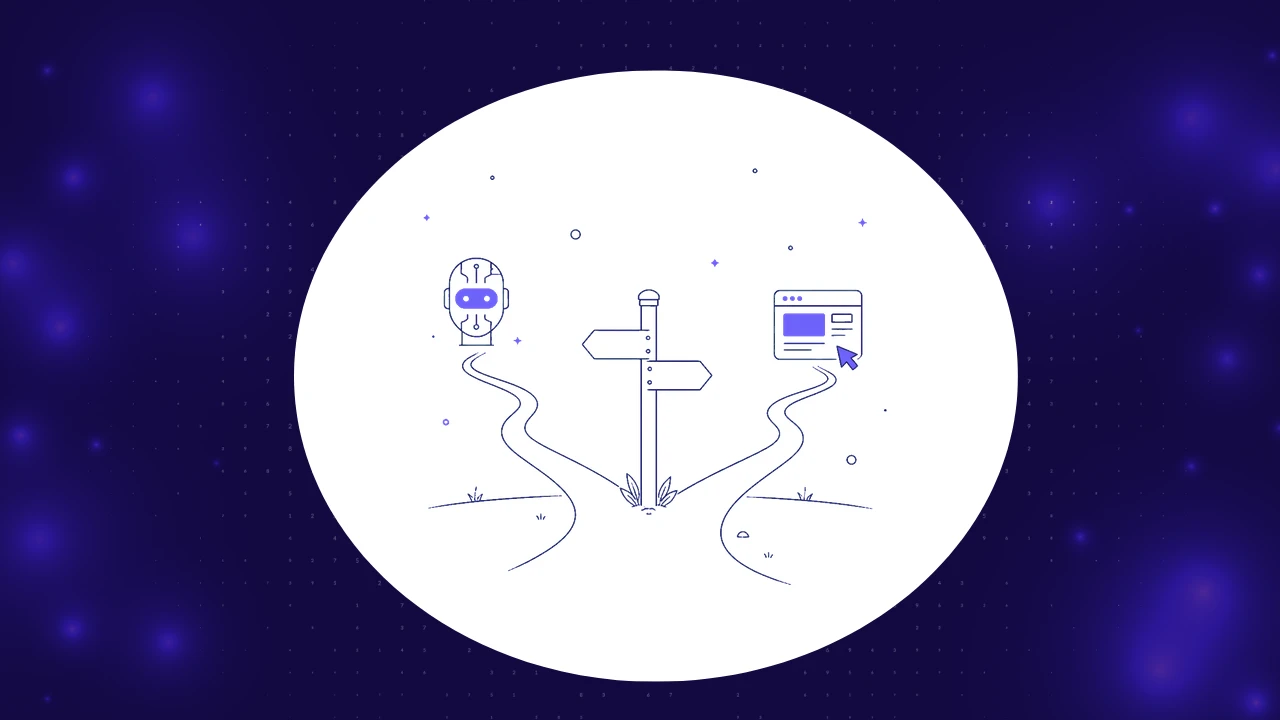
Ask a single question: where does the AI sit?
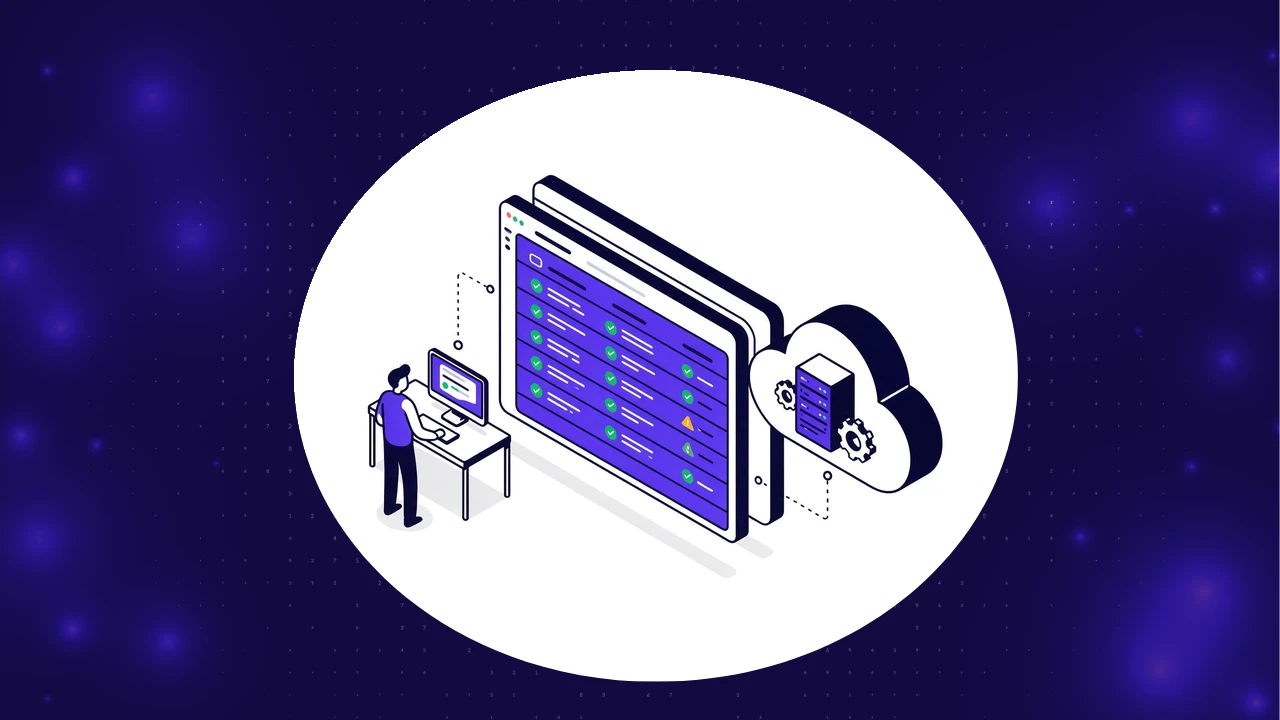
In agentic AI testing, the AI is the tester. It reads your checkout page, figures out the steps, clicks through, and flags what broke. Your app is ordinary software. Deterministic. The same input should give the same output, and when it does not, that is a bug.
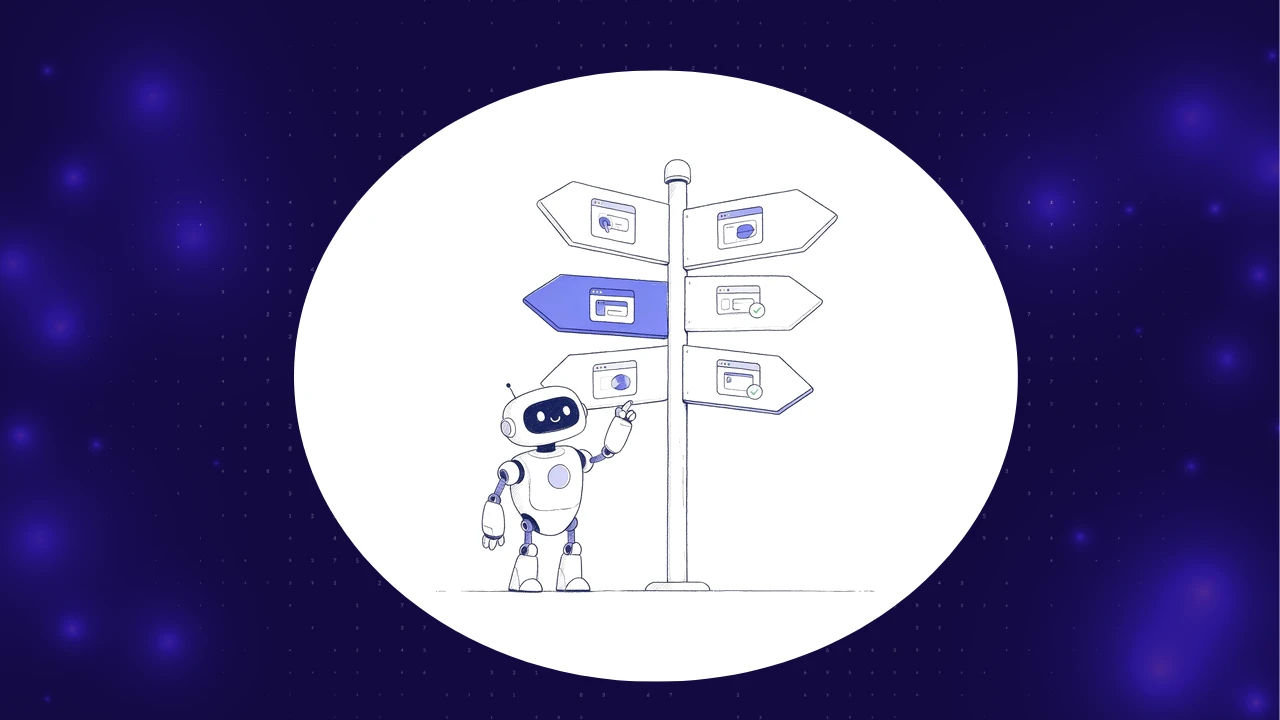
In AI agent testing, the AI is the thing on trial. You built a support agent, a coding copilot, or a multi-step research bot, and now you have to prove it behaves. The catch is that it does not behave the same way twice. Run the same prompt three times and you can get three different routes to three different answers. That is not a bug. That is the nature of the system, and it breaks every assumption baked into traditional QA.
So one discipline assumes determinism and hunts for the run where it broke. The other assumes non-determinism and measures how often the agent lands in an acceptable zone. Same three words rearranged, completely different jobs. Here is the side by side.
| Dimension | Agentic AI testing | AI agent testing |
|---|---|---|
| What is tested | Regular software (web app, mobile app, API, ERP) | An AI agent or LLM system (chatbot, copilot, autonomous agent) |
| Who or what does the testing | Autonomous AI testing agents | Eval harnesses, human reviewers, and LLM-as-a-judge |
| Core assumption | Deterministic: same input, same output | Non-deterministic: outputs and paths vary run to run |
| Pass or fail logic | Binary assertions against expected results | Statistical scoring across multiple runs and rubrics |
| Typical methods | Test generation, self-healing execution, cross-browser runs | Trajectory evals, tool-call accuracy, task completion, guardrail checks |
| Example failure mode | A renamed button ID breaks a locator | The agent hallucinates a refund policy or calls the wrong tool |
| Representative tools | ContextQA, agentic test platforms | DeepEval, Ragas, agent-eval platforms |
| Who owns it | QA and SDET teams | ML, AI product, and applied-science teams |
If you only remember one row, make it the first one. What is under test decides everything downstream. When we help teams sort this out, the confusion almost always traces back to skipping that question. For the broader autonomous-QA picture, our guide to agentic AI and autonomous QA agents covers the tester side in depth.

Direction of testing, drawn out
Same arrow, flipped. On the left the agent acts on the app. On the right the harness acts on the agent. That flip is the whole distinction, and it decides which tools, metrics, and team you reach for.
Why this matters more in 2026
Map both to the ISTQB test levels and the confusion gets even clearer. Agentic AI testing spans the familiar pyramid: unit, integration, system, and acceptance, just executed by agents instead of hand-written scripts. It lives inside your CI/CD pipeline and gates releases the way test automation always has. Nothing about the target changed. The tester got smarter.
AI agent testing does not fit that pyramid cleanly. There is no stable oracle. As IBM puts it, agent behavior is non-deterministic, so you cannot rely on a single expected result (IBM, 2026). Practitioners lean on coverage maps and statistical evaluation instead of binary pass and fail counts, and averaging scores across three or more runs to absorb variance is now standard advice (SitePoint, 2026). Errors compound across steps, trajectories wander, and failures spread across many components. That is a different sport.
The reason it is boiling over now is that both trends arrived at once. Teams are shipping agent-powered features into production while also adopting agentic tools to test everything else. So a single QA lead ends up owning two jobs that share three words and almost nothing else. And the vendors are not helping, because plenty of marketing pages use the phrases interchangeably. If you are validating an agent as a product, start with how to test multi-agent systems and the AI agent evaluation tools compared rundown, which cover the eval side properly.
Where each approach fits in the stack
They can overlap at the seams. If your product is an AI agent, the buttons and API endpoints around it still need ordinary functional testing, and that part is agentic AI testing. The reasoning core underneath needs eval work, and that is AI agent testing. Most real teams need both, which is exactly why separating them matters.
Honest limitations of each
Neither side is magic. Agentic AI testing agents still need clear intent and good context. Point one at an ambiguous flow with no acceptance criteria and it will make confident, wrong guesses. And they inherit the old flakiness problem unless the platform handles it. AI agent testing has a harder ceiling: because there is no single correct answer, your evals are only as good as your rubric and your judge, and an LLM-as-a-judge can be biased or inconsistent. Neither replaces human review for high-stakes behavior. We are candid about this with customers, because pretending otherwise is how teams end up trusting a green dashboard that never actually checked the risky path.
How ContextQA sits on the agentic side
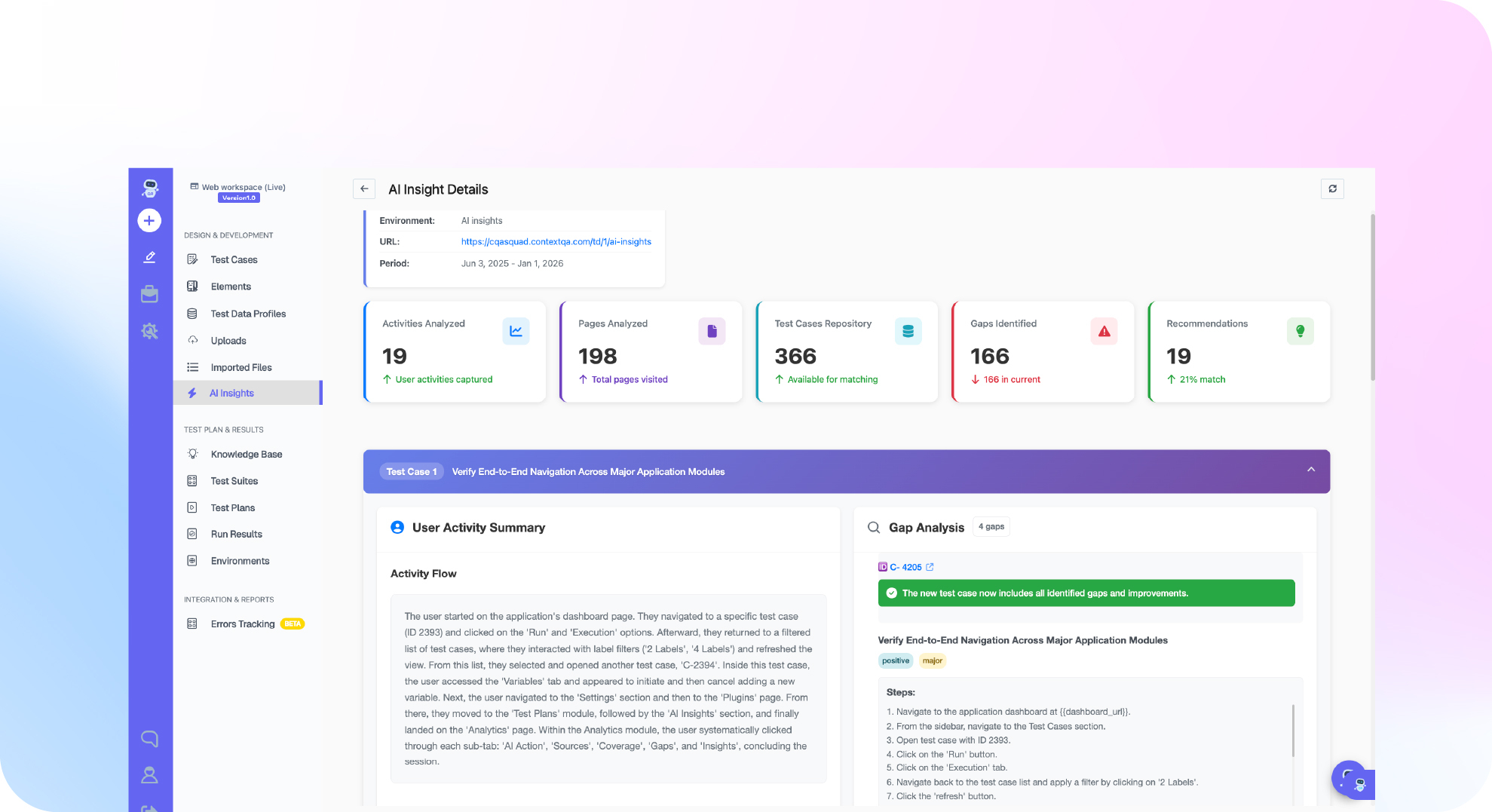
ContextQA is an agentic AI testing platform, squarely on the left of that diagram. Autonomous agents read the application, generate tests from plain-language intent, and run them across browsers, mobile devices, and APIs. The clearest proof is external. When IBM validated the platform, ContextQA migrated roughly 5,000 test cases in minutes using watsonx.ai natural-language processing and removed the flakiness that had been dragging the suite down (IBM case study). That is the agentic side doing what it is built for: testing real software, fast, without brittle hand-authored scripts.
Two capabilities make the deterministic-testing job hold up in practice. First, AI-based self-healing uses multi-layered element fingerprinting across visual, accessibility, DOM, and text signals, so a renamed button does not tip over the suite the way it would with a single fragile locator. Second, root-cause analysis classifies every failure as a real bug, a test issue, an environment problem, or a flake, which is the difference between a report you act on and a wall of red you ignore. As founder Deep Barot has framed it, the goal is testing that keeps pace with delivery rather than gating it.
Coverage runs wide: web, mobile, API, Salesforce, ERP and SAP, database, and security surfaces, wired into Jenkins, CircleCI, GitHub Actions, GitLab, and JIRA. The platform holds a 4.8 out of 5 rating on G2 and carries High Performer recognition. For teams building agents, ContextQA also runs an MCP server exposing roughly 67 tools and connecting around 50 testing tools, which is where the agentic and agent-testing worlds start to touch.
Do this now: a 30-minute sorting exercise
- Name your system under test (2 min). Write one sentence. If it ends in “an AI agent,” you are in AI agent testing. If it ends in “a web app, API, or mobile app,” you are in agentic AI testing.
- Check for a stable oracle (5 min). Run your key flow twice. Identical result means deterministic testing applies. Varying results mean you need statistical evals.
- Assign the owner (3 min). Deterministic work goes to QA or SDET. Agent-eval work goes to ML or AI product. Do not blur these.
- Shortlist the right tool class (5 min). For the app side, look at agentic test platforms like ContextQA. For the agent side, review the evaluation tools compared post.
- Estimate the failure cost (5 min). Skim the cost of AI agent failures and the real cost of AI agent evaluation so budget matches risk.
- Run a real trial (10 min). Book a working session at ContextQA book a demo and bring one flow from each category.

The takeaway
Agentic AI testing and AI agent testing are not synonyms, they are near opposites. One uses AI to test software. The other tests the AI itself. Ask where the AI sits, and the right tools, metrics, and team fall into place. ContextQA lives on the agentic side, where it helped IBM move roughly 5,000 test cases in minutes and strip out flakiness. If you are trying to figure out which problem you actually have, book a demo and bring one example of each.
By Deep Barot, AI & Search Visibility Strategist.