TL;DR: QA testing as a service means renting an external team and toolchain to run your software testing on demand, instead of hiring and managing testers in house. It works when you need to scale coverage fast or fill a skills gap, and it fails when your product changes hourly, context is hard to transfer, or nobody owns quality internally. Around 68 percent of enterprises already outsource some testing (Panto, 2026), and the outsourced software testing market is set to reach 70.42 billion dollars in 2026 (The Business Research Company). This guide shows exactly when QA testing as a service pays off, when it backfires, and how to get the scale without losing control.
Quick answers
What is QA testing as a service? It is a delivery model where a third party provides testers, infrastructure, and processes as an on demand service. You pay for testing capacity instead of building a permanent team, and you scale it up or down as releases require.
Does QA testing as a service save money? Usually, on paper. Industry estimates put the saving at 40 to 60 percent versus an equivalent in house team once you include salaries, benefits, tools, and infrastructure (Kualitatem). The catch is that the saving only holds if the coordination overhead stays low.
When should you not use QA testing as a service? Avoid it when your application changes daily, when deep product context is the bottleneck, or when no one on your side owns quality. In those cases the handoffs cost more than the testing saves.
What QA testing as a service actually is
QA testing as a service is the practice of outsourcing your quality assurance to an external provider who supplies the people, the tooling, and the test environments as a managed service. The provider can be a boutique team of a few specialists or a global vendor with thousands of testers. The point is the same: you consume testing as capacity rather than owning it as headcount.
It sits next to two neighbors that are easy to confuse. Plain testing as a service is the broad category, and dedicated test automation services focus on building and running automated suites. QA testing as a service is the fuller version, covering manual and automated testing, exploratory work, and release sign off, delivered on a subscription or per project basis.
The market reality: why so many teams try it
The pull toward QA testing as a service is not hype, it is budget math. Testing already eats a large slice of engineering spend, and buying it as a service promises to convert a fixed cost into a flexible one. The adoption numbers reflect that pressure.
Roughly 70 percent of firms outsource at least some QA tasks, and nearly 40 percent of large companies now put a quarter of their IT budget into testing (Panto, 2026). When testing is that expensive, the promise of paying only for what you use is hard to ignore. But averages hide the failures, and the teams that regret QA testing as a service usually ignored the conditions below.

When QA testing as a service works
QA testing as a service is a strong fit when the work is bounded, the context is transferable, and someone on your side still owns quality. These are the situations where it reliably pays for itself.
- You need to scale coverage fast. A big release, a new platform, or a compliance deadline can demand more testing than your team can staff in time. Buying capacity on demand beats a three month hiring cycle.
- You have a clear skills gap. Performance, security, accessibility, and localization testing all need specialists you may not employ full time. A service gives you that expertise for the weeks you need it.
- The scope is well defined. A stable product, a documented spec, and clear acceptance criteria transfer cleanly to an external team. The less tribal knowledge a test needs, the better it outsources.
- You want an independent quality check. An outside team brings fresh eyes and no assumptions, which industry data links to a 25 percent lift in defect detection on average (Testriq).
- Testing demand is spiky. If you need heavy testing at release time and little in between, a service matches cost to demand far better than a fixed team.
When QA testing as a service fails
The failures are predictable, and they almost always trace back to context loss and coordination drag rather than to bad testers. Here is where QA testing as a service breaks down.
- Your product changes by the hour. When you deploy several times a day, an external team is always testing yesterday’s build. The handoff latency turns QA testing as a service into a bottleneck instead of a boost.
- Context is the real work. If understanding your domain, your users, and your edge cases is harder than running the tests, that knowledge does not transfer in a kickoff call. The tests will pass while missing what matters.
- Coordination swallows the savings. Time zone gaps, ticket round trips, and status meetings add a tax that grows with every handoff. The communication overhead of outsourcing often does not pay off until you reach real scale.
- Nobody internal owns quality. Outsourcing the work is fine. Outsourcing the responsibility is not. When quality becomes the vendor’s job, it quietly stops being anyone’s job.
- The relationship is manual and opaque. If you cannot see test runs, results, and coverage in real time, you are buying reports, not confidence.
The real cost: in house vs service vs automated
The sticker comparison favors outsourcing, and it is real as far as it goes. A senior QA automation engineer on a 120,000 dollar salary costs north of 170,000 dollars once you add benefits, taxes, tooling, and management overhead (Kualitatem). Against that, a service that bills only for active testing looks cheap.
| Factor | In house team | QA testing as a service | AI powered automation |
|---|---|---|---|
| Upfront cost | High (hiring, tools) | Low (pay as you go) | Low (subscription) |
| Product context | Deep, built in | Shallow, transferred | Deep, retained in tests |
| Speed to test a new build | Fast | Slow (handoff) | Instant (in pipeline) |
| Scales with releases | Poorly | Well | Well |
| Coordination overhead | Low | High | Low |
| Who owns quality | You | Ambiguous | You |
The column the sticker price hides is context. In house teams carry it for free, a service has to rebuild it on every engagement, and modern AI automation bakes it into the tests themselves so it does not walk out the door when a contract ends. That is the difference between paying less and spending well.
A decision framework you can use today
Instead of asking whether QA testing as a service is good or bad, ask two questions about your own situation: how fast does your product change, and how transferable is the context needed to test it. Those two axes sort almost every team into the right choice.
Most software companies live in the bottom right quadrant. They ship constantly and their hardest testing needs real product knowledge. That is exactly where a pure QA testing as a service model struggles, and where keeping ownership in house while automating the repetitive work wins.
The ContextQA alternative: scale without the handoff
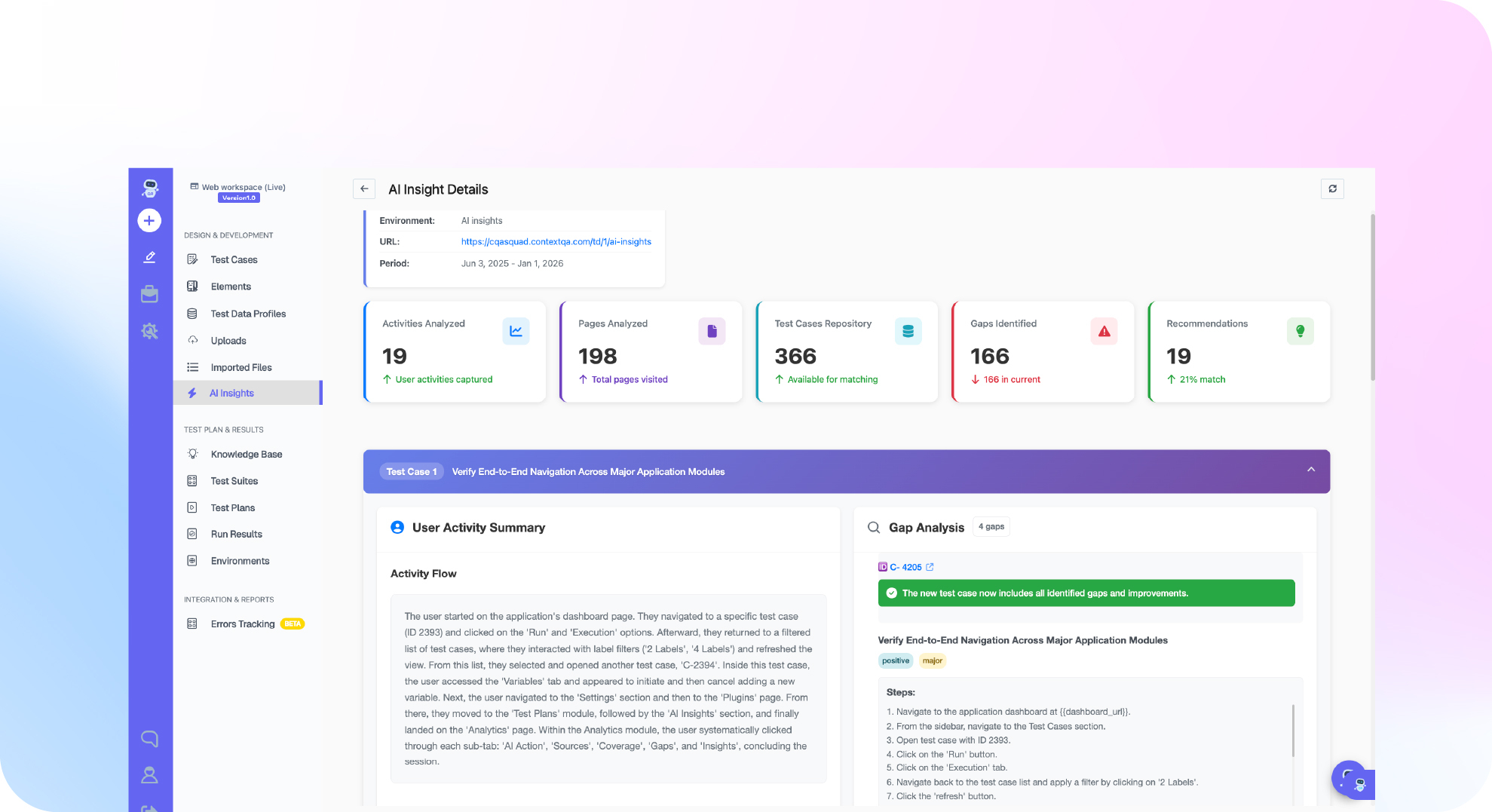
There is a third option between hiring a full team and renting one. You keep quality ownership in house and let AI absorb the repetitive testing work, so you get the scale of a service without the context loss. This is where ContextQA’s AI testing suite fits.
- Anyone on your team can author tests. With plain English test creation, your product experts write tests in the language they already think in, so the context stays with the people who have it.
- Tests fix themselves. AI based self healing repairs broken locators when the UI changes, removing the maintenance load that makes in house automation feel expensive.
- Failures explain themselves. Root cause analysis labels each failure as a real bug, a test issue, an environment problem, or a flake, so you act instead of investigate.
- It runs everywhere your product ships. From web automation to mobile automation and API testing, coverage lives in one place and runs in your pipeline.
The IBM case study describes ContextQA migrating and automating 5,000 manual test cases using watsonx.ai.
Get service level scale without giving up control of quality
See how ContextQA lets your own team author, run, and self heal a full regression suite, so you keep the context an outsourced QA vendor never gets. Bring your trickiest flow to a live demo.
Book a ContextQA DemoHow to pilot QA testing as a service before you commit
If the decision framework points you toward a service, do not sign an annual contract on day one. Run a small, time boxed pilot that stresses the exact failure modes above, so you learn how a QA testing as a service partner behaves on your real product rather than on a polished pitch. A good pilot answers one question: does the coordination overhead stay smaller than the coverage you gain.
- Pick one real, messy flow. Choose a feature with genuine edge cases, not the happy path. You want to see whether the provider surfaces the bugs your own team would.
- Write down the context you had to explain. Every question the external team asks is context that will not transfer for free. A long list here is a warning that your product sits in the hard to outsource quadrant.
- Deploy a change mid pilot. Ship an update partway through and measure how long it takes the service to re test. That lag is your real world speed mismatch, made visible.
- Demand live visibility. Ask to see test runs, results, and coverage as they happen, not a weekly PDF. If the only artifact is a report, you are buying opacity.
- Score the coordination tax. Count the meetings, tickets, and time zone delays the pilot cost you. Compare that against the hours of testing you actually received.
A pilot that clears all five is a partner worth scaling with. A pilot that stumbles on context transfer or re test speed is telling you that QA testing as a service is the wrong shape for your product, and that keeping quality in house with AI automation will serve you better. Either way, you learn it in two weeks and a small budget instead of a year and a large one.
Frequently asked questions
Is QA testing as a service the same as staff augmentation?
No. Staff augmentation adds individual testers who work inside your team and processes. QA testing as a service delivers a managed outcome, the provider owns the people, tools, and process and hands you results. Augmentation keeps more context on your side, a full service keeps less.
How do I keep control when I outsource testing?
Keep three things in house: the definition of what quality means for your product, visibility into test runs and coverage in real time, and one internal owner accountable for release quality. Outsource the execution, never the responsibility.
Can AI automation replace QA testing as a service?
For fast moving products, increasingly yes. AI automation gives you on demand scale like a service, but it keeps the tests, the context, and the ownership inside your team. Many companies use a service for one off specialist work and AI automation for the everyday regression load.
The bottom line
QA testing as a service is a genuinely good tool for a specific job: bounded, well specified testing that needs to scale fast or fill a skills gap. It fails when your product changes constantly, when context is the hard part, or when quality stops being someone’s job internally. Run your own situation through the change rate and context questions before you sign anything. And if you are in the fast moving, context heavy quadrant where most software teams live, the smarter path is to keep ownership in house and let AI carry the repetitive load. Book a demo and see your own regression suite author and heal itself.
Written by Deep Barot.