
TL;DR: Test automation services help teams build, run, and maintain automated test suites without hiring a full in-house automation team. The three service models (staff augmentation, managed testing, platform-based automation) each fit different team sizes and budgets. This guide compares what to look for, common mistakes teams make when choosing a provider, and why platform-based services like ContextQA deliver faster ROI than traditional consulting models.
Key Takeaways:
- Test automation services fall into three models: staff augmentation ($80-200/hr), managed testing ($15K-50K/mo), and platform-based automation ($500-5K/mo).
- Platform-based services deliver fastest ROI because you don’t wait for consultants to learn your codebase.
- The Capgemini World Quality Report 2024-25 found that 67% of organizations increased their QA budgets, with automation being the top investment priority.
- The number one mistake: choosing a provider that builds automation on frameworks your team can’t maintain after the engagement ends.
- ContextQA’s platform model combines AI-driven automation with self-healing, meaning tests stay stable without ongoing service fees for maintenance.
- G2 verified reviews report 50% regression time reduction and 80% automation rates with ContextQA’s platform approach.
- Always require a pilot or proof of concept before signing an annual contract with any automation service provider.
Definition: Test Automation Services Professional services or platforms that help organizations design, build, execute, and maintain automated software testing. Service models range from consulting engagements where external engineers write automation scripts, to managed testing where a provider operates the entire QA function, to platform-based automation where AI-powered tools enable teams to automate testing themselves.
The Capgemini World Quality Report 2024-25 found that 67% of organizations increased their QA budgets in the past year. Automation was the number one investment priority. And yet the same report showed that most teams still automate less than 40% of their test cases.
That gap between budget and execution is where test automation services come in. And where a lot of money gets wasted.
I’ve watched companies spend six figures on automation consulting engagements that produced test suites nobody on the internal team could maintain. I’ve seen managed testing contracts where the vendor used outdated frameworks because that’s what their engineers already knew, not what was right for the client. And I’ve seen platform-based tools (including ContextQA) deliver results in weeks that traditional service engagements took months to achieve.
The goal of this guide isn’t to sell you on one approach. It’s to help you understand which model fits your team and what questions to ask before you spend money.

Quick Answers:
What are test automation services? Professional services or platforms that help organizations build, execute, and maintain automated testing. The three main models are staff augmentation (hiring external engineers), managed testing (outsourcing QA operations), and platform-based automation (AI tools that enable your team to automate directly).
How much do they cost? Staff augmentation: $80 to $200 per hour. Managed testing: $15,000 to $50,000 per month. Platform-based tools like ContextQA: $500 to $5,000 per month with faster time-to-value.
Which model is best for small teams? Platform-based automation gives small teams (under 5 QA engineers) the fastest path to results because AI handles test generation and maintenance instead of requiring dedicated automation specialists.
Comparing the Three Test Automation Service Models
Every test automation service falls into one of three models. Understanding the differences prevents the most common purchasing mistakes.
| Factor | Staff Augmentation | Managed Testing | Platform-Based Automation |
| How it works | External engineers join your team and write automation | Provider runs your entire testing operation | AI platform enables your team to automate directly |
| Typical cost | $80-200/hr per engineer | $15K-50K/month | $500-5K/month |
| Time to first value | 2-4 months (learning curve) | 1-3 months (onboarding) | 1-2 weeks (AI generation) |
| Who maintains tests | You, after engagement ends | Provider, ongoing | Platform AI (self-healing) |
| Framework dependency | High (tied to engineer’s skills) | Medium (tied to provider’s tools) | Low (platform-managed) |
| Best for | Teams needing specific framework expertise | Enterprises with complex, multi-app testing | Teams wanting fast coverage without hiring |
| Risk | Knowledge loss when engineers leave | Vendor lock-in, loss of internal expertise | Feature limits of platform |
Let me walk through each one.
Staff augmentation means hiring external automation engineers, usually through a consulting firm. They join your team, learn your application, and write test scripts. The benefit is flexibility: you get experienced engineers without permanent headcount.
The risk is knowledge transfer. When the engagement ends (and it always ends), your internal team inherits a codebase they didn’t write. If those consultants used Playwright and your team only knows Selenium, you now own tests you can’t maintain.
Definition: Test Automation Framework The underlying technical structure (languages, libraries, design patterns, reporting tools) that test scripts are built on. Common frameworks include Selenium, Playwright, Cypress, and Appium. The choice of framework affects maintainability, team skill requirements, and long-term costs.
Managed testing outsources the entire QA function to a provider. They handle planning, execution, reporting, and maintenance. You define quality goals; they deliver results.
Definition: Managed Testing Services An outsourcing model where an external provider takes full responsibility for test planning, execution, reporting, and maintenance. The client defines quality goals and the provider delivers against them with their own team and tools. Common in enterprises with complex testing needs but limited QA headcount.
This works for enterprises with complex, multi-application testing needs. The risk is losing internal QA knowledge. If the vendor relationship ends, you’re starting from scratch.
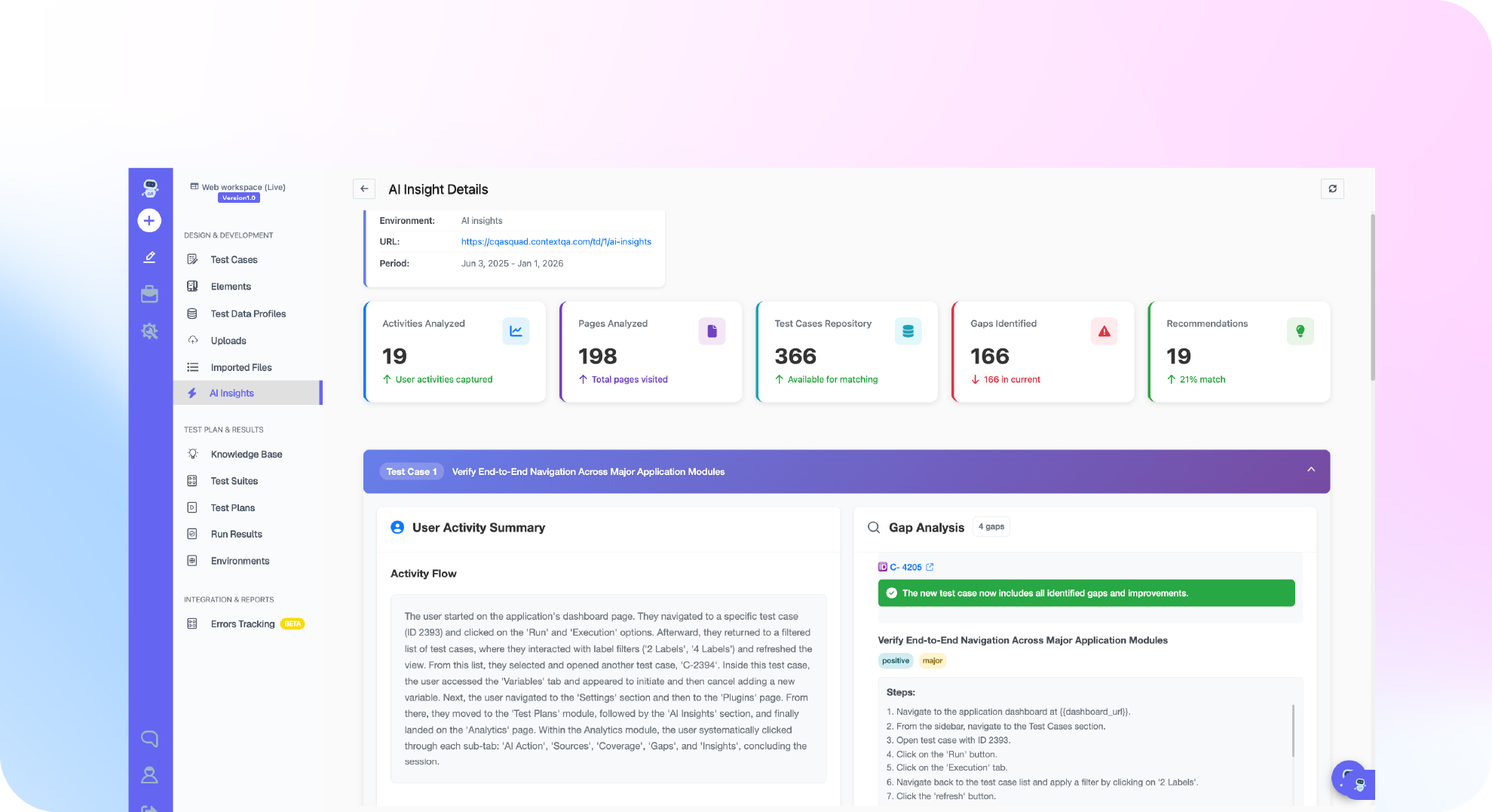
Platform-based automation uses AI-powered tools that enable your existing team to automate testing without deep framework expertise. ContextQA’s platform sits squarely in this category. AI generates tests, self-healing maintains them, and your team stays in control of the testing strategy.
The advantage: no ramp-up time, no knowledge loss when people leave, and no framework maintenance. The IBM ContextQA case study demonstrated 5,000 test cases automated in minutes, a timeline impossible with either of the other two models.
Five Questions to Ask Before Choosing a Provider
These five questions will save you from the most expensive mistakes I’ve seen teams make.
1. What happens to our automation after the engagement ends? If the answer is “you’ll need ongoing support from us,” that’s a warning sign. You want automation that your team can own independently. Platform-based tools like ContextQA avoid this problem entirely because there’s no custom code to inherit, just the platform.
2. What frameworks and tools will you use, and does our team know them? A consulting firm might deliver beautiful Cypress tests, but if your team writes Python, maintaining those tests becomes a full-time job. Check that the provider’s technology choices align with your team’s skills or that the platform abstracts the complexity away.
3. How do you handle test maintenance as our application changes? This is where service costs balloon. Traditional services charge per hour for maintenance. AI-powered platforms like ContextQA’s AI-based self healing handle maintenance automatically. The difference in long-term cost is significant.
4. Can we see real results from similar clients? Ask for case studies with specific numbers. G2 verified reviews provide independent customer data for ContextQA: 50% regression time reduction, 80% automation rate, 150+ backlog cases cleared in week one. Be skeptical of providers who only offer vague testimonials without measurable outcomes.
5. Will you do a paid pilot before we commit to an annual contract? Any confident provider will agree to a pilot. ContextQA’s pilot program runs for 12 weeks with published benchmarks: 40% improvement in testing efficiency. If a provider won’t offer a trial period, ask yourself why.
Why the Service Model Is Shifting Toward Platforms
The DORA State of DevOps research consistently shows that elite-performing teams own their testing capabilities internally. They don’t outsource the core quality function. They use tools that make their existing team more effective.
That’s the fundamental shift happening in test automation services. The consulting model (expensive, slow to start, creates dependency) is being replaced by platform models (affordable, fast, empowering).
Deep Barot, CEO and Founder of ContextQA, articulated this in a DevOps.com interview: AI should run 80% of common tests. The remaining 20% need human judgment that no outsourced team can replicate as well as your own product experts.
ContextQA’s enterprise features include SOC 2 and ISO 27001 compliance, on-premise deployment options, and GDPR-ready data handling. These enterprise requirements used to be arguments for large managed testing providers. Now they’re available in the platform model at a fraction of the cost.
The platform integrates natively with Jenkins, GitHub Actions, GitLab CI, CircleCI, Azure DevOps, JIRA, Asana, and Monday.com through pre-built connectors available on the integrations page.
Limitations and Honest Tradeoffs
Platform-based automation isn’t the right choice for every situation.
If your application has extremely complex business logic that requires deep domain expertise to test (think actuarial calculations in insurance or regulatory compliance workflows in banking), a platform alone may not be enough. You’ll need people who understand the domain, whether internal or augmented.
If your organization has strict requirements for on-premise test execution with no cloud components, some platform tools (including ContextQA, though it does offer on-prem options) may require architecture discussions before deployment.
And if your team has zero QA capacity (not even one person who can define test scenarios), a fully managed service might make sense as a bridge while you hire.
Real Outcomes: Platform vs. Traditional Service
The IBM ContextQA case study provides the clearest comparison point. Before partnering with IBM’s Build program, ContextQA’s customers faced the standard automation challenge: thousands of manual test cases in spreadsheets, slow migration, and persistent flakiness.
Using IBM’s watsonx.ai NLP models, ContextQA migrated 5,000 test cases within minutes. The traditional consulting approach to the same task? Weeks of manual effort by dedicated engineers.
G2 verified reviews validate the ongoing value:
- 50% regression time reduction (time savings start immediately, not months later)
- 80% automation rate (higher than most managed testing engagements achieve)
- 150+ backlog cases cleared in the first week (faster onboarding than any consulting engagement)
The ContextQA platform covers web automation,mobile automation,API testing, Salesforce testing, and cross-browser/device execution. That breadth typically requires multiple vendors in a managed testing model.
ContextQA’s context-aware AI testing platform, IBM Build partnership, and G2 High Performer recognition provide the credibility that enterprise procurement teams evaluate when choosing between service models.
Do This Now Checklist
- Calculate your current automation cost (15 min). Add up: QA team hours spent on manual testing + hours maintaining existing automation + any external vendor costs. This is your baseline.
- Identify your highest-value automation targets (15 min). List the 10 test flows that run most frequently and break most often. These are your first automation candidates regardless of which service model you choose.
- Check framework alignment (10 min). Document what programming languages and testing tools your team currently knows. Any service provider or platform must work with these skills, not against them.
- Request three proposals or demos (30 min). Compare at least one provider from each model type (staff augmentation, managed, platform). Evaluate on time-to-value, maintenance model, and total cost of ownership over 12 months.
- Require a pilot (15 min to request). Before any annual commitment, run a pilot. ContextQA’s pilot program provides a 12-week benchmark with measurable efficiency improvements.
- Book a demo with ContextQA (15 min). See the platform-based model in action. Bring your highest-priority test flow and watch it get automated live.
Conclusion
Test automation services are evolving from expensive consulting engagements to AI-powered platforms that deliver results in weeks, not months. The right choice depends on your team size, technical skills, and testing complexity.
For most teams in 2026, the platform model offers the best balance of speed, cost, and long-term sustainability. ContextQA’s combination of AI test generation, self-healing maintenance, and automated root cause analysis eliminates the dependency on external engineers while delivering measurable improvements from week one.
Book a demo to compare ContextQA against your current automation approach.