
TL;DR: SAP testing automation is the process of using automated tools to validate SAP business processes, transactions, and integrations after system changes, upgrades, or migrations. The Horváth S/4HANA Transformation Study (Q1 2025, 200 executives) found that only 8% of completed SAP migrations finished on schedule, 60% exceeded budget, and 65% missed initial quality targets. “Underestimated testing and data migration phases” was explicitly cited as a top reason. With ECC 6.0 mainstream support already ended (December 2025) and roughly 17,000 customers still on legacy ERP, automated SAP testing is not optional. It is the difference between a controlled migration and a catastrophic one.
Definition: SAP Testing Automation The practice of using automated testing tools to verify that SAP business processes (order to cash, procure to pay, record to report, hire to retire) function correctly after system changes. This includes functional testing (do transactions produce correct results?), regression testing (did a change break existing functionality?), integration testing (do connected systems still exchange data correctly?), and performance testing (does the system handle transaction volume under load?). SAP testing is distinct from general web testing because SAP applications use proprietary UI frameworks (SAP GUI, SAP Fiori, SAP Business Client) that require specialized element identification strategies.

Quick Answers:
Why is SAP testing automation important? SAP serves approximately 425,000 to 480,000 customers in over 180 countries. 90% of Fortune 500 companies run SAP. When SAP breaks, the impact is massive: industry estimates place average downtime costs at approximately $9,000 per minute. Manual testing of complex SAP business processes (which can span dozens of transactions across multiple modules) is too slow to keep pace with the release cadence and too error prone for business critical workflows.
What SAP processes need automated testing? The four core process areas are: order to cash (sales orders, deliveries, billing, payment), procure to pay (purchase orders, goods receipt, invoice verification, payment), record to report (journal entries, period close, financial statements), and hire to retire (employee onboarding, payroll, benefits, termination). Each process spans multiple SAP modules and multiple transaction codes.
How often does SAP release changes that require testing? S/4HANA Cloud Public Edition releases twice per year (January and July). On premise editions follow a biennial major release cycle with Feature Pack Stacks approximately every six months. Monthly security patches and daily SAP Notes add continuous change. Every change requires regression testing of affected business processes.
The SAP Migration Testing Crisis
I want to start with the data that should make every SAP project sponsor uncomfortable.
The Horváth S/4HANA Transformation Study is the most detailed independent research available on SAP migration outcomes. Based on interviews with 200 executives in Q1 2025:
| Migration Metric | Result |
| Completed on schedule | Only 8% |
| Average schedule overrun | 30% longer than planned (14.9 months planned vs 19.5 months actual) |
| Exceeded planned budget | 60%+ |
| Missed initial quality targets | 65% |
| Top cited reason for deviations | “Underestimated testing and data migration phases” |
That last row is the one that matters for this blog. The number one reason SAP migrations go wrong is not technology selection. It is not change management. It is not insufficient planning. It is underestimated testing.
CIO.com reported that SAP customers continue to struggle with migration complexity, and the testing burden is a recurring theme. At the current migration pace, roughly 17,000 ECC customers (nearly half of the approximately 35,000 total) will still be on legacy ERP by the 2027 support deadline. ECC 6.0 EHP 0 through 5 mainstream support already ended on December 31, 2025. EHP 6 through 8 support ends December 31, 2027, with extended maintenance available until 2030 at a 2% premium on top of license fees.
The urgency is real. The migration deadline is approaching. And the testing workload for each migration is massive: hundreds of business processes, thousands of transactions, millions of data records that need to be validated in the new environment. Manual testing at this scale is not feasible within project timelines and budgets.
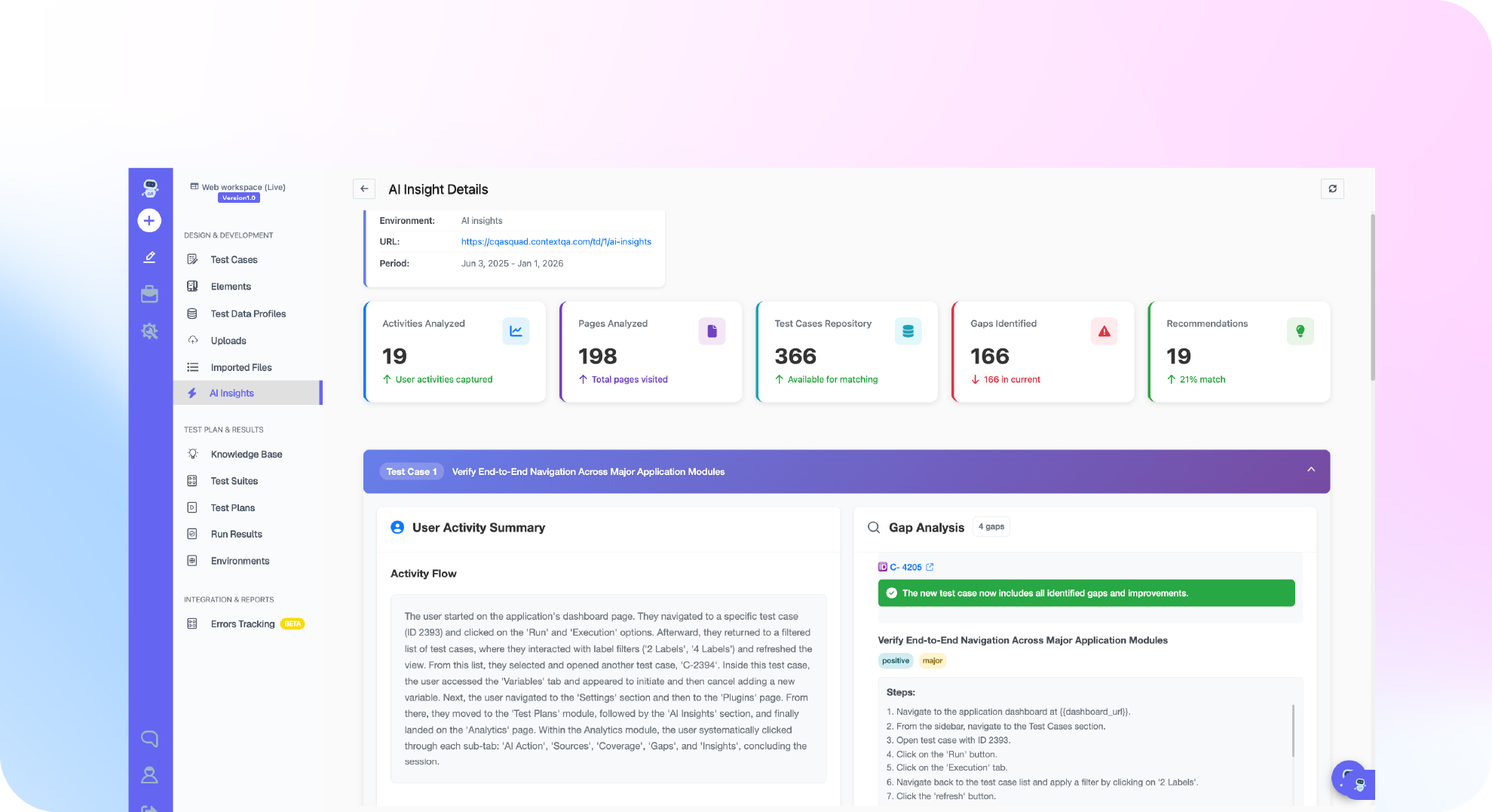
ContextQA’s ERP/SAP testing was built for exactly this scenario: AI powered automation that handles the volume and complexity of SAP regression testing without requiring specialized SAP scripting knowledge.
What Makes SAP Testing Different from Web Testing
SAP testing is not just web testing with an SAP login. The differences are fundamental, and they explain why general purpose automation tools often struggle with SAP.
| Dimension | General Web Testing | SAP Testing |
| UI framework | Standard HTML/CSS/JavaScript | SAP GUI (desktop), SAP Fiori (web), SAP Business Client |
| Element identification | Standard CSS selectors, XPath, accessibility tree | SAP control IDs, Fiori OData bindings, SAP GUI scripting objects |
| Test scope | Single application, typically 10 to 50 pages | Multiple modules (FI, CO, MM, SD, PP, HR), hundreds of transactions |
| Data dependencies | Relatively independent test data | Complex master data with referential integrity across modules |
| Business process length | Typically 3 to 10 steps | Often 20 to 50 steps spanning multiple transactions and modules |
| Change frequency | Continuous deployment (multiple times per day) | Scheduled releases (biannual for cloud, biennial for on premise) plus monthly patches |
| Failure impact | User experience degradation | Business process stoppage, financial reporting errors, compliance violations |
ContextQA handles both SAP Fiori (web based) and SAP GUI (desktop based) interfaces through its web automation engine. The AI based self healing is particularly important for SAP because SAP upgrades frequently change Fiori control IDs and app structures, breaking traditional selectors. Self healing keeps tests stable across SAP releases without manual selector maintenance.
The Six Types of SAP Testing You Need to Automate
1. SAP Regression Testing (Highest Priority)
Every SAP change (upgrade, patch, customization, transport) requires regression testing to verify that existing business processes still work. For a typical SAP implementation with 200+ active business processes, manual regression testing takes 4 to 8 weeks. Automated regression testing takes 4 to 8 hours.
ContextQA’s AI testing suite automates full end to end SAP business processes, running the complete order to cash flow (from sales order creation through delivery, billing, and payment) in a single automated test.
2. SAP Integration Testing
SAP rarely operates alone. It connects to CRM systems, ecommerce platforms, banking interfaces, warehouse management systems, and third party logistics. Each integration point is a potential failure during upgrades.
ContextQA’s API testing validates the integration layer: IDoc processing, RFC connections, OData services, and REST APIs that connect SAP to external systems.
3. SAP Data Migration Testing
Moving data from ECC to S/4HANA involves transforming data structures, mapping fields, and validating referential integrity. ContextQA’s database testing and AI data validation verify that migrated data is complete, consistent, and correctly transformed.
4. SAP Performance Testing
SAP systems must handle peak transaction volumes: month end financial closes, seasonal sales spikes, payroll runs for thousands of employees. ContextQA’s performance testing simulates these peak loads against SAP transactions to identify bottlenecks before they affect production.
5. SAP Fiori UI Testing
SAP Fiori apps are web based, but they use proprietary SAPUI5 controls that render differently from standard HTML elements. ContextQA’s visual regression catches Fiori UI regressions that functional tests miss: misaligned tiles, broken responsive layouts, icon rendering issues.
6. SAP Security and Authorization Testing
SAP role based access control is complex: hundreds of roles, thousands of authorization objects, segregation of duties requirements for SOX compliance. ContextQA’s security testing validates that authorization configurations are correctly applied after changes.
SAP Clean Core: Why It Matters for Testing
SAP’s Clean Core strategy is changing the testing landscape for every SAP customer. The idea is straightforward: keep the ERP system as close to standard SAP as possible. Move customizations to SAP Business Technology Platform (BTP) or build them through approved extensibility methods.
SAP formalized an A through D extensibility framework in August 2025:
| Level | Description | Testing Impact |
| Level A | Fully compliant, upgrade safe (standard APIs, approved extension points) | Minimal regression testing per upgrade |
| Level B | Mostly compliant (minor deviations from standard) | Moderate regression testing |
| Level C | Significant customization (custom ABAP, modified standard objects) | Extensive regression testing |
| Level D | Modifications, direct table writes | Full regression testing every upgrade. Severe upgrade risk. |
The testing implication: every SAP release is a practical test of how clean the core actually is. Organizations at Level C and D face massive regression testing workloads with each update. One SAP customer documented reducing 28,000 custom objects to under 7,000 with 85% automation before migration.
ContextQA’s ERP/SAP testing helps teams at every Clean Core level. For Level A/B: lightweight regression suites that run quickly on each release. For Level C/D: full process regression automation that validates every customization point.
How to Build an SAP Testing Automation Program
Phase 1: Process Inventory (Week 1 to 2). Document every business process that runs in SAP. Map them to modules, transactions, and business owners. Prioritize by business criticality and change frequency. Use ContextQA’s risk based testing to rank processes by impact.
Phase 2: Test Design (Week 3 to 4). For the top 20 critical processes, design end to end test scenarios. Each scenario should cover the happy path plus 2 to 3 key variations (credit holds, partial deliveries, return processing). The AI testing suite can generate test cases from process documentation.
Phase 3: Automation Build (Week 5 to 8). Build automated tests for the top 20 processes. Run them against the current system to establish baselines. Connect to your SAP transport management through all integrations.
Phase 4: Integration into Change Pipeline (Week 9 to 12). Automate test execution as part of every SAP transport release. Tests run automatically when a transport moves to the QA environment. Results feed back to the project team through AI insights.
This 12 week rollout matches ContextQA’s pilot program and delivers the 40% efficiency improvement documented in the program’s benchmarks.
Original Proof: ContextQA for Enterprise SAP Testing
The IBM ContextQA case study documents 5,000 test cases automated through AI. For SAP implementations with hundreds of business processes, this scale of automation is essential. Manual testing of 5,000 cases would take months. AI powered testing completes it in hours.
G2 verified reviews show 50% regression time reduction and 80% automation rates. For SAP teams running 4 to 8 week regression cycles, cutting that to 2 to 4 weeks translates directly to faster releases and earlier issue detection.
Deep Barot, CEO and Founder of ContextQA, designed the platform with enterprise applications specifically in mind. The Salesforce testing module demonstrates the same cross platform capability: AI powered testing that handles proprietary UI frameworks without requiring specialized scripting. The IBM Build partnership validates this approach at enterprise scale.
The ERP Market Context: Why SAP Testing Demand Is Accelerating
The global ERP market reached $66 billion in 2024 (Gartner), with cloud ERP accounting for approximately 70% and growing at 14.5% annually. SAP was named a Leader in the 2025 Gartner Magic Quadrant for Cloud ERP Finance. This matters for testing because cloud ERP means more frequent releases, automatic updates, and less control over when changes arrive.
SAP customers facilitate approximately 87% of global commerce, roughly $46 trillion in transactions annually. When SAP systems break, the business impact is not limited to internal operations. It affects supply chains, customer orders, financial reporting, and regulatory compliance.
The combination of legacy migration urgency (17,000+ customers needing to move to S/4HANA), cloud adoption acceleration (more frequent releases requiring more frequent testing), and Clean Core strategy (customization reduction requiring validation) creates a testing demand surge that manual approaches cannot address.
I have seen SAP teams with 8 to 12 people spending 6 weeks on manual regression testing for each major release. Those same teams, with automated testing through ContextQA’s ERP/SAP testing, complete regression in under a week with higher coverage. That 5 week difference per release multiplied by 2 to 4 major releases per year is the ROI case for SAP testing automation. Use the ROI calculator to model this for your specific team size and release cadence.
Limitations and Honest Tradeoffs
SAP testing automation requires SAP expertise. Even the best AI testing tool needs humans who understand SAP business processes to define what “correct” means. An automated test can verify that a sales order creates a delivery. But knowing that the delivery should trigger a specific billing plan based on the customer’s payment terms requires domain knowledge.
Legacy SAP GUI is harder to automate than Fiori. SAP GUI (the traditional desktop client) uses a proprietary scripting interface that is less flexible than web automation. Fiori apps, being web based, are significantly easier to automate with modern tools.
Custom ABAP creates testing complexity. Organizations with heavy Z code customizations face unique testing challenges because the customizations are not documented in standard SAP test catalogs. The testing team must reverse engineer business logic from custom code, which is time consuming regardless of the automation tool. I have worked with organizations that had over 28,000 custom objects in their SAP landscape. Before they could even start migration testing, they had to inventory, classify, and prioritize which customizations to keep, refactor, or retire. That classification effort alone takes months and requires deep SAP functional knowledge that most testing teams do not have in house.
Do This Now Checklist
- Count your active SAP business processes (15 min). If you do not have a documented process inventory, start by listing the top 20 processes your business depends on.
- Check your ECC support timeline (5 min). If you are on ECC 6.0 EHP 0 through 5, your mainstream support already ended. If on EHP 6 through 8, you have until December 2027.
- Measure your current regression test cycle time (10 min). Days or weeks from transport release to QA sign off. That is your baseline for improvement.
- Identify your Clean Core level (10 min). Count your custom objects (Z-code, custom tables, modified standard). Organizations above 10,000 custom objects face the highest testing burden per upgrade.
- Automate your top 5 critical processes (30 min). Start with order to cash and procure to pay using ContextQA’s ERP/SAP testing.
- Start a ContextQA pilot (15 min). Benchmark SAP regression automation over 12 weeks.
Conclusion
SAP testing automation is the difference between an SAP migration that finishes on schedule and one that runs 30% over (which is the average). With only 8% of S/4HANA migrations completing on time and “underestimated testing” as the top cited reason, automated SAP testing is not a nice to have.
ContextQA’s ERP/SAP testing, self healing, and AI powered regression automation address the scale and complexity that SAP environments demand.
Book a demo to see ContextQA running automated SAP business process tests.