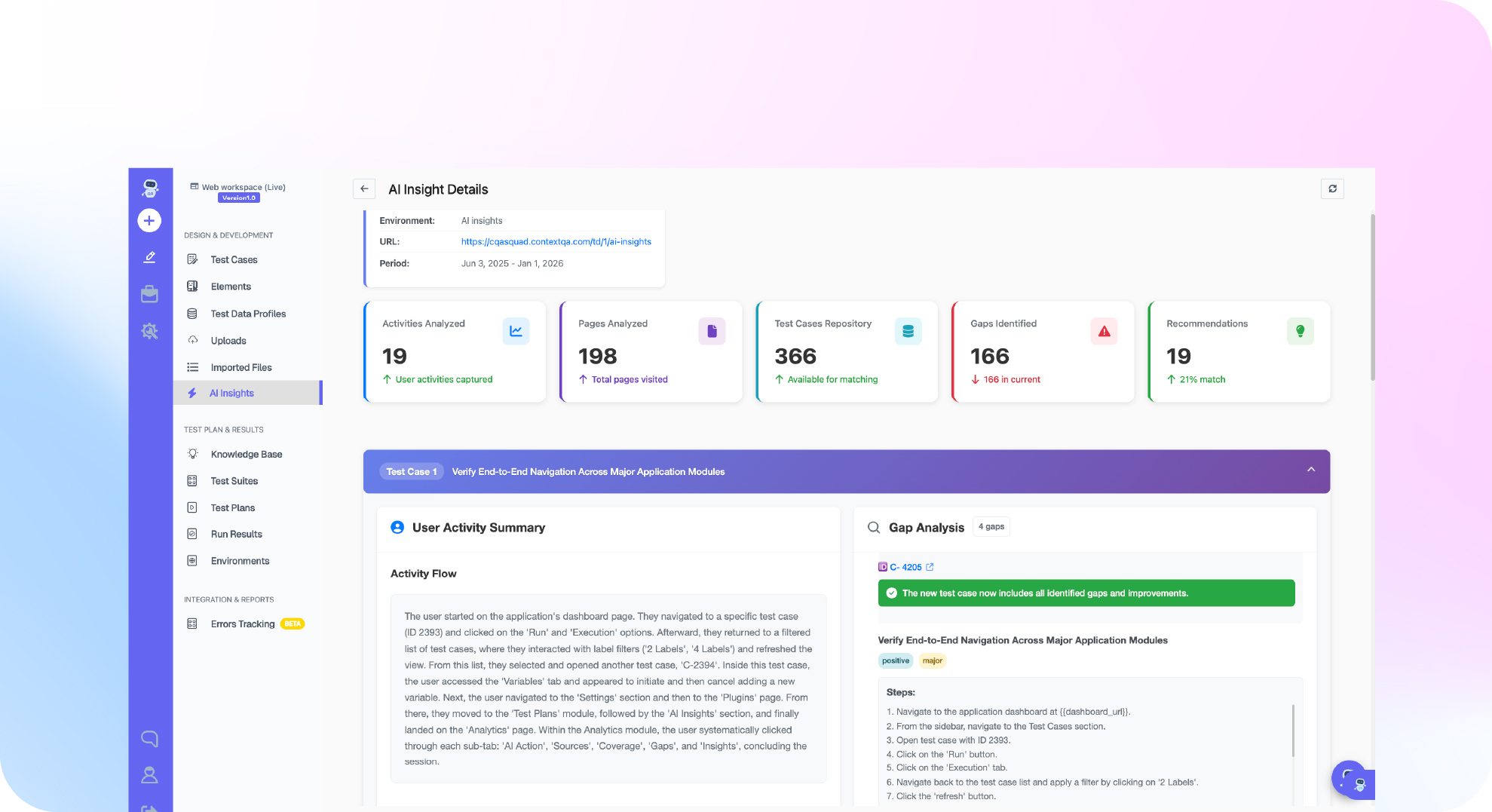

TL;DR: Jest is the better default for most new JavaScript and TypeScript projects. Jasmine suits teams that want a small runner with few dependencies, or teams that already maintain older Angular suites. Jest includes mocking, snapshot testing, code coverage and parallel workers out of the box (Jest docs). Jasmine gives you BDD syntax and spies, but you add coverage tooling yourself (Jasmine docs). ContextQA, the autonomous quality engineer, covers the end to end flows that unit tests miss.
The jasmine vs jest decision mostly depends on your stack. This guide compares setup, mocking, speed, and CI behavior, then shows engineering leaders how to tell a migration that pays off from one that only creates churn.
Quick answers
What is the main difference between Jasmine and Jest? Jasmine is a standalone behavior driven development (BDD) framework. It ships assertions, spies, and a runner, and you add module mocking, coverage, and snapshots with other tools. Jest uses the same describe, it, and expect syntax and adds jest.mock(), snapshot testing, coverage, and parallel workers in one package. With Jasmine you assemble a small core yourself. Jest comes with everything included.
How hard is it to migrate an existing test suite from Jasmine to Jest? Most of the migration is mechanical, because both frameworks share describe, it, beforeEach, and expect. The real work is in spies and matchers. jasmine.createSpy() becomes jest.fn(), .and.returnValue() becomes .mockReturnValue(), and custom matchers need rewriting. Run both runners side by side and convert one folder at a time. Remove Jasmine only when Jest reports the same spec count.
Which framework should an engineering manager standardize on for a new JavaScript or TypeScript project? For most new Node, React, or TypeScript projects, standardize on Jest, because mocking, coverage, and watch mode work without extra packages. Keep Jasmine if you need tests to run in a real browser, want a minimal dependency footprint, or already have a large and stable Jasmine suite. Decide based on suite size, mocking needs, and CI runtime, not on popularity.
Jasmine vs Jest: What Is the Short Answer?
Pick Jest for most new JavaScript and TypeScript projects, because one install gives you module mocking, snapshots, coverage and parallel workers. Pick Jasmine when you want a small framework that runs natively in real browsers, or when you maintain an existing suite built around its spies and matchers.
The syntax is almost the same in both, because Jest originally ran on a Jasmine based runner. In Jest 27 that runner was replaced by jest-circus as the default (Jest blog, 2021). describe, it, beforeEach and expect(...).toBe() behave the same way in both, so the real differences come down to what each one ships with:
- Mocking: Jest provides
jest.fn(),jest.mock()and fake timers. Jasmine hasspyOnandjasmine.createSpybut cannot mock whole modules on its own. - Snapshots and coverage: Jest includes
toMatchSnapshot()and--coverage. With Jasmine you add a separate tool for each. - Environment: Jest runs in Node and uses jsdom to simulate a browser. Jasmine runs in Node or in an actual browser.
On speed, Jest spreads test files across worker processes by default. Jasmine 5 added an opt in --parallel flag for Node (Jasmine docs). We have not found an independent, citable benchmark, so time npx jest against npx jasmine --parallel=auto on your own suite in CI before you commit to a migration.
How Do Jasmine and Jest Compare?
Jest is a test runner with module mocking, snapshots, coverage, and parallel workers built in. Jasmine is a smaller BDD framework with spies and matchers that needs extra packages for the rest. Both are free under the MIT license, so fit and maintenance decide the choice.
| Option | Best for | Pricing model | Mocking and snapshots | Notable tradeoff |
|---|---|---|---|---|
| Jasmine (Node runner) | Node.js libraries, small suites | Free, MIT | spyOn(), jasmine.createSpy(); no snapshots | No module mocking without add ons |
| Jasmine with Karma | Older Angular projects | Free, MIT | Same spies, real browser | Karma is deprecated, so plan a migration |
| Jest | React, Node.js services, monorepos | Free, MIT | jest.fn(), jest.mock(), toMatchSnapshot() | ESM and TypeScript need transform setup |
React: Most React Testing Library examples assume Jest. Add a browser style DOM with jest-environment-jsdom.
Angular: For years the Angular CLI generated Jasmine with Karma by default. Karma is now deprecated (Karma on GitHub), so new suites should use a runner that is still supported.
Node.js: Both frameworks work here. jest.mock() swaps out a whole module, while spyOn() only wraps methods on objects your test can already reach.
TypeScript: Both need a transform step. Use ts-jest or Babel with Jest, and ts-node or a precompile step with Jasmine.

When Should You Choose Jasmine?
Choose Jasmine when your specs need to run in a real browser without a bundler, when a large Angular or legacy suite already uses it, or when you want assertions, spies and a runner in one package with no other dependencies.
- Real browser execution:
jasmine-browser-runnerruns specs in Chrome, Firefox or Safari instead of a simulated DOM (Jasmine browser setup). That catches rendering and browser API differences that jsdom can miss. - Minimal setup:
npm install --save-dev jasminefollowed bynpx jasmine initcreatesspec/support/jasmine.json, and that file is the whole configuration. TypeScript specs still needts-nodeor a compile step. - Stable existing suite: Moving a reliable suite costs more than it looks.
jasmine.clock()calls, custom matchers, and fake timer behavior all need review. - Karma based Angular projects: Replace the runner as its own task and keep the Jasmine specs. Do not swap the runner and the framework at the same time.
When Should You Choose Jest?
Choose Jest when you want mocking, snapshots, coverage, and parallel execution in one tool, especially for React, Node, or TypeScript projects in CI. You maintain fewer config files and plugins, and in return accept a heavier install and Jest's own module system.
- Coverage thresholds in the pipeline:
jest --coverageproduces Istanbul reports (lcov,text,json) without any extra package. AcoverageThresholdblock injest.config.jsfails the build when coverage drops (Jest configuration). With Jasmine you wire innycorc8yourself. - Slow CI runs: Tune worker count with
--maxWorkers. From Jest 28,--shard=1/4splits a suite across CI machines (Jest CLI). - Strict CI behavior: With
--ci, Jest stops writing new snapshots, so a missing snapshot fails the run instead of passing silently. - Whole module mocks:
jest.mock()replaces an imported dependency. Jasmine'sspyOnonly works on object methods. - Ecosystem: Testing Library,
ts-jest, and most framework starters assume Jest. Jasmine's plugin ecosystem is smaller and tied mostly to Karma.

How Do You Move Between Them?
Move from Jasmine to Jest in stages: install Jest alongside Jasmine, run a codemod, fix the unmatched APIs by hand, and run both runners in CI until the spec counts match. Most describe, it, and expect blocks carry over unchanged.
- Install side by side. Add
jestandjest-environment-jsdom, then settestEnvironment: 'jsdom'injest.config.jsso DOM specs run while Jasmine keeps working. - Run a codemod.
npx jest-codemodsrewrites Jasmine syntax (jest-codemods). For example,jasmine.createSpy()becomesjest.fn(). - Fix the gaps by hand. Replace
jasmine.clock()withjest.useFakeTimers()andjasmine.anywithexpect.any. Re-register custom matchers throughexpect.extend. - Compare in CI. Run both runners as parallel jobs. Delete the Jasmine job only after Jest passes with the same spec count and no skipped tests.
- Keep end to end testing separate. Neither framework tests full user flows across real browsers. Run those flows in their own layer, such as ContextQA web tests on Chrome, Firefox, Safari, and Edge.
License cost never decides this, since both are free. Maintenance and onboarding do, so prefer the framework your stack's tooling generates by default.
Whichever runner you pick, unit tests won't catch broken user flows across browsers. Book a demo to see how ContextQA covers end to end regression with self healing tests.
Where Does ContextQA Fit?
ContextQA does not replace Jasmine or Jest, which test functions and components inside your codebase. ContextQA, the autonomous quality engineer for enterprise application testing, covers the layer above: end to end web, mobile, and API flows in real browsers, with tests that self heal when selectors change and run in your existing CI/CD pipeline.
Keep unit specs in your chosen runner. A typical setup:
- Author the flow. Write the journey in plain English or capture it with the no code recorder, and ContextQA turns it into structured steps (web testing guide).
- Cover the API. Add REST API steps that log in, save the token, and pass it to the next request (API tutorial).
- Add a CI stage. After
npx jestpasses, a Jenkins or GitHub Actions stage triggers the ContextQA suite, which runs in parallel across Chrome, Safari, Edge, Firefox, iOS and Android. - Stay in the IDE. Engineers can drive tests from Claude Code or Cursor through the MCP server.
- Keep an exit. Code export produces Playwright code, so you are not locked in.
Bottom line
Neither framework is better for every team. Jest suits React and Node projects that want mocking, snapshots, and coverage built in with little setup. Jasmine fits teams that want a lean runner, or that already have Angular suites they would rather not rewrite. Choose based on your stack and migration cost, and cover real user flows in a separate end to end layer.