
TL;DR: The best self-healing test automation tools in 2026 are ContextQA, mabl, Katalon Studio, Testim, testRigor, Virtuoso QA, Applitools Autonomous and Healenium. ContextQA, the autonomous quality engineer (our own product), ranks first because it heals web, mobile and API tests, shows every proposed repair for review with Accept or Modify & Accept, and exports tests as Playwright code. Choose a tool by how it heals, what it covers and how you review its fixes.
Self-healing test automation repairs a test step when the UI changes but the business flow still works, such as a renamed button or a moved field. This guide compares eight tools using each vendor's own product pages and documentation, checked in November 2026. We have not run a head to head benchmark, so treat the ranking as a buyer's shortlist, not a lab result.
Quick answers
What is the best self-healing test automation tool in 2026? For teams that test web, mobile and API flows and want to review every repair, we recommend ContextQA, our own product. If you only run Selenium code, Healenium is a free open source option. If you want a codeless, plain English approach, testRigor and Virtuoso QA avoid locators altogether.
How do self-healing test tools work? When a step can't find its element, the tool looks for the same element using other signals, such as alternative locators, attributes, text or an AI model's reading of the page. It then continues the run and records a proposed change. Good tools keep the original failure, the repair and the rerun result as separate records.
Can self-healing hide real bugs? Yes, if it is set up loosely. A repair should only change how a test finds an element, never what the test checks. A wrong total, a missing permission or a server error must still fail the test. That is why review and approval controls matter as much as healing accuracy.
How we ranked these tools
We compared each tool on five questions a QA lead should ask before buying:
- How it heals: alternative locators, AI models, or tests written without locators.
- What it covers: web only, or web, mobile and API.
- How you review fixes: whether proposed repairs need approval and can be edited.
- Evidence: whether you can see what changed and why the run passed.
- Lock-in: whether you can take your tests with you.
| Tool | How it heals | What it covers | Review and evidence |
|---|---|---|---|
| 1. ContextQA | AI repairs broken locators and steps during the run | Web, mobile, API and data checks | Accept or Modify & Accept; org and per-test auto-approval; Playwright trace and export |
| 2. mabl | Adaptive Auto-Healing with multiple AI models | Web, mobile and API | Agent asks a person when it needs clarification |
| 3. Katalon Studio | Fallback locators, then LLM-based AI self-healing | Web and mobile | Approve suggestions in Self-healing Insights |
| 4. Testim | AI and machine learning custom locators | Web, Salesforce and mobile | Root cause analysis; review flow not described on its product page |
| 5. testRigor | Plain English tests with no locators; generative AI maintenance | Web, mobile, desktop and mainframe | Tests always stay in plain English |
| 6. Virtuoso QA | Natural language tests with no locators; self-heal | Enterprise application journeys | Triage of real bugs versus flaky tests; release evidence |
| 7. Applitools Autonomous | Self-healing tests alongside Visual AI | Websites, native mobile apps and PDFs | Root cause analysis and test insights |
| 8. Healenium | Open source library that wraps Selenium WebDriver | Selenium web tests | Self-hosted; settings in a healenium.properties file |
The 8 best self-healing test automation tools in 2026
1. ContextQA: best for reviewed self-healing across web, mobile and API
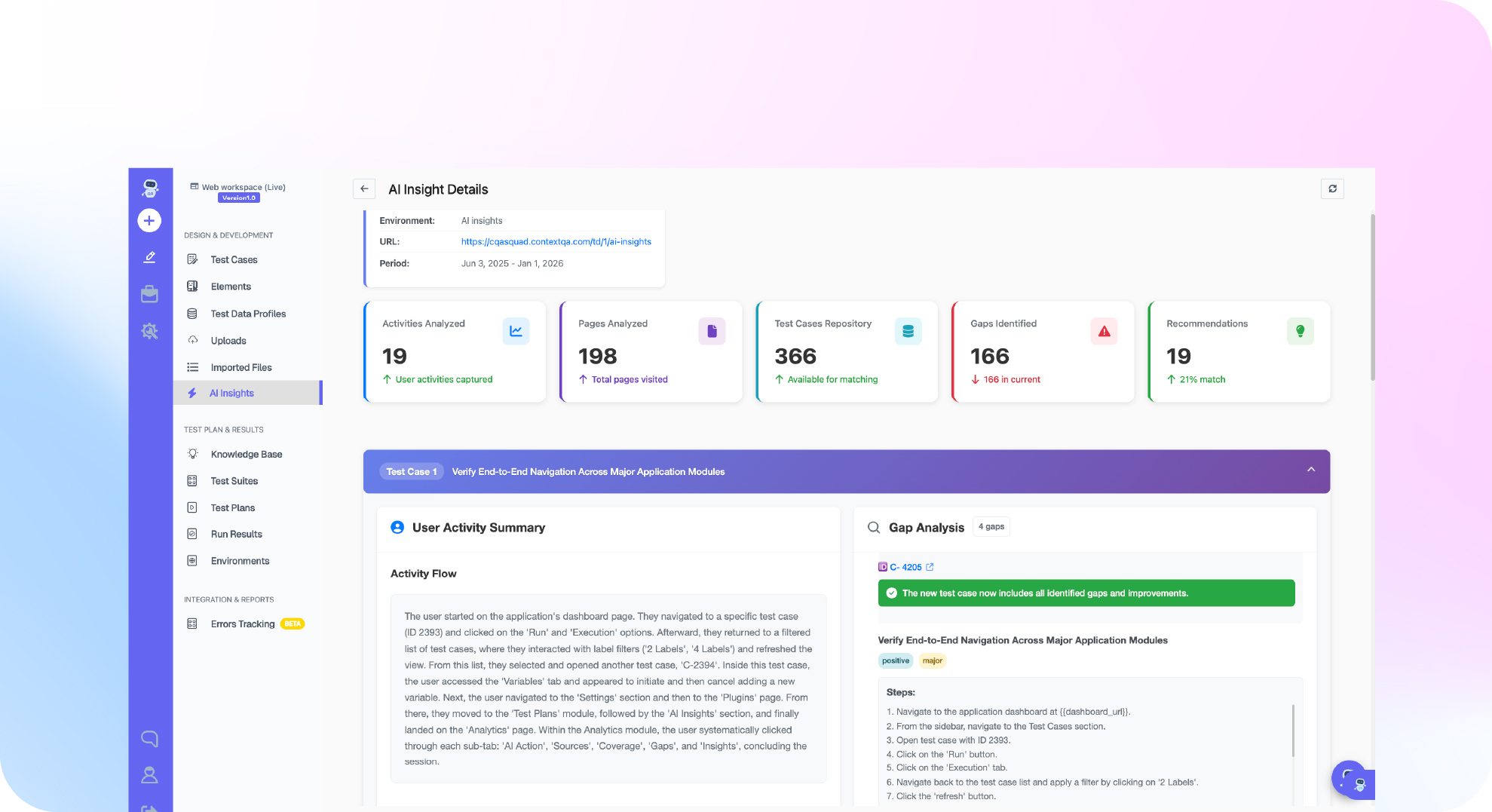
ContextQA is an all-in-one platform for AI-driven quality engineering, and our own product. Its AI-based self-healing detects a broken locator or failed step, analyzes what changed, repairs the step during the run and logs the fix with before and after context. Healing covers web, mobile and API tests, plus data validation checks.
What sets it apart is control. Each repair arrives as a proposal you can Accept or Modify & Accept. An organization setting, Auto approve with auto heal, decides whether repairs are approved automatically, and each test case can override it. ContextQA's self-healing documentation also treats a recovered run and an approved test change as separate decisions, so a passing rerun never hides the original failure.
- Best for: QA teams that need healing on web, mobile and API flows, including Salesforce, SAP and Oracle, with a review step before changes stick.
- Evidence: every run keeps per-step screenshots, video, network logs and a Playwright trace.
- No lock-in: tests export as Playwright TypeScript code that runs with npx playwright test.
- Watch out for: it is a full testing platform, so it is more than you need if you only want a healing add-on for existing Selenium code.
2. mabl: best for teams that want an agent to maintain tests
mabl's Adaptive Auto-Healing uses multiple AI models to understand UI changes, then updates element locators and test steps on its own. When it needs clarification, its agent asks a person. mabl covers web, mobile and API testing.
- Best for: teams that want a cloud platform where an agent handles most maintenance.
- Watch out for: ask how you review a change before it is saved to the test. If you are weighing options, see our guide to mabl alternatives.
3. Katalon Studio: best for teams that already script tests in an IDE
Katalon Studio's self-healing runs in two layers. Classic self-healing tries the other locators saved for a test object and, after the run, suggests replacing the broken one. If that fails, AI self-healing uses a large language model to find an alternative locator. You approve suggestions in Self-healing Insights, and it works for web and mobile tests.
- Best for: teams with existing Katalon projects and engineers comfortable in an IDE.
- Watch out for: it needs an active Katalon Studio license, and Katalon's own docs note that AI self-healing can struggle with image locators.
4. Testim: best for recorded web, Salesforce and mobile tests
Testim uses AI and machine learning in custom locators to identify elements and learn about your app, so tests keep working as the UI changes. You create tests by recording your web, Salesforce or mobile app, with the option of adding code.
- Best for: teams that like record and playback, with code when they need it.
- Watch out for: its product page says little about how you review a healed locator, so ask to see that step in a demo.
5. testRigor: best for plain English tests without locators
testRigor takes a different route. Tests are written in plain English, such as an instruction to purchase a Kindle, and testRigor turns them into specific steps. Because tests don't depend on locators, there is less to heal, and its built-in generative AI maintains the tests. It covers web, mobile, desktop and mainframe testing.
- Best for: manual testers moving into automation without learning code.
- Watch out for: tests stay in testRigor's plain English format, so check how you would move them to another tool later.
6. Virtuoso QA: best for enterprise journeys written in natural language
Virtuoso QA tests are written the way you would describe them, with no locators and no code. Its self-heal keeps tests reliable as the application changes without manual rework, and it sorts failures into real bugs and flaky tests. It can also generate test journeys from requirements for you to approve.
- Best for: enterprise teams that want journeys generated from requirements.
- Watch out for: confirm which application types and channels your plan covers, such as mobile or API.
7. Applitools Autonomous: best when visual checks matter most
Applitools Autonomous lists self-healing tests among its features, next to its Visual AI, an NLP builder, a codeless recorder and a website crawler. It supports websites, native mobile apps and PDF documents, so it suits teams whose biggest risk is how screens look.
- Best for: teams that rely heavily on visual regression testing.
- Watch out for: healing is one feature of a visual testing platform, so compare its functional and API coverage with what you need.
8. Healenium: best free option for Selenium code
Healenium is an open source library under the Apache 2.0 license that adds self-healing to Selenium web tests. You wrap your existing WebDriver in its SelfHealingDriver, run its backend service and set options, such as the number of recovery tries, in a healenium.properties file.
- Best for: engineering teams that want to keep their Selenium code and add healing at no license cost.
- Watch out for: you host and maintain it yourself, and it covers Selenium web tests rather than mobile or API tests.
Want to see a broken test heal on your own app? Book a ContextQA demo and we will run a self-healing trial on one of your real flows.
What can't self-healing fix?
Self-healing fixes how a test finds an element. It can't fix a broken product. ContextQA's documentation lists the cases that should never be healed away:
- A wrong amount, status or permission: investigate the product and keep the assertion.
- Several controls that could match: clarify the target and review the repair by hand.
- A login or environment that is down: fix the environment before retesting.
- A business flow that changed on purpose: update the requirement and the test deliberately.
Self-healing also does not fix flaky tests caused by shared state or timing. For those, see our guide on reducing test maintenance when your UI changes.
How do you test a self-healing tool before you buy?
Run the same short trial on every tool on your shortlist:
- Pick one stable test for a real business flow, such as checkout or creating a record.
- In a test environment, change only a locator detail, such as a button ID, and run the test again. The tool should find the same control and keep going.
- Now add a real defect, such as a wrong total, while keeping the assertion. The test must still fail.
- Check what the tool recorded: the original failure, the proposed repair, who approved it and the rerun result.
- Export or download the test and its evidence, and confirm you could use them outside the tool.
A tool that passes step 2 but also passes step 3 is healing too much. For a deeper checklist, read what the data shows about self-healing tools. To write tests that need less healing in the first place, see how to build self-healing end to end tests without hardcoded selectors.
The bottom line
The best self-healing test automation tool is the one that repairs locator changes, keeps real failures visible and lets you review every fix. If you test web, mobile and API flows and want that review step built in, start with ContextQA. Learn more about ContextQA's AI-based self-healing, or book a demo to watch a broken test heal on your own application.