
TL;DR: Resilient end to end tests locate elements the way users find them: by ARIA role, accessible name, label, and stable data-testid attributes, never by brittle CSS or XPath chains. In Playwright, use getByRole, getByLabel, and getByTestId inside page objects so a markup change touches one file. ContextQA, the autonomous quality engineer, records tests without hardcoded selectors. When an element drifts, it matches candidates on text, ARIA attributes, and context, then applies a reliable repair or flags it for review (docs).
Teams that build self healing end to end tests without hardcoded selectors stop losing sprint time to brittle XPath and CSS paths that break on every UI refactor. This guide shows how to replace them with role, label, and test id locators in Playwright, organize them in page objects, and use ContextQA self healing to repair element drift without masking real failures.
Quick answers
What should self healing fix in an end to end test, and what should it never fix? It should repair only element location drift, such as a renamed or moved button. It should never rewrite a failed assertion, hide a server error, or cover a deleted workflow. ContextQA heals only when a step cannot find its element (docs).
How does multi attribute matching find a changed element without a hardcoded selector? It uses several signals: visible text, ARIA role and label, input type, and context. ContextQA snapshots the DOM and screenshot, uses the step description as a semantic query, ranks equivalent candidates, and persists the healed reference (docs).
How do I roll out self healing tests without disrupting our current CI/CD process? Put three or more passing cases in a regression suite, run it manually, then schedule it with Slack alerts (tutorial). Self healing is on by default, and tests export to Playwright code (code export).
What does it mean to build self healing end to end tests without hardcoded selectors, and when do you need it?
Building self healing end to end tests without hardcoded selectors means locating elements by role, label, or test id instead of brittle CSS or XPath paths. These tests survive routine UI changes and fail only on genuine defects. You need them when selector maintenance consumes more release time than catching real regressions.
How to write tests without hardcoded selectors. In Playwright, target what users and assistive technology see (Playwright locators docs):
await page.getByRole('button', { name: 'Sign in' }).click();
await page.getByLabel('Email').fill('qa@example.com');
await page.getByTestId('checkout-submit').click();
Avoid locators like div.form > button:nth-child(2), which break on any layout change.
What self healing adds. In ContextQA, self healing activates when a step cannot find its element. It then applies a reliable repair or records a suggestion for review, and it does not rewrite failed assertions or mask server errors (ContextQA self healing docs).
What do you need before you start?
You need four things: an environment you can test safely, a locator convention your team agrees on, a small set of passing tests, and a runner. In practice, that means a staging target, a disposable account with known seed data, your existing Playwright setup, and a ContextQA workspace pointing at your base URL.
- Safe test environment: An approved staging app, an isolated account, seed data, and cleanup that runs even when assertions fail. Keep your repository's Playwright version and lockfile (ContextQA docs).
- Locator contract: Use accessible roles and labels first. Add
data-testidonly where no stable accessible name exists. Playwright locators created withgetByRole,getByLabel, andgetByTestIdauto wait and retry when an action or web first assertion runs on them (Playwright best practices). - Passing baseline: At least three cases that pass individually, so your first failure is a real regression (tutorial).
- ContextQA workspace: Self healing is on by default and needs no configuration (self healing docs).

How do you build self healing end to end tests without hardcoded selectors, step by step?
Locate elements by role, accessible name, label, or a stable data-testid, wrap those locators in page objects, and add a healing layer that recovers from UI drift at runtime. Healing must repair locators only, never assertions, so real product failures still fail the build and reach the engineer who owns the change.
- Add
data-testidattributes where an element has no stable accessible name, and enforce them in code review. - Write locators from user facing attributes inside page objects:
import { Page } from '@playwright/test';
export class LoginPage {
constructor(private page: Page) {}
email = () => this.page.getByLabel('Email');
submit = () => this.page.getByRole('button', { name: 'Sign in' });
}
- Assert business outcomes, such as
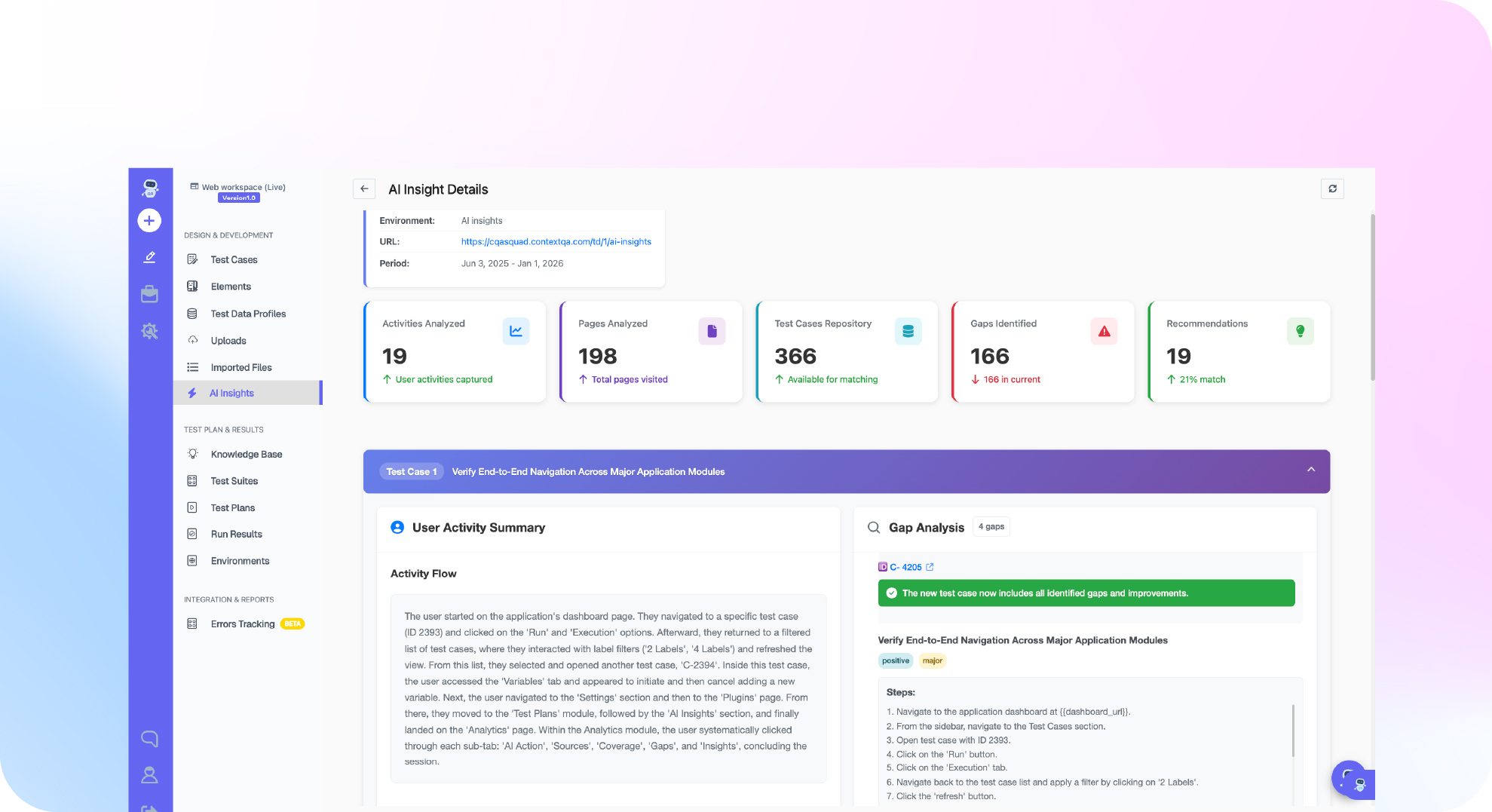
await expect(page).toHaveURL(/dashboard/), rather than the click sequence. - Add runtime healing. When an element is missing, the ContextQA self healing agent captures a DOM snapshot and a screenshot, ranks candidates by visible text, ARIA labels and roles, and input type, and either applies a reliable repair or records a suggestion.
- Run the suite from CI and review every healed step before merging.
What are the most common mistakes people make?
The most common mistakes are hardcoding brittle CSS or XPath selectors, treating self healing as a fix for real product failures, using fixed sleeps that cause flaky runs, and never reviewing healed steps. Each one raises maintenance cost in CI/CD because engineers spend release time repairing tests instead of catching regressions.
- Brittle selectors: Chains like
div.form > button:nth-child(2)break on any layout change. UsegetByRole,getByLabel, andgetByTestIdso locators follow user visible meaning. - Healing as a mask: ContextQA self healing repairs element location drift only. It does not correct failed assertions, server errors, or deleted workflows (self healing docs).
- Fixed sleeps:
page.waitForTimeout(3000)passes locally and flakes under CI load. Use web first assertions such asexpect(locator).toBeVisible(). - Unreviewed heals: Repairs nobody reviews pile up quietly. Check healed references and suggestions after each regression run.
- Unmeasured ROI: Track hours spent fixing selectors per sprint, before and after adoption, instead of relying on vendor estimates.
How do you know it is working?
Self healing is working when locator drift stops failing builds but real defects still do. Track three numbers per run: steps healed, heals applied versus left as suggestions, and failures that remain assertion or server errors. If healed steps rise while genuine failures drop to zero, review the heals before trusting a green build.
Establish a flakiness baseline first. Google reported that about 1.5% of all test runs produced a flaky result and almost 16% of tests showed some flakiness (Google Testing Blog, 2016). Measure your own rate before migrating so you can prove any improvement.
Govern every heal. A heal onto the wrong element can let a test pass while a real defect exists, so the bug goes undetected, or it can fail a good build. ContextQA applies only sufficiently reliable repairs and records the rest as suggestions (self healing docs). Assign a named owner to review suggestions weekly, and use execution evidence to see whether the original or a healed element produced each result.
Migrate in stages. Start with critical journeys that already pass. Rebuild them with role and label locators or the no code recorder, then run both suites in parallel until results match.
How does ContextQA automate self healing tests without hardcoded selectors?
ContextQA describes each step by intent, such as "Click the Sign In button," rather than a hardcoded selector, then heals locator drift at run time. When an element is missing, its agent snapshots the DOM and screenshot, searches by visible text, ARIA labels and roles, and applies or suggests a repair. It is on by default.
The model handles element location, while assertions stay under your control. A typical workflow:
- Author without selectors. Record the flow with the no code recorder, or describe the journey from Claude Code, Cursor or Codex through the MCP server and review the generated steps.
- Build a baseline. Click Test Development, open Test Suites, click + Create Test Suite, and add passing cases (tutorial).
- Run from CI/CD. Trigger the plan from Jenkins or GitHub Actions.
- Audit heals. Execution evidence shows whether the original step or a healed element produced the result. Failed assertions still fail (docs).
- Keep an exit. Export to Playwright when you need the tests as code.
If UI changes keep breaking your end to end tests, see how ContextQA records and self heals tests without hardcoded selectors: explore AI based self healing or book a demo.

What should you do right now?
Start by auditing your selectors. Replace brittle CSS and XPath with role, label, and test id locators, then centralize them in page objects. After that, let an AI test automation platform such as ContextQA repair the locator drift that remains, while failed assertions, server errors, and broken workflows still fail loudly.
- Run
grep -rnE "xpath=|//[a-z*]|nth-child" tests/ | wc -lfor a rough count of lines that may contain brittle selectors, then review the matches by hand, since the pattern can also catch URLs and comments. - Rewrite them with
getByRole,getByLabel, andgetByTestId, addingdata-testidwhere no stable accessible name exists. - Move locators into page objects so one UI change means one edit.
- Replace
waitForTimeoutcalls with web first assertions such astoBeVisible. - Record one critical journey with the ContextQA no code recorder.
- Add passing tests to a suite and schedule a nightly plan with Slack alerts.
- Export the suite to Playwright to confirm you are not locked in.
Bottom line
Self healing end to end tests start with locators built from roles, labels, and test ids, wrapped in page objects so a UI change means one edit. ContextQA adds a second layer: its AI self healing repairs drifted locators while failed assertions still fail. On Monday, audit your flakiest suite for brittle selectors, then read how AI based self healing works.
Sources
These are the primary sources behind the statistics and product behavior described above. Product claims about ContextQA link to its own documentation, and locator guidance links to the official Playwright documentation, so you can verify each statement against the original page.