
TL;DR: TDD (test driven development) is a developer practice. You write a failing unit test, write just enough code to pass it, then refactor. BDD (behavior driven development) builds on TDD by describing expected behavior as plain language Given, When, Then scenarios. Product, QA, and engineering agree on those scenarios before coding starts. TDD shapes code design and BDD aligns teams on acceptance criteria, so teams can use both. ContextQA, the autonomous quality engineer, turns plain English scenarios into executable tests.
The TDD vs BDD question usually comes up when a test suite grows faster than the team's confidence in releases. This guide covers what each practice costs, what it catches, where it fits in a CI/CD pipeline, and how to choose without rewriting your process.
Quick answers
Which is better for a team with a large legacy codebase, TDD or BDD? On a legacy codebase, start with BDD style acceptance scenarios on the business critical flows, then add TDD for each module you refactor. Legacy code usually has no unit seams, so writing unit tests first stalls until you extract dependencies. Scenarios written against observable behavior give you a regression safety net before you start moving code.
Does BDD slow down delivery compared to TDD? BDD adds upfront time for product, QA, and developers to agree on scenarios. TDD adds time inside the developer loop but needs no extra meetings. Whether BDD speeds you up depends on how much of your rework comes from misunderstood requirements. If little of it does, the collaboration is overhead. If much of it does, the scenarios usually pay for themselves.
Who owns the tests in TDD versus BDD? In TDD, developers own the tests, because each test is written right before the code it drives and lives next to that code. In BDD, ownership is shared: product owners define behavior, QA refines edge cases, and developers or SDETs automate the step definitions. Assign that ownership on purpose, because unmaintained scenarios become a stale second spec and a source of flaky CI runs.
TDD vs BDD: what is the short answer?
TDD means writing a failing unit test before the code that passes it. BDD means agreeing on behavior as plain language scenarios before building. TDD shapes code design at the developer level. BDD aligns product, QA, and engineering on requirements. The two practices work together rather than compete, and the real decision is where each one belongs.
The main differences are who writes the tests and how detailed they are. Developers write TDD tests as code in a unit framework, and those tests run in milliseconds. BDD scenarios use Given, When, Then steps in .feature files that a product owner can read, and they usually run as slower integration or end to end tests in CI.
- TDD pros: fast feedback, smaller modules, and a regression safety net at the unit layer.
- TDD cons: it cannot confirm the feature matches what the customer asked for, and tests tied to the implementation break during refactors.
- BDD pros: a shared vocabulary, acceptance criteria you can run as tests, and living documentation.
- BDD cons: the step definition code that connects scenarios to the app needs owners. If product never reads the scenarios, they turn into long test scripts.
Use TDD where complex logic is the risk. Use BDD where misread requirements are the costly failure.
How do TDD and BDD compare?
TDD and BDD differ in who writes the test and what it proves. In TDD, a developer writes a failing unit test first, which proves a function behaves correctly. In BDD, product, QA, and engineering agree on Given, When, Then scenarios in plain language, which prove a feature delivers the agreed business behavior.
| Practice | Best for | Test artifact | Written by | Main tradeoff |
|---|---|---|---|---|
| TDD | Logic, algorithms, APIs | Unit tests in code | Developers | Tests the code, not the requirement |
| BDD | User facing features | Gherkin .feature files | Product, QA, developers | Step definitions need ongoing upkeep |
| ATDD | Acceptance criteria per story | Acceptance tests | Whole team | Planning cost before every story |
Here is one discount rule written both ways. As a BDD scenario in checkout.feature, it reads: Given a cart totaling $100, When the shopper applies code SAVE10, Then the total is $90. As a TDD unit test, it becomes test_apply_discount_rejects_expired_code(), which asserts that apply_discount() raises a ValueError for an expired code.
The two also run at different pipeline stages. TDD unit tests run on every commit and finish in seconds. BDD scenarios drive a browser or API, so they fit better at pull request merge or in a nightly regression stage.
When should you choose TDD?
Choose TDD when the developers writing the code also decide what correct behavior is. The red, green, refactor cycle (Martin Fowler, 2023) fits libraries, APIs, algorithms, and backend services, where requirements are technical, feedback has to arrive in seconds, and no product owner needs to read the tests.
TDD usually wins in these situations:
- Logic heavy code. Pricing rules, parsers, data transforms, and state machines have many edge cases. Unit tests cover them faster than Gherkin scenarios can describe them.
- Fast feedback loops. A unit suite runs in the IDE and on every commit, so a regression fails the build before code review instead of after merge.
- Design pressure. Writing the test first pushes you toward small interfaces and injectable dependencies, and that code stays cheap to change.
- Small technical teams. If no business stakeholder will read scenarios, a Gherkin layer adds upkeep without creating shared understanding.
The tradeoff: TDD proves the code does what developers intended, not what users asked for. Add end to end checks on your critical flows.
When should you choose BDD?
Choose BDD when your hardest problem is agreeing on what the software should do, not how the code is built. Introduced by Dan North as an evolution of TDD (North, 2006), BDD gives product owners, QA, and developers one readable spec, and the same scenarios run as acceptance tests in CI.
BDD is worth the extra work in these situations:
- Requirements keep getting misread. In a "three amigos" session, a product owner, a developer, and a tester turn each story into concrete examples. Ambiguity surfaces in planning, not in a failed regression run.
- Non coders must review coverage.
.featurefiles read as plain English, so a product owner can approve scenarios without opening test code. - Behavior crosses layers. Checkout, onboarding, and approval workflows touch the UI, APIs, and data. Unit tests alone miss the gaps between those layers.
- Auditors trace acceptance criteria. Each scenario maps to a ticket, so tests double as current documentation.
- You are also weighing ATDD. ATDD (acceptance test driven development) writes customer acceptance tests before the code. BDD builds on it with a structured shared language and a focus on examples.
Skip BDD if only developers read your tests. The step definition glue then becomes upkeep that nobody benefits from.
How do you move between them?
Move between TDD and BDD one feature at a time instead of rewriting your suite. Keep your existing unit tests as the TDD base. Add Gherkin scenarios only for flows where product owners need to read and approve behavior. Teams can run both layers, each at its own pipeline stage.
- Pick one pilot flow. Choose a flow where requirements often cause disputes, such as checkout or signup. That is where shared scenarios are most likely to reduce rework.
- Write scenarios before code. The product owner, developer, and tester agree on a few scenarios in a
.featurefile before the first commit. The developer then works test first underneath them. - Draft with AI, review by hand. AI assistants can draft Gherkin from a ticket's acceptance criteria, but a domain expert still has to add the edge cases the ticket leaves out. ContextQA can generate end to end tests from plain English and export them to Playwright, so that layer stays in your repo.
- Measure the pilot. Compare rework hours and escaped defects against a similar feature before rolling out further.
- Run both layers in CI. Run unit tests on every commit and scenarios on every pull request in Jenkins or GitHub Actions.
If your team is stuck choosing between TDD and BDD while tests drift from real behavior, book a demo to see ContextQA turn plain English scenarios into self healing tests.

Where does ContextQA fit in?
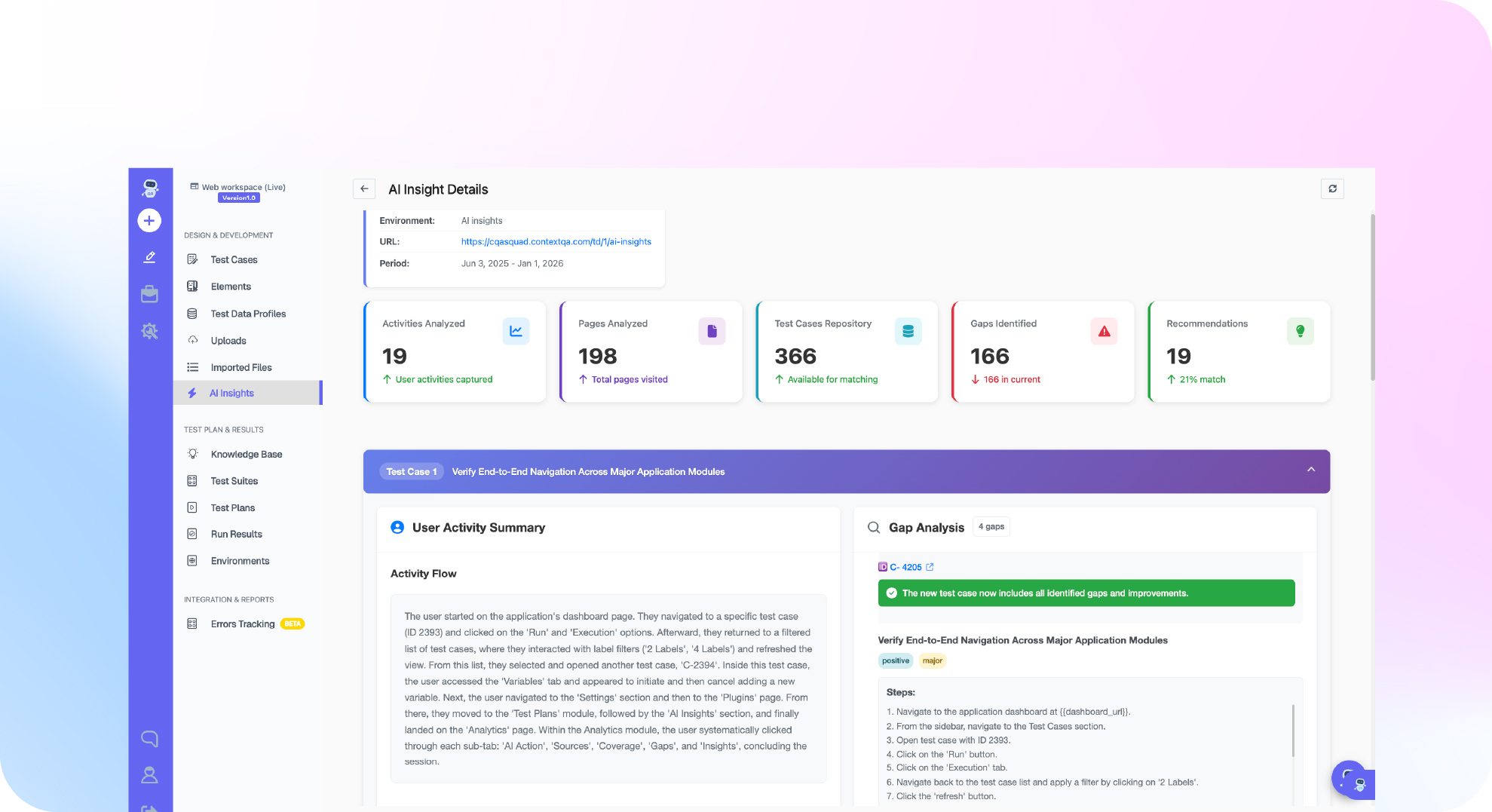
ContextQA does not replace TDD or BDD. It covers the layer above unit tests: the acceptance and end to end checks that BDD scenarios describe. Your team states expected behavior in plain English, or points ContextQA at a ticket, Figma file, or Swagger spec. ContextQA generates the tests, runs them, and repairs selectors when the UI changes.
A typical workflow:
- Developers keep writing red, green, refactor unit tests in their own framework.
- For each user story, a tester or product owner describes the behavior in plain English or captures it with the no code recorder. This is the shared authoring BDD aims for. See the web testing overview.
- For API acceptance criteria, chain the steps: authenticate, capture the token, call a protected endpoint, and check the status code and payload. The API tutorial walks through it.
- Run the suite from Jenkins or GitHub Actions in parallel across Chrome, Safari, Edge, and Firefox, or trigger it from Claude Code or Cursor through the MCP server.
- If you want the tests as code in your repo, export them to Playwright.
TDD vs FDD: FDD (feature driven development) plans delivery around client valued features. Generating tests from each feature ticket fits that rhythm.
TDD vs BDD vs DDD: DDD (domain driven design) models the business domain and is not a testing method. Its shared vocabulary should appear in your BDD scenarios and plain English tests.
Bottom line
TDD vs BDD is not a choice between rival practices. It is a decision about where each one belongs. Use TDD where complex logic is the risk: write failing unit tests first and run them on every commit. Use BDD where misread requirements cause rework: agree on Given, When, Then scenarios before coding and run them at merge. Add scenarios one feature at a time, and give each scenario a named owner.
Sources
These are the primary sources for the two practices compared above: Martin Fowler's description of the red, green, refactor cycle, and Dan North's original article that introduced behavior driven development as an evolution of TDD.