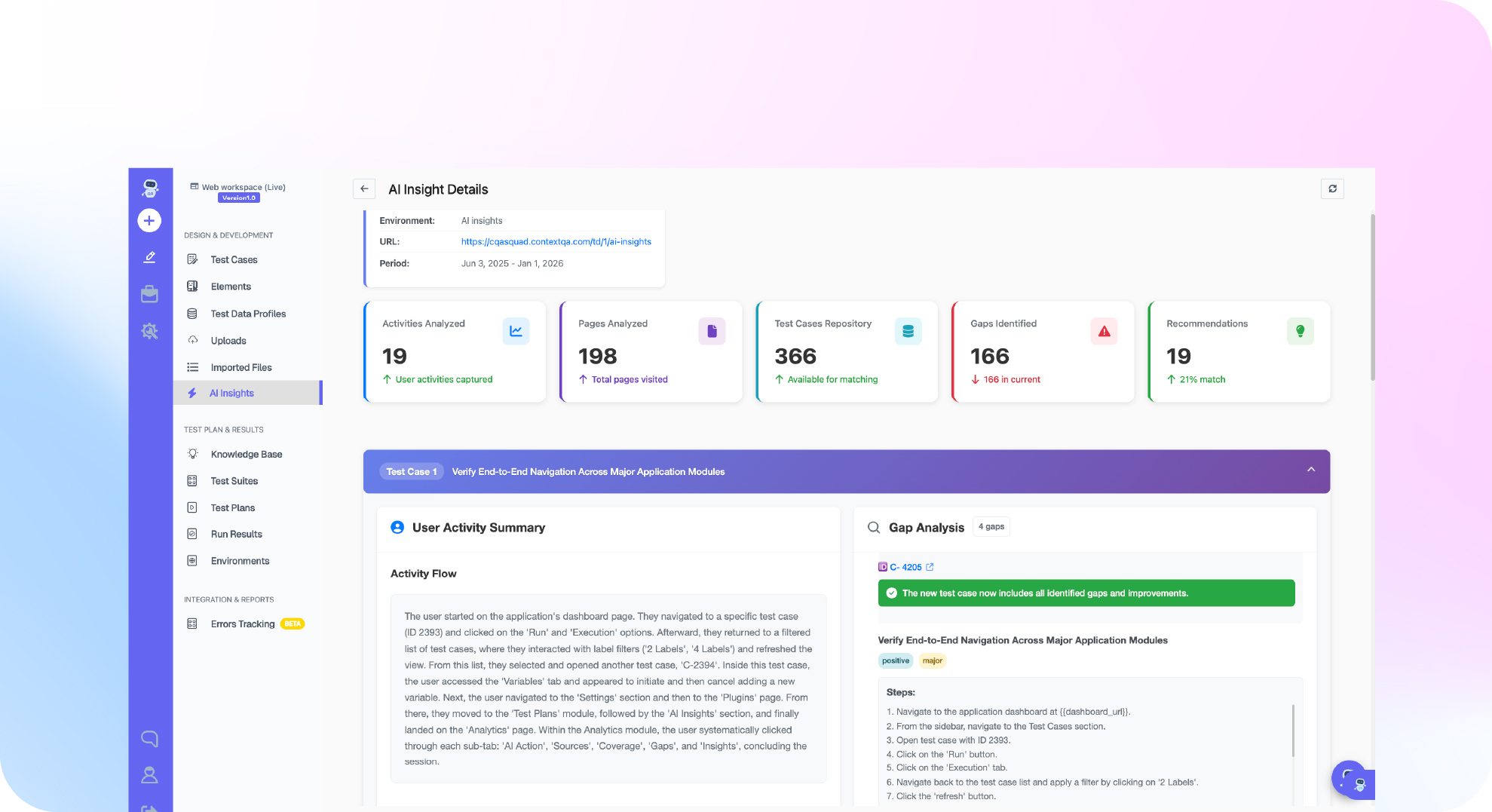

TL;DR: Most UI test maintenance comes from four sources: brittle selectors, hard coded waits, stale test data, and layout shifts. To reduce it, anchor locators to stable contracts such as accessible roles, labels and test IDs. Replace fixed sleeps with condition based waits, and isolate test data per run. Let self healing repair renamed or moved selectors, route every heal through review, and fail outright when behavior, text or permissions change. ContextQA, the autonomous quality engineer, applies self healing to broken locators.
If you want to reduce automated test maintenance when UI changes, first find where the hours go. This guide covers locator strategy, a before and after selector change, reviewed self healing, and the failures that should stop a release instead of being healed.
Quick answers
Where does test maintenance time actually go when the UI changes? Four areas: selectors pointing at renamed or moved elements, waits that break when render timing shifts, test data that no longer matches new fields or validation rules, and layout shifts that move click targets. Selector breakage is usually the most repetitive, because one changed component fails every test that touches it.
What kind of UI test failure should fail the build instead of being self healed? Fail rather than heal when the change could be a real defect: a removed form field, a button relabeled from "Delete" to "Archive", a control visible to the wrong role, or error text whose meaning changed. Self healing is for cosmetic locator drift, such as a new CSS class or a moved DOM node.
What is a concrete before and after example of a resilient locator change? Before: div.form > div:nth-child(3) > button.btn-primary breaks when a designer adds a wrapper or renames a class. After: getByRole('button', { name: 'Sign In' }) or [data-testid="login-submit"] targets what the element is, not where it sits. In ContextQA, the step reads "Click the Sign In button" and the AI identifies the element.
What does it mean to reduce automated test maintenance when UI changes, and when do you need it?
It means cutting the hours your team spends repairing tests that fail because the interface moved, not because the product broke. The work targets brittle selectors, hard coded waits, stale test data, and layout assumptions. You need it when red builds stop signaling regressions and engineers start rerunning or skipping suites to get a merge through.
UI tests break because they bind to implementation details: an XPath like //div[3]/button[2], a generated class such as .css-1x9f2k, or a sleep(2000) tuned to last quarter's render time. A redesign wraps the button in a new container, and the locator points at nothing while checkout still works.
Maintainable suites follow a few habits:
- Locate by intent: use role, label, visible text, or a stable
data-testid, never DOM position. - Wait on state, not time: wait for an element to be visible or a request to finish.
- Isolate test data: seed data per run so tests never depend on leftovers.
- Assert outcomes: check what the user sees, not markup structure.
ContextQA applies the first habit by default: testers write plain English steps and the AI identifies elements (For Testers).
What do you need before you start?
You need three things before cutting maintenance: a list of which tests broke during recent UI changes and why, a locator policy your developers agree to, such as stable data-testid attributes or accessible roles, and a test structure that keeps selectors in one place. Without these, self healing can quietly hide real defects.
- Role based locators (`getByRole`, `getByLabel`): These survive CSS and DOM restructuring. They fail when an accessible name changes, which is often a real defect.
- `data-testid` attributes: Stable through copy and layout changes, but they need developer buy in and a lint rule so nobody removes them.
- Page Object Model: One class per page means one UI change requires one edit. Classes grow large when components are shared.
- Plain English steps in ContextQA: A step like "Click the Sign In button" carries no selector (For Testers).
Bottom line: choose one locator policy and one place for selectors before you turn on self healing.

How do you reduce automated test maintenance when UI changes, step by step?
Anchor locators to user facing intent instead of page layout, replace fixed waits with state checks, move test data out of scripts, and let self healing repair broken selectors. Review every repair like a code change, and define in writing which UI changes must fail rather than heal, so real regressions stay visible in every run.
- Replace layout selectors with role and label locators.
// Before: breaks when a wrapper div is added
await page.locator('#app > div:nth-child(3) > button.btn-primary').click();
// After: survives layout shifts
await page.getByRole('button', { name: 'Sign In' }).click();
await expect(page.getByText('Welcome back')).toBeVisible();
- Remove `waitForTimeout` calls. Use assertions that retry until the element reaches the expected state.
- Parameterize data. In ContextQA, reference
{{username}}in a step and upload a CSV. Each row runs as a separate execution (For Testers). - Enable [AI based self healing](https://contextqa.com/platform/ai-based-self-healing/) and review each heal. Treat a repaired locator like a pull request.
- Make some changes fail instead of heal. A missing button, changed error copy, or a denied permission should fail the test.
When you evaluate self healing tools, confirm that heals are logged where reviewers can see them, and that tests export to Playwright so you can leave without rewriting the suite.
What are the most common mistakes?
The most common mistakes are blaming the framework, locating elements by DOM position, accepting every self healed repair without review, relying on fixed waits, and asserting on pixels when behavior is what matters. Each one turns a routine UI change into a red build that someone has to triage by hand during the sprint.
- Blaming the framework: Switching runners rarely cuts maintenance by itself. Brittle selectors and shared test data break the same way everywhere.
- Positional selectors:
//div[3]/button[2]breaks when one wrapperdivappears.getByRole('button', { name: 'Place order' })survives it. - Unreviewed healing: A missing price or a "Delete" button relabeled "Archive" should still fail.
- Fixed sleeps:
waitForTimeout(5000)hides slow responses until CI load changes. - All visual or all DOM: Use DOM assertions for text, state and values, and visual snapshots for a few high value screens.
Bottom line: most maintenance comes from how tests locate elements and what they assert, not from which runner executes them.
How do you know it is working?
It is working when UI changes stop creating repair work: fewer selector fixes per sprint, a falling flaky test count, and every healed locator reviewed instead of silently accepted. Track maintenance hours, healing events, and failure causes for four to six sprints, then compare them against a baseline recorded before you changed anything.
Flakiness is the noise you are trying to remove. Google reported that about 16% of its tests showed some flakiness and about 1.5% of all test runs returned a flaky result (Google Testing Blog, 2016).
The Engineering Manager docs list the ContextQA metrics to watch:
- Self healing rate: how much manual repair the AI absorbed. Audit a sample of heals every sprint.
- Flaky test count: this should fall as fixed waits and brittle selectors leave the suite.
- Test execution time: shows whether the suite stays fast enough to run on every PR.
To estimate cost, use repair_hours_per_sprint × loaded_hourly_rate. Return is the drop in that figure minus license cost and review time. If a UI test breaks on a validation rule, move that assertion into an API or component test.
How can you use ContextQA to reduce automated test maintenance when UI changes?
ContextQA cuts UI driven maintenance in three places. Testers write plain English steps or record a flow instead of hand coding selectors. AI based self healing repairs broken locators when the UI changes. A test plan runs from your CI/CD pipeline as a merge check, so layout drift surfaces on the pull request, not after release.
- Author without selectors. In Test Cases → New Test Case, enter a starting URL and write steps such as
Click the "Sign In" button. The AI identifies the element (For Testers). - Let healing absorb locator churn. AI based self healing repairs broken locators. Watch the Self healing rate metric to see how much repair work it absorbs (For Engineering Managers).
- Check design system changes in CI. Have the pipeline start a small plan, keep the returned run ID, check its status with a bounded timeout, and stop on every non success result. Validate the pass, failure, timeout, and expired token paths first, and reserve full regression plans for release.
- Update tests beside the component diff. Connect ContextQA MCP in Cursor and review the created test before running it. Use Playwright export if you want the code in your repository.
If UI changes keep breaking your selectors and eating sprint time, book a demo to see how ContextQA self heals broken locators.

What should be on your do this now checklist?
Start by measuring where maintenance time goes: selectors, waits, test data, or layout shifts. Then fix your locator strategy, enable self healing with human review, write down which UI changes must fail instead of heal, and run a small plan on pull requests. Together these cut repair work without hiding real regressions from reviewers.
- Tag last sprint's broken tests by cause: selector, wait, test data, or layout shift.
- Replace positional XPath like
//div[3]/buttonwithgetByRole('button', { name: 'Sign In' }). - Replace fixed sleeps with waits on a visible state or network response.
- Turn on AI based self healing and review each healed locator.
- Write a must fail list: removed buttons, changed error text, wrong totals, and permission leaks.
- Track self healing rate and flaky test count (For Engineering Managers).
- Confirm Playwright export works so healed tests stay portable.
Bottom line
UI changes do not have to mean a sprint of broken selectors. Start with the four sources of maintenance: brittle locators, hard coded waits, stale test data, and layout shifts.
- Locators: anchor them to roles, labels, and stable test IDs.
- Self healing: let self healing test automation repair locator drift, and review every heal.
- Real failures: keep business assertions strict, so a regression fails instead of being healed.
If your suite already costs more to maintain than it protects, decide whether to fix or rebuild legacy test automation.
Sources
The external statistic comes from the primary source below. ContextQA product steps link inline to the relevant pages on learning.contextqa.com and contextqa.com.