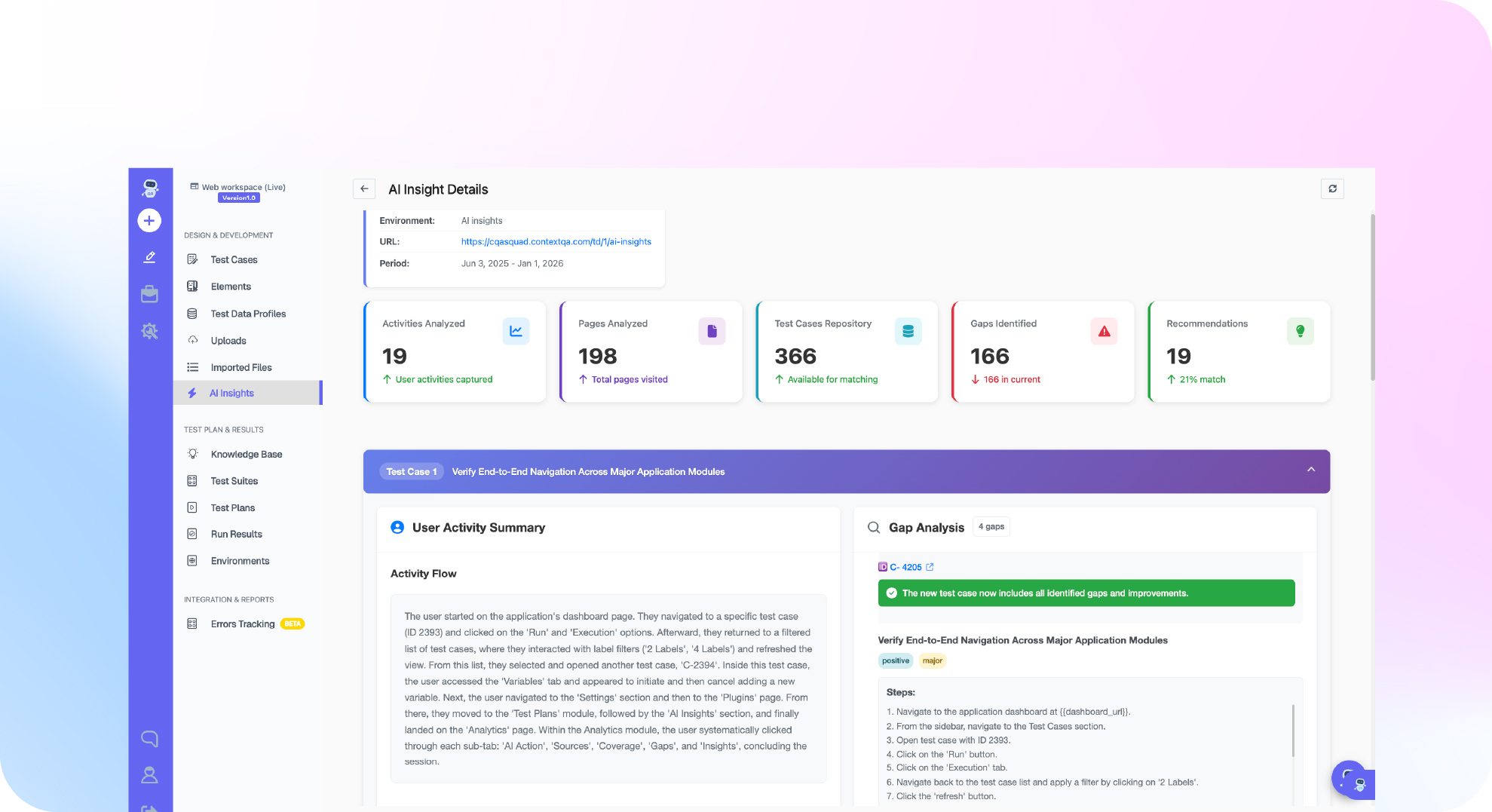

TL;DR: A test automation engineer designs, builds, and maintains the automated tests that run in a CI/CD pipeline. These tests cover UI, API, and regression checks, so teams can release without long manual test cycles. Daily work includes writing test scripts, fixing flaky tests, keeping selectors working when the UI changes, and reporting failures with enough evidence for developers to act. The US Bureau of Labor Statistics tracks this work under software developers, quality assurance analysts, and testers. ContextQA Ship, the autonomous quality engineer, tests every pull request before merge and reproduces reported bugs.
If you work as a test automation engineer, you probably spend more time triaging flaky failures and reproducing vague bug reports than writing new coverage. This guide shows how Ship, the autonomous quality engineer from ContextQA, tests every pull request with impact analysis and targeted regressions before merge. It also shows how Ship reproduces bugs reported in Jira, Linear, or Slack and gives engineers root cause evidence.
Quick answers
What does a test automation engineer actually do day to day on a product team? They write and maintain automated tests that run in CI/CD on every pull request. Then they triage failures, fix flaky tests, and update selectors after UI changes. Ship takes over the repetitive part by running impact analysis and targeted regressions on each pull request.
Should a small SaaS team hire a QA automation specialist or adopt an autonomous quality engineer first? Start with the repetitive work. If most QA time goes to rerunning regressions and reproducing bug reports, Ship covers that without a new hire, and you can start free with no credit card. Hire a person once you need someone to own test strategy and release decisions.
How do automation engineers handle bug reports that developers cannot reproduce? By hand, they rebuild the steps, capture logs and environment details, and narrow down which change caused the defect. Ship automates this for bugs reported in Jira, Linear, Slack, or a service desk. It reproduces the issue, finds the likely root cause, and hands over the evidence.
Automation Engineer vs. Autonomous Quality Engineer: What Is the Short Answer?
An automation engineer writes and maintains the code that tests an application on every build, so nobody clicks through it by hand. The role still matters in 2026, but the hours are shifting. An autonomous quality engineer such as Ship now handles routine pull request testing and bug reproduction, which leaves people free to own design and coverage.
In 2026, the core skills are:
- One language used in production, such as TypeScript, Python, or Java.
- A browser framework such as Playwright.
- Pipeline config such as
.github/workflows/test.ymlor aJenkinsfile. - Locator strategy and API testing.
- Triaging flaky tests, meaning tests that pass and fail on the same code.
- Reviewing AI generated tests before they join the suite.
How the three roles differ:
- Automation engineer: owns the framework, the suites, and the CI runs.
- SDET (software development engineer in test): builds test harnesses, mocks, and testability hooks inside the product codebase.
- QA engineer: owns risk analysis, exploratory testing, and release sign off, with or without writing code.
Ship uses impact analysis to pick and run targeted regressions on every pull request before merge. It also reproduces reported bugs and shows the likely root cause with evidence. That gives your engineers more time for framework design and less time rerunning failed jobs.
How Do an In House Engineer, an Agency, and Ship Compare?
A full time hire gives you expertise you own and deep product context, but it costs a salary and a long hiring cycle. An outsourced agency adds capacity quickly and bills for every hour. Ship, the ContextQA autonomous quality engineer, tests every pull request without adding headcount. Each option fits a different team.
| Option | Best for | Pricing model | Tradeoff |
|---|---|---|---|
| In house automation engineer | Owning a framework long term | Salary plus benefits | Slow to hire; maintenance grows with the suite |
| QA automation agency | Fixed scope backlogs, release crunches | Hourly or monthly retainer | Product context leaves when the contract ends |
| Ship | Small product teams merging many PRs | Self serve, start free | Covers PR testing and bug reproduction, not QA strategy |
For salary benchmarks, use the BLS Occupational Employment and Wage Statistics data for software quality assurance analysts and testers, filtered by metro. BLS does not list automation as a separate title, so treat its figures as a baseline.
Hire an engineer when someone has to own the test architecture, triage flaky tests, and decide which CI gates block a merge. Use an agency when the work has a clear end date. Ship works alongside either one.

When Should You Choose a Test Automation Engineer?
Choose a person when the testing problem needs judgment and code ownership. That includes building a framework from scratch, testing hardware or protocol layers, designing strategy across teams, and meeting audit rules that require a named human owner. A hire suits work that is architectural and long lived, not the repetitive pull request checks that run on every merge.
- You are standardizing on a framework. Choosing between Playwright, WebDriver based tools, or component test runners is design work. So is writing the fixtures, page objects, and
playwright.config.tsprojects that come after. - Your stack is unusual. Embedded devices, custom protocols, device labs, and contract tests between microservices often need harnesses that no tool provides out of the box.
- You need a strategy owner. Someone has to decide what belongs in the unit, contract, and end to end layers, and set quarantine rules for flaky tests.
- Compliance needs a human sign off. Some regulated teams must name one person who is accountable for test evidence.
- Releases slip because nobody trusts the suite. For many SaaS startups, this is the signal to make a first QA hire.
When you interview, skip the trivia questions. Give candidates a flaky Playwright test and ask them to find the cause. Ask when they would replace waitForSelector with web first assertions like expect(locator).toBeVisible(), which Playwright's best practices recommend. Strong candidates talk about test isolation, test data, and parallel runs.
When Should You Choose Ship?
Choose Ship when the bottleneck is volume, not strategy. Signs include many pull requests a week, regressions that slip through because nobody ran the right tests, and bug tickets that bounce between support and engineering. Ship is self serve, so a small product team can try it on one repository before deciding whether it also needs a hire.
- Regressions merge untested. Impact analysis maps each code change to the flows it could affect. Ship then runs targeted regressions on those flows before merge, not the full suite for a one line change.
- Bug reports cannot be reproduced. Ship picks up reports from Jira, Linear, Slack, or a service desk. It reproduces the bug, finds the likely root cause, and attaches the evidence.
- No QA headcount yet. Developers who already own CI files such as
.github/workflows/ci.ymlcan add Ship's pull request checks without waiting for a hire. - You already have an engineer. Adding Ship doesn't mean replacing anyone. Ship gathers the evidence, and your engineer decides what to do with it.
How Do You Move Between Them?
Move in stages, not in one cutover. Keep your existing suite running in CI and record a baseline for flaky test rate, merge time, and escaped defects. Then add Ship to pull requests in one repository. Expand only when those numbers improve, and shift engineers from maintaining scripts to reviewing the evidence Ship produces.
- Record a baseline first. Pull 30 days of CI history. Record your flaky test rate (tests that fail, then pass on retry with no code change), time from PR open to merge, and defects that escape to production.
- Keep the current suite. Your
npx playwright testorpytestjob stays a required check, so the release pipeline doesn't change on day one. - Pilot on one repository. Connect Ship to one active repo so it runs impact analysis and targeted regressions on every pull request. Pick the repo where UI changes break the most scripts.
- Route bug reports to Ship. Point it at the Jira, Linear, or Slack channel where bugs arrive.
- Measure the same three metrics again. If they improved, add more repositories. If they didn't, the only cost was one pilot.
- Retire duplicate scripts. Delete hand maintained tests only where Ship's pull request checks cover the same flow.
If pull requests keep merging with regressions you never ran and bug reports you can't reproduce, see how Ship tests every pull request and reproduces reported bugs: Get started free, no credit card needed.

Where Does ContextQA Fit?
ContextQA Ship works beside your QA automation engineers, not in place of them. Ship is the ContextQA autonomous quality engineer for smaller product teams. It tests every pull request with impact analysis and targeted regressions before merge. It also reproduces reported bugs, finds the likely root cause, and hands engineers the evidence.
The pull request loop runs in four steps:
- A developer opens a pull request.
- Ship runs impact analysis to find the flows the change could affect.
- Ship runs targeted regressions on those flows.
- The team reviews the results before deciding to merge.
The bug loop starts from a report in Jira, Linear, Slack, or a service desk. Ship reproduces the bug, finds the likely root cause, and gives the engineer the evidence, so fewer tickets stall as "cannot reproduce."
Ship is its own product, not a module of the enterprise platform. Teams that need Salesforce or SAP workflows tested end to end, or the wider set of ContextQA testing solutions, should book a demo of the ContextQA platform instead.
Bottom line
A test automation engineer still owns the work that needs judgment: framework design, test strategy, flaky test quarantine rules, and which CI gates block a merge. Ship, the ContextQA autonomous quality engineer, handles the repetitive volume: impact analysis and targeted regressions on every pull request, plus bug reproduction with root cause evidence. New to the category? Review the fundamentals of test automation. Hire for ownership, outsource bounded scope, and let Ship handle the reruns.
Sources
The external facts and recommendations in this guide come from the primary sources below. Occupation and salary data come from the US Bureau of Labor Statistics. Locator and assertion guidance comes from the official Playwright documentation, which the Playwright project maintains and updates with each release.
- US Bureau of Labor Statistics, Occupational Outlook Handbook: Software Developers, Quality Assurance Analysts, and Testers
- US Bureau of Labor Statistics: Occupational Employment and Wage Statistics
- Playwright documentation: Best Practices