TL;DR: The AI voice agent testing tools category went from empty to crowded in about eighteen months, and almost every comparison of it is written by one of the vendors in it. The one independent academic assessment published so far, a human-driven benchmark built on 21,600 human judgments across 45 simulations, found evaluation accuracy ranging from 62.7 percent to 86.7 percent between platforms on the same conversations. That is a 24 point spread on the single thing these tools exist to do. Pick on evidence, not on positioning.
Definition: AI voice agent testing tools are platforms that simulate inbound or outbound phone conversations against a voice agent, score the resulting calls for transcription accuracy, intent handling and task completion, and run those simulations repeatedly so that regressions surface before customers hear them. They differ from general LLM evaluation tools in that they operate on audio rather than text, and they have to model interruption, latency, accent, background noise and telephony behavior.
Quick answers
What is the difference between voice agent testing and normal LLM evaluation?
Audio. A text evaluation harness never sees the failure modes that dominate voice: a regional accent breaking transcription, a caller interrupting mid sentence, a 1.4 second pause reading as a dropped call, DTMF tones that never register. Text evaluation is necessary and it covers maybe half the surface.
Which voice agent testing tool is best?
There is no single answer, and any comparison that gives you one is selling something. The category splits cleanly into contact center assurance incumbents, simulation-first startups, and evaluation-first startups. Which is right depends on whether your risk sits in telephony integration, in conversational edge cases, or in scoring accuracy.
Can you build this in house?
Partly. Recording calls, replaying audio and scoring transcripts is a few weeks of work. What is hard to build is a simulation layer that produces realistic caller behavior at volume, plus accent and noise variation, plus a scoring model that agrees with human judgment. That last one is where the measurable differences between commercial tools actually live.
How we evaluated these AI voice agent testing tools
Five criteria, chosen because they map to how voice agents actually fail rather than to feature lists.
| Criterion | What we looked for | Why it separates tools |
|---|---|---|
| Simulation realism | Does the simulated caller behave like a caller, including interruption, hesitation and correction | A scripted caller only finds scripted bugs |
| Evaluation accuracy | Does the tool’s pass or fail judgment agree with a human listening to the same call | An inaccurate scorer produces confident noise |
| Audio-native handling | Real audio through a real telephony path, not a text transcript round trip | Codec, latency and DTMF failures are invisible to text |
| Concurrency | How many simultaneous calls the platform can drive | Load behavior of a voice agent differs from its single call behavior |
| Coverage variation | Accent, dialect, noise and language switching as first class test dimensions | This is the largest untested surface in production voice agents |
What the only independent benchmark actually found
Most of what is written about this category is vendor comparison content. There is one published academic attempt at measuring the tools themselves, and it is worth reading with your eyes open.
Testing the Testers, a human-driven quality assessment of voice AI testing platforms, collected 21,600 human judgments across 45 simulations and validated evaluation accuracy against ground truth on 60 conversations. On simulation quality, scored through pairwise human comparison and normalized into a league ranking, the three platforms assessed scored 61.0, 48.9 and 43.0. On evaluation accuracy, meaning how often the platform’s verdict matched a human’s verdict on the same call, the results were 86.7 percent, 75.7 percent and 62.7 percent, with F1 scores of 0.919, 0.842 and 0.728 (Andres et al., 2026).
Now the caveat, stated plainly because it changes how you should read those numbers. The top scoring platform in that study is one of the three platforms being evaluated, and the arXiv listing does not display author affiliations. Treat the ranking as directional and the methodology as the genuinely useful part. What is not in dispute, and what matters for your decision, is the spread: on identical conversations, these platforms disagreed with human judgment at rates between 13 and 37 percent. A testing tool that is wrong about a third of the time is not a safety net, it is a second source of defects.
The practical takeaway is to run your own agreement check before you trust any of them. Take 50 real calls, have a human score them, run the same 50 through the tool, and measure agreement. That is a day of work and it is the only number in this whole category that is about your calls.
The AI voice agent testing tools, reviewed
Grouped by what they are actually built around, since the category descriptions vendors use for themselves overlap heavily.
Cyara
The incumbent. Cyara comes from contact center and IVR assurance rather than from the AI wave, and it added agentic AI testing for voice and IVR alongside AI trust modules for compliance and bias detection in a March 2026 launch. The company positions it as testing AI agents with AI agents, with the test agents simulating customer interactions across scenarios, exercising branching logic and comparing expected against actual outcomes.
Where it fits: enterprises whose risk sits in telephony, routing and IVR integration rather than in the language model. If your voice agent lives behind a real contact center stack with queues, transfers and legacy IVR trees, that stack is a large part of your failure surface, and the AI-native startups mostly do not touch it. Where it is heavier than you may want: procurement cycle, price point and setup effort are enterprise scale, which is a poor fit for a team validating a first pilot.
Coval
Simulation-first, with a stated methodology borrowed from how autonomous vehicle teams use simulation infrastructure. The pitch is volume and variation of simulated conversations wired into CI/CD, so that every change to a prompt, a model version or a tool definition triggers a run rather than a review.
Where it fits: teams that already ship voice agent changes frequently and want the gate inside the pipeline. In the independent benchmark above it placed second on simulation quality at 48.9 and third on evaluation accuracy at 62.7 percent, which reads as a platform that generates good test volume and is less reliable at judging the results. If you have humans reviewing failures anyway, that trade is defensible. If you plan to auto-gate releases on its verdict, run the agreement check first.
Hamming
Founded in 2024 and backed by a 4.3 million dollar seed round, Hamming describes itself as a flight simulator for voice agents and covers both pre-release QA and production monitoring. Its differentiating claims are audio-native evaluation rather than transcript round trips, simulation of over a thousand concurrent calls, replay of production calls as test cases, and DTMF and IVR emulation.
Where it fits: the concurrency and DTMF claims matter more than they sound. A voice agent that handles one call correctly and degrades at 200 concurrent calls is a common and expensive failure, and most evaluation tooling tests one conversation at a time. Production call replay is the other genuinely useful feature here, because it converts real failures into permanent regression tests without anybody writing a scenario.
Cekura
Formerly Vocera, a Y Combinator F24 company founded in 2024, covering automated QA and observability for both voice and chat agents. Its emphasis is on reducing the manual burden of writing test cases: the platform analyses agent behavior and generates test cases covering common failure modes and edge cases rather than requiring a human to enumerate them.
Where it fits: teams with a working agent and no test suite, which is most teams. Auto-generated coverage is the fastest path from zero to something. It scored 43.0 on simulation quality and 75.7 percent on evaluation accuracy in the independent benchmark, the reverse profile of Coval, so read it as more trustworthy in its scoring than in its simulation variety.
Evalion
Evaluation-first. It took the top position on both axes of the published benchmark, 61.0 on simulation quality and 86.7 percent evaluation accuracy with an F1 of 0.919. The caveat above applies directly here and you should weight the result accordingly, but the underlying claim, that scoring quality is the differentiator rather than simulation volume, is a reasonable thesis on its own merits.
Where it fits: teams whose bottleneck is human review time. If engineers are listening to calls to decide whether an automated verdict was right, scoring accuracy is the metric that buys back hours.
Also in the category
Bluejay, Braintrust, Roark, TestZeus, Tuner and SuperBryn all appear in current market surveys of voice agent testing. We have not reviewed them in depth here because there is not enough independently verifiable material on any of them yet to say something useful, and a paragraph of restated marketing copy is worse than an honest omission. If one of them is on your shortlist, run the 50 call agreement check described above and let your own data rank them.
FREE RESOURCE
Every tool on this page is solving an evaluation design problem first
The differences between these platforms come down to how they score a conversation, which is the same problem as scoring any agent that calls tools and holds state across turns. If you are choosing between them, the scoring layer is what you are really comparing. Our ebook on testing AI agents covers how to design a rubric that survives non-deterministic output, how to measure agreement between an automated scorer and a human reviewer, and how to handle multi-turn state, which is the layer sitting underneath every voice-specific feature in the table above.
Get the AI agent testing ebookAI voice agent testing tools compared
| Tool | Built around | Strongest for | Independent benchmark result |
|---|---|---|---|
| Cyara | Contact center and IVR assurance | Telephony, routing, IVR trees, compliance modules | Not assessed |
| Coval | Simulation volume in CI/CD | High change frequency, pipeline gating | Simulation 48.9, accuracy 62.7% |
| Hamming | Audio-native QA plus monitoring | Concurrency, DTMF and IVR, production replay | Not assessed |
| Cekura | Auto-generated test coverage | Going from no suite to a suite quickly | Simulation 43.0, accuracy 75.7% |
| Evalion | Scoring accuracy | Reducing human review load | Simulation 61.0, accuracy 86.7% |
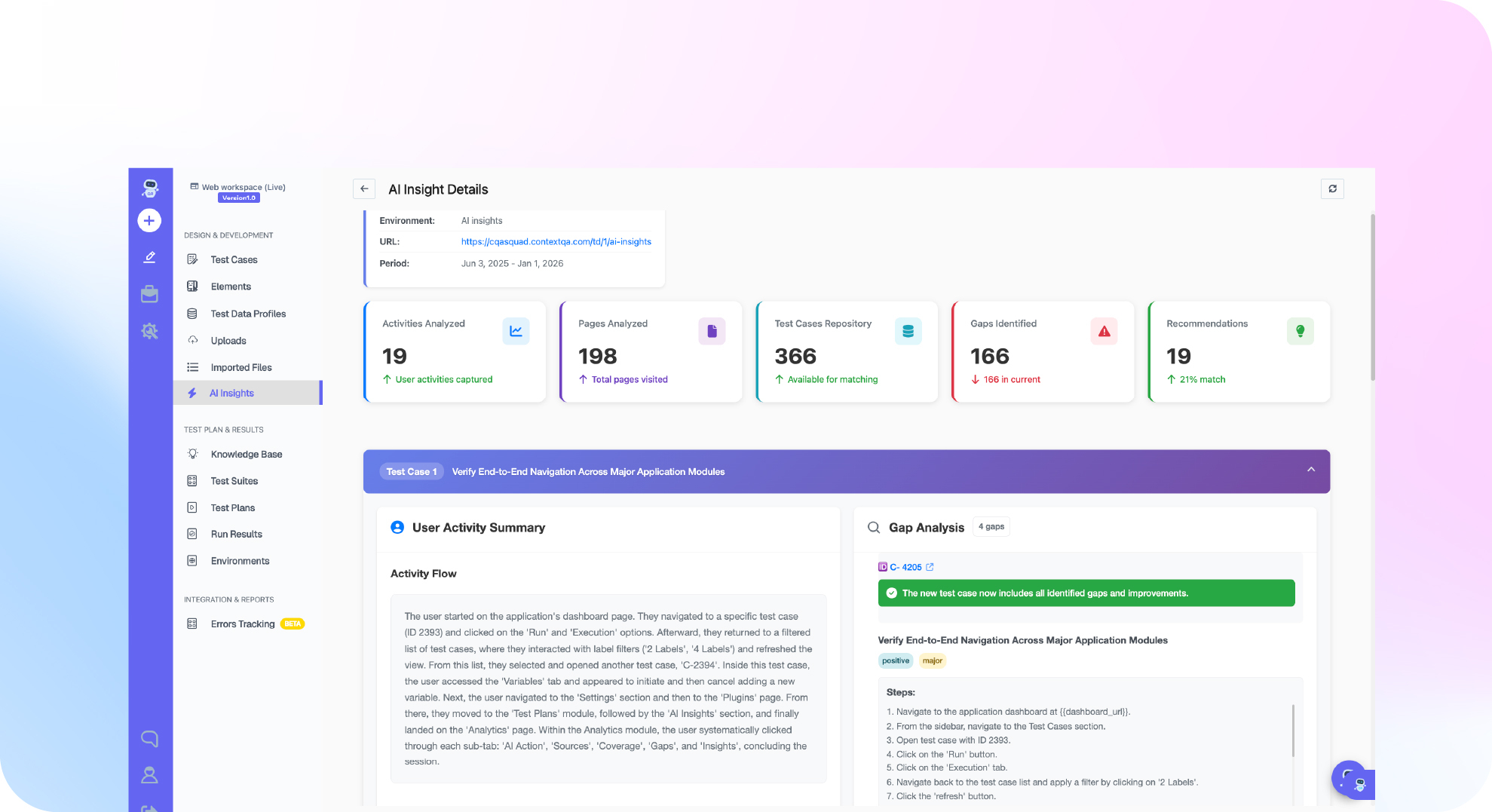
| ContextQA | Agent testing inside a full QA platform | Teams testing voice alongside web, mobile and API | Not assessed |
Benchmark figures are from the published assessment cited above and cover only the three platforms that study examined. Absence from that column means not assessed, not assessed poorly.

Three capabilities that separate these tools
Feature lists in this category converge. Three things do not, and they are what to press on in a trial.
Can it execute an accent and dialect matrix you define? Most platforms treat accent as a configuration option rather than a test dimension, and this is where production voice agents lose the most task completions. A 2025 error analysis found the best of four commercial recognition systems returned a 31.95 percent average word error rate across 72 hours of naturalistic speech from 160 speakers in a single English city (Serditova, Tang and Steffens, 2025). Ask whether you can supply your own clips and group results by accent, or whether you get one blended accuracy number.
Does it score three layers or one? Word error rate, intent match and task completion fail independently. An agent can transcribe perfectly and route to the wrong intent, or mistranscribe a word and still complete the task. A platform that reports a single accuracy figure cannot tell you which layer to fix.
Does it measure latency at the turn boundary? Voice agents live inside a turn-taking loop, so instrument time to first audio out rather than total response time. Past roughly one second, callers talk over the agent, which stacks a barge-in failure on top of a latency failure and corrupts the transcript you were going to score.
Two more to confirm on the operational side, because they decide whether the platform survives contact with your pipeline: whether tests can be triggered over an API for CI, and whether you can export your test cases if you switch vendors. Both are routinely absent and rarely advertised.
Building and scoring the matrix itself is a separate job from choosing who runs it. Our guide to testing AI voice agents covers the matrix design, the noise and barge-in cases, the latency thresholds and the consent and opt-out coverage that outbound calling requires under the FCC’s 2024 ruling.
On episode 3 of The Agentic Quality podcast, a senior developer who built test infrastructure for a major voice assistant made the point that this problem is older than the current tooling wave. His team built a language for defining how to test a voice agent in two days, and eight years later it was still running in production. The same conversation covers why he will not let an AI write the tests for AI written code, since the model that wrote the code believes the code is correct.
More on agent evaluation practice in the full episode.
How to choose
Answer three questions in order and the shortlist writes itself.
Where does your risk actually sit? If it is telephony, routing, transfers and IVR, you want the contact center assurance lineage. If it is conversational behavior and prompt or model changes, you want the AI-native platforms. If it is both, you will end up with two tools or with a platform that spans the whole QA estate rather than voice alone.
Are you gating releases automatically or reviewing failures manually? Auto-gating puts all the weight on evaluation accuracy, because a wrong verdict blocks a good release or lets a bad one through unattended. Manual review shifts the weight to simulation variety, because humans are the scorer and the tool’s job is to generate interesting calls.
What is your caller population? If it is linguistically narrow, accent coverage is a nice-to-have. If it spans regions, second-language speakers or bilingual callers, it is the deciding criterion, and you should test each candidate against your own accent matrix during the trial rather than after purchase.
A 30 day evaluation plan
Week 1. Pull 50 real calls covering your top three intents and a spread of outcomes. Have a human score each for intent match and task completion. This is your ground truth and it is the most valuable artifact in the whole exercise.
Week 2. Build the accent matrix. Three intents, five utterance variants, six accent groups, clean and noisy. Use the two open corpora above for breadth and your own recordings for ground truth.
Week 3. Run both artifacts through each shortlisted tool. Measure agreement with your human scores, and measure per-group task completion. Two numbers per tool, both from your data.
Week 4. Test the integration, not the product. Can it run in your pipeline, does it handle your telephony path, can it replay production calls, what does concurrency cost. Most category disappointments are integration disappointments.
Run the 50 call agreement check before you sign anything
The independent benchmark above found evaluation accuracy ranging from 62.7 to 86.7 percent across three platforms on identical conversations. That spread means a vendor’s own accuracy claim tells you almost nothing about how it will score your calls, with your accents, your intents and your audio path. So test it directly: take 50 of your own recorded calls, have one of your reviewers score them blind, and compare. Bring those 50 calls to a demo and we will run them through ContextQA voice agent testing live, show the per-call verdicts next to your reviewer’s, and you leave with an agreement rate you measured rather than a number we quoted. Voice runs alongside web, mobile and API suites, so a voice regression fails the same build as a broken assertion.
Book a ContextQA DemoBottom line
The AI voice agent testing tools market is young enough that the honest comparison is a method rather than a ranking. The one independent benchmark available shows a 24 point spread in evaluation accuracy between platforms on identical conversations, which means the choice materially changes what you find. Run 50 human-scored calls through every candidate, build an accent matrix from your own caller geography, and let those two numbers decide. Any vendor unwilling to be measured that way has told you something useful.
Sources
- Miguel E. Andres, Vadim Fedorov, Rida Sadek, Enric Spagnolo-Arrizabalaga and Nadescha Trudel, Testing the Testers: Human-Driven Quality Assessment of Voice AI Testing Platforms, arXiv, revised January 2026. Cited for the 21,600 human judgments, 45 simulations, 60 ground truth conversations, and the simulation and evaluation accuracy figures.
- Dana Serditova, Kevin Tang and Jochen Steffens, Automatic Speech Recognition Biases in Newcastle English: An Error Analysis, 2025. Cited for the 31.95 percent word error rate and the DECTE corpus of 72 hours from 160 speakers.