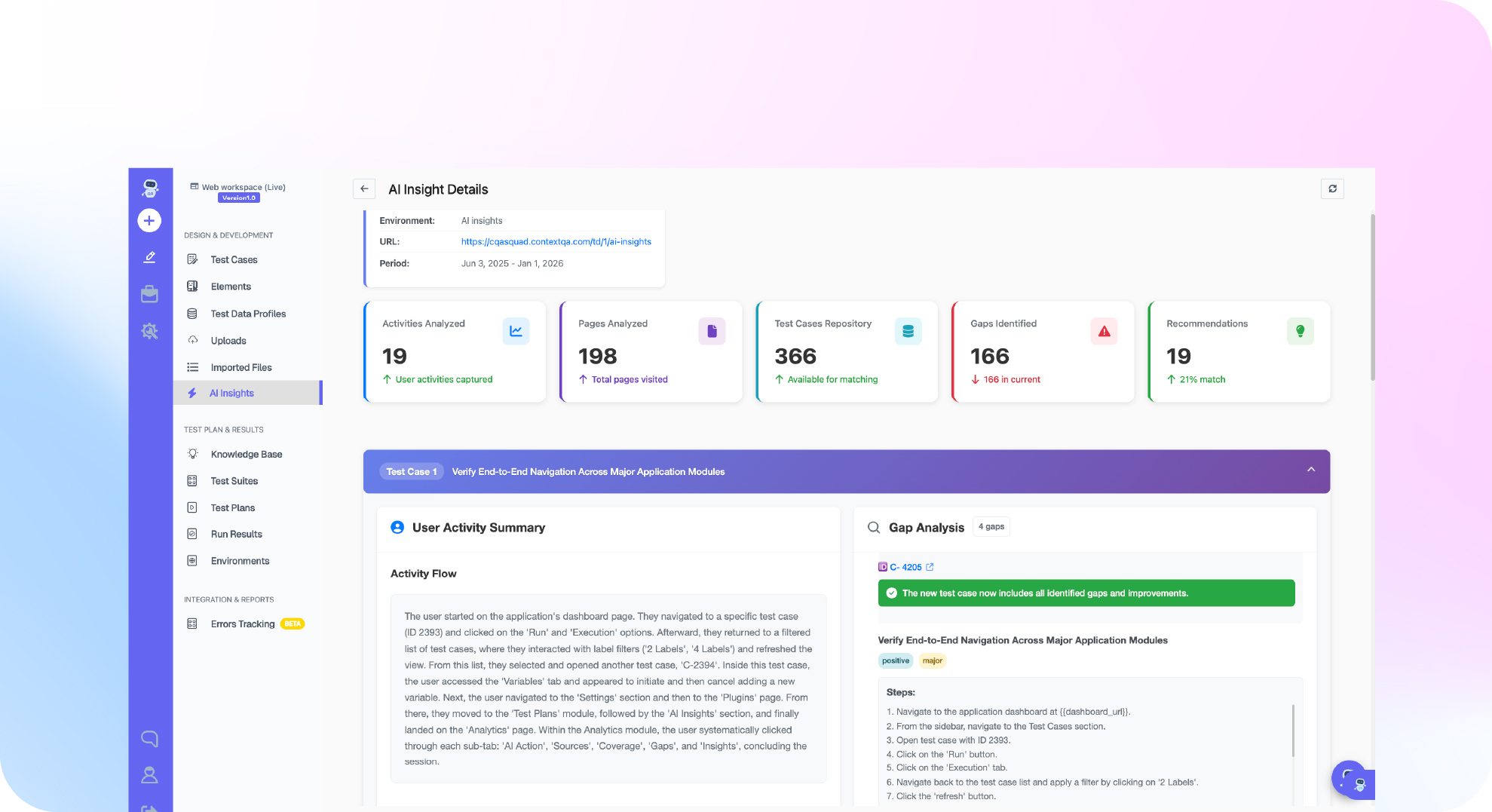

TL;DR: The contextqa vs testgrid decision comes down to where your testing bottleneck sits. ContextQA is an AI-native platform built around AI-generated tests, self-healing, and black-box testing of AI agents. TestGrid is strongest as real-device infrastructure, offered on a public cloud, a dedicated cloud, or as a device lab inside your own network. With mobile traffic at 58.99 percent of worldwide web usage in September 2026, device coverage matters, but so does the cost of writing and maintaining the tests that run on those devices.
Quick answers
Is ContextQA or TestGrid better for AI test automation?
ContextQA is the stronger pick when your main problem is test authoring and maintenance. It generates tests with AI, repairs broken locators through self-healing, and tests AI agents as black boxes. TestGrid also ships AI test generation, but its core strength is the real-device and browser infrastructure underneath the tests.
Is TestGrid better for real-device mobile testing?
Yes, if owning or reserving physical hardware is the requirement. TestGrid runs real Android and iOS devices on its public cloud, on a dedicated cloud, or in a custom device lab deployed on your premises. Teams in regulated industries that cannot send traffic outside their firewall often start their evaluation there.
How do ContextQA and TestGrid pricing compare?
TestGrid publishes a Starter package at $199 per seat per month, with Growth and Device Lab packages priced through sales. ContextQA uses custom, sales-led pricing tied to your testing footprint rather than seat count. Model your total cost on suites, runs and maintenance hours, not on the headline seat price alone.
What is the core difference in ContextQA vs TestGrid?
The core difference is the layer of the testing stack each product optimizes. ContextQA optimizes the test itself: how it is created, how it survives UI change, and how it evaluates systems that do not behave deterministically, such as LLM-powered agents. TestGrid optimizes the place a test runs: which device, which OS version, which network, and whose data center.
That split matters because the two problems cost money in different ways. A missing device model shows up as an escaped defect on a phone you never tested. A brittle suite shows up as engineers rerunning and patching scripts every sprint. NIST's planning report on testing infrastructure estimated that inadequate software testing infrastructure cost the U.S. economy $59.5 billion a year, and that feasible improvements could recover about $22.2 billion of it. The report is from 2002, but its central point still holds: most of that cost comes from finding defects late.
In a ContextQA vs TestGrid evaluation, neither product replaces the other. One gives you infrastructure depth. The other gives you AI-native test authoring. Your choice depends on which of those two gaps is larger on your team today.
How do the two platforms approach test creation?
ContextQA treats test creation as an AI problem first. Tests are generated by AI, and when the application UI changes, self-healing updates the affected steps instead of failing the run. The goal is to cut the maintenance hours that usually grow with suite size. If your QA engineers spend more time fixing selectors than designing coverage, this is the axis to evaluate.
TestGrid has also moved into AI-assisted authoring. Its pricing page lists AI test case generation for manual and automation tests, more than 27 AI testing agents on the Starter package, and a feature called AgentRx for self-healing and AI bug summaries. It also lists downloadable open-source test code, and its Device Lab package supports existing Selenium, Appium, Cypress and Playwright tests.
The practical ContextQA vs TestGrid difference for a buyer:
- Starting point: ContextQA starts from AI-generated tests. TestGrid starts from device and browser infrastructure, with AI features added on top.
- Existing scripts: TestGrid is a natural home for a large, working suite of
AppiumorSeleniumscripts that just needs more devices. - Maintenance load: ContextQA targets teams whose suite breaks every time the UI changes and who want self-healing at the center of the workflow.
- AI agents under test: ContextQA supports black-box testing of AI agents, a separate problem from running deterministic UI scripts.
Developer sentiment explains why the authoring layer gets so much scrutiny. In the 2025 Stack Overflow Developer Survey, 84 percent of respondents use or plan to use AI tools in their development process, yet about 46 percent say they distrust the accuracy of AI output. An AI testing platform has to show its work, not just produce green checkmarks.
Which tool gives better real-device coverage?
On hardware, the ContextQA vs TestGrid answer favors TestGrid, because hardware is its product. Its Device Lab package includes real Android and iOS devices, real browsers including legacy versions, dedicated environments deployed on premises or in a private cloud, unlimited users and execution minutes, and 24/7 device availability. It also lists MDM support, audio testing, image injection and biometric support, which matter for banking and healthcare apps that use cameras and fingerprint prompts.
Real devices still matter in 2026 because emulators do not reproduce everything. Pew Research Center reports that 91 percent of U.S. adults own a smartphone, so phone behavior is the default user experience for most consumer products. Device makers also keep the OS mix moving. Apple reported that 79 percent of all iPhones were on iOS 26 as of June 7, 2026, which leaves a long tail of older versions your app still has to support.
ContextQA approaches mobile from the test side. Its mobile app testing workflow focuses on keeping mobile tests steady across devices through AI-generated steps and self-healing, so a layout shift on one screen size does not cascade into a red build. If you already have device access through an internal lab or a cloud provider, the question becomes whether your bottleneck is the hardware or the test logic running on it.
A useful rule of thumb:
- List the failures from your last three releases. Tag each one as device-specific or logic-specific.
- Count the maintenance hours your team spent on broken tests over the same period.
- Pick the platform that targets the larger number. Device-specific failures point toward TestGrid. Maintenance hours point toward ContextQA.
How do on-premises and security options compare?
Both products support on-premises deployment, which puts ContextQA vs TestGrid on the same shortlist for regulated teams. The details differ.
- TestGrid: The Device Lab package runs on premises or as a hosted private environment, with data residency, full audit logs and virtual USB. Growth adds LDAP, MFA, SSO through SAML or OAuth, and site-to-site VPN. TestGrid notes that its AI features need outbound connectivity to its hosted AI infrastructure, with a scriptless option for networks that restrict that traffic.
- ContextQA: ContextQA supports on-premises deployment for teams that need test execution and data to stay inside their own environment.
Ask both vendors the same three questions during a ContextQA vs TestGrid evaluation. Where does test data go when AI generates or heals a test? Which features stop working with no outbound internet access? Who holds the audit log, and can you export it? The answers matter more than either brochure.
What does ContextQA vs TestGrid cost?
TestGrid lists its Starter package at $199 per seat per month on the same pricing page cited above. Starter includes a token allowance for AI features, where a typical AI-generated test case uses 10 to 20 tokens, while self-healing, bug summaries and root cause analysis do not consume tokens. Growth and Device Lab are custom priced and include unlimited tokens. Confirm any seat minimum with TestGrid sales, since the public page does not spell one out clearly.
ContextQA uses custom, sales-led pricing. Its pricing model is built around your testing footprint rather than a seat count, which changes the math for teams where many developers contribute tests but only a few own the suite.
When you compare ContextQA vs TestGrid quotes, normalize them on three numbers:
- Cost per executed test run across a typical month, including parallel runs.
- Maintenance hours per sprint that the platform is expected to remove or add.
- Infrastructure you no longer buy, such as an internal device lab or a separate grid contract.
Labor is usually the biggest line. The U.S. Bureau of Labor Statistics reports a median annual wage of $104,300 for software quality assurance analysts and testers as of May 2025. A tool that saves one QA engineer five hours a week often outweighs a few hundred dollars of difference in seat pricing.
How do the frameworks and integrations fit your pipeline?
Most teams already run open-source frameworks, so integration fit decides how painful adoption will be. Appium describes itself as an open-source ecosystem for UI automation across iOS, Android, desktop and TV platforms. Playwright supports Chromium, WebKit and Firefox on Windows, Linux and macOS, with native mobile emulation for Chrome on Android and Mobile Safari.
TestGrid fits teams that want to keep those scripts and point them at more hardware. Its Device Lab package explicitly supports existing Selenium, Appium, Cypress and Playwright tests. ContextQA fits teams that want AI to generate and maintain a large share of the suite, so engineers spend their time on coverage design and on harder targets such as AI agents.
The Google DORA research program summarizes the risk well: its 2025 report describes AI as an amplifier of an organization's existing strengths and weaknesses. Put an AI testing layer on a disorganized suite and you get disorganized results faster. Put it on a clear coverage plan and the maintenance savings compound.
How should you decide between ContextQA and TestGrid?
Settle ContextQA vs TestGrid on your largest measurable gap, not the longer feature list.
- Choose TestGrid if your defects are mostly device-specific, you need physical hardware inside your firewall, or you have a large working
Appiumsuite that only needs more devices. - Choose ContextQA if your team loses hours every sprint to broken tests, you want AI-generated tests and self-healing at the center of the workflow, or you need to test AI agents as black boxes.
- Run both if you need a private device lab and an AI-native authoring layer. The products sit at different layers, so this is a real option for larger organizations.
Comparing an AI-native testing layer with device infrastructure? See how the ContextQA platform handles AI-generated tests, self-healing and AI agent testing on your own app, then book a demo and bring your three ugliest flaky tests.
Run a two-week proof of concept with real tests, not vendor samples. Use the same five critical user flows on both platforms so the ContextQA vs TestGrid result is comparable. Measure setup time, first green run, and how many tests survive a deliberate UI change. The platform that keeps the most tests passing without manual edits after that change is usually the one that will hold up at scale.
Frequently Asked Questions
Can ContextQA and TestGrid be used together?
Yes. TestGrid works at the device and infrastructure layer, while ContextQA works at the test authoring and maintenance layer. Larger teams sometimes keep a private device lab for hardware coverage and use an AI-native platform to generate and heal the tests that run on it. Confirm integration paths with both vendors during your evaluation.
Does TestGrid offer self-healing tests?
Yes. TestGrid's pricing page lists AgentRx self-healing and AI bug summaries on its Starter package, and notes that self-healing does not consume AI tokens. Evaluate how it handles a deliberate UI change on your own app, since self-healing quality varies with how your pages are built.
Which option suits a regulated industry?
Both support on-premises deployment. TestGrid adds a device lab with data residency and audit logs, but its AI features need outbound access to hosted AI services. ContextQA also supports on-premises deployment. Ask each vendor which features work with no outbound traffic before you sign.
Bottom line
The contextqa vs testgrid question has a clear answer once you name your bottleneck. If hardware coverage and data residency for real devices are the gap, TestGrid's device lab and cloud options are built for that. If test creation, maintenance and AI agent testing are the gap, ContextQA's AI-native approach targets it directly. Measure your last three releases before you choose, and use the ContextQA comparison hub to check how it stacks up against the other platforms on your shortlist.