
TL;DR: Playwright's built-in --shard flag splits one test suite across multiple CI machines, not just multiple worker processes on one machine, and that distinction is what actually shortens a pipeline. Teams pairing --shard with a GitHub Actions matrix routinely cut a 30 to 40 minute end-to-end run to under 10 minutes, which matters because developers now wait close to 40 minutes on average for a CI pipeline to finish, according to Incredibuild's 2026 CI/CD benchmark report. The part most teams get wrong is not the YAML. It is forgetting that four machines hitting the same test database at the same time might corrupt each other's state within the first few runs.
Quick answers
What is the difference between Playwright workers and sharding?
Workers are separate OS processes on a single machine, each running its own browser instance and picking up test files as they finish. Sharding works a level above that: it splits the entire suite into N pieces and hands each piece to a separate CI job, often on a separate machine, and each of those jobs then runs its own pool of workers against its own slice of tests.
How do you shard Playwright tests in GitHub Actions?
Define a matrix with a shardIndex array and a shardTotal value, run the test command with --shard=${{ matrix.shardIndex }}/${{ matrix.shardTotal }} inside each matrix job, upload every job's blob report as a build artifact, then run a final job that downloads all the blob reports and merges them into one combined HTML report.
Does sharding break tests that hit a shared database?
It will, if the state is not isolated first. Two shards writing to the same rows, the same seeded user, or relying on the same global setup script at the same time will collide. Partition data per worker using Playwright's parallelIndex, or give each shard its own schema or a disposable database.
The CI/CD Bottleneck: Why Sequential E2E Runs Kill Deployment Velocity
Every team that adds real Playwright coverage eventually hits the same wall. A suite that takes four minutes with thirty tests takes thirty five minutes with four hundred, and now it sits between a merged pull request and a deploy. That same report found only 9.4 percent of teams get from commit to production in under an hour, while 43.5 percent take more than a full week.
Running tests sequentially, one after another in a single process, is usually the single biggest contributor to that number, because end-to-end tests spend most of their wall-clock time waiting: waiting for a page to load, an API to respond, an animation to finish. A CPU sits mostly idle during that wait, and sequential execution wastes it. Google's DORA research is blunt about the consequence: elite teams deploy on demand, multiple times a day, with lead times under 24 hours, and that is structurally out of reach if one quality gate eats thirty five of those minutes by itself.
The fix is not fewer tests. Cutting end-to-end coverage to hit a time budget just moves risk downstream into production, where it costs more to find. The fix is running the tests already written differently: in parallel, across more than one process, and past a certain suite size, across more than one machine.

Understanding Playwright Worker Pools vs OS Threading
Playwright's parallelism model surprises engineers coming from Selenium Grid or JMeter, where "parallel" usually means multiple threads sharing one process, and often sharing memory too. Playwright works differently: every test runs inside its own worker, and each worker is a separate, independent OS process orchestrated by the test runner, not just a thread inside one shared program.
Each worker starts its own browser and gets reused across multiple test files instead of restarting for every file. That is why the first file in a run is rarely the slowest one. Once a worker is "warm", meaning its browser is already running, it picks up the next file faster.
That process-level isolation is a real advantage over thread-based parallelism. A memory leak, a crashed browser, or a hung page in one worker cannot corrupt another worker's state, because the two do not share memory. Playwright also shuts a worker down completely after any failing test inside it and restarts it fresh, specifically to guarantee a clean environment for whatever runs next in that slot.
You can set the worker count two ways: pass --workers 4 on the command line, or set the workers option in playwright.config.ts. Locally, Playwright sizes the pool to your machine's available CPU cores automatically, so you rarely need to set it yourself.
In CI, set it explicitly instead of trusting the default. Most hosted runners, including GitHub's standard Ubuntu runners, have far fewer usable cores than a developer's laptop. Pushing --workers to 16 on a 2-core runner does not add more parallelism. It just makes the machine switch between tasks constantly, and the suite often runs slower instead of faster. A safe default: set workers: 2 in CI and leave it undefined locally, so CI stays conservative while your own machine uses whatever it actually has.
Workers solve one machine's worth of parallelism. If the framework choice itself is still open, our breakdown of Playwright vs Selenium vs Cypress in 2026 compares how each one handles parallel execution. Sharding is the next lever, and it is the one most teams reach for once a single machine's worker pool stops being enough.
Step-by-Step: Setting Up GitHub Actions Matrix Sharding for Playwright (With Code YAML)
GitHub Actions supports this natively through a matrix strategy, no third-party action required. Here is the full path from one sequential job to four parallel shards with a single merged report.
- Add a strategy matrix to the test job in your workflow file, with
shardIndex: [1, 2, 3, 4]andshardTotal: [4]. - Set
fail-fast: falsein the same strategy block, so one shard failing does not cancel the other three mid-run. - Change the test command to
npx playwright test --shard=${{ matrix.shardIndex }}/${{ matrix.shardTotal }}. GitHub Actions expands that into--shard=1/4,--shard=2/4,--shard=3/4, and--shard=4/4across the four matrix jobs automatically. - Set the reporter to
blobin CI, for examplereporter: process.env.CI ? 'blob' : 'html'insideplaywright.config.ts, so each shard writes a machine-readable report instead of four competing HTML reports fighting over the same output folder. - Upload each shard's blob report as a build artifact.
- Add a final job that depends on all four shard jobs, downloads every blob report into one folder, and runs
npx playwright merge-reports --reporter html ./all-blob-reportsto produce a single combined HTML report for the entire suite. - Start with a conservative shard count relative to suite size. Four shards for roughly four hundred tests is a reasonable first ratio. Re-measure before adding more.
There is a ceiling here worth knowing about upfront. Doubling the shard count rarely halves wall-clock time past a certain point, because every matrix job pays the same fixed startup cost, checking out the repository, installing dependencies, installing browser binaries, before it runs a single test. Eight shards means paying that fixed cost eight times in parallel instead of four. Caching that setup work, covered further down, buys more than adding shards does once you are past four or five.
Handling Shared Database State and Test Isolation during Sharded Runs
This is the step teams skip, and it is the one that actually determines whether sharding works. Four shards running at the same time against one shared staging database, one seeded test user, or one global setup script are not four independent test runs anymore, they are four processes racing each other to mutate the same rows.
Playwright gives you two different IDs here, and mixing them up is an easy mistake. workerIndex goes up every time a worker restarts after a failure, so it is not stable across a single run: the same worker slot can get a new number partway through. parallelIndex stays fixed for the whole run, a number between 0 and your worker count minus 1 that never changes.
Because parallelIndex is stable, it is the one to use for keying a database user, a tenant ID, or a schema name. Give each parallel slot its own row of seed data ahead of time, keyed by parallelIndex, and tests stop overwriting each other's data no matter which shard or worker happens to run them.
The other trap is a single globalSetup script that seeds shared fixture data once per shard. If one shard's teardown deletes that fixture while another shard is still mid-test against it, that second shard fails for a reason that has nothing to do with the code under test. It gets logged as flaky and re-run into passing, which hides an architecture problem behind a retry button instead of fixing it.
When a full database-per-shard setup is not realistic, the cheaper fix is tagging every record a test creates with a run ID built from shardIndex and parallelIndex together, and scoping cleanup to only that tag. It does not give full isolation, but it stops the most common failure mode: one shard's cleanup step deleting rows another shard is still using.

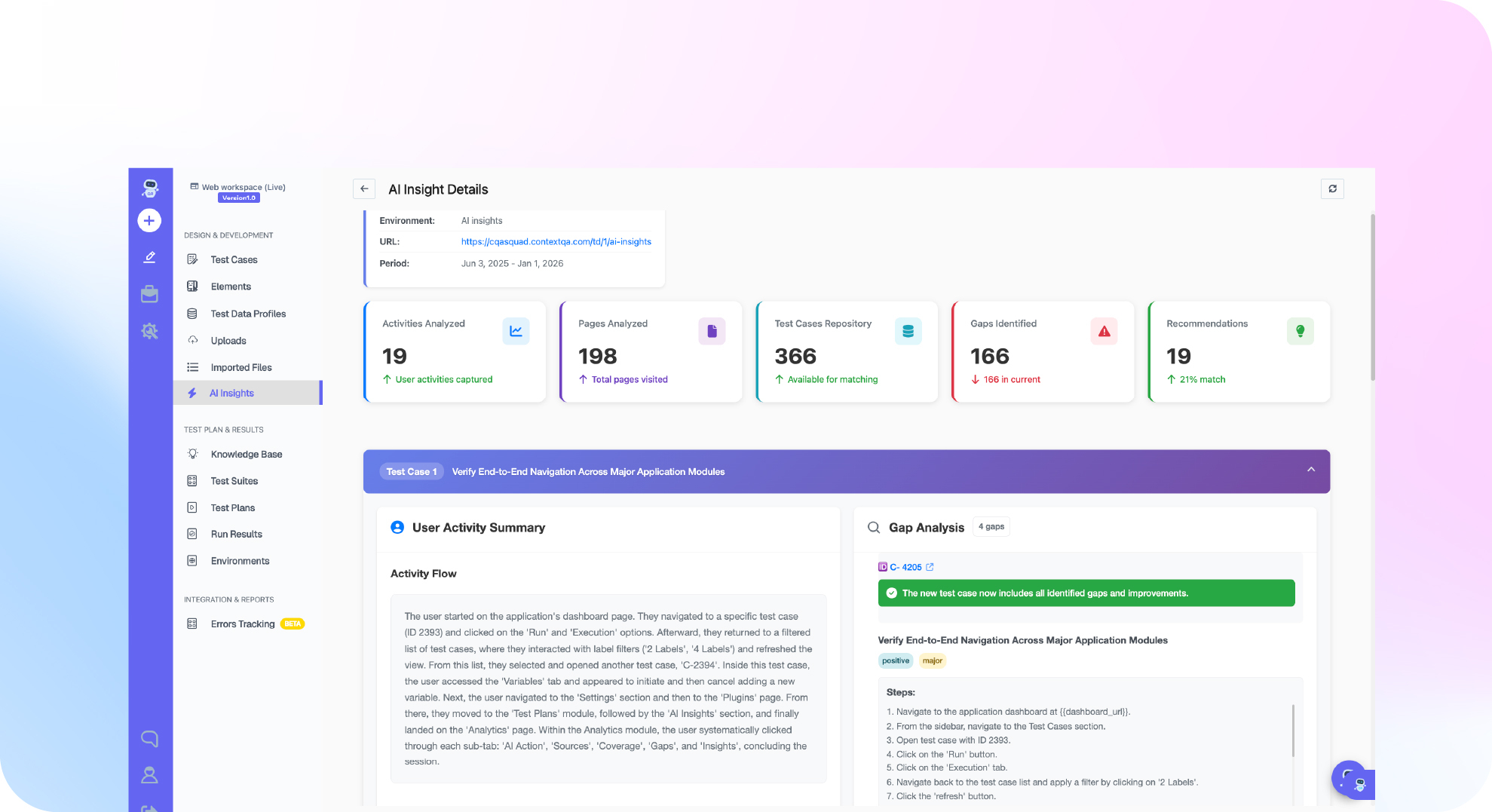
Every fix above is still hand-maintained YAML, worker math, and locator upkeep. ContextQA's Parallel Nodes run test cases concurrently inside one plan, no YAML to maintain and no blob reports to merge by hand, and because locators self-heal automatically, the shard that broke last week because a button moved fixes itself before the next run instead of failing again. See it on a 15-minute demo.
Reducing Cloud Infrastructure Costs with Parallel Cloud Runners
Sharding trades wall-clock time for compute minutes, and it is worth being honest about that trade before rolling it out broadly. GitHub Actions bills by the minute per runner, so four ten-minute shard jobs cost roughly the same total compute-minutes as one forty-minute job. What sharding actually buys is developer time, a shorter wait before a pull request can merge, not necessarily a smaller bill. Some teams see a larger bill, because the fixed per-job overhead (checkout, dependency install, browser install) now runs four, eight, or sixteen times instead of once.
Caching is what keeps that overhead from eating the savings. Cache node_modules and the Playwright browser binaries with actions/cache, keyed on the lockfile hash, and every shard skips a multi-minute install step it would otherwise repeat. For teams running sharded suites dozens of times a day, this is usually a bigger cost lever than the shard count itself.
Past a certain scale, self-hosted or dedicated cloud runners can undercut GitHub-hosted runner pricing for CPU-heavy Playwright workloads, though that trade brings its own maintenance overhead and is worth evaluating only once shard count and caching are already tuned.
Frequently Asked Questions
How many shards should I start with?
Match shard count to suite size and CI runner availability rather than picking a round number. Four shards for a few hundred tests is a common starting point. Measure wall-clock time before and after, then add shards only while the improvement is still roughly linear.
Do I need the blob reporter to shard tests?
You need it if you want one combined HTML report at the end. Without it, each shard produces its own separate report, which works but makes it harder to see the whole suite's result in one place.
Can I combine sharding with fullyParallel mode inside each shard?
Yes. Sharding decides which slice of tests a CI job runs, and fullyParallel (or the worker count) decides how that job parallelizes its own slice. They operate at different levels and are meant to be used together.
Bottom line
Playwright sharding is a config change, not a rewrite: a matrix block, a shard flag, a merge step. The part that takes real engineering judgment is test isolation, and skipping it is what turns a promising sharding rollout into a suite full of intermittent failures that get shrugged off as flaky. Get isolation right first, then shard, and pair it with self-healing test maintenance if locator upkeep, not runtime, is what is actually eating your team's time.