
TL;DR: The strongest Katalon alternatives in 2026 split into two groups: open-source frameworks (Playwright, Selenium, Cypress) that cost nothing to license but need engineers to maintain code, and commercial platforms (testRigor, Testsigma, ContextQA) that trade a subscription for less authoring and upkeep. Katalon itself lists its Professional plan at $2,199 per seat per year on its official pricing page, so seat count drives the math for most teams. Pick katalon alternatives by measuring maintenance hours in a two week pilot, not by feature lists.
Quick answers
What is the best free alternative to Katalon?
Playwright is the most complete free option for web testing. It is open source under the Apache 2.0 license, runs Chromium, WebKit and Firefox on Windows, Linux and macOS, and supports Node.js, Python, Java and .NET. You trade Katalon's recorder and low-code editor for writing and maintaining test code yourself.
Which Katalon alternative needs the least test maintenance?
Platforms with AI self-healing usually need the least upkeep, because they repair broken locators when the UI changes instead of failing the run. ContextQA, testRigor and Testsigma all reduce scripting. Measure it yourself: run the same 20 regression tests across two UI releases and count how many needed a human fix.
Is switching from Katalon worth the migration effort?
It is worth it when license renewals, seat growth or locator maintenance cost more than a rewrite. Start with your 20 to 30 highest value regression flows, not the full suite. If those run stable for two weeks on the new tool, migrate the rest in batches tied to your normal release cycle.
Why are QA teams looking for Katalon alternatives in 2026?
Most teams start looking for the same three reasons: cost per seat, test maintenance load, and how well the tool fits an AI-assisted workflow. Katalon is a capable all-in-one tool. It covers web, mobile, API and desktop testing in one product. But the pricing model and the scripting style do not suit every team.
Start with cost. Katalon's free tier covers local authoring, record and playback, and local execution. The Professional plan, which adds AI agents, parallel execution and integrations with Jira, GitHub, GitLab, Slack and Azure DevOps, carries a list price of $2,199 per seat per year. At the time of writing, Katalon shows a limited-time offer of $1,000 per seat for the first 3 seats, running until October 31. Enterprise pricing is custom. For a team of 15 automation engineers at list price, that is roughly $33,000 a year before any services.
The second driver is maintenance. Every UI change that renames a button or moves a field can break a locator (the selector a test uses to find an element on the page). Teams with large regression suites often spend more hours repairing tests than writing new ones. That hidden cost rarely appears on a pricing page, and it is the number that should drive your decision.
The third driver is AI. Developer use of AI is now close to universal. The 2025 DORA report summary found AI adoption among software development professionals reached 90%, a 14% increase over the previous year, across nearly 5,000 respondents. QA leaders now ask whether a test tool can generate, repair and explain tests, not only run them. For a detailed look at how the two products differ on that point, read our breakdown of ContextQA vs Katalon.

What should you compare before you switch tools?
Compare katalon alternatives on total cost of ownership, not license price. A free framework with a heavy maintenance load can cost more than a paid platform. Use these six criteria to score every option on the same scale.
- License model. Per seat, per parallel run, usage based, or free. Seat pricing punishes teams that want product managers and developers to read or edit tests.
- Authoring style. Code (TypeScript, Java, Python), low-code, or plain English. Match it to who will write tests in 12 months, not who writes them today.
- Maintenance load. How the tool handles locator changes. Ask whether it self-heals, flags the change for review, or simply fails.
- Coverage. Web, mobile, API, desktop, email and database checks. Count the surfaces your regression suite actually touches.
- CI/CD fit. Native support for GitHub Actions, GitLab CI, Jenkins or Azure Pipelines, plus parallel execution and clear failure reports.
- Exit cost. Whether you can export tests as code if you leave. Lock-in matters more as your suite grows.
Trust in AI output also deserves a line on the scorecard. In the Stack Overflow 2025 Developer Survey, 46% of developers said they distrust the accuracy of AI tools, while 33% said they trust it. The top frustration, cited by 66%, was AI solutions that are "almost right, but not quite." Any AI test platform you evaluate should show what it changed and why, so a reviewer can approve or reject each repair.
The stakes are not small. CISQ estimates that poor software quality cost the US at least $2.41 trillion in 2022, with accumulated technical debt around $1.52 trillion. A test suite that breaks quietly or gets skipped because it is flaky adds to that bill.
Which Katalon alternatives fit which kind of team?
The right tool depends on who writes tests and how much engineering time you can spend on upkeep. Here are six katalon alternatives, grouped by the kind of team they suit best.
- Playwright (code first, free). Hosted in Microsoft's GitHub organization, Playwright has about 97.8k stars on its GitHub repository and ships under the Apache 2.0 license. The Playwright documentation confirms support for Chromium, WebKit and Firefox on Windows, Linux and macOS. You start a project with
npm init playwright@latest. It suits teams with strong TypeScript or Python skills who want full control and zero license cost. - Selenium (code first, free). The longest-running option. The Selenium WebDriver documentation notes that WebDriver is a W3C Recommendation, which means every major browser vendor implements the same protocol. It fits Java-heavy teams and organizations with existing grid infrastructure. Expect to build your own reporting, waits and retry logic.
- Cypress (code first, free core). Popular with front-end developers because tests run in the browser alongside the app. The Cypress browser documentation lists Chrome-family browsers, Edge and Firefox, with WebKit support still marked experimental behind the
experimentalWebKitSupportflag. Check that limit if Safari coverage matters to you. - testRigor (plain English, commercial). According to testRigor's own site, tests are written in plain English and cover web, native and hybrid mobile apps on iOS and Android, API checks and email, with Windows desktop testing only in paid versions. It fits teams where manual testers will own automation.
- Testsigma (low-code, commercial). Testsigma's pricing page lists Pro and Enterprise plans, both with custom quotes rather than published prices. Budget a sales conversation into your evaluation timeline.
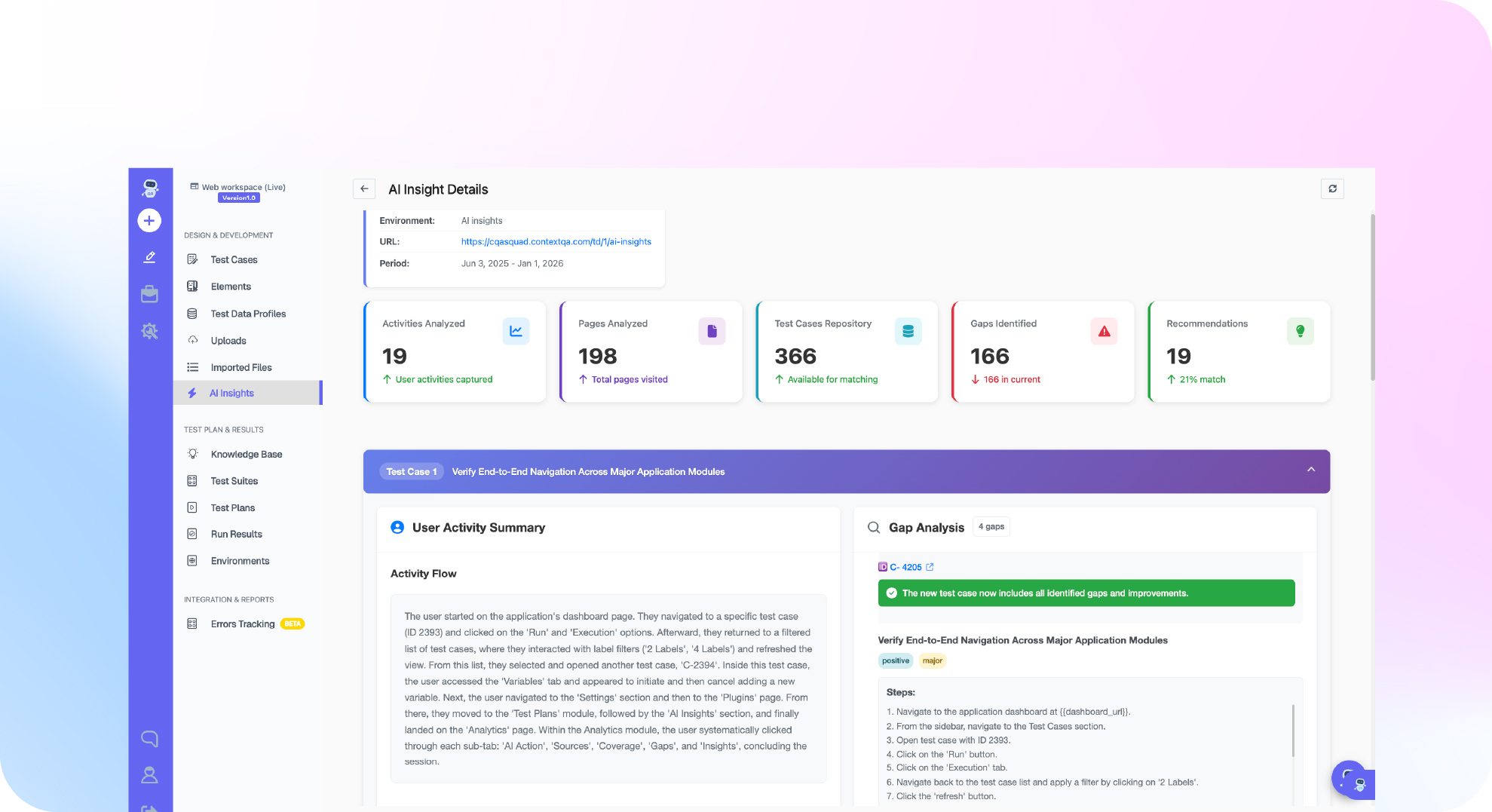
- ContextQA (AI-native, commercial). ContextQA generates tests with AI and uses self-healing tests that repair themselves when locators change, so a renamed button does not fail the run. It suits teams that want to cut maintenance hours without hiring more SDETs.
If your requirements include SSO, audit logs and on-premises deployment, our guide to the best Katalon alternatives for enterprise QA teams goes deeper on security and procurement criteria.
How do open-source frameworks compare with AI platforms on maintenance?
Open-source frameworks cost nothing to license but put the full maintenance load on your engineers. AI platforms charge a subscription but absorb part of that load. The useful question is which cost is larger for your suite.
Consider a mid-sized web app with 400 end-to-end tests and a UI that ships changes every two weeks. In a code-first framework, each release that renames elements or restructures a form means someone opens the test files, finds the broken selector, and updates it. Good practice reduces this. Use role-based locators like getByRole() in Playwright, keep page objects in one place, and avoid brittle XPath. But the work never reaches zero.
On a self-healing platform, the tool tries alternative attributes when the primary locator fails. Then it either repairs the step or flags it for review. The risk is a false pass, where the tool "heals" onto the wrong element and the test goes green while the feature is broken. That is why the review step matters. Ask every vendor to show a repair log that lists the old locator, the new one, and the confidence behind the change.
Use this rough rule when you weigh katalon alternatives from each group:
- Choose a code-first framework when you have at least two engineers who enjoy writing test code, your UI changes slowly, and you need deep control over network mocking and test fixtures.
- Choose an AI platform when manual testers outnumber SDETs, your UI changes every sprint, and test maintenance already consumes more than a quarter of your automation hours.
- Run both when developers own unit and component tests in code and QA owns end-to-end regression on a platform. Many teams land here.
How do you migrate from Katalon without losing coverage?
Migrate in stages, and prove stability on your chosen katalon alternatives before you retire anything. A rushed cutover is the most common way teams lose regression coverage during a tool change.
- Inventory the suite. Export a list of every Katalon test case, its last run date, and its pass rate. Retire tests that have not run in 90 days or that duplicate other checks.
- Pick 20 to 30 critical flows. Choose login, checkout, signup, billing and any path tied to revenue or compliance. These become your pilot set.
- Rebuild the pilot set on two tools. Run them side by side with Katalon for two weeks. Keep both pipelines green so you have a baseline.
- Measure maintenance, not speed. Track how many tests broke after each UI deploy and how long each fix took. This is the number that predicts your next 12 months.
- Migrate in batches. Move 50 to 100 tests per sprint, grouped by feature area, so failures are easy to trace.
- Switch CI gates last. Only point your
mainbranch merge gate at the new suite once it has run stable for at least two full release cycles.
Our 30-day test automation POC framework has a scoring sheet you can reuse for steps 3 and 4.

Keep Katalon licenses active until the final batch passes. Overlapping one renewal cycle costs less than a gap in regression coverage during a major release.
A few details catch teams out during migration. Test data is the first. Katalon projects often store data in Excel or internal data files, so plan to move those into fixtures or a test data service before you rebuild tests. Custom keywords are the second. Any custom keywords your team wrote need an equivalent helper in the new tool, so list them early. Reports are the third. Stakeholders who read your current Katalon dashboards will want the same view, so agree on the replacement report before cutover day.
Want to see how many of your Katalon tests would survive your next UI release without a fix? Explore the ContextQA platform to see AI-generated, self-healing regression tests in action, or book a demo and bring your 20 most fragile flows to the call.
Frequently Asked Questions
Can I import Katalon test scripts into another tool directly?
Rarely as-is. Katalon scripts rely on Katalon-specific keywords and project structure, so most tools need a rebuild rather than an import. The fastest path is recreating your critical flows from their test case descriptions, then migrating the remaining tests in batches. Keep your Katalon object repository as a reference for locators during the rebuild.
Do Katalon alternatives support mobile and API testing too?
Some do. Playwright, Selenium and Cypress focus on browsers, so mobile apps need Appium and APIs need a separate client or framework. Commercial platforms such as testRigor, Testsigma and ContextQA cover web, mobile and API in one tool, which reduces the number of suites and reports your team maintains.
How long does a Katalon migration usually take?
It depends on suite size and tool choice. A pilot of 20 to 30 flows fits in two weeks. After that, teams moving 50 to 100 tests per sprint can migrate a 500 test suite in roughly five to ten sprints. Retiring stale tests first often cuts that time noticeably.
Bottom line
The best katalon alternatives are the ones that lower your total cost of ownership: license, engineering hours and the risk of broken releases combined. Playwright, Selenium and Cypress win on control and zero license cost when you have engineers to maintain code. testRigor, Testsigma and ContextQA win when maintenance is the bottleneck and non-developers need to own tests. Run a two week pilot on your most fragile flows, count the fixes, and let that number decide. If code ownership matters to your exit plan, look at how code export works before you sign anything.