
TL;DR: The strongest browserstack alternatives for mobile app testing in 2026 are Sauce Labs for enterprise real device clouds, TestMu AI (formerly LambdaTest) for price-to-coverage, AWS Device Farm for pay-per-minute use, TestGrid for on-premise device labs, and self-hosted Appium for full control. Your device matrix matters more than the vendor logo: Android held 69.17 percent of worldwide mobile OS share in September 2026, so most teams need deep Android coverage first. Pick by where your tests must run, how many parallel sessions CI needs, and whether devices can leave your network.
Quick answers
What is the best BrowserStack alternative for mobile app testing?
There is no single winner. Sauce Labs fits enterprises that want a large real device cloud with a private device option. TestMu AI fits teams that need many parallel sessions at a lower entry price. TestGrid fits regulated teams that need devices on their own premises. Match the tool to your constraint, not to a ranking.
Is there a free BrowserStack alternative for mobile apps?
Appium is the free, open source option, but you supply the devices, hosts, and maintenance. AWS Device Farm offers a one-time trial of 250 device minutes as its standard offer. Firebase Test Lab has a no-cost tier, but Google has announced it will shut the service down in 2027, so avoid new investment there.
Do I need real devices, or are emulators enough?
Use both. Emulators and simulators are fast and cheap for functional checks on every pull request. Real devices catch hardware, OEM skin, memory, and network behavior that virtual devices miss. A common split runs emulators on each commit and a smaller real device suite before every release.
Why do teams look for BrowserStack alternatives for mobile app testing?
Teams rarely leave BrowserStack because it lacks devices. Its App Automate product lists more than 30,000 real iOS and Android devices and supports Appium, Espresso, XCUITest, and Maestro. The reasons are usually narrower and more practical.
- Cost per parallel session: Mobile suites grow fast. Every new parallel session on a hosted cloud is a line item, and finance teams notice when CI wait time is solved by buying more concurrency.
- Data residency: Banks, insurers, and healthcare teams often cannot send production-like test data to shared public devices. They need private or on-premise hardware.
- Product sprawl: Some teams want fewer tools, not a separate product for each of manual app testing, automated app testing, visual checks, and test management. Our breakdown of ContextQA vs BrowserStack covers that consolidation question in detail.
- Test maintenance: A large device cloud does not fix flaky locators. If half your failures are selector changes, more devices just reproduce the same failure in more places.
Before you compare vendors, write down which of these four problems you are solving. It changes the shortlist completely.
What should you check before you switch?
A device cloud is plumbing. Evaluate it the way you would evaluate CI runners: on throughput, coverage, and failure clarity.
- Map your real device matrix. Pull the top 20 device models and OS versions from your own analytics. That list, not a vendor's headline device count, is the coverage you need.
- Check OS version currency. Google Play requires that, from August 31, 2026, new apps and app updates target Android 16 (API level 36) or higher. Confirm the vendor has API 36 devices in stock and sets
targetSdk = 36builds up without extra steps. - Check iOS adoption speed. Apple reports that 79 percent of all iPhones ran iOS 26 as measured on June 7, 2026. iOS users upgrade quickly, so the vendor must add new iOS versions within days of release, not months.
- Measure parallel capacity. Count how many sessions your pipeline needs to finish the mobile suite in under 15 minutes. Price that number, not the entry plan.
- Inspect failure artifacts. Run five failing tests. Check that each gives you video, device logs, network logs, and a screenshot at the failing step.
- Test framework compatibility. Run your existing Appium, Espresso, or XCUITest suite unchanged. If the migration needs code rewrites, add that cost to the comparison.
Treat this as a short proof of concept with a fixed scorecard. Two weeks is enough to see real queue times and real flake rates.
Which BrowserStack alternatives are worth a shortlist in 2026?
The seven options below cover the realistic paths. Pricing comes from each vendor's own pricing page at the time of writing. Treat any figure as a starting point and confirm it during procurement.
Sauce Labs: enterprise real device cloud
Sauce Labs is the most direct like-for-like replacement for teams already running Appium on a hosted real device cloud. Its Real Device Cloud plan starts at $199 per month billed annually, or $249 month-to-month, with one parallel test, unlimited users, and unlimited testing minutes. A Virtual Device Cloud plan for emulators and simulators starts at $149 per month billed annually.
- Best for: Enterprises that want a large shared device pool plus a private device cloud option.
- Watch for: The private device cloud, SSO, and IPSec proxy sit in the Enterprise tier, which has no public price.
- Concurrency: The comparison table lists 1 to 24 concurrent sessions depending on plan.
TestMu AI (formerly LambdaTest): price-to-coverage
LambdaTest now operates as TestMu AI. Its pricing page lists Real Device Plus Automation Cloud at $199 per month billed annually for automated testing, and Real Device Plus Live at $39 per month for manual sessions, across 10,000 plus real Android and iOS devices. A free tier gives five short live sessions per month.
- Best for: Teams scaling both mobile web and native app matrices who want low entry pricing.
- Watch for: Model the cost at your real parallel count, since entry plans start with a single session.
AWS Device Farm: pay per device minute
AWS Device Farm suits teams that already run CI on AWS and have uneven test volume. It charges $0.17 per device minute on pay-as-you-go, or $250 per device slot per month for unmetered use. Private devices start at $200 per month. The standard free trial is 250 device minutes, one time.
- Best for: Bursty workloads, such as a large release regression once a week.
- Watch for: Pay-per-minute gets expensive for teams that run full suites on every commit. Do the math at your daily volume.
Firebase Test Lab: only for short-term needs
Firebase Test Lab has been a common low-cost choice for Android teams. On the Blaze plan you get 30 free physical device minutes per day, then $5 per device hour, plus 60 free virtual device minutes, then $1 per hour. The same page states Test Lab is deprecated and will be fully shut down on September 30, 2027.
- Best for: Teams already using it who need a bridge while they plan a migration.
- Watch for: Do not build a new pipeline on a service with a published end date.
Which options suit regulated or code-first teams?
Not every team can rent public devices. For some, data rules or security reviews block a shared cloud entirely.
TestGrid: on-premise and private device labs
TestGrid is the shortlist entry for regulated teams. Its Starter package costs $199 per seat per month with four devices or browsers. A Custom Device Lab package offers on-premise or private cloud deployment with dedicated environments, at custom pricing. One detail matters for air-gapped buyers: its AI features need outbound connectivity to TestGrid's hosted AI service, and a scriptless on-premise option exists for networks that block that traffic.
- Best for: Banking, healthcare, and public sector teams with strict data residency rules.
- Watch for: Confirm which features work fully offline before you sign.
Appium: the free, code-first foundation
Appium sits underneath most mobile suites, including many that run on the clouds above. Its documentation describes a core plus drivers, clients, and plugins, where drivers handle each platform. You install a platform driver with appium driver install uiautomator2 for Android, and choose it in your session with the appium:automationName capability set to UiAutomator2 or XCUITest.
- Best for: Teams with platform engineers who want full control and zero license cost.
- Watch for: You own device procurement, USB hubs, battery health, OS updates, and flaky host machines. Hardware upkeep is a real headcount cost.
- Portability: Because the major clouds accept Appium scripts, writing in plain Appium keeps you free to switch vendors later.
ContextQA: for web-first teams with webview or PWA apps
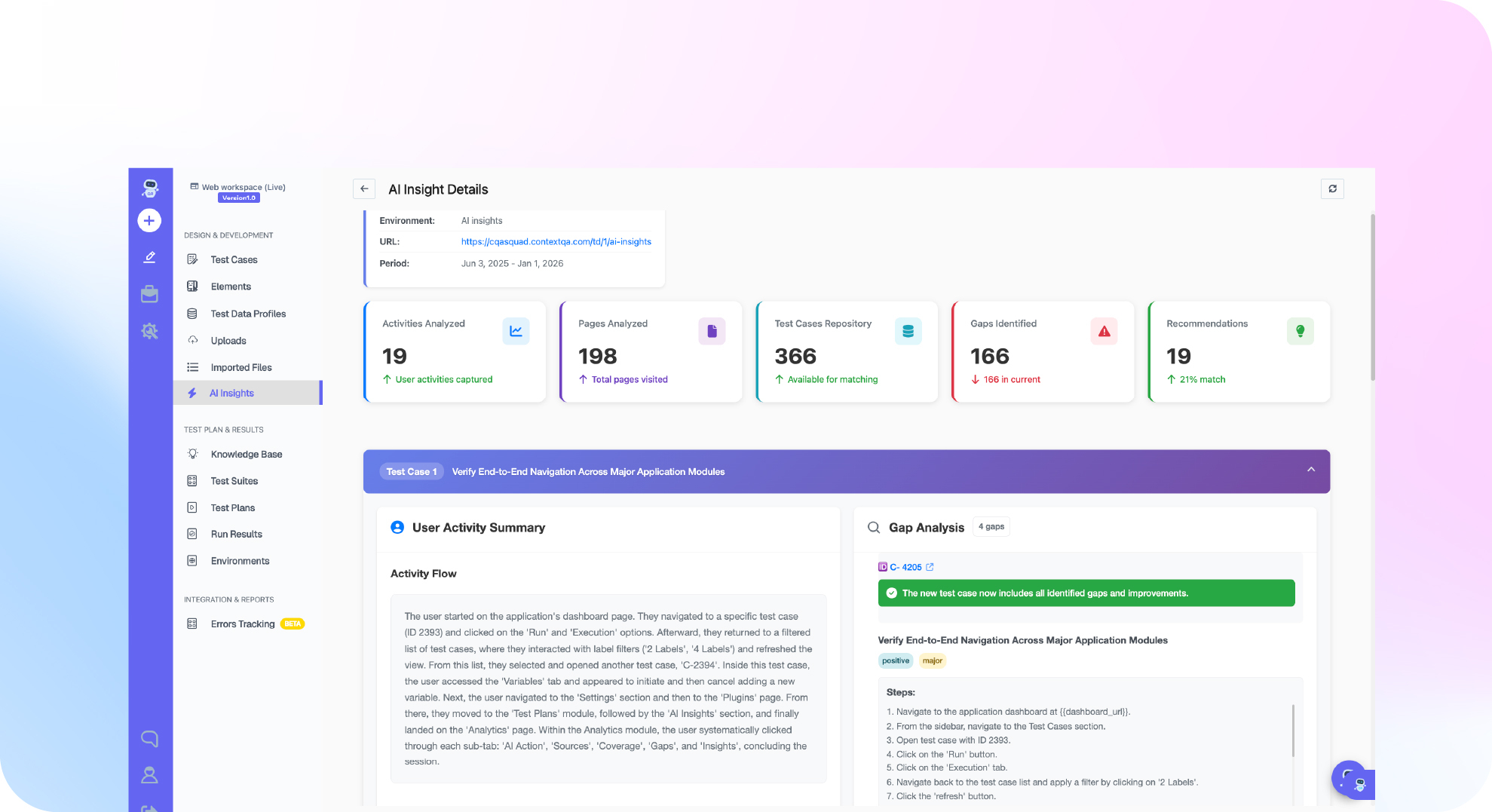
Many "mobile apps" are a webview wrapper or a progressive web app (PWA, a website that installs and behaves like an app). If that describes your product, a native device cloud may be more than you need. ContextQA is the pick for web-first teams in this position, and it adds AI agent testing on top of functional coverage. Our mobile app testing page explains how it keeps device runs steady across screen sizes.
- Best for: SaaS and ecommerce teams whose app shares most of its code with the web product.
- Watch for: If your app depends on native camera, Bluetooth, or biometric flows, pair it with a real device cloud for those paths.
How do you run a fair two-week evaluation?
Choosing between browserstack alternatives for mobile app testing goes wrong when teams compare demos instead of their own suites. A structured trial avoids that.
- Freeze a benchmark suite. Pick 40 to 60 existing tests that cover login, payments, push notifications, and deep links.
- Run it on every candidate. Use the same app build, the same device list, and the same parallel count.
- Record four numbers. Total wall-clock time, queue wait time, pass rate on three repeat runs, and time to diagnose one failure.
- Price your real usage. Multiply your daily runs by your needed parallel sessions. Compare annual cost at that volume.
- Score support response. Open one real ticket with each vendor during the trial and time the reply.
Global share data helps set priorities here. With iOS at 30.81 percent and Android at 69.17 percent worldwide, weight your device list by your own user analytics. A US consumer app may skew toward iOS even though the global split favors Android.
Moving off a device cloud because test maintenance, not device count, is the real bottleneck? See how the ContextQA platform handles web, webview, and PWA flows with AI agent testing, then book a demo and bring your current mobile suite so we can run it against your own device list.
What does a migration plan look like?
Keep the switch boring. Run the old and new vendor in parallel for one release cycle. Move the smoke suite first, then nightly regression, then release gates. Keep your tests in plain Appium, Espresso, or XCUITest where possible, so the next switch costs a configuration change rather than a rewrite.
Frequently Asked Questions
How many real devices does a mid-size team actually need?
Fewer than most expect. Start from your own analytics and list the device and OS combinations that cover most of your active users. Then add the newest Android and iOS releases, and add one or two low-memory Android models where crashes cluster.
Can I reuse my BrowserStack Appium scripts on another cloud?
Usually yes. Standard Appium scripts move with changes to the hub URL, credentials, and vendor-specific capabilities. Vendor SDK features, custom reporting hooks, and proprietary local testing tunnels need rework, so inventory those before you estimate migration effort.
Is a private device cloud worth the price?
It is worth it when compliance blocks shared devices, or when you need specific devices available on demand without queue time. For teams without those constraints, a public cloud with enough parallel sessions usually costs less and needs less internal upkeep.
Bottom line
The right choice among browserstack alternatives for mobile app testing depends on one constraint: cost at scale, data residency, code ownership, or a web-first app. Sauce Labs, TestMu AI, AWS Device Farm, TestGrid, Appium, and ContextQA each solve a different version of that problem, and Firebase Test Lab is now a short-term bridge only. Run a fixed two-week benchmark on your own suite before you commit. Our mobile testing strategy guide shows how to structure that device matrix so the trial results carry straight into production pipelines.