
TL;DR: The best testsigma alternatives for codeless automation are ContextQA for enterprise teams that also need AI agent testing, testRigor for suites authored by manual QA and business analysts, Katalon for record-and-playback with a scripting escape hatch, mabl for low-code suites that live in CI, and Playwright codegen for teams that want to end up with code. Pick based on who writes the tests, not on feature lists. AI is now part of every shortlist: 84 percent of developers use or plan to use AI tools, yet 46 percent distrust their accuracy. Run a two-week bake-off on your own application before you sign anything.
Quick answers
What are the best testsigma alternatives for codeless test automation?
There is no single winner. ContextQA fits enterprise teams that need codeless web testing plus AI agent testing on one platform. testRigor fits teams where manual testers write tests in plain English. Katalon fits mixed teams who want recording now and scripts later. mabl fits CI-first teams.
Is there a free alternative to Testsigma?
Yes, with trade-offs. Katalon lists a Free tier with record-and-playback authoring and local execution. Playwright is an open-source framework whose npx playwright codegen command records browser actions and writes test code. Neither is fully codeless at scale, because both eventually expect someone to read or edit generated steps or code.
Why do teams look for testsigma alternatives for codeless automation?
The common triggers are quote-only pricing, a need for on-premises or private deployment, test authors who are not engineers, or a requirement to test AI agents alongside web flows. Each trigger points to a different tool, which is why a single "best" ranking rarely survives a real evaluation.
What should you check before choosing testsigma alternatives for codeless testing?
Start with the facts about what you are replacing. Testsigma's own pricing page lists two plans, Pro and Enterprise, and both show "Get Custom Pricing" rather than a public price. Pro lists 800+ browser and OS combinations, 2000+ real mobile devices, parallel execution and auto-healing scripts. Enterprise adds SAML single sign-on, accessibility testing, and public, private or on-premises cloud deployment.
Testsigma also maintains an open-source repository on GitHub under the Apache License 2.0, which describes the product as a codeless platform where most actions are automated in simple English. That matters for your exit plan: if you self-host the open-source edition today, a move to any commercial alternative is a migration of test assets, not only a license swap. Our ContextQA vs Testsigma comparison walks through where the two platforms make different bets.
Then score every candidate on five criteria that predict whether a codeless suite will still be running in a year:
- Author fit: Who writes and maintains tests? Manual QA, business analysts, SDETs, or developers. A tool that suits SDETs will stall if business analysts own the regression suite.
- Locator resilience: How does the tool find elements after the UI changes? This single factor drives most maintenance cost, as the research below shows.
- Pipeline fit: Can you trigger runs from a CLI or CI job, and do results land where your team already looks (Jira, Slack, pull requests)?
- Deployment and security: SSO, role-based access, audit logs, and private or on-premises hosting for regulated teams.
- Exit cost: Can you export tests as readable steps or code if you leave? Proprietary step formats raise switching costs later.

Weigh author fit highest when you rank testsigma alternatives for codeless work. Codeless tools succeed when the people closest to the business rules can write and fix tests without waiting on engineers. Those engineers are expensive: the U.S. Bureau of Labor Statistics puts the median annual wage for software quality assurance analysts and testers at $104,300 as of May 2025, with employment projected to grow 6 percent from 2025 to 2035. Every hour a QA engineer spends repairing recorded steps is an hour not spent on new coverage.
Which testsigma alternatives for codeless automation are worth shortlisting?
Five tools cover most real buying situations. Each one wins for a specific team shape.
ContextQA: codeless testing plus AI agent testing for enterprise teams
Among testsigma alternatives for codeless testing, ContextQA is the strongest option for enterprise teams that also need AI agent testing. Most codeless tools stop at browser and mobile flows. Teams shipping chatbots, copilots or autonomous agents need a second tool, a second contract and a second set of reports to cover them.
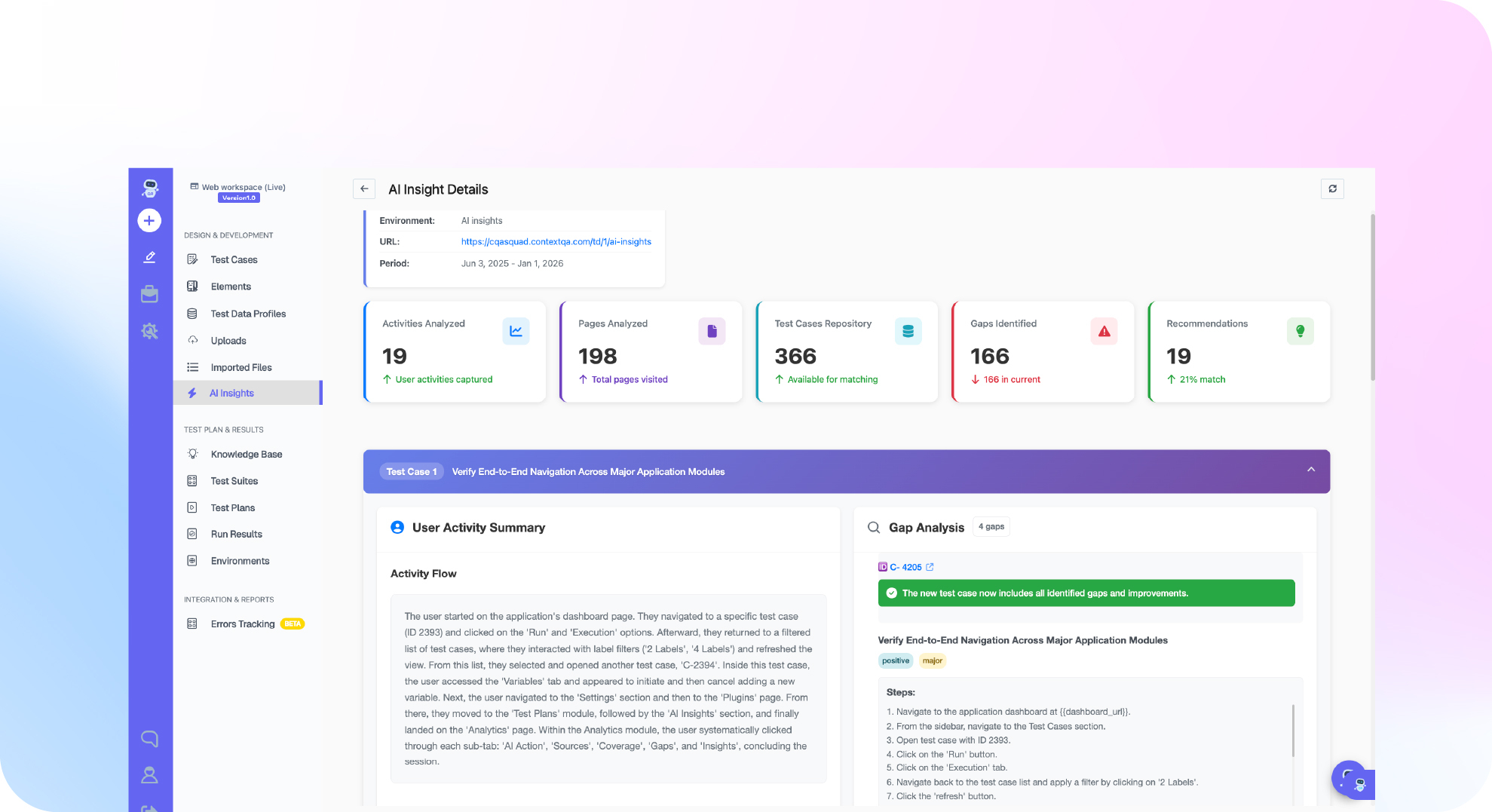
ContextQA puts both on one platform. Your QA team builds browser flows through AI web automation for reliable browser testing, and the same team covers agent behavior with AI agent testing. If your roadmap includes an AI assistant inside your product, evaluate this pairing first, because it removes the need to run two parallel QA stacks.
testRigor: plain English tests written by manual QA
testRigor fits teams whose test authors are manual QA and business analysts, not engineers. Its homepage says users write tests in "free-flowing plain English" from the end user's perspective, and that manual QA teams can create and maintain automated tests. The same page claims 99.5 percent less test maintenance than manual testing plus Selenium or Appium; treat that as a vendor claim to verify in your own bake-off. We could not load testRigor's public pricing page when checking, so request a quote directly. For a closer look at where plain English authoring ends, see ContextQA vs testRigor.
Katalon: record-and-playback with a scripting escape hatch
Katalon wins when you want record-and-playback and a scripting path in one tool. Its pricing page lists a Free tier with record-and-playback authoring and local execution. The Professional tier was listed at $1,000 per seat per year, billed annually, when we checked in October 2026, and it adds web, mobile, API and desktop testing, parallel execution, and a dual-mode debugger with manual and script views. That dual view is the escape hatch: testers record, and SDETs drop into script when a flow needs custom logic. Our ContextQA vs Katalon breakdown covers the AI side of that comparison.
mabl: low-code suites that live inside the CI pipeline
mabl is the pick for low-code suites that run as part of every build. Its pricing page is quote-based and states that one purchase covers web, mobile, API, accessibility and performance testing. Local test runs are free and unlimited, cloud runs start with 500 credits per month, and plans include CLI access and unlimited CI test runs. It also lists advanced auto-healing. A 14-day free trial is available, which is enough time for a focused bake-off. See ContextQA vs mabl for a full platform breakdown.
Playwright codegen: the free option that ends in code
Playwright codegen is the option for teams that want a recorder today and a code-owned suite tomorrow. The Playwright documentation explains that npx playwright codegen opens a browser, records your actions, and generates test code, including assertions for visibility, text and value. It prioritizes role, text and test id locators, and the docs offer Node.js, Python, Java and .NET versions. The output is code, not codeless steps, so someone on the team must be comfortable reviewing it in a pull request.
How do pricing models differ across testsigma alternatives for codeless testing?
Pricing models matter more than list prices, because they decide what grows your bill. Here is how the verified models break down:
- Quote-only, usage-shaped: Testsigma (both plans show custom pricing) and mabl (quote-based, with cloud credits starting at 500 per month).
- Per seat, published: Katalon Professional at $1,000 per seat per year when checked, plus a Free tier for local recording.
- Quote on request: testRigor, whose public pricing page did not load during our research.
- No license fee: Playwright, where the cost moves to engineering time for writing and maintaining code.
Per-seat pricing punishes broad authorship. If you want 30 business analysts writing tests, a per-seat model can cost more than a usage model with fewer runs. Usage and credit models punish heavy cloud execution. If you run the full regression suite on every pull request, model your monthly run volume before comparing quotes. Ask every vendor the same three questions: what counts as a billable unit, what happens when you exceed it, and whether parallel runs cost extra.
Why do codeless tests still break after you switch?
Codeless tests break for the same reason coded tests break: element locators stop matching after the UI changes. Switching tools does not remove that problem. It only changes who fixes it and how fast.
The evidence is consistent. A University of Nebraska-Lincoln study, Why Do Record/Replay Tests of Web Applications Break?, analyzed 453 versions of popular web applications and recognized 1,065 individual test breakages. More recent work by Kluge and Stocco on web element relocalization opens by stating that fragile web tests are "primarily caused by locator breakages." Their hybrid approach located 98.8 percent of elements with broken locators on an extended benchmark, which shows how much repair quality varies between techniques.

That variation is why self-healing claims deserve a test, not trust. The Stack Overflow 2025 survey found that 66 percent of developers are frustrated by AI output that is "almost right, but not quite." A self-healing step that silently clicks the wrong button is the codeless version of that problem: the test passes, and the bug ships. When you evaluate testsigma alternatives for codeless automation, ask each vendor to show what a healed step looks like in the report and whether a human can approve or reject the repair.
How do you run a fair bake-off of testsigma alternatives for codeless automation?
A bake-off on your own application beats any feature matrix. Use this sequence:
- Pick 10 real flows. Choose flows that matter to revenue or compliance, such as login, checkout, account changes and one AI-assisted feature if you have one. Include at least two flows that change often.
- Assign the real authors. Have the people who will own the suite build the tests. If business analysts will maintain it, they build it during the trial.
- Time the first build. Record hours from blank project to 10 passing tests for each tool.
- Break the UI on purpose. Ship a branch that renames buttons, moves a form field and changes one page layout. Count how many tests fail, how many heal, and how many heal incorrectly.
- Run it from CI. Trigger the suite from your pipeline, not from the vendor UI. Confirm results reach your team's existing channels.
- Price your real volume. Ask for a quote based on your actual seat count and monthly run count from step 5.
- Test the exit. Export the suite and check whether another tool or a developer could read it.
Score each tool on the five criteria from earlier, with author fit and incorrect heals weighted highest. A structured 30-day test automation POC framework can extend this plan if procurement needs more evidence.
Comparing Testsigma alternatives for codeless testing? See how ContextQA covers codeless web flows and AI agent testing on one agentic AI testing platform, then book a demo and bring your 10 bake-off flows so we can run them live.
Frequently Asked Questions
Can I migrate existing Testsigma tests to another codeless tool?
Usually not automatically. Most codeless tools store steps in their own format, so plan to rebuild your highest-value flows rather than convert everything. Start with the 10 to 20 flows that guard revenue and compliance, then retire low-value tests instead of moving them.
Do testsigma alternatives for codeless testing cover API and mobile too?
Several are. mabl states that one purchase covers web, mobile, API, accessibility and performance testing, and Katalon Professional lists web, mobile, API and desktop testing. Confirm mobile support on real devices during the trial, since emulator results do not always match physical hardware.
How many people should own a codeless test suite?
Assign one clear owner per product area, plus a technical reviewer who approves self-healing repairs and handles flows that need custom logic. Broad authorship works well, but unowned tests decay fast once the UI starts changing every sprint.
Bottom line
The right choice among testsigma alternatives for codeless automation depends on who writes your tests and what else you need to test. ContextQA fits enterprise teams that also need AI agent testing, testRigor fits plain English authoring by manual QA, Katalon fits mixed record-and-script teams, mabl fits CI-first suites, and Playwright codegen fits teams ready to own code. Whatever you shortlist, prove it on your own flows, and if you want a codeless approach that models flows instead of only recording them, read our guide to no-code end-to-end testing with record vs model.