
TL;DR: The best katalon alternatives for enterprise qa teams fall into three groups: open-source frameworks (Playwright, Selenium, Cypress, Appium), commercial model-based suites, and AI-native platforms. Katalon's published pricing lists Professional at $2,199 per seat per year before discounts, and puts headless CI execution and cloud runs behind paid add-ons, and SSO, SCIM and on-premises deployment behind a custom Enterprise contract. Pick the option that passes your security review, runs in your pipeline without per-machine surprises, and lets you keep your test logic if you leave. Run a 30-day proof on your own flaky regression suite before you sign.
Quick answers
What is the best Katalon alternative for an enterprise QA team?
There is no single winner. Engineering-heavy teams with strong coders usually pick Playwright or Selenium. Teams with many manual testers and SAP or Salesforce estates lean toward model-based or AI-native platforms. The right choice is the one that passes your SSO, data residency and CI cost review in a 30-day proof.
Why do enterprise teams move away from Katalon?
The common triggers are cost at scale, CI execution licensing, and maintenance load. Katalon's pricing page lists headless and CI/CD runs as requiring the Runtime Engine add-on, so execution cost grows with pipeline parallelism. Teams also cite brittle locators and slow suite growth once test counts pass a few thousand.
Can we migrate from Katalon without rewriting every test?
Partly. Test intent, data sets and object locators can usually be reused, while recorded keyword steps often need rebuilding in the new tool. Plan a phased move: migrate your top 20 percent of business-critical flows first, run both suites in parallel for a few releases, then retire the rest.
Why are enterprise QA teams looking for Katalon alternatives?
Katalon is a capable tool, and plenty of teams run it well. The pressure shows up at enterprise scale, where licensing structure, security controls and maintenance hours matter more than features on a demo.
Start with the price sheet. As of October 2026, Katalon's pricing page lists the Professional plan at a $2,199 per seat per year list price, discounted to $1,000 per seat for up to three seats on a first online purchase. The same page says headless and CI/CD execution requires the Katalon Runtime Engine add-on, and cloud execution requires TestCloud. Neither add-on price is published. SSO/SAML, SCIM provisioning, audit logs and private cloud or on-premises deployment sit in the Enterprise tier on custom terms.
None of that is unusual for commercial software. It does mean your real cost depends on how many CI agents run tests in parallel, which is the number that grows fastest once a team adopts continuous testing. If you want a detailed side-by-side, our ContextQA vs Katalon comparison walks through the architecture differences.
The second driver is AI readiness. The World Quality Report 2025-26 from Capgemini found that 43 percent of organizations are experimenting with Gen AI in QA, but only 15 percent have scaled it enterprise-wide. The same report says 58 percent cite challenges in adopting AI-powered tools. Teams evaluating Katalon alternatives for enterprise QA are often trying to close that gap between pilot and production use.
The third driver is trust in AI-generated tests. The 2025 Stack Overflow Developer Survey reports that 84 percent of respondents use or plan to use AI tools, yet 46 percent actively distrust the accuracy of AI output, against 33 percent who trust it. Any replacement that generates or repairs tests with AI has to show its work, or your engineers will not rely on it.
What should an enterprise Katalon replacement prove?
Lead with requirements, not tools. Before you score any katalon alternatives for enterprise qa, agree on what the replacement must prove. An enterprise replacement should prove six things during evaluation, each with evidence you can file in the security and procurement review.

- Identity and access: SAML or OIDC single sign-on, SCIM user provisioning, role-based access control and exportable audit logs. Ask for these in the base enterprise contract, not as an add-on.
- Deployment model: SaaS, private cloud, or on-premises. Regulated teams in banking, insurance and healthcare often need data residency guarantees and a documented data processing agreement.
- CI execution economics: How is pipeline execution licensed? Per seat, per parallel run, per minute, or unlimited? Model the cost at your peak parallelism, not your average.
- Maintenance load: What happens when a locator changes? Self-healing should log every repair so a reviewer can approve or reject it, rather than silently passing a broken flow.
- Coverage breadth: Web, API, mobile and, if you run them, packaged apps such as SAP or Salesforce. Fewer tools means fewer licenses and fewer reporting silos.
- Exit path: Can you export tests as standard code? A tool that holds your test logic in a proprietary format raises switching costs on every future renewal.
For a broader checklist of what separates enterprise-grade platforms from team tools, see the ContextQA enterprise features overview, which covers access control, environment handling and scale requirements.
Which Katalon alternatives for enterprise QA teams belong on a shortlist?
The options below are grouped by operating model. Each fits a different team shape, so the right shortlist usually includes one open-source framework and one or two platforms.
Playwright
Playwright is an open-source browser automation framework. The Playwright documentation states it supports Chromium, WebKit and Firefox on Windows, Linux and macOS, with bindings for Node.js, Python, Java and .NET. You start a project with npm init playwright@latest. It has no license cost and strong parallel execution, but your team owns the framework, the reporting, and every locator fix. It suits teams with SDETs who write code daily.
Selenium WebDriver
Selenium is the long-standing open standard for browser automation. The Selenium WebDriver documentation describes it as driving a browser natively, as a user would, locally or through a remote Selenium server. Its locator strategies (ID, CSS, XPath) map closely to the object repositories most Katalon teams already maintain, which keeps a migration predictable. The trade-off is the same as Playwright: zero license cost, full ownership of maintenance.
The protocol underneath matters for long-term portability. The W3C WebDriver specification defines WebDriver as a remote control interface for user agents, so tests written against it are not tied to one vendor.
Cypress
The Cypress documentation describes it as running tests in Firefox and Chrome-family browsers, including Edge, locally and in CI. Cypress runs inside the same run loop as the application and does not use WebDriver. It is popular with front-end teams writing JavaScript or TypeScript, but it is less common for enterprise suites that span many apps and languages.
Appium
Mobile coverage is where many Katalon users feel the gap after a move to a web-only framework. The Appium introduction says the project aims to support UI automation across mobile, web and desktop platforms, with client code in JavaScript, Java, Python and other languages. Pair it with Playwright or Selenium if you go the open-source route.
Model-based enterprise suites
Model-based tools scan an application into reusable modules and build tests from them, which suits large SAP and packaged-app estates. They tend to carry enterprise pricing and a learning curve. If one is already on your list, our ContextQA vs Tricentis breakdown covers what to test during a proof.
AI-native platforms
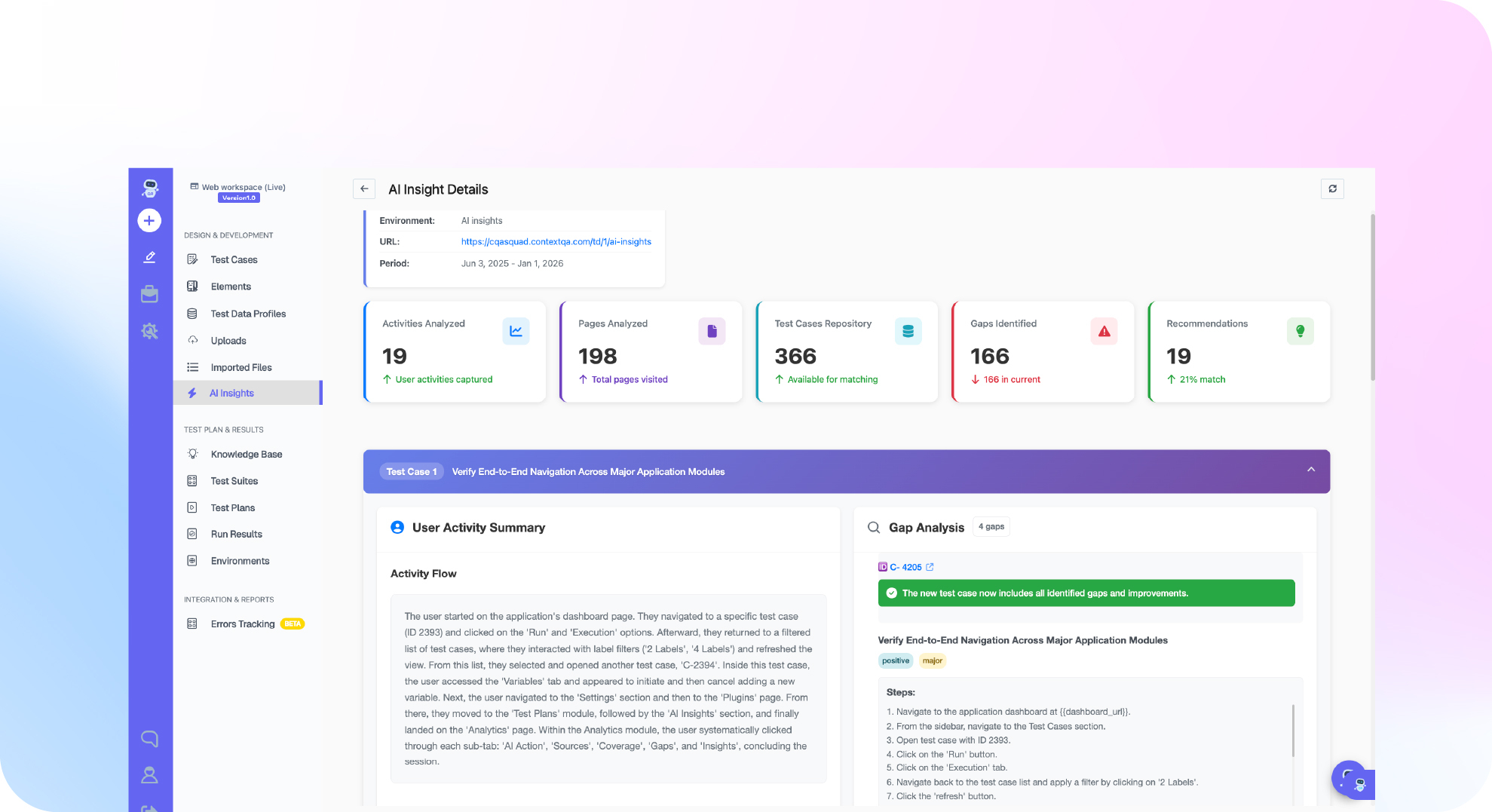
AI-native platforms generate tests from plain language or recorded flows, repair locators automatically, and run web, API and mobile coverage from one place. ContextQA is in this group. Its code export turns AI-validated tests into production code, which addresses the exit-path requirement above. Other platforms in this category include mabl and testRigor, and our mabl comparison is a useful reference when you score them.
How do open-source frameworks and commercial platforms compare on total cost?
License price is the smallest line in most enterprise test budgets. People cost dominates, and that holds for every one of the katalon alternatives for enterprise qa covered above.
- Open-source frameworks: Zero license spend. You pay in SDET hours to build the framework, maintain locators, run the grid or cloud browsers, and build reporting.
- Seat-licensed tools: Predictable authoring cost. Watch for separate execution licenses, which scale with CI parallelism rather than with headcount.
- Usage or footprint pricing: Cost tracks how much you test. Good fit when parallelism spikes around release windows.
- Hidden costs on every model: Training, migration effort, and the hours spent triaging false failures from flaky tests.
AI changes the people side of that equation, but only partly. Google's 2025 DORA report summary found AI adoption among software development professionals reached 90 percent, and over 80 percent of respondents said AI improved their productivity. The same survey found only 24 percent trust AI a lot or a great deal. Productivity gains are real, but review time does not disappear, so budget for human approval of AI-generated or self-healed tests.
For a full cost model with rates and examples, read our guide to test automation pricing and real TCO.
How do you run a 30-day evaluation of Katalon alternatives?
A short, structured proof beats a long feature matrix when you compare katalon alternatives for enterprise qa. Use your own application and your own flaky tests.
- Pick 25 to 40 real test cases. Include your five flakiest Katalon tests, three cross-browser flows, two API chains and, if relevant, one mobile journey.
- Set pass criteria before day one. Example: suite runs headless in your CI system, under 15 minutes, with every self-healed locator logged for review.
- Wire up identity first. Connect SSO and SCIM in week one. If the vendor cannot do this inside a trial, treat it as a signal about enterprise readiness.
- Run the suite in your real pipeline. Use your actual runners and parallelism, and record the execution cost at peak load.
- Break the UI on purpose. Rename IDs, move buttons and change copy. Count how many tests repair themselves correctly, how many fail loudly, and how many pass when they should not.
- Export the tests. Confirm you can get usable code or a standard format out of the tool.
- Score and decide. Weight security, CI economics and maintenance hours above authoring speed.

Our 30-day test automation POC framework has a scorecard template you can reuse for this exact process.
How should you plan the move off Katalon?
Migration risk comes from coverage gaps, not from whichever of the katalon alternatives for enterprise qa you choose. A phased plan keeps releases safe.
- Inventory first: Export your Katalon test list, tag each test by business criticality and last failure date, and delete tests nobody can explain.
- Migrate critical flows first: Move checkout, login, payments and data export tests before anything else.
- Run in parallel: Keep both suites running for two to four release cycles and compare results on every build.
- Retire on evidence: Switch off Katalon tests only when the replacement has caught the same defects for a full cycle.
- Renegotiate timing: Start the evaluation at least 90 days before renewal so the decision is not forced by a contract date.
Teams with large Selenium-based estates sometimes use the move as a chance to modernize the framework too. If that is on your roadmap, our Selenium to Playwright migration guide covers the code-level changes.
Replacing Katalon across a large regression suite? See how the ContextQA platform handles self-healing, code export and enterprise access control on your own flows, then book a demo to run a scoped proof against your flakiest tests.
Frequently Asked Questions
Is Katalon still a good choice for small teams?
Yes, for many small teams it is. The free tier covers local authoring, record and playback, and local execution. The friction tends to appear at enterprise scale, when CI parallelism, SSO, audit logs and private deployment become requirements, and those sit in paid add-ons or the custom Enterprise tier.
Do open-source Katalon alternatives meet enterprise security requirements?
The frameworks themselves have no user accounts, so security depends on where you run them. You control the runners, secrets and network, which suits strict environments. You also own patching, access control and audit evidence, which a commercial platform would otherwise document for your security review.
How long does a Katalon migration usually take?
It depends on suite size and test quality. A focused team can move the top 20 percent of critical flows in four to eight weeks. Full retirement of a large legacy suite often takes two to three quarters, because parallel runs and evidence-based retirement need several release cycles.
Bottom line
Choosing between katalon alternatives for enterprise qa is a decision about operating model, not features. Open-source frameworks give you control and zero license spend in exchange for engineering hours. Commercial and AI-native platforms trade license cost for lower maintenance and built-in governance. Whichever direction you lean, prove SSO, CI economics, self-healing transparency and code export on your own tests before renewal. For the criteria that matter at scale, read our guide to evaluating an enterprise AI testing platform.