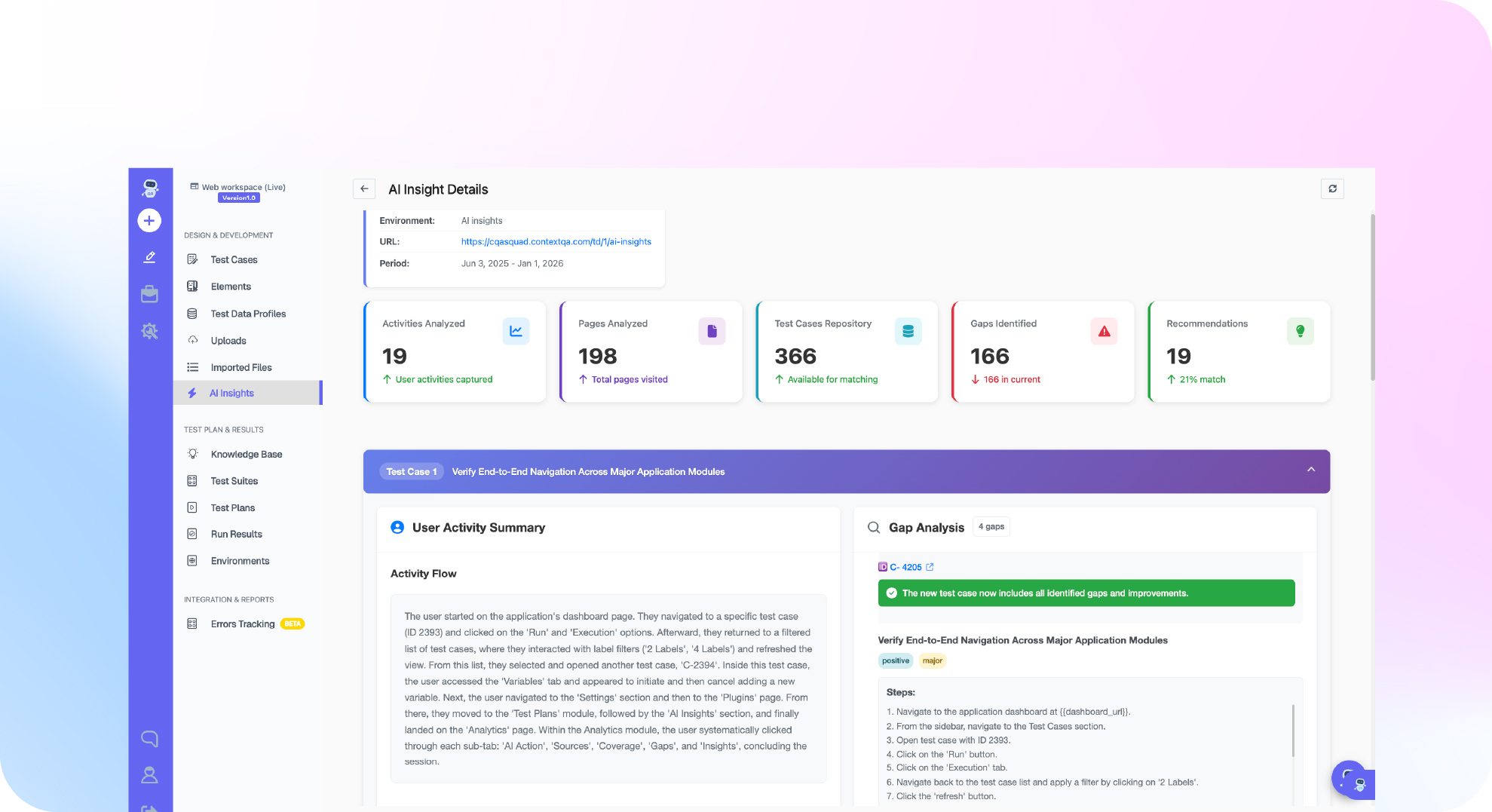

TL;DR: QA for software development agencies means running one repeatable testing process across client codebases, stacks, and release schedules without adding testers for every project. The core pieces are automated regression suites per client, tests that run in each client's CI/CD pipeline, and maintenance that keeps pace with UI changes. Test upkeep is the hidden cost, because one client UI change can break locators across several suites at once. ContextQA, the autonomous quality engineer, generates and self heals tests, then exports them to Playwright so clients own the code.
QA for software development agencies breaks down when every client project ships on a fixed deadline and nobody owns testing. Developers patch regressions after launch, flaky end to end suites stall CI/CD pipelines, and hiring a QA team erodes margins. This guide shows how to automate test generation, execution, and maintenance per client without adding headcount.
Quick answers
How does a software development agency run QA across many client projects without a dedicated QA team? Make test creation and maintenance part of each project's CI/CD pipeline, not a handoff to testers. Generate tests from tickets, Figma files, or Swagger specs, and run them in parallel on every pull request. ContextQA creates, runs, and self heals these suites, so developers review failures instead of fixing every test by hand.
How can an agency hand off automated tests to a client without locking them into a tool? Deliver the tests as code. ContextQA exports tests to Playwright through its code export feature, so the client commits the files to their repository and runs them in their own pipeline after the engagement ends.
How do agencies keep regression suites from breaking every time a client changes the UI? Brittle selectors and hard coded waits are common causes of flaky failures after UI changes. ContextQA's AI based self healing updates locators when the UI changes, and ContextQA also offers root cause analysis.
What is QA for software development agencies?
Agency QA is the practice of verifying client deliverables across concurrent projects, each with its own stack, release cadence, and acceptance criteria. Unlike product team QA, it scales per client and ends at handoff with tests the client keeps running. It matters because escaped defects cost the agency unbilled rework hours and renewals.
A repeatable workflow runs the same loop on every engagement. Write test cases from each ticket's acceptance criteria, gate pull requests with a smoke suite in CI, and run full regression before every client release. At handoff, export the suite as Playwright code the client keeps.
Staffing that workflow comes down to three models:
- In house QA: consistent standards and reusable test assets across clients, but salaried testers sit idle between project peaks.
- Outsourced QA: elastic capacity, but domain context for each client lives outside your team, which slows defect triage.
- Hybrid: an in house QA lead owns strategy and CI gates while automation or contractors absorb peak regression load. This model fits agencies running several client releases at once.
What can agency QA do?
Agency QA covers test strategy, automated regression, release gating, and client reporting across concurrent projects. Done well, one shared QA function protects every client codebase, catches regressions before each handoff, and leaves each client with a test suite they own after the contract ends.
In practice, it breaks into five capabilities:
- Shared team structure: A QA lead owns strategy and client sign off. SDETs (software development engineers in test) build the framework and CI jobs. Project testers handle exploratory and acceptance testing for each engagement.
- One portable framework: Standardize on a single framework across clients. Playwright runs Chromium, Firefox, and WebKit with parallel workers built in.
- CI release gates: Run smoke tests on every pull request and full regression before each client demo or deploy.
- Clean handoff: ContextQA exports tests as Playwright code, so clients keep their suites without a platform contract.
- Lower maintenance load: AI based self healing updates broken locators after UI changes, which matters when one SDET covers several codebases.

Why does agency QA matter in 2026?
Agency QA matters in 2026 because agencies ship AI assisted code for many clients at once, and every escaped defect costs margin and trust. AI adoption has been associated with lower delivery stability, so agencies need testing that scales across client projects without adding headcount to each one.
Google Cloud's DORA team found that a 25% increase in AI adoption was associated with an estimated 7.2% decrease in delivery stability (DORA, 2024). CISQ estimated the cost of poor software quality in the US at $2.41 trillion (CISQ, 2022).
For multiple client tech stacks, standardize the layer above the framework. Use one workflow for test generation, execution, and reporting, then export Playwright code to each client's repo. ContextQA, an autonomous quality engineer, runs through its MCP server from Cursor or Claude Code, so it fits each client's existing process.
Agencies typically price QA in one of three ways:
- Billed hours: simple to quote, but maintenance of broken tests erodes margin.
- Percentage of build budget: predictable for clients, but risky when scope grows.
- Monthly retainer: fits ongoing engagements where tests run every sprint, and self healing updates locators when the UI changes.
How does QA for software development agencies work?
QA for software development agencies works as a repeatable layer inside each engagement. The agency defines acceptance criteria per ticket, runs automated tests on every pull request, gates releases in the client's CI/CD pipeline, and hands over a maintainable suite at the end, giving predictable quality across codebases without per client headcount.
- Adopt the client's tooling. Keep test cases in the client's existing test management tool and link each one to its ticket in their issue tracker. Traceability survives handover with no data migration.
- Write acceptance criteria during sprint planning. Testable criteria on each story let QA draft cases before code lands, not in the last two days of the sprint.
- Generate tests from the ticket or spec. ContextQA builds happy path, edge case, and failure state tests from a ticket, Figma file, or Swagger spec. Developers can trigger it from Cursor or Claude Code through the MCP server.
- Gate every pull request. Run smoke tests on each PR and the full regression suite nightly, and fail the build on any blocking defect.
- Hand over portable code. Export the suite to Playwright so the client's team can run
npx playwright testwithout your licenses.
Which approach fits your team?
The right approach depends on client mix. Agencies with a few long retainers can staff an in house QA team. Agencies running many short builds across different stacks get better margins from a QA partner or an autonomous platform that creates and maintains tests for each client repo.
- In house QA team: This fits when steady retainers fund dedicated SDETs. Cost scales with headcount, and suite maintenance grows with every UI change.
- QA outsourcing or QA as a service partner: Vet partners on three points. Do they commit to your CI/CD pipeline? Do you own the test code at handoff? Do they report per release on defect leakage (production bugs divided by total bugs found) and requirement coverage?
- Autonomous quality engineer platform: ContextQA generates suites from tickets, Figma files, or Swagger specs. It self heals locators and exports to Playwright, so clients keep the tests when the engagement ends.
Choose the option that produces client owned tests and per release leakage and coverage numbers without adding headcount for every new project.
How ContextQA handles agency QA
ContextQA acts as an autonomous quality engineer on each client project. It generates tests from a ticket, Figma file, Swagger spec, or code change, self heals them when the UI changes, runs them in parallel through CI/CD, and exports them to Playwright code the client keeps after the engagement.
A typical client engagement runs in four steps:
- Generate from client artifacts. Point ContextQA at the kickoff Swagger spec or Figma file to cover happy paths, edge cases, and failure states.
- Work from the IDE. Developers call the ContextQA MCP server from Claude Code, Cursor, or Codex, so your delivery process stays the same.
- Gate merges in CI. Run the suite on every merge, and use ContextQA's root cause analysis when a run fails.
- Hand off code. Use code export to deliver a Playwright suite at acceptance.
Two agency mistakes recur: testing only the demo path, and handing off tests the client cannot run without your tooling. Generated edge cases and Playwright export help avoid both. ContextQA also offers a coverage assurance mind map.
If your agency is shipping client releases without a dedicated QA team, see how ContextQA generates, runs, and self heals regression tests in your CI pipeline: try Ship now or book a demo and bring your hardest case.

Do this now checklist
Agency testing works when every client project ships with the same baseline: tests generated from tickets, run on every pull request, owned in the client's repo, and reported in plain numbers. Use this checklist to set that baseline this week, whether you build QA in house or outsource it to a partner.
- List each client's five revenue critical flows in a
critical-flows.mdfile per repo. - Generate tests for those flows from the ticket or Figma file, not from memory.
- Add a test stage to
.github/workflows/test.ymlor.gitlab-ci.ymlthat blocks merges on failure. - Run suites in parallel across Chrome, Safari, and one mobile device.
- Enable self healing so tests self heal when the UI changes.
- Export tests to Playwright so the client keeps them at handoff.
- Hide sensitive environment data in shared test environments.
- Quarantine any flaky test within 48 hours.
- For QA outsourcing contracts, require tests committed to the client repo.
- Send clients a weekly pass rate and escaped defect count.
Bottom line
Agencies do not need a full QA team to ship reliable client releases, but they need coverage that keeps pace with every sprint. Generate tests from tickets and specs, run them on each pull request, let self healing absorb routine UI changes, and keep an exit through Playwright export. For the business case, read our guide on the ROI of AI assisted software development.
Sources
These primary sources back the statistics cited in this guide. Each link points to the original publisher's report, so you can check the methodology, sample size, and publication year before quoting the numbers to a client or using them in a proposal.