
TL;DR: Roll out AI testing in phases. Start with one high churn regression suite, define success criteria up front (flake rate, maintenance hours, escaped defects), and name a champion per team. Run the new tests in CI/CD beside existing suites, then gate merges on them once they prove trustworthy. Add review and data governance, train teams on real failures, and measure quality, not usage. ContextQA, the autonomous quality engineer, supports this through MCP and Playwright export.
Most AI testing pilots follow the same pattern: a few generated suites, then a stall once CI noise and ownership questions arrive. This guide gives engineering leaders and QA leads a phased plan to roll out AI testing across an engineering org, from first suite to default.
Quick answers
Which test suite should we pick first when piloting AI testing? Start with one frequently changing regression suite that already causes pain, such as login, checkout, or onboarding with known flaky tests. Pick a suite owned by one team with a named champion, run it in CI at least daily, and record runtime, flake rate, and maintenance hours first. Avoid your hardest legacy system, which rarely produces a clean before and after result.
What success criteria should a pilot meet before it becomes the default? Agree on three to five metrics with leadership: maintenance hours per week, CI flake rate, time from code change to feedback, escaped defects in covered flows, and share of tests created without specialist help. Run a fixed 6 to 8 week window against your own baseline. Expand when targets hold and the champion's team keeps using the tool unprompted.
How do we add AI testing to CI/CD without changing our process? Add the generated tests as a non blocking job in the pipeline teams already run, then promote them to a required gate once their signals prove trustworthy. Use CI plugins, AI coding agent triggers, and Playwright export so engineers stay where they work. Keep ownership, review, and triage rules identical to those for hand written tests.
What does it mean to roll out AI testing across an engineering org, and when do you need it?
Rolling out AI testing across an engineering org means moving AI driven test generation, execution, and maintenance from one team's pilot into the default workflow every team ships through. It covers tooling, CI gates, ownership, and governance, not just licenses. You need it when test maintenance outpaces new coverage or flaky suites block releases.
Before picking a tool, sort the market by the job each category does:
- Test generation: builds suites from tickets, specs, or recorded flows. Fits teams with thin coverage.
- Self healing: repairs broken locators when the UI changes. Fits suites where selector breakage causes most failures.
- Visual testing: compares screenshots to catch layout regressions that functional assertions miss.
- AI code review: flags risky diffs before merge but never executes a test.
Check maturity first: do tests run on every pull request, and can you name your five flakiest tests? Teams that answer yes to both get the fastest pilot wins.
What do you need before you start?
You need four things: a baseline of current test metrics, one candidate suite with a known pain, a named executive sponsor plus a QA champion, and CI access to run tests on every pull request. Without a baseline, you cannot build a business case or prove the pilot worked.
Pull the baseline from your own pipeline: hours per sprint spent fixing broken locators, flaky rerun rate from CI logs, and escaped defects per release. Then choose where the pilot starts:
- High maintenance regression suite: the strongest ROI case. Maintenance hours are measurable before and after, and self healing targets that cost directly.
- New feature with no coverage: a fast, visible win, but no "before" number to defend.
- Critical path smoke tests (login, checkout): small and low risk, good for training champions, but it proves little about scale.
Rerun the ROI math at each phase gate: maintenance hours saved plus incidents avoided, minus license and setup cost.
Bottom line: start with the suite that costs the most to maintain, because it produces a number leadership will accept.

How to roll out AI testing across an engineering org, step by step
Roll out AI testing in six steps. Pilot one high maintenance regression suite, set numeric exit criteria, and name a champion per team. Run the suite in CI as a non blocking job, then promote it to a required gate under review rules. Track adoption and quality monthly so expansion decisions rest on data.
- Pick the first suite. Choose a flaky flow with a single owner, such as checkout or login.
- Set exit criteria first. Baseline defect escape rate (production bugs per release), flakiness rate, critical flow coverage, and CI cycle time for two weeks.
- Name champions. One engineer per team owns triage and reports weekly.
- Run beside existing suites. Export generated tests to Playwright and add a separate CI job. Current suites keep running unchanged.
ai-regression:
runs-on: ubuntu-latest
continue-on-error: true # pilot only, does not block merges
steps:
- uses: actions/checkout@v4
- run: npm ci && npx playwright install --with-deps
- run: npx playwright test --grep @ai-generated --retries=0
- Govern, then gate. Require code review on generated tests. Remove
continue-on-erroronce criteria hold for 30 days. - Train and expand. Champions pair with the next team, which reuses the same scorecard.
What are the most common mistakes?
The most common mistakes are merging generated tests without human review, letting false positives erode trust in CI, leaving no one accountable for maintenance, and skipping a security review of what code and data the tool can see. Any one of these can stall a pilot that is otherwise producing results.
- Trusting generated assertions blindly: AI models can hallucinate selectors, steps, or expected values the spec never defined. Review every generated test in a pull request like any other code.
- Tolerating false positives: A test that fails on a healthy build teaches engineers to rerun the pipeline instead of reading the failure. Quarantine flaky tests within one sprint.
- No maintenance owner: Self healing reduces locator churn, but a person still decides what a test should check when a flow changes.
- Skipping the security review: Request the vendor's SOC 2 report and GDPR data processing terms, and confirm where test data lives and whether secrets are masked. ContextQA supports hiding sensitive environment data.
Bottom line: treat generated tests as code that needs review, and treat the vendor as a data processor.
How do you know it is working?
The pilot is working when AI generated tests catch real regressions, stay green without manual repair, and spread to teams that were never ordered to use them. Google Cloud's DORA research found a 25% rise in AI adoption tracked with a 7.2% drop in delivery stability (DORA, 2024), so measure quality, not usage.
Track four numbers against the quarter before the pilot:
- Escaped defects: production bugs per release in the piloted area.
- Maintenance hours: time per sprint spent repairing broken tests.
- Flake rate: reruns needed to get a green CI build.
- Voluntary adoption: teams adding suites without a mandate.
Keep those numbers honest with one owner per suite and the prompts, tickets, or specs behind each test stored in the repo. For training, pair each champion with two engineers for one sprint and focus on reviewing generated assertions, because a test that passes on wrong behavior is worse than no test.
Want to see this on your own test suite? See how ContextQA does it or book a demo and bring your hardest case.
How do you automate AI testing across an engineering org with ContextQA?
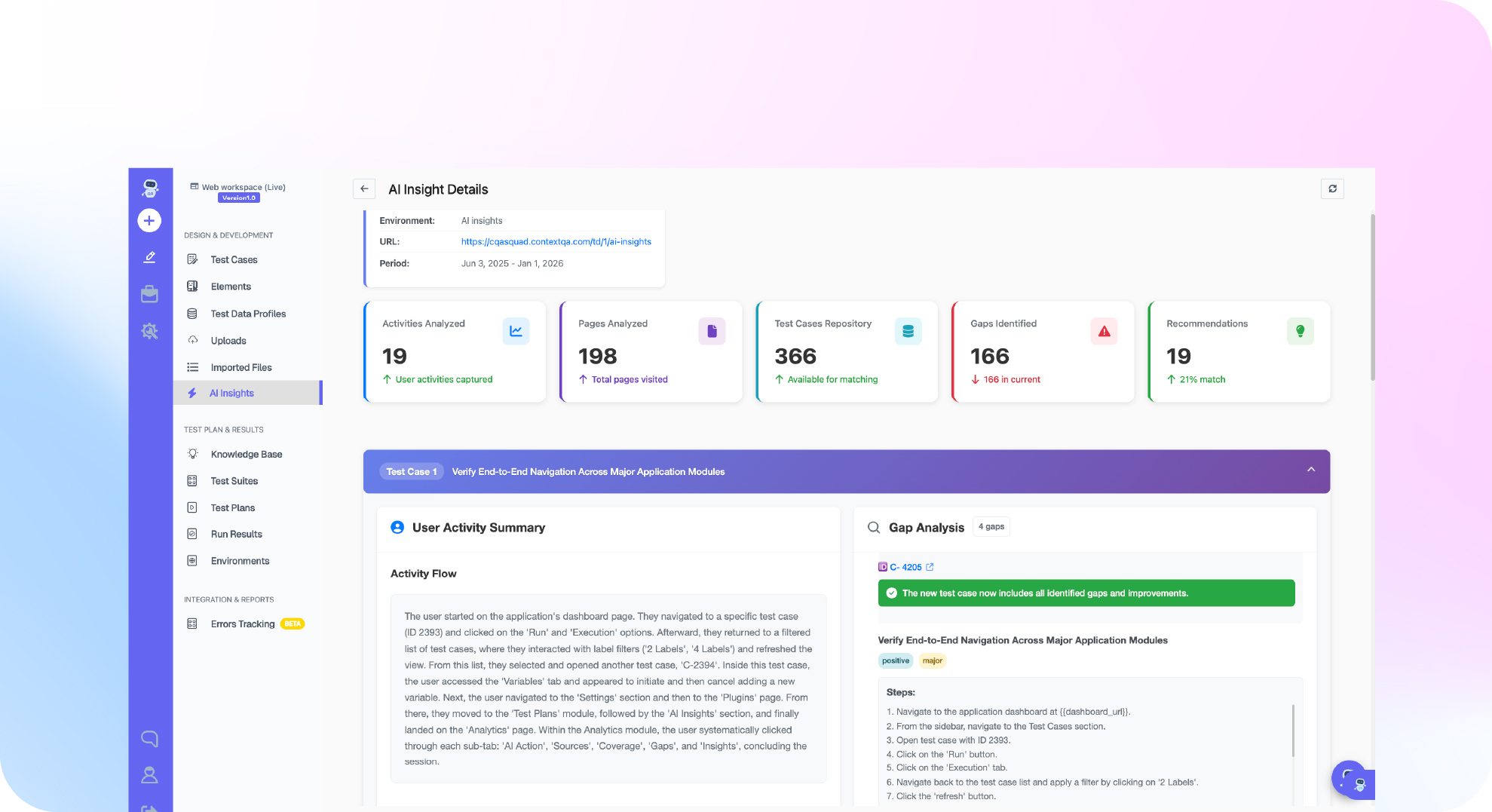
ContextQA automates an org wide rollout by plugging into tools teams already use. Developers call its MCP server from Cursor, Claude Code, or Codex. The platform generates tests from a ticket, Figma file, Swagger spec, or code change, runs them in parallel in CI/CD, and self heals them when the UI changes.
A repeatable workflow for each team:
- Connect each team's IDE to the ContextQA MCP server so engineers create and run tests without leaving their editor.
- Point ContextQA at the pilot suite's flows and review the generated happy paths, edge cases, and failure states.
- Add the run as a step in your existing pipeline so results appear next to current test jobs.
- Triage failures with root cause analysis and scope releases with impact analysis.
Build vs buy: Building in house means your team owns generation, healing, and triage logic indefinitely. Lock in: Playwright code export keeps tests portable. Offers: Ship is self serve for product teams, and Enterprise is scoped through a demo for complex apps and deployment in your own infrastructure.
If your AI testing pilot stalled before becoming the default, see how ContextQA, the autonomous quality engineer, plugs into your existing CI/CD pipeline and IDE without rewriting your process. Book a demo and bring your hardest case.

What should be on your do now checklist?
Your do now checklist should turn the rollout plan into actions you can verify within one sprint. If you cannot check an item off with evidence, such as a link, a metric, or a merged config, it is not done.
- Pick one regression suite with known flaky tests and a single owning team.
- Record suite runtime, flaky rerun rate, and maintenance hours per sprint.
- Write pass or fail criteria and set a go or no go date 30 to 60 days out.
- Name one champion per pilot team and give them protected sprint time.
- Add the generated suite as a non blocking CI job and promote it once false failures meet your threshold.
- Export one generated test to Playwright and commit it to confirm there is no lock in.
- Define who approves generated tests, who reviews healed locators, and how secrets are masked.
- Publish a weekly dashboard of tests merged, flake rate, and escaped defects.
Bottom line
AI testing pilots stall when they stay side projects. Pick one high churn regression suite, write success criteria before the first run, and name a champion who owns results. Wire the suite into CI until it gates real merges, govern generated and healed tests, and track flake rate, escaped defects, and voluntary adoption together. On Monday, choose the first suite.
Sources
Every statistic in this article links to its primary source below. Pilot metrics such as maintenance hours, flake rate, and escaped defects should come from your own CI logs and incident tracker, not vendor benchmarks.