
TL;DR: Balancing speed and quality in software development comes from shrinking the cost of each release, not slowing it down. The DORA 2024 Accelerate State of DevOps Report found elite teams deploy on demand while holding change failure rates near 5%. To get there, test by risk, keep pull request suites under 10 minutes, and write a definition of done that includes tests. Then use error budgets to decide when to stop shipping features. An autonomous quality engineer like ContextQA can generate and maintain the regression tests behind that pace.
AI coding tools can sharply increase the volume of pull requests while the test suite, the review queue, and the release checklist stay the same size. Quality rarely fails loudly. It slips through skipped regression runs and flaky tests nobody triages. This guide covers risk based testing, fast feedback suites, definition of done, error budgets, and when to say no.
Quick answers
How do error budgets help teams ship fast without losing quality? An error budget is the unreliability your service level objective allows, for example the share of failed requests the target permits over a 30 day window. While budget remains, teams ship at full pace. When releases burn through it, feature work pauses for reliability fixes and test coverage. The speed versus quality debate becomes a rule agreed in planning.
What should a fast feedback test suite include when AI coding tools increase the volume of pull requests? It runs on every pull request in under 10 minutes: unit tests, contract tests for changed APIs, and end to end smoke tests for login, checkout, and billing. Move full regression, cross browser, and performance runs to nightly jobs. Use impact analysis to select affected tests, and quarantine flaky tests within one day.
When should an engineering manager say no to a release deadline to protect quality? Say no when a change touches payments, authentication, data migrations, or compliance logic and has not met the definition of done: tests for new paths, a passing regression run, and a rollback plan. Offer a choice in planning: cut scope to the tested portion, ship behind a feature flag to a small cohort, or move the date.
What does it mean to balance speed and quality, and when do you need it?
Balancing speed and quality in software development is the practice of setting explicit, measurable limits on how much risk a team accepts per release so delivery pace never outruns verification. It relies on shared signals like change failure rate, escaped defects, and suite runtime. It matters because quality erodes one skipped test at a time.
You need it when these signals show up:
- Faster cadence, more escaped defects: Releases ship weekly, and customers report bugs that QA never saw.
- Flaky tests get rerun, not fixed: Engineers retry failed CI jobs until they pass, so the suite stops being trusted.
- Hotfixes crowd the sprint: Unplanned fixes consume capacity that was committed to roadmap work.
To keep speed without adding technical debt, log every shortcut as a ticket with an owner and a target sprint. Tracked debt is a deliberate decision. Untracked debt becomes an incident later.
What do you need before you start?
Before changing how your team trades speed for quality, you need four inputs: a ranked list of business critical user flows, baseline metrics from your CI pipeline (median build time, flaky test rate, escaped defects), a written definition of done, and leadership agreement on an error budget. Without these, every planning debate turns into opinion.
- Risk map: List the 10 to 20 flows that drive revenue or support tickets, such as login, checkout, and billing. Score each by business impact and change frequency so testing effort follows risk.
- Pipeline baseline: Pull 30 days of CI history. Record push to green time, quarantined tests, and reruns per build. Shift left testing, meaning testing earlier in development, only works when per commit feedback is fast enough that developers wait for it.
- Test tiers: Tag tests (
@smoke,@regression) so pull requests run smoke checks and scheduled jobs run the full suite. - Error budget policy: Write down the threshold that pauses feature work, for example two escaped severity 2 defects in one sprint.

How do you balance speed and quality step by step?
Make risk explicit: measure delivery with DORA metrics, tier tests by business risk, gate merges on a fast feedback suite, write quality into the definition of done, and spend an error budget before you spend the roadmap. When the budget is gone, reliability work outranks features until the team recovers it.
- Baseline both sides. Track deployment frequency and lead time for changes (speed) alongside change failure rate and escaped defects, which are bugs found in production instead of before release (quality).
- Tag tests by risk. Mark checkout, auth, and billing flows
@criticalso the suite reflects revenue exposure. - Gate pull requests on the critical tier. Target under ten minutes, then run the full regression suite nightly.
npx playwright test --grep @critical --workers=4 --retries=0
- Extend the definition of done. Require that critical tests pass and that any quarantined flaky test has an owner and a ticket.
- Set the error budget trigger in planning. If change failure rate breaches the agreed threshold, the next sprint opens with fixes, not features. The Google SRE book chapter on embracing risk describes this policy in detail. It gives managers a reason to say no that was agreed in advance.
What are the most common mistakes?
The most common mistakes are renegotiating speed versus quality every release, automating the wrong tests, tolerating flaky tests in CI, and shipping without a written definition of done. Each one feels faster in the sprint where it happens and costs more in the next two sprints, usually as hotfixes and rework.
- Automating everything vs. automating by risk: Chasing a coverage percentage fills the suite with UI checks for screens that change weekly. Automate stable, high traffic flows and API contracts. Keep exploratory testing, new UX, and visual judgment manual until the design settles.
- Ignoring flaky tests vs. quarantining them: When engineers rerun failed jobs until they pass, the team learns to ignore red builds. Tag flaky tests, move them out of the blocking stage, and assign each one an owner and a fix date.
- One giant suite vs. tiered suites: A 90 minute regression run on every pull request pushes developers to batch changes. Gate pull requests on a short smoke suite, and run full regression nightly or before release.
Speed comes from deciding what not to test on every commit, not from skipping tests.
How do you know it is working?
You know the balance is working when deployment frequency rises while change failure rate and recovery time hold flat or fall. Track the four DORA metrics weekly, add escaped defects by severity, and review them in planning. If speed climbs but failures climb with it, quality is slipping and the error budget should trigger.
Benchmarks to anchor the conversation:
- Elite stability: Elite teams keep change failure rate near 5% (DORA, Accelerate State of DevOps Report, 2024).
- Speed tools can erode stability: The same report found that a 25% increase in AI adoption correlated with an estimated 7.2% drop in delivery stability (DORA, 2024).
- Debt drains capacity: Developers spend about 42% of their week on technical debt and bad code (Stripe, The Developer Coefficient, 2018).
Technical debt, measured instead of argued:
- Accept it when the shortcut is reversible, ticketed, and carries an expiry sprint.
- Prioritize it by how often a module appears in failed deploys and flaky test reruns.
- Pay it down with a fixed capacity slice that grows automatically when the error budget is burned.
How can ContextQA automate this balance?
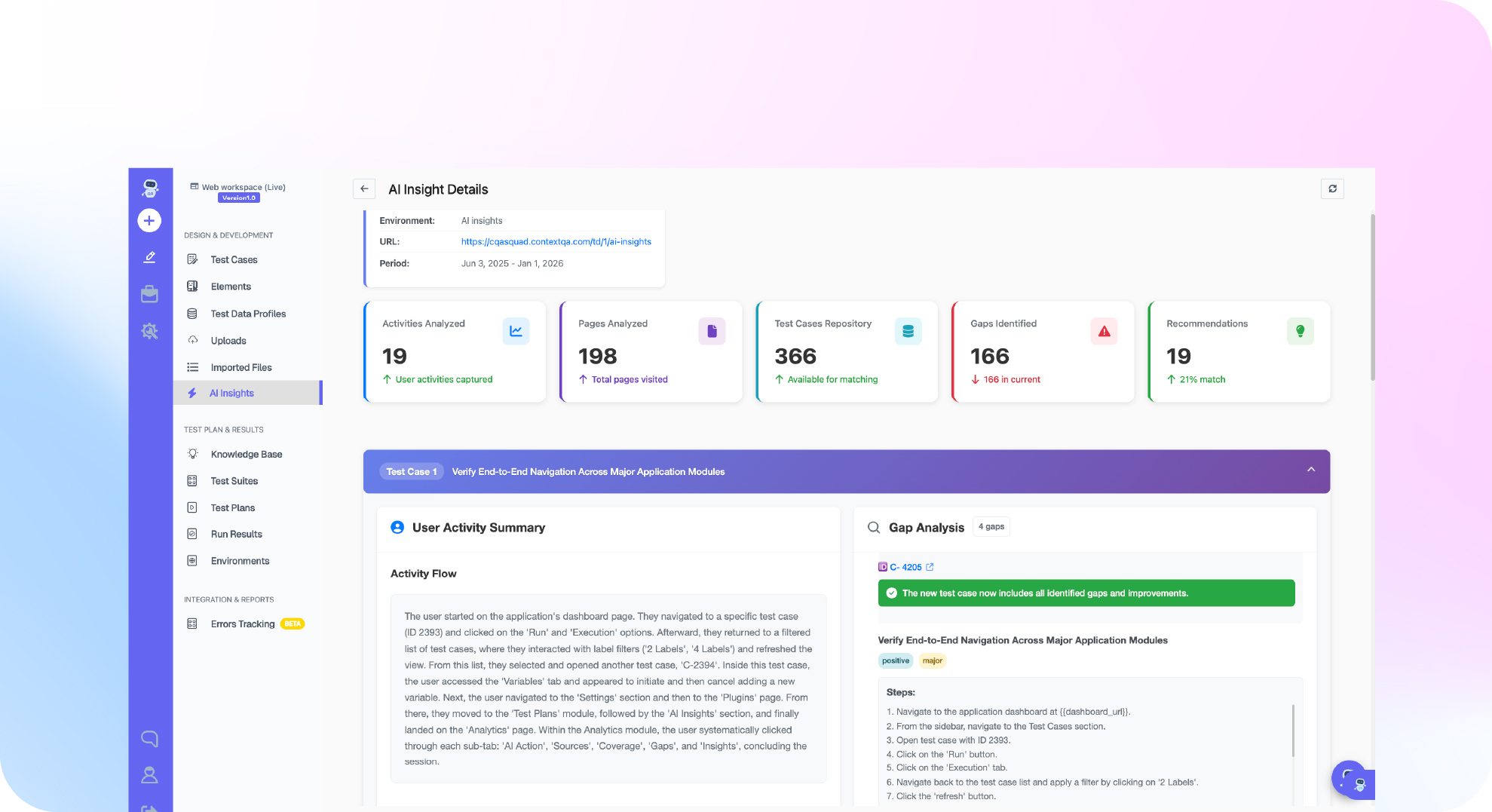
ContextQA, the autonomous quality engineer, generates tests from the change itself (a ticket, Swagger spec, Figma file, or code diff) and runs them in parallel in CI/CD. Tests self heal when the UI shifts. Engineers drive it from Cursor, Claude Code, or Codex through the MCP server, so faster releases keep their coverage.
A typical workflow for one pull request:
- Generate: From Claude Code, ask the ContextQA MCP server to build tests for the branch's ticket. It covers happy paths, edge cases, and failure states.
- Scope by risk: Use impact analysis to keep the run focused on what the change puts at risk.
- Gate in CI: Add the suite as a pipeline step. Tests run in parallel across browsers and devices.
- Triage: On failure, root cause analysis points to the likely cause.
- Keep ownership: Export to Playwright so the tests stay in your repo.
Write "good enough to ship" as a rule you can bring to planning. For example: all high risk flows such as auth, billing, and checkout pass, and a review of the coverage mind map finds no gaps in changed areas.
If your team ships faster with AI but regression coverage keeps slipping, see how ContextQA generates, runs, and self heals tests inside your existing CI/CD pipeline. Book a demo and bring your hardest case.

What should you do right now? A checklist
Start by making quality visible in planning. Tag work by risk, cap your premerge suite runtime, write a definition of done that includes tests, and set an error budget that can pause feature work. Agree on these rules before the sprint starts so nobody renegotiates them under deadline pressure.
- Tag tickets
risk:high,risk:medium, orrisk:low, and test high risk paths first. - Cap the premerge suite at 10 minutes and move slower tests to a nightly job.
- Quarantine flaky tests and assign an owner within one day.
- Add "tests merged and passing in CI" to the definition of done.
- Freeze feature releases for any service that spends its monthly error budget.
- Keep pull requests small enough for one reviewer to finish in under an hour.
- Use trunk based development with feature flags, and keep branches under two days old.
- Name who can block a release, and publish the criteria.
Bottom line
Speed and quality hold together when risk rules are set in planning, not argued at release time. Rank work by risk, keep pull request suites under ten minutes, put tests in the definition of done, and let an error budget pause features. For automation patterns, see the ContextQA solutions overview.
Sources
Each link points to the original report or book chapter, so you can verify the numbers before bringing them into a planning or budget discussion.