
TL;DR: ContextQA partnered with IBM after connecting at SXSW, and IBM's Build Partner team helped bring generative AI into our testing platform through IBM watsonx.ai studio. The result, published in IBM's own case study: 5,000 manual test cases migrated and automated within minutes, using watsonx.ai's NLP models instead of a from-scratch rewrite. Here is what that partnership actually involved.
Quick answers
What is the partnership between ContextQA and IBM?
ContextQA worked with IBM's Build Partner team, the group IBM uses to support companies building on its AI and cloud stack, to integrate generative AI into ContextQA's test automation platform. The collaboration started after the two teams connected at SXSW.
What is IBM watsonx.ai, and what does it do inside ContextQA?
watsonx.ai is IBM's studio for building and deploying AI models. ContextQA used its natural language processing models to read existing manual test cases and convert them into automated test scripts, without needing a custom-trained model or a large labeled dataset.
What problem did this actually solve?
Migrating manual test cases into automated ones has traditionally meant a slow, manual rewrite, one test at a time. watsonx.ai's NLP models let ContextQA process that migration in bulk, cutting a process that normally takes a team weeks down to minutes.
How the Partnership Started
The partnership did not start in a boardroom. It started at SXSW, where ContextQA's team connected with IBM's Build Partner team, the group inside IBM that works hands-on with companies building products on IBM's AI and cloud stack. That relationship turned into direct technical support: IBM helped ContextQA figure out how to bring generative AI into a testing platform without asking customers to hand over a training dataset or hire a data science team just to get started.
The Problem: Thousands of Manual Test Cases, No Time to Rewrite Them
Most QA teams do not start from zero. They start with years of manual test cases sitting in spreadsheets, test management tools, or a retiring engineer's head, and turning that backlog into automated coverage has historically meant rewriting each one by hand. For a team with a few hundred test cases, that is a slog. For a team with thousands, it is a project nobody ever actually finishes.
ContextQA needed a way to migrate and automate that backlog at scale, without requiring the kind of large labeled dataset a custom-trained model would need, and without landing on a model built on privacy-questionable training data. Fast, accurate, and clean on the data-sourcing side is a narrower list of options than it sounds.

How IBM watsonx.ai Powered the Migration
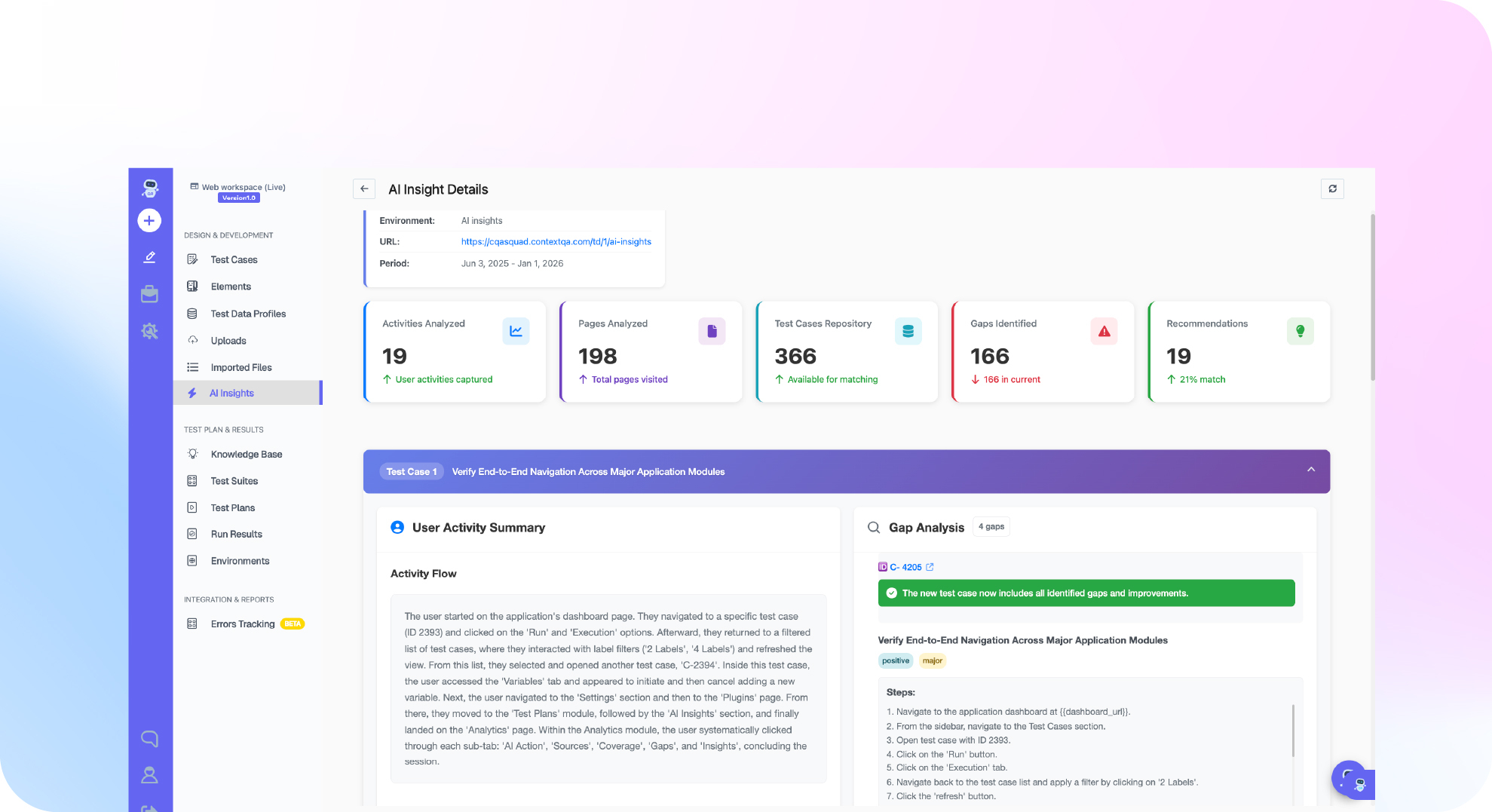
watsonx.ai is IBM's studio for building, training, and deploying AI models, and the piece ContextQA leaned on was its natural language processing models. Instead of hand-coding each automated test, ContextQA fed its existing manual test cases into watsonx.ai's NLP models, which read the plain-language steps a human tester would follow and converted them into automated scripts.
That NLP layer did more than one job. Per IBM's case study, ContextQA also used it to help eliminate flaky test results and to improve how accurately the platform flags what a code change actually touched, so teams are not left re-running an entire suite to find out.
Manual rewrite vs. watsonx.ai migration
- Speed: A hand rewrite goes one test case at a time and takes a team weeks. watsonx.ai's NLP models processed the entire backlog in minutes.
- Data required: A custom trained model needs a large labeled dataset. watsonx.ai's existing NLP models needed neither a custom model nor a labeled dataset to get started.
- Effort: A rewrite needs an engineer to read and recreate every test by hand. watsonx.ai read the plain language steps directly from the existing manual test cases.
- Side effects: A straight rewrite only produces new scripts. The watsonx.ai migration also helped eliminate flaky test results and improved how accurately the platform flags what a code change actually touched.
The Results: 5,000 Test Cases Automated in Minutes
- 5,000 manual test cases migrated and automated, per IBM's published case study.
- Minutes, not weeks. The entire migration ran in minutes, replacing a process that would normally take a team days or weeks by hand.
- Zero custom trained models or large labeled datasets required to get started.
- 2 additional problems solved in the same pass: flaky test results and unclear change impact analysis.
The number IBM published is the clearest proof point: ContextQA migrated and automated 5,000 manual test cases within minutes using watsonx.ai's models, work that would normally take a team days or weeks. Deep Barot, ContextQA's CEO and Founder, put it simply in IBM's case study: "We were able to migrate all those cases and automate them within a few minutes. This is the power of generative AI that IBM provides."
Beyond the raw migration speed, the partnership also touched two problems sitting underneath most testing backlogs: flaky results and unclear impact analysis. Automating a migration only matters if what comes out the other side is reliable, and if the platform can tell a team what a given change actually touched instead of re-running everything and hoping.

Migrating thousands of manual test cases into reliable automated coverage without a rewrite is exactly what ContextQA's platform does for every team, not just the ones with an IBM partnership behind them. See it on a 15-minute demo.
Frequently Asked Questions
Is ContextQA built on IBM watsonx.ai for every customer?
The migration work IBM highlighted used watsonx.ai's NLP models specifically for automating the test case conversion process. ContextQA's platform is not exclusively tied to IBM's stack, but the partnership shaped how the migration and change-detection features were built.
Do I need my own IBM watsonx.ai account to use ContextQA?
No. The IBM partnership shaped how ContextQA built its own migration and automation capabilities, but using ContextQA does not require a separate IBM account or license.
Can a team with a large manual test case backlog get the same result?
The core problem IBM's case study describes, thousands of manual test cases sitting unautomated, is common, not unique to ContextQA's own backlog. It is the exact scenario ContextQA's platform is built to handle for customers.
Bottom line
The IBM partnership is really a proof point for a bigger idea: migrating a legacy manual testing backlog into automated coverage does not have to be a multi-month project anymore. If you are evaluating whether an AI-driven testing platform is worth the switch for your own team, our guide to what makes an enterprise AI testing platform is a good next read.