
TL;DR: The human who merges AI-written code owns it. Accountability splits across four roles: the author who prompted and submitted the change, the reviewer who approved it, the test owner who proves its behavior, and the release owner who ships it. Automated tests and required merge checks, run by an autonomous quality engineer like ContextQA, turn that ownership into evidence.
Every engineering leader shipping with AI coding assistants eventually asks who is accountable when a human approves code they did not write. The assistant cannot be paged at 2 a.m. The reviewer skimmed a large diff. The suite passed, but nobody can say what it covered. This article gives you a four role ownership model, the evidence each role must produce, and a checklist for Monday.
Quick answers
Who is accountable when AI writes the code and a human approves it? The people and the organization that ship the code are accountable, never the AI tool. The engineer who prompts and commits owns the change, the reviewer owns the approval, and the company owns the outcome in production. An assistant cannot be paged, disciplined, or sued, so ownership has to be assigned to named humans explicitly.
What should each role verify before AI-assisted code reaches production? The author verifies they understand every line, ran it locally, and added tests for new behavior. The reviewer verifies logic, security paths, and that tests actually exercise the change. The test owner verifies the regression suite covers happy paths, edge cases, and failure states, and the release owner verifies required checks passed, a rollback plan exists, and no critical failures are open.
How do automated tests and required merge checks turn AI code ownership into evidence? Encode the definition of done as required merge checks: unit tests, regression on affected flows, and no new critical static analysis findings. Store the test run ID, commit SHA, and approver for every deploy so the release owner has a record. Generate tests from the ticket or spec rather than the diff, because tests written by the same assistant that wrote the code can share its blind spots.
Who is accountable when AI writes the code?
Accountability for AI-written code belongs to the people and the organization that ship it, never to the AI tool. Your SLAs and data protection obligations do not distinguish between a function an engineer typed and one an assistant suggested. If a generated SQL query leaks tenant data, the incident is yours. Treat this as framing for counsel, not legal advice.
The old model assumed the author understood every line because they wrote it. Now reviewers face plausible code with subtle failures: a retry loop with no backoff, an auth check comparing the wrong field. The author trusts the assistant, the reviewer trusts the author, and nobody owns the test that should have failed.
- Author owns the change.
- Reviewer owns the approval.
- Test owner owns coverage of the feature area.
- Release owner owns the production outcome.
Why does AI code accountability matter in 2026?
AI code accountability matters in 2026 because assistants now produce a large share of shipped code, vendor terms place output risk on the customer, and approval clicks rarely prove anyone verified behavior. "The AI wrote it" is not an answer a customer, auditor, or board will accept.
The Stack Overflow Developer Survey 2025 reports that 84% of respondents use or plan to use AI tools in development, while more respondents distrust AI output accuracy than trust it. The Google Cloud DORA Accelerate State of DevOps Report 2024 found that a 25% increase in AI adoption was associated with an estimated 7.2% decrease in delivery stability.
Assistant terms typically say you own the output and must review and test it, and any indemnity usually covers third party IP claims, not a broken checkout flow. The revised Product Liability Directive (EU) 2024/2853 treats software as a product, and the Cyber Resilience Act, Regulation (EU) 2024/2847 starts vulnerability reporting duties September 11, 2026. The EU AI Act, Regulation (EU) 2024/1689 mainly governs AI systems you build or deploy. None shifts responsibility to the coding tool.
"Whoever merged it owns it" fails in practice: a reviewer approves a large diff on style alone, nobody tests an edge case the model invented, and CI is green because it only ran tests that existed.

How does the four role ownership model work?
The model assigns four named human roles to every change: the author prompts and submits it, the reviewer approves it, the test owner proves its behavior, and the release owner ships it. The AI is a tool, never an owner. Each role signs off on recorded evidence before the change moves forward.
- Declare AI involvement. Add an
ai-assistedlabel or PR checkbox, plus anAssisted-by: <tool>commit trailer. This routes scrutiny; it does not assign blame. - Route review by risk. Use
CODEOWNERSso payments, auth, and migrations require a named domain owner. - Assign a test owner per critical flow. Checkout, login, and invoice export each get one name.
- Encode done as a required merge check. Unit tests, regression on affected flows, and no new critical static analysis findings.
- Give the release owner a record. Store the test run ID, commit SHA, and approver for every deploy.
- Trace escaped defects to missing evidence. Ask which role's verification would have caught the bug, then fix that control.
# .github/CODEOWNERS
/src/payments/ @payments-leads
/tests/e2e/payments/ @qa-lead-payments
/.github/workflows/ @release-owners
<!-- .github/pull_request_template.md -->
- [ ] AI assistant used for part of this change
- [ ] I can explain every line in this diff
- [ ] Tests cover the failure paths I changed
Add security scans as required jobs, such as semgrep ci --config p/owasp-top-ten and gitleaks detect --source . --exit-code 1. Let the release owner own the workflow file so nobody, human or assistant, quietly weakens checks.
Scale the model by blast radius, not headcount:
- Startup, 2 to 8 engineers: the author is also test owner and the tech lead releases. Fast, but the author grades their own work.
- Growth SaaS, 10 to 40 engineers: a separate reviewer, a QA lead as test owner, and the EM releases. The QA lead can bottleneck.
- Software agency: agency QA owns tests and the client signs the release, with a test report and Playwright export per release.
- Enterprise or regulated: four different people plus a change board and a signed release record. Slowest, most defensible.
What to do Monday: commit a CODEOWNERS file for your three riskiest directories, add the PR checklist, and name a test owner for your top five flows.
What are the limitations and tradeoffs?
A four role ownership model makes accountability traceable, but it adds review time, creates suites someone must maintain, and can produce false confidence when checks test the wrong things. It also does not settle legal liability. Contracts, especially agency agreements, must assign that explicitly.
- Review fatigue. Assistants produce diffs faster than humans read. Cap PR size or reviewers approve 800 lines on a skim.
- Coverage theater. A line coverage threshold alone passes tests that assert nothing. Generate tests from the ticket or spec, not the diff.
- Slow suites breed overrides. A 40 minute suite turns override labels into the norm.
- Maintenance needs an owner. Without self healing, flaky tests get marked
skipand the evidence trail breaks.
For agencies, tie warranties to acceptance defined as a passing run of named tests in the client's CI. A dispute then becomes "was this behavior in the agreed suite?" This is not legal advice.
If your team cannot prove who verified AI written code before release, book a demo of ContextQA and bring your hardest case. See how the autonomous quality engineer generates tests from each code change and runs them in CI/CD so every owner has evidence.

How does ContextQA support AI code accountability?
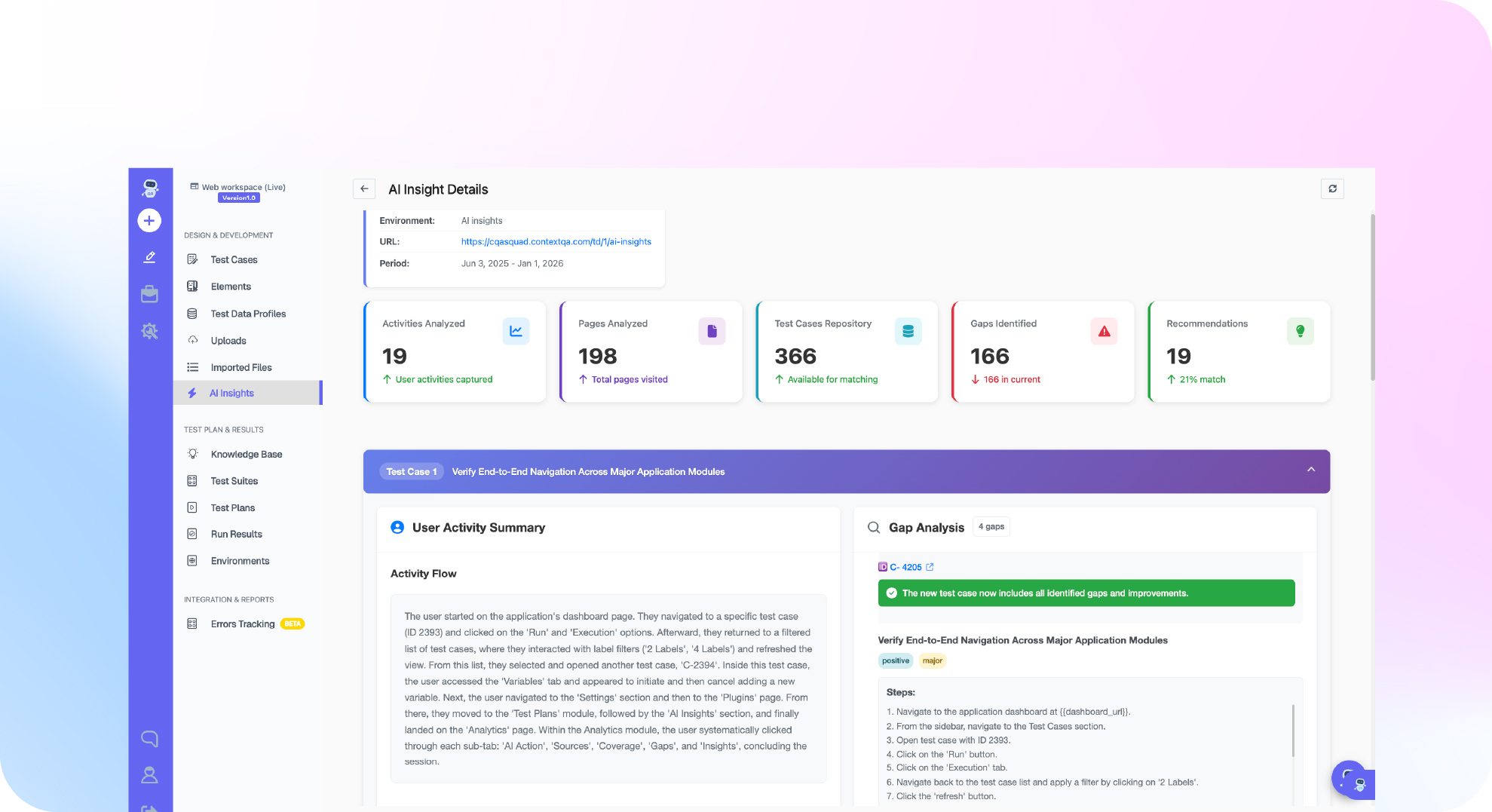
ContextQA does not decide who owns a defect; your ownership model does. It supplies the evidence each owner needs: tests generated from the ticket or code change, CI runs, self healing as the UI changes, and failures traced to a root cause, so every role signs off on results instead of trust.
- Author: tests generated from the ticket, Figma file, Swagger spec, or code change, covering happy paths, edge cases, and failure states.
- Reviewer: impact analysis on the change, plus parallel runs across browsers and devices.
- Test owner: self healing when the UI changes, and Playwright code export for version control.
- Release owner: CI/CD integration with root cause analysis on any failure.
Through the ContextQA MCP server in Cursor, Claude Code, or Codex, an author building a checkout coupon field has ContextQA generate tests from the ticket's acceptance criteria rather than from the diff the assistant produced: expired coupon, empty field, server error. The passing suite exports to Playwright, is committed with the feature, and CI reruns it on merge.
ai_coding_policy:
author: { must: disclose AI assistance, evidence: happy path, edge, error tests }
reviewer: { must: approve only with passing tests, evidence: test run link, affected flows }
test_owner: { must: review exported Playwright tests weekly, evidence: suite health report }
release_owner: { must: block on failing required checks, evidence: CI result, override notes }
defect_rule: assign an escaped defect to the first role whose evidence was missing
The defect_rule turns blame into a lookup. Enterprise teams can deploy ContextQA in their own infrastructure to keep evidence inside the security boundary.
Bottom line
When AI writes the code, accountability stays with the humans and the organization that ship it. Assign a named author, reviewer, test owner, and release owner to every change. Make each produce recorded evidence: an AI label, CODEOWNERS routing, required merge checks, and a release record. Scale controls to blast radius and watch for coverage theater.
Start with our AI-generated code testing checklist. Then weigh the risks in is AI-generated code safe.
Sources
The statistics and regulatory references above come from these primary sources. Survey and research figures reflect the 2024 and 2025 editions, and EU regulations link to official EUR-Lex texts. Confirm how each regulation applies to your products with legal counsel.