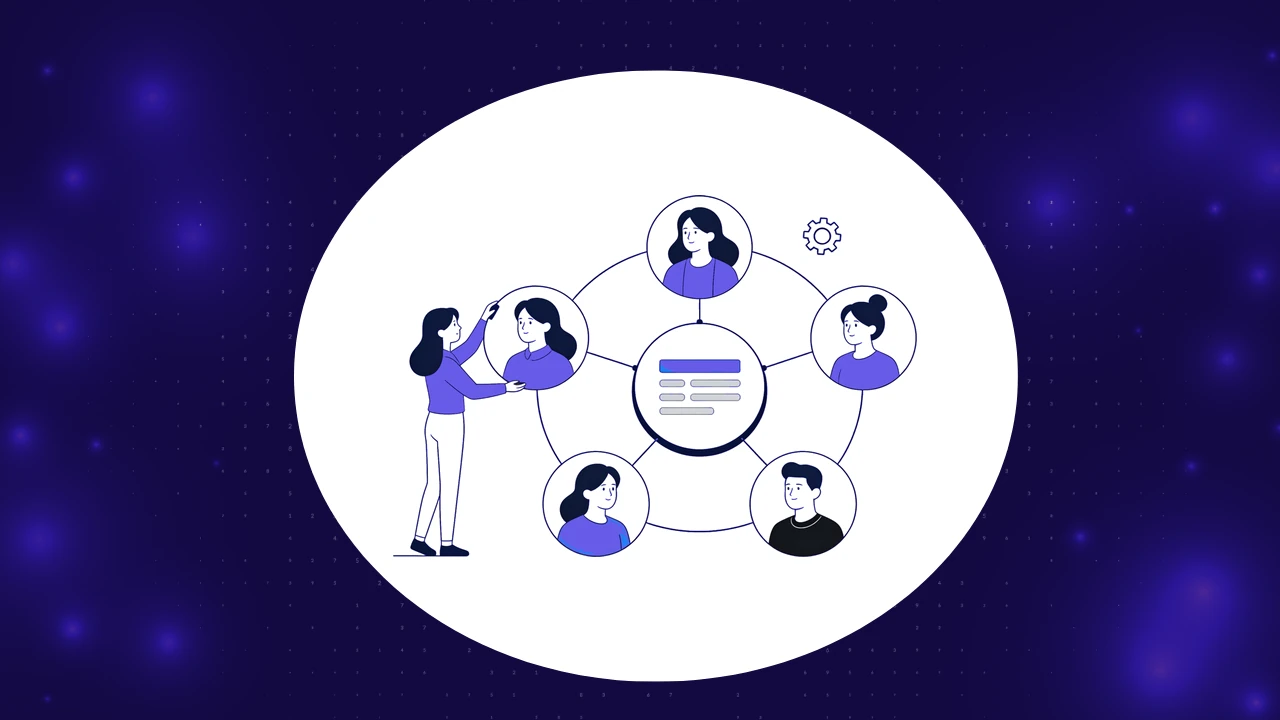
TL;DR: The 1-QA-per-3-developers heuristic that shaped QA team structure for a decade is breaking, because AI agents now write and maintain the tests that justified the ratio. With the US median salary for software QA analysts and testers at roughly $102,000 per year, every structural decision is a six-figure decision per seat. This guide covers the ratios that still make sense, the full cost math of a QA team, which tasks genuinely move to AI, and a restructuring path that upgrades your people instead of cutting them.
Last updated: July 4, 2026
Quick answers
What is a good QA to developer ratio? The traditional heuristic is 1 QA per 3 to 5 developers. With AI handling test authoring and maintenance, high-performing teams now run 1 quality engineer per 8 to 10 developers, with the role shifted from writing tests to owning risk, reviewing agent output, and directing coverage.
How many QA engineers do I need with AI test automation? Roughly half the traditional count for the same coverage, as a planning baseline. A 30-developer organization that would classically staff 8 to 10 QA roles typically needs 4 to 5 when AI agents own authoring and maintenance, with the freed budget best spent on senior quality engineers and test data infrastructure.
What does a QA engineer cost? US median base pay is about $102,000 per year, with the 90th percentile above $160,000. Fully loaded, with benefits, taxes, and equipment, budget roughly 1.3 times base: about $133,000 per seat per year. A traditional 10-person QA team is a $1.3 million annual decision.

What is the ideal QA to developer ratio in 2026?
There was never one true number, but the industry converged on 1:3 to 1:5 because manual regression and script maintenance scaled linearly with the code being shipped. Each developer added features; features added flows; flows added tests; tests broke and needed humans. The ratio was a maintenance formula wearing a strategy costume.
AI test automation breaks the formula at its base: when test authoring takes minutes in plain English and self-healing maintenance absorbs UI churn, the per-developer QA burden drops sharply. What does not drop is the need for judgment: deciding what to test, interpreting risk, reviewing what agents produce, and owning the definition of quality. That is why the modern answer is a smaller, more senior QA team structure rather than no QA at all: 1 quality engineer per 8 to 10 developers, at a higher skill and salary tier than the roles it replaces.
How much does a QA team actually cost?
Ground the QA team structure conversation in salary data before touching an org chart. The BLS occupational data for software QA analysts and testers puts the national median at roughly $102,000, with the spread running from about $84,000 at the 10th percentile to over $215,000 at the 90th in high-cost markets. Staffing-market data adds the seniority curve: KORE1’s 2026 salary guide shows automation-capable QA engineers commanding a clear premium over manual-only testers, a gap that widens every year.
Apply the standard 1.3x loading for benefits and overhead and each median seat costs about $133,000 per year. The classic 10-person pyramid, 6 manual and scripted testers, 3 automation engineers, 1 lead, runs $1.3 million annually, and the uncomfortable audit question is what fraction of those hours goes to work AI now does reliably: writing regression scripts, fixing locators, re-running flaky suites, and formatting reports.
How does AI change QA team structure?
Three shifts, all visible in hiring data and none of them “QA goes away.”
The floor rises. Roles whose core output was manually executed regression or hand-maintained scripts are being absorbed by agents. Career guidance platforms like Coursera’s QA tester overview now describe automation skills and AI literacy as baseline expectations for the role, not differentiators.
The center of gravity moves to judgment. The quality engineer of this cycle spends their day directing coverage, reviewing agent-generated tests the way seniors review junior code, investigating the failures that matter, and saying no to releases. AI-powered QA teams report the time saved goes into exploratory testing and risk work that never fit the old schedule.
New adjacent roles appear. Test data engineering, environment management, and agent oversight become explicit jobs instead of things automation engineers did at 5 pm. Small teams combine them into a platform role; large teams staff them properly.
How many QA engineers do you need with AI agents?
The worked example, for a 30-developer product organization. Traditional QA team structure at 1:3.5 gives you 8 to 9 QA heads: call it 6 test executors and script maintainers, 2 automation engineers, 1 lead, about $1.1 million loaded.
The AI-augmented equivalent: 4 quality engineers embedded with squads at 1:8, owning risk and reviewing agent output. 1 platform engineer owning test data, environments, and the automation platform itself. That is 5 heads, about $700,000 loaded, delivering broader coverage because agents do not queue work the way humans do. The remaining $400,000 is a decision: two senior hires, a performance and security testing capability you never had, or margin. Teams that treat it purely as savings usually regret it within two release cycles; the reinvested version outperforms.
Two honest caveats. Heavily regulated environments keep more human verification by policy, and legacy-heavy stacks migrate slower because flow knowledge lives in people. Run the build versus buy analysis and the ROI benchmarks against your own numbers before touching the org chart.
How do you restructure without losing your best people?
Retrain before you rehire. Your manual testers hold the flow knowledge no new hire has: they know which button the finance team actually clicks and which weird path breaks quarter-end. Plain-English test platforms make that knowledge directly productive without a coding prerequisite, which converts your most at-risk roles into your agent-directing roles.
Move maintenance off humans first. The first structural win is not a staffing change, it is taking locator repair and flaky triage off the team’s plate so capacity becomes visible. Restructure after you can see what freed hours exist, not before.
Upgrade the lead role. The QA lead who coordinated spreadsheets becomes the quality strategist who owns risk models and coverage decisions. If your test management stack still assumes manual coordination, fix that alongside the org, not after it.
Set the review bar explicitly. Agent-written tests get reviewed like junior-engineer code: sampled, standards enforced, feedback loops closed. Teams that skip this discover six months of quietly redundant coverage.
Which mistakes wreck QA team restructuring?
Cutting before capability. Removing heads on the promise of automation, before the platform is proven on your stack, is how organizations end up with neither people nor coverage. Sequence: prove the platform, see the freed capacity, then restructure.
Keeping the old work assignments. Buying an AI platform and leaving engineers assigned to hand-maintain scripts produces the worst of both: platform cost plus legacy toil. The QA team structure has to change with the tooling or the tooling becomes shelfware.
Hiring the old job description. If your next QA posting still leads with a specific framework’s syntax instead of risk judgment, test design, and AI oversight, you are hiring for the previous decade at this decade’s salaries.
Ignoring the outsourcing question. Some teams should not staff this at all: managed test automation services beat in-house structures for organizations below a certain engineering scale. Do that math honestly before designing an org you cannot feed.
What skills should you hire for in QA now?
The job description is the org chart’s leading indicator, and most QA postings are still hiring 2019. The 2026 posting leads with risk judgment: the ability to look at a release and rank what could hurt the business. It asks for test design and coverage thinking rather than framework syntax, since syntax is now the agent’s job. It requires AI oversight skills, meaning the candidate can review, correct, and direct machine-generated tests the way a senior reviews a junior’s pull request.
It rewards domain depth, because the tester who knows how claims adjusters actually work catches what no generic engineer sees. And it treats communication as core, since the modern quality engineer’s main output is a decision memo, not a test count.
Two credentials worth deprioritizing: raw manual test-case throughput, which agents have absorbed, and single-framework certifications, which age out with the framework. The interview exercise that predicts success best: give the candidate a real feature spec and ask what they would test first and why. The answer reveals risk thinking in ten minutes.
How do specialist testing roles fit the new structure?
Performance testing moves from an annual consulting event to a pipeline capability owned by the platform engineer, with quality engineers defining the thresholds that matter per flow. Security testing splits: automated scanning belongs to the pipeline, while genuine penetration work stays specialist, bought or shared with the security org. Accessibility becomes a standing gate rather than a launch scramble, cheap to automate at the flow level and expensive to retrofit. The pattern across all three: the specialist knowledge concentrates into thresholds, policies, and edge-case judgment, while the repetitive execution joins the agent workload. Teams below about 20 developers should not staff any of these separately; fold the thresholds into the quality engineer role and buy the deep expertise as needed.
What does the restructuring timeline look like?
Quarter one: prove and measure. Run the platform on two real applications, keep the org unchanged, and instrument everything: authoring time, maintenance hours, coverage growth. This quarter produces the numbers that make every later conversation factual instead of political.
Quarter two: shift the work. Move regression authoring and maintenance onto the platform for the proven applications. Start the retraining track: your manual testers become the first agent directors because their flow knowledge transfers directly. Freed hours go to the exploratory and risk work that never fit before, visibly, so the team experiences the change as an upgrade rather than a threat.
Quarter three: restructure officially. New titles, new job descriptions, the 1:8 embedded model, and the reinvestment decision made explicitly with the sponsor. By sequencing the org change last, you restructure around demonstrated capacity instead of vendor promises, which is the entire difference between this playbook and the layoff-first version that fails.
How does QA team structure differ by company stage?
Startup, under 15 engineers: no dedicated team, one accountable quality owner, AI tooling for the labor. The failure mode at this stage is not too little QA; it is the founding engineer who guards release quality leaving without a succession plan. Write the test strategy down before it lives in one head.
Scale-up, 15 to 60 engineers: the first real QA team structure decision. Hire the senior quality engineer before the junior testers, embed them with the highest-risk squad rather than centralizing, and stand up the automation platform in the same quarter, because a first QA hire without tooling becomes a manual bottleneck with a fancy title within six months.
Mid-size, 60 to 200 engineers: the hybrid takes shape: embedded quality engineers at 1:8, one platform owner, and the first genuine specialization decisions around performance and security thresholds. This is also where the reinvestment pool from automation first becomes visible enough to fight over; decide its use deliberately or it evaporates into general engineering headcount.
Enterprise, 200-plus: structure becomes portfolio management: multiple embedded groups, a central platform and standards team, compliance-fluent roles where regulators require them, and an explicit governance answer for who owns quality when three squads share one customer journey. The ratios matter less here than the interfaces between the groups.
How do you measure the restructured QA team?
The old metrics, test-case counts and pass percentages, reward exactly the busywork the agents absorbed. The restructured QA team structure needs measures that track judgment and outcomes.
Escaped-defect rate stays the north star: production incidents traceable to inadequate coverage, trended per release. It is the one number that survives every methodology fashion.
Coverage of ranked risk, not raw flows: what percentage of the top-twenty revenue-critical journeys have automated coverage that ran green in the last release? Twenty deep beats four hundred shallow, and this metric says so out loud.
Time to test new features: the lag between a feature reaching staging and its coverage existing. This is the metric AI tooling should visibly crush, and if it does not, the platform conversation reopens.
Agent review quality: sample the machine-generated tests monthly the way you sample junior code: assertion quality, redundancy, naming. A rising redundancy rate is the early warning that oversight slipped.
Team health, measured annually: attrition among your senior quality engineers is the metric that invalidates all the others when it goes wrong. The restructure that looks efficient and bleeds its judgment layer within a year was a layoff with extra steps, and the escaped-defect trend will say so two quarters later.
More questions teams ask about QA team structure
Centralized QA team or embedded testers: which structure wins? Embedded wins for speed and context, centralized wins for standards and career paths, and the 2026 answer is the hybrid the artifact above implies: quality engineers embedded 1:8 in squads, with a small central platform function owning tooling, test data, and standards. Pure centralized QA team structure reappears only in heavily regulated programs where independence is mandated.
Do startups need a dedicated QA team at all? Below about 15 engineers, no dedicated team, but a deliberate quality owner: one senior engineer accountable for the test strategy, with AI tooling doing the authoring labor. The first dedicated quality hire lands best between 15 and 25 engineers, and hiring that person senior beats hiring two juniors on every dimension that matters later.
How does QA team structure change in regulated industries? The ratios compress less. Healthcare, banking, and aviation keep independent verification layers and audit-ready documentation by mandate, so plan 1:5 rather than 1:8 and add a compliance-fluent quality role. The AI still absorbs authoring and maintenance; what it cannot absorb is accountable sign-off, and regulators price that in humans.
Where do SDETs fit in the new QA team structure? The strongest SDETs become the platform engineers, owning the automation infrastructure, test data systems, and agent oversight standards, which is more senior work than maintaining page objects ever was. The framework-maintenance portion of the old SDET job is precisely what the agents took; the engineering-judgment portion got promoted.
What do the first 90 days of the new structure look like for the QA lead?
The restructure hands the QA lead a genuinely different job, and the first quarter sets whether the new QA team structure earns credibility or reverts.
Days 1 to 30: baseline everything. Publish the current numbers before changing anything: escaped defects last quarter, coverage of the top-twenty journeys, feature-to-coverage lag, hours logged on maintenance. Unflattering baselines are the point; they are what improvement gets measured against, and publishing them buys the credibility the next two quarters will spend.
Days 31 to 60: move one squad, visibly. Pick the friendliest squad, shift its regression authoring and maintenance to the platform, and let its quality engineer demonstrate the new rhythm: risk review Mondays, agent output sampling Wednesdays, exploratory Fridays. One working example recruits the other squads better than any mandate.
Days 61 to 90: formalize and defend. Write the new role definitions, set the review-bar policy for agent-generated tests, and take the reinvestment decision to the sponsor with the 60-day numbers attached. The defense matters: this is the window where a finance partner reads the freed capacity as a cut opportunity, and the lead who arrives with escaped-defect and coverage trends wins that meeting; the one who arrives with enthusiasm does not.
Where ContextQA fits your team design
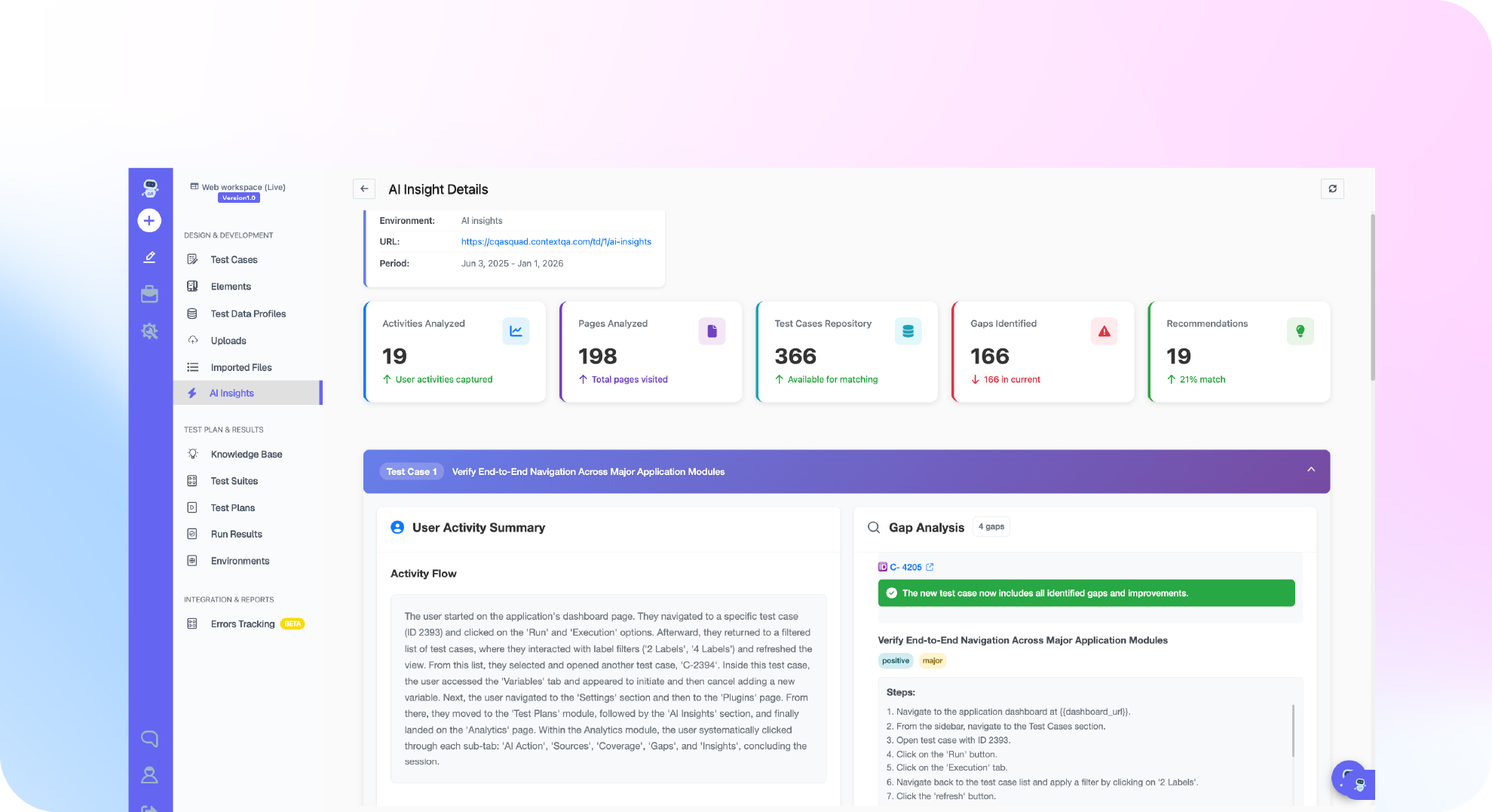
ContextQA is built for the restructured QA team structure this article describes. Plain-English test creation means your domain experts, the manual testers with a decade of flow knowledge, become productive agent directors on day one, no coding gate. Self-healing removes the maintenance line that justified the old ratios, and AI agent testing covers the new workload arriving as your product itself ships agents. The freed capacity shows up in the first release cycle, which makes the restructuring conversation concrete instead of theoretical. Book a demo and bring your current org chart; the before-and-after math above works best on real numbers.
The bottom line
QA team structure in 2026 is a budget reallocation problem, not a headcount reduction problem. The $1.3 million traditional pyramid buys mostly maintenance labor that AI agents now perform; the winning restructure spends the same money on fewer, more senior quality engineers, a real platform and data capability, and the exploratory and risk work that never fit the old schedule. Prove the platform first, retrain the people who hold your flow knowledge, and let the ratios follow the freed capacity. The teams that get this right do not shrink QA; they finally give it the job title it deserved.
Sources
- SalaryTruth: BLS OEWS data for Software Quality Assurance Analysts and Testers. Median and percentile salary figures.
- KORE1: QA Engineer Salary Guide 2026. Seniority and automation-skill premiums.
- Coursera: What Is a QA Tester? Current role expectations and skills baseline.