
TL;DR: Test automation for regulated industries means automating quality checks while preserving the evidence, traceability, and data controls an auditor expects. You test security, data privacy, access control, and accessibility, and every run leaves an audit-ready trail. It matters because the average data breach now costs 4.88 million dollars, and a healthcare breach 9.77 million (IBM Cost of a Data Breach 2024). This guide covers what to test, how to keep your audit trail intact, and how to move fast without cutting compliance corners.
Definition: Test automation for regulated industries is the use of automated testing in sectors governed by standards like HIPAA, PCI DSS, SOC 2, GDPR, or GxP, where tests must not only verify behavior but also produce traceable, auditable evidence and protect sensitive data. It extends test automation, which ISTQB defines as using software to control test execution and compare actual results to expected ones, with compliance as a first-class requirement.
Quick answers
How is testing different in regulated industries? You test the same functionality plus security, data privacy, access control, and accessibility, and you must keep an auditable record of what was tested, when, and with what result. Evidence and traceability are part of the deliverable in regulated work, not an afterthought you bolt on later.
Can you automate testing in a compliant way? Yes, and you should. Automation actually improves compliance because it produces consistent, timestamped evidence every run, instead of relying on manual notes. The key is using test data that contains no real customer information and keeping a clear test-to-requirement trail.
What does an auditor want to see? Proof that a requirement was tested, the result, the evidence (screenshots, logs, video), who or what ran it, and when. A good automation platform produces this automatically on every run.
Why quality and compliance are inseparable here
In a regulated industry, a bug is not just a bad experience, it can be a breach, a fine, or a failed audit. The financial stakes are blunt. The average data breach reached 4.88 million dollars in 2024, and the cost is far higher in regulated sectors: healthcare breaches averaged 9.77 million dollars, the costliest of any industry for the fourteenth year running (IBM Cost of a Data Breach 2024).
Poor software quality feeds directly into that risk. CISQ put the cost of poor software quality in the US at 2.41 trillion dollars (CISQ), and in regulated sectors a quality failure can become a compliance failure overnight. The financial industry faces the same pattern. That is why test automation in these industries is not just about speed; it is a control that reduces real, quantifiable risk.

What test automation must cover in a regulated industry
Functional correctness is table stakes. On top of it, regulated testing has to cover a set of concerns that ordinary web apps can treat as optional. These six are the backbone of a compliant test plan.
Notice that two of these, accessibility and audit evidence, are often missed entirely by teams new to regulation. Accessibility is a legal requirement in many jurisdictions, not a nice-to-have, which is why we cover accessibility testing and WCAG compliance in depth. Audit evidence is the difference between passing and failing the audit even when your software is fine, because if you cannot prove you tested it, to the auditor you did not.
The compliance evidence trail
The single biggest mindset shift for regulated testing is that the test result is only half the deliverable. The other half is the evidence that proves it. A compliant automated run does not just pass or fail; it leaves a trail an auditor can follow from the requirement to the proof.
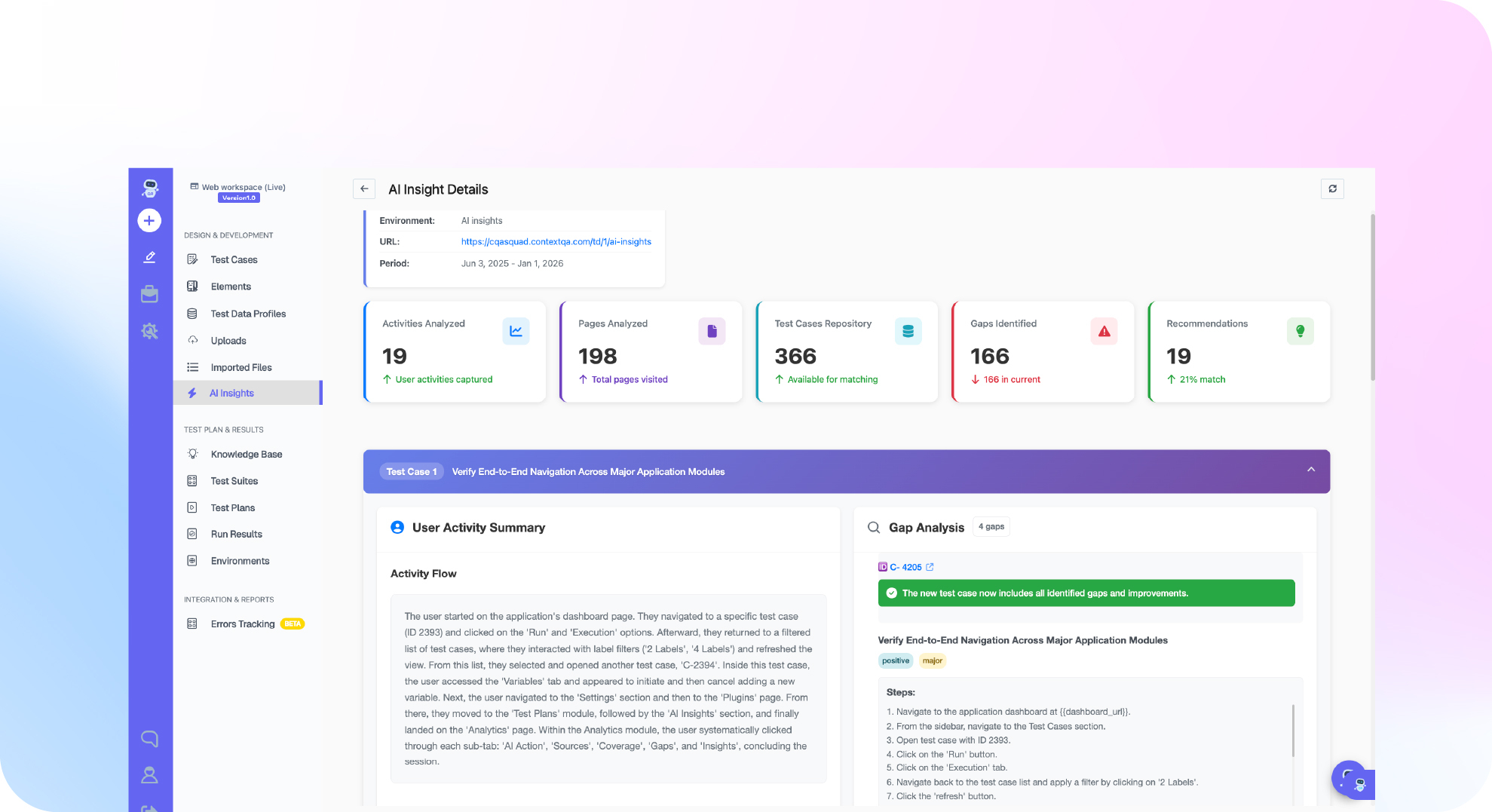
This is where automation beats manual testing for compliance, not just for speed. A human tester writes a note that says it passed. An automated run captures the screenshots, the video, the logs, the timing, and a classification of any failure, every single time, with a timestamp. ContextQA’s root-cause analysis adds the why, labeling each failure as a real bug, a test issue, an environment problem, or a flake, which turns a red run into defensible evidence rather than a mystery.
Requirements by industry
The specifics differ by sector, but the shape is the same: protect data, control access, and prove it. Here is how the common regimes map to what you test.
| Industry | Key regimes | Testing emphasis |
|---|---|---|
| Healthcare | HIPAA, HITECH | PHI protection, access control, audit logs |
| Finance and fintech | PCI DSS, SOC 2, SOX | Transaction integrity, data security, traceability |
| Government and public | GDPR, WCAG, FedRAMP | Privacy, accessibility, evidence retention |
| Life sciences | GxP, FDA CSV | Validation, traceability to requirements |
Whatever the regime, the testing job rhymes. Keep real data out of test environments, prove who can access what, make every test trace back to a requirement, and keep the evidence. Get those four right and most audits become a matter of exporting what you already have.
How to automate without breaking your audit trail
The fear that stops regulated teams from automating is that automation will move faster than governance can follow. The fix is to make the automation itself the source of evidence, rather than something you document separately. When every run stores its own screenshots, logs, and pass or fail status with a timestamp, your audit trail is a byproduct of testing, not extra work bolted on after.
Control where that evidence lives. The strongest setups keep test data and evidence inside your own environment, with clear retention rules, and limit what any automated account can touch. Ask any platform three questions before you trust it with regulated work: where does our data live, how is each run isolated, and what gets sent to any third party. enterprise features exist precisely to answer these for teams under audit.
Testing for security and data privacy
Security testing is non-negotiable in a regulated industry, because the breach figures above are what you are insuring against. Automate the checks that catch the common holes: injection points, broken access control, and exposed data, and run them on every release so a regression cannot quietly reopen a vulnerability. Dedicated security testing should be part of the pipeline, not a once-a-year penetration test.
Data privacy is the other half. The cardinal rule is simple: no real customer data in test environments, ever. Use synthetic or masked data that looks real enough to exercise the system without exposing a single actual record. A test suite that runs on production PII is itself a compliance violation, no matter how good the tests are. Build the masking into your data setup so it is impossible to get wrong by accident.
Accessibility is a compliance requirement, not a nicety
In many jurisdictions, accessibility is law, and an inaccessible product can mean a lawsuit regardless of how secure it is. Automate WCAG checks into your pipeline so accessibility regressions are caught like any other defect, and pair the automated scan with human review for the things tools cannot judge. Our guide to accessibility testing and WCAG compliance covers how to build this in. Treating accessibility as a launch-blocking test, not a backlog item, is what separates teams that pass audits from teams that settle complaints.
How to validate and trace tests
Traceability is the thread auditors pull. Every test should map to a requirement, and every requirement should map to its tests, so you can answer the auditor’s core question instantly: show me that this requirement was tested and that it passed. In validated environments like life sciences, this test-to-requirement linkage is formal, but the discipline pays off in any regulated sector. Keep the mapping in your test management, not in someone’s head.
Validation goes a step further: proving the testing system itself works as intended. Keep a record of your test configuration, your data handling, and your evidence retention, so the process is defensible and not just the results. With AI now part of most workflows and 75.9 percent of developers using it (DORA), document how AI is used in your testing too, because auditors will increasingly ask.
Common mistakes in regulated test automation
- Real PII in test data. The most common and most serious mistake. Mask or synthesize, always.
- Evidence as an afterthought. If the run does not produce proof automatically, you will scramble at audit time.
- No requirement traceability. Tests that map to nothing cannot prove compliance.
- Skipping accessibility. It is law in many places, not an enhancement.
- Unscoped automation accounts. A test account with broad access is a breach waiting to happen.
Each of these turns a passing test suite into a failing audit. The software can be perfect and you can still fail, because in regulated work the proof is part of the product.
How ContextQA supports regulated testing
ContextQA was built for the scale and rigor regulated teams need. The AI testing suite runs across real browsers and devices and captures screenshots, video, and logs on every run, which is the evidence trail an audit requires. security testing probes for vulnerabilities as part of the pipeline, root-cause analysis classifies every failure so a red run is defensible, and enterprise features cover the isolation and control questions auditors ask. For sector-specific needs, our industry verticals go deeper.
The proof that this works at enterprise scale is real. When IBM worked with ContextQA, the team migrated about 5,000 test cases and removed the flakiness that had been slowing them down (IBM case study). That is the kind of rigor a regulated program needs. For the finance angle specifically, our piece on AI in fintech compliance and security covers how AI fits compliance and security.
Your regulated-industry testing checklist
- Mask or synthesize all test data (30 minutes). Confirm zero real PII in any test environment.
- Turn on evidence capture (15 minutes). Screenshots, video, and logs on every run.
- Map tests to requirements (1 hour). Every requirement linked to its tests, both ways.
- Add security checks to CI (30 minutes). Injection, access control, exposed data, every release.
- Automate WCAG checks (30 minutes). Catch accessibility regressions like any other defect.
- Set evidence retention and access rules (30 minutes). Decide where evidence lives and who can see it.
- See it on your own app. Bring a regulated flow and book a demo to watch it tested with a full evidence trail.
Why teams hesitate to automate in regulated industries
The usual worry is that automation introduces risk faster than governance can keep up, so regulated teams stay manual longer than they should. The instinct is understandable but backwards. Manual testing is actually the weaker control for compliance, because it depends on a person remembering to capture evidence, doing it consistently, and not making a mistake under deadline pressure. Auditors do not trust memory; they trust records.
Automation, done right, is the stronger control precisely because it is consistent. Every run does the same checks in the same order and produces the same evidence, with a timestamp, whether it is the first run or the thousandth. The path past the hesitation is to treat compliance as a design requirement of the automation from day one, not a layer added later. Build the evidence and data controls in, and automation becomes the thing that makes audits easier rather than scarier.
How AI changes regulated testing
AI is now part of most engineering workflows, and regulated teams cannot pretend otherwise. It speeds up authoring tests, generating test data, and triaging failures, all of which help a compliance program move faster. The catch is that auditors will increasingly ask how AI is used in your testing, so the answer has to be documented rather than improvised. Treat AI as a tool you can explain, not a black box you hope no one questions.
There are two practical guardrails. First, keep a human in the loop for anything that affects compliance evidence or test data handling, because accountability still has to land on a person. Second, never let AI tooling touch real customer data; the same masking rules apply to the AI as to everything else. Used within those limits, AI raises throughput without weakening the controls, and the gains are real as long as you measure them rather than assume them.
Continuous compliance: testing on every release
Compliance is not an annual event, even though audits are. The strongest regulated programs treat it as continuous, running the security, privacy, access, and accessibility checks on every release so a regression cannot quietly reopen a closed gap. When testing runs on every change, the audit is just a matter of exporting evidence you already have, instead of a frantic scramble to reconstruct what happened over the past year.
This is where automation earns its place in the pipeline. Wire the compliance checks into CI/CD so they block a release the same way a failed unit test would, and you turn compliance from a periodic project into a property of the system. The teams that pass audits without drama are the ones for whom every release was already an audit in miniature. Continuous testing is how you get there.
How long does compliant test automation take to set up?
The core controls can be in place in a few weeks, and the program matures over a quarter or two. Start with the non-negotiables: masked test data, automatic evidence capture, and security checks in CI. Those three alone move the needle on both risk and audit readiness, and none of them takes long to stand up with the right platform. The slower work is building out traceability and retention policy, which is process as much as tooling.
Sequence it by risk. Automate the checks that protect sensitive data and prove access control first, because those map to the costliest failures, then layer in accessibility and full requirement traceability. Done in that order, you reduce real exposure from the first week while the more procedural pieces follow. A staged rollout also gives your compliance and engineering teams time to align on what evidence actually needs to be kept.
A worked example: testing a patient portal
Take a healthcare patient portal under HIPAA. A compliant automated test of the login and records flow does several things at once. It runs on synthetic patient data, never a real record. It verifies that a patient can see only their own records and not anyone else’s, the access-control check that sits at the heart of HIPAA. It confirms the session times out as policy requires, and it captures screenshots and logs of every step with a timestamp.
When that test runs, it produces exactly what an auditor wants: proof that access control was tested, the result, and the evidence behind it, all traceable to the HIPAA requirement it covers. Add an automated accessibility scan so the portal is usable by patients with disabilities, and a security check for the common injection and access flaws, and a single flow now exercises four compliance concerns at once. Multiply that across the portal’s critical journeys and you have a regulated test suite that defends itself at audit time.
Who owns compliance testing?
It is shared, and the failures happen in the gaps between owners. Engineering owns building and running the automated checks. QA owns coverage and evidence quality. Compliance or the security team owns the requirements and what an auditor will accept. When those three operate in separate silos, tests get written that satisfy no regulation and requirements get documented that no test covers. The fix is a shared definition of done that includes the compliance evidence, agreed by all three before a feature ships.
Make the platform the common ground. When the automated suite produces the evidence compliance needs in a form auditors accept, the three teams are working from one source of truth instead of three spreadsheets. That alignment is worth more than any single tool feature, because the most expensive audit findings are almost always the ones that fell between two teams who each assumed the other had it covered.
Does automation replace manual compliance review?
No, and treating it that way is a trap. Automation handles the repeatable, evidence-producing checks brilliantly: data masking verification, access-control rules, security regressions, accessibility scans, and the capture of proof on every run. That is the bulk of the volume, and automating it frees your specialists from rote work. What it does not replace is human judgment about whether the controls are the right ones and whether the evidence actually satisfies the regulation.
Think of automation as the engine and human review as the steering. Auditors still want to see that a knowledgeable person designed the test plan, interpreted the edge cases, and signed off on the program. The winning model is automation for scale and consistency, human expertise for judgment and accountability. Teams that try to fully automate compliance away end up with a pile of evidence no one can vouch for, which is worse than less evidence that someone can.
The bottom line
In a regulated industry, test automation is a risk control, not just a speed tool. Cover security, privacy, access, and accessibility, keep real data out of testing, map every test to a requirement, and let each run leave an audit-ready trail. With the average breach at 4.88 million dollars and healthcare at 9.77 million (IBM Cost of a Data Breach 2024), the cost of cutting corners dwarfs the cost of doing it right. Automate the proof, not just the test, and the audit stops being something you fear and becomes a report you export. In regulated work the quality of your evidence is the quality of your defense, so build the trail in from the first test rather than reconstructing it the week before the auditor arrives. Want to see regulated testing with a full evidence trail on your own app? book a demo and bring your most sensitive flow.