
TL;DR: Vendor lock-in happens when a test automation platform stores your tests in a proprietary, unexportable format, so switching tools later means rebuilding your suite from zero. Gartner has forecast low-code tooling to reach $44.5 billion by 2026, so exit costs are becoming a real budget line, not a hypothetical. Code export, generating real Playwright, Selenium, Cypress, or WebdriverIO code you can read, version, and run anywhere, is the direct fix.
Definition: Test automation vendor lock-in is the state where your test cases live inside a platform’s proprietary model, recorder format, or internal database in a way that cannot be extracted and executed independently.
Quick answers
What is vendor lock-in in test automation?
It is when your test suite is stored in a format that only one platform can run, meaning you cannot switch tools without rebuilding every test from scratch. It shows up most often in codeless and model-based automation tools.
Is codeless test automation the same thing as vendor lock-in?
Not automatically, but they correlate closely. Codeless just means you did not write the test by hand. Lock-in is a separate question: can that test’s underlying logic be exported and run somewhere else, or does it only exist inside that vendor’s engine?
How does code export prevent lock-in?
Code export converts your AI-generated or model-based tests into real automation code in a mainstream framework, such as Playwright or Cypress, that you own outright and can run in any CI/CD pipeline, with or without the original platform.
How test automation vendor lock-in actually happens
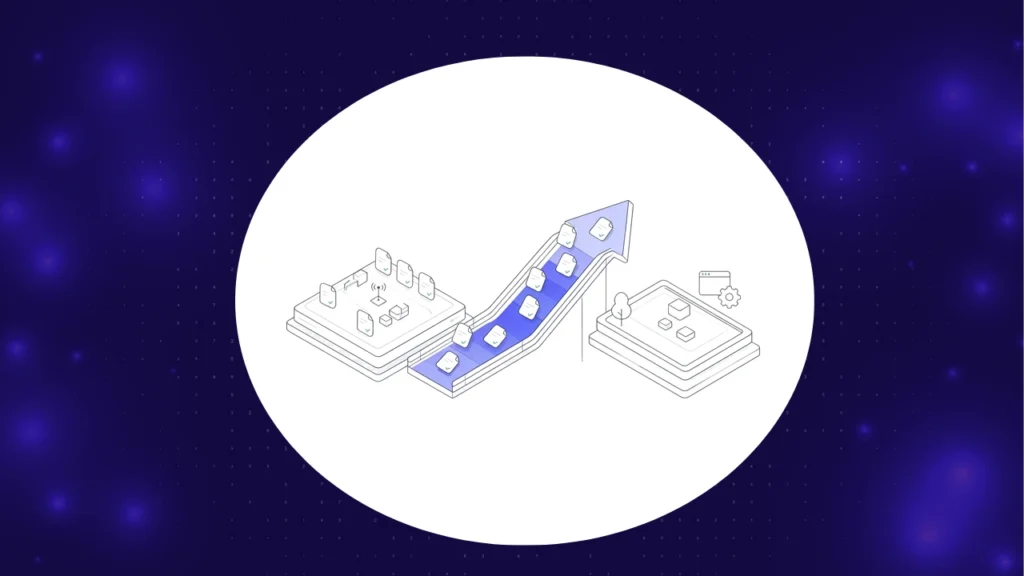
Nobody signs up for lock-in on purpose. It creeps in through convenience. A codeless or model-based platform lets your team build coverage fast, record a flow, describe a scenario in plain English, drag a few steps together, and the tests just run. That speed is real. What is not obvious on day one is what those tests are made of underneath. ISTQB defines test automation as the use of software to perform or support test activities, which is a broad enough definition to cover both a Playwright script and a proprietary drag-and-drop model equally well. That is exactly the gap lock-in lives in: two things can both technically qualify as “test automation” while one of them is something you own and the other is something you rent. If the platform stores your tests as a proprietary model rather than as source code, you have built an asset you cannot take with you.
Reviewers of model-based codeless platforms like ACCELQ have noted this pattern directly: a genuine ramp-up curve despite the “codeless” label, and assets tied to that model that do not port cleanly to another tool once you outgrow it or want to leave. That is not a knock on any one vendor. It is how the architecture works. A visual model is easy to build and easy to demo. It is hard to export as anything a different platform, or a plain CI pipeline, can just run.What happens when you leaveLocked in (proprietary model)Tests exist only inside the vendor’s engineNo readable source to hand to engineeringMigration means rebuilding the suite from zeroHistorical run data and baselines stay behindRenewal negotiations happen with no real exit optionExportable (real framework code)Tests convert to Playwright, Selenium, Cypress codeLands in your repo, reviewable like any pull requestMigration is a framework choice, not a rebuildRuns in Jenkins, GitHub Actions, or CircleCI directlyRenewal is a real choice, not a forced oneBased on ContextQA product documentation and independent review analysis of model-based codeless platforms.
The four things that actually make code exportable or not
| Question to ask | Proprietary/model-based platform | Code-exportable platform |
|---|---|---|
| What format are my tests stored in? | Internal model, recorder script, or database row | Source code in Playwright, Selenium, Cypress, or WebdriverIO |
| Can I read the test without the vendor’s UI? | Usually no | Yes, it is a file in your repo |
| What happens on migration? | Full manual rebuild of the suite | Framework code you already own, ready to run elsewhere |
| Who can maintain it? | Only people trained on that platform’s model | Any engineer who knows the target framework |
Notice the pattern: every row comes down to one question, does a human engineer, not just the vendor’s engine, get to read and run the result. That single distinction is why ContextQA built code export as a first-class feature rather than an afterthought, and it is also the exact gap a comparison like ContextQA vs. ACCELQ is built to make concrete.
A migration that looks ordinary until you try it
Picture a mid-size QA team, six engineers, roughly 1,200 regression tests, running everything through a codeless platform they picked three years ago because it let non-engineers build coverage fast. The team has grown since then. So has the app. Now the codeless platform’s pricing has jumped at renewal, and the QA lead wants to compare it against a code-first alternative before signing another year.
The comparison should take an afternoon. Instead it takes six weeks, because the export button in the old platform produces a zip file of internal model definitions, not runnable code. Nobody on the team can read them without the vendor’s editor open. The only honest path forward is to rebuild the suite by hand in a real framework, test by test, while both systems run in parallel so nothing slips through the gap. Six weeks of two engineers’ time, an unplanned line item nobody budgeted for, purely because the exit was never actually available. That is not a worst case. It is the median story for a suite built on a proprietary model once it needs to move.
Now run the same scenario with a code-exportable platform. The comparison really does take an afternoon, because the “export” step produces the same Playwright or Cypress files an engineer would have written by hand, sitting in a folder, ready to run. Whether the team ultimately switches or stays becomes a real decision made on price and features. It stops being a decision made under duress because leaving was never actually on the table.Worried your current suite would not survive a migration?Run a real export, not a demo, on a slice of your own tests during a pilot.See the pilot program
Start a ContextQA pilot and export a real slice of your suite before you commit to anything.
Why this is a 2026 budget problem, not a hypothetical
Low-code and codeless adoption is not a niche trend anymore. Gartner has forecast the low-code development market to reach $44.5 billion by 2026, with low-code tools accounting for 75% of new application development, up from 40% in 2021. Zoom into testing specifically and the codeless test automation segment alone is projected to grow from $2.7 billion in 2025 to $11.4 billion by 2035. Put those two numbers together and the conclusion is simple: more QA budget is riding on these platforms every year, which means the exit cost problem gets bigger every year too, not smaller. Zoom out to the full picture and the stakes get bigger still. Fortune Business Insights values the entire automation testing market at $24.25 billion in 2026, and every dollar of that spend is a dollar that either builds a portable asset or a rented one.
I keep coming back to a simple test when I talk to QA leads about this. Ask your current or prospective vendor one direct question: “if we exported everything today, what exactly do we get, and in what format?” Watch how confidently they answer. A platform built around code export answers in one sentence. A platform built around a proprietary model tends to answer with a feature list instead of a file format, which is itself the answer.
The honest limitations of code export
- Exported code still needs a real maintainer. Code export removes the format lock-in, not the need for an engineer who understands Playwright, Selenium, Cypress, or WebdriverIO well enough to keep the suite healthy.
- AI-generated tests still need code review. Just like AI-generated production code, exported test code should go through a pull request and a human read before it ships into CI, not a blind merge.
- You are still choosing a framework family. Exportability lowers the cost of switching platforms. It does not erase the earlier decision of which framework ecosystem, Playwright, Selenium, or Cypress, your team standardizes on, and that choice still carries its own switching cost.
That third point matters more than it looks. The State of JS 2025 survey found respondents use an average of 4.4 different testing tools, hardly a settled market, with Playwright pulling ahead on satisfaction (91%) well past Cypress (72%). Framework choice is still a live decision even after you solve the platform lock-in problem. Code export just makes sure that decision stays yours to make, on your own timeline.Testing tool satisfaction, State of JS 2025Playwright91%Cypress72%Source: State of JS, 2025 testing survey
How ContextQA’s code export actually works
This is where I will be direct about what ContextQA does, because it is the concrete answer to everything above. You select the tests you want, pick a target framework (Playwright, Selenium, Cypress, or WebdriverIO, in TypeScript, JavaScript, Java, or Python), and ContextQA generates a full, production-shaped export: feature files, page objects with real selectors, step definitions, configuration for drivers and timeouts, helper utilities, test data files, support scripts, and a package.json with a README. The whole export takes about two minutes. It drops into an existing repo and runs out of the box in Jenkins, GitHub Actions, or CircleCI, no glue code required.
The part I think matters most: exported tests stay untouched in your repo even after the platform itself updates. That is a meaningfully different promise than “you can always ask support for an export.” ContextQA has also validated this kind of migration at real scale, an IBM case study documents roughly 5,000 test cases migrated with flakiness removed in the process, not a toy example. It is also worth saying plainly: ContextQA is rated 4.8 out of 5 on G2, and code export is one of the features reviewers call out by name.1Select the tests to exportPick any validated, AI-generated test case2Pick a target frameworkPlaywright, Selenium, Cypress, or WebdriverIO3AI generates the full artifact setFeature files, page objects, steps, config, helpers4Code lands in your own repoReviewable like any other pull request5Runs in your CI/CD, no glue codeJenkins, GitHub Actions, CircleCI out of the box

Where code ownership needs to hold up: web, mobile, API, and CI/CD
Lock-in risk is not limited to one layer of testing. It shows up wherever tests get created and stored. ContextQA applies the same export path across web automation, mobile automation, and API testing, so a mobile regression suite is exportable the same way a web checkout flow is. Tests generated or healed through AI-based self-healing export the same way too, the healing logic does not stay trapped behind a proprietary layer once you pull the code.
For teams already running agents against their codebase, ContextQA’s MCP server exposes the same testing operations to tools like Claude, Cursor, and VS Code Copilot directly. That matters here for a specific reason: an agent that can trigger a code export on demand, inside your own toolchain, is a very different ownership story than one that has to open a vendor’s UI and hope an export button exists.
CI/CD is really the place lock-in gets tested for real, not the sales call. A pipeline either runs your tests, or it does not, and a proprietary model usually needs a dedicated plugin, a hosted runner, or an API call back to the vendor just to execute inside Jenkins, GitHub Actions, or CircleCI. Exported code skips that dependency entirely. It is a checkout step and a run command, same as any other test suite in the repo. Small detail, big difference the day that vendor has an outage during your release window and your pipeline needs to run anyway.
Do this now: a lock-in audit you can run this week
- (10 min) Ask your current vendor directly: “if we exported everything today, what format would we get?” Write down the exact answer.
- (15 min) Compare that answer against the table earlier in this post. Real framework code, or a proprietary model you cannot read?
- (20 min) Count your actual test suite size, then estimate the manual rebuild time if that answer turned out to be “you can’t.” That number is your real lock-in cost.
- (15 min) Check the test automation ROI calculator and rerun your numbers with a real migration cost included, most calculators quietly assume you never leave.
- (20 min) If a codeless platform is on your shortlist, read a direct comparison, like ContextQA vs. ACCELQ, before you sign anything multi-year.
- (30 min) Book a live demo and ask to see an actual code export, start to finish, on a test you bring yourself.
Accent and dialect coverage is a test dimension, not a setting
This is where production voice agents lose the most task completions, and it is routinely treated as a configuration option instead of something you test across.
The disparities are documented and they are not marginal. A 2025 error analysis of Newcastle English evaluated four commercial recognition systems, selected the best performer, and ran it across the Diachronic Electronic Corpus of Tyneside English, 72 hours of naturalistic speech from 160 speakers. The winning system returned an average word error rate of 31.95 percent, with errors tracking regional phonological, lexical and morphosyntactic features (Serditova, Tang and Steffens, 2025). Roughly one word in three wrong, from the best of four systems, on speech from a single English city.
That is consistent with the wider literature. Analysis of commercial recognition from five major vendors against a corpus of sociolinguistic interviews found large racial disparities across all five (Koenecke, 2021). A separate audit built on over 2,700 speakers of English born in 171 different countries found service performance varied with the speaker’s country of birth even after controlling for linguistic variables (DiChristofano et al.).
Building the matrix
Two open corpora make this cheap to start. The Speech Accent Archive at George Mason University holds samples where native and non-native speakers of English read the same paragraph, holding content constant so accent is the only variable (Speech Accent Archive). Mozilla Common Voice publishes openly licensed multilingual voice data with demographic labels attached to many clips (Common Voice).
A workable first matrix: your top three call intents, five utterance variants each, six accent groups drawn from your real caller geography, clean and noisy audio. That is 180 to 360 clips.
Pick the six accent groups from where your calls actually come from, not from a list of world accents. Your call detail records already have the geography. An agent serving Glasgow, Newcastle and Birmingham needs those three before it needs a generic non-native category.
Scoring it: three numbers, not one
Score word error rate, intent match and task completion separately, per accent group. They fail independently and conflating them hides the interesting cases. An agent can transcribe a sentence perfectly and route it to the wrong intent. It can mistranscribe a word and still complete the task because the intent survived. Only the split tells you which layer to fix.
Then the threshold that matters: set a maximum acceptable gap between your best and worst accent group, not just an average floor. The gap threshold is the one that changes behavior, because it stops an improvement for the majority accent from counting as progress on its own. An agent that goes from 94 to 96 percent on the majority group while the worst group stays at 71 has not improved, it has widened.
Noise and barge-in
Run every accent group twice, clean and noisy. Noise is not one condition: a warehouse, a car with road noise, a cafe with competing speech and a speakerphone in a hard-surfaced room fail differently. Competing speech is the hardest, because the agent has to decide what is not addressed to it.
Barge-in deserves its own cases. It is the behavior when a caller talks over the agent, and there are three distinct outcomes to test: the agent stops and listens, the agent talks through the interruption, or the agent stops and loses the caller’s utterance. The third is the worst and the easiest to miss, because the transcript shows the agent stopped politely and gives no sign that the input vanished.
For the audio path itself there is a standard rather than a convention. ITU-T Recommendation P.863 defines an objective method for predicting perceived speech quality across narrowband to fullband links (ITU-T P.863). Scoring the audio path separately stops you attributing a codec problem to your model, which is a common and expensive misdiagnosis.
Latency, measured at the turn boundary
Voice agents live inside a turn-taking loop, so delay reads as brokenness even when the answer is right. Nielsen Norman Group’s response time limits still hold as design thresholds: 0.1 seconds for a response that feels instantaneous, 1.0 second for keeping a user’s flow of thought uninterrupted, and 10 seconds as the outer limit of held attention (Nielsen Norman Group).
Instrument the one second boundary, and measure time to first audio out rather than time to a complete response. A caller does not experience the end of the sentence, they experience the silence before it starts. An agent that begins speaking in 700 milliseconds and takes four seconds to finish feels responsive. One that thinks silently for two seconds then delivers the same sentence in two feels broken.
Latency also compounds with everything above. Past a second, callers interrupt, which produces a barge-in event, which produces a partial utterance, which produces a transcription error that gets attributed to accent. Test latency first or you will misdiagnose the rest.
RUN THE MATRIX, NOT A SPOT CHECK
180 clips across six accent groups is a sprint, and it is where the failures are
Everything on this page is buildable in-house, and the reason teams do not is that running 360 variants by hand and scoring three layers per clip is a week of somebody’s life every release. ContextQA voice agent testing executes the accent and dialect matrix with noise injection and barge-in cases, scores word error rate, intent match and task completion as separate numbers per group, and runs alongside your web, mobile and API suites so a voice regression fails the same build as a broken assertion. Bring your call detail records and we will build the matrix from your real caller geography rather than a generic accent list.
Build the matrix from your own call dataConsent, disclosure and opt-out on outbound calls
Outbound changes the picture from a quality problem to a regulatory one. In February 2024 the Federal Communications Commission adopted a Declaratory Ruling recognizing that calls made with AI-generated voices are artificial under the Telephone Consumer Protection Act, bringing them under the same consent restrictions as other artificial or prerecorded voice calls (FCC, 2024).
The testing consequence is direct. Disclosure, consent capture and opt-out handling each need test cases, and they need them across every accent group, because an opt-out phrase misrecognized is a regulatory exposure rather than a quality metric. Three cases to write first:
- Opt-out phrasing variety. “Take me off your list”, “stop calling me”, “remove me”, “I’m not interested, don’t call again”. Run each through every accent group. This is the single highest-risk recognition failure in the whole suite.
- Opt-out under interruption. A caller saying “stop calling me” over the top of the agent, which combines the barge-in case with the compliance case. If barge-in drops the utterance, the opt-out is lost silently.
- Disclosure delivered before substance. Assert that the AI disclosure completes before the agent begins the actual purpose of the call, including on the fastest path where a caller answers immediately.
On episode 3 of The Agentic Quality podcast, a senior developer who built test infrastructure for a major voice assistant made the point that this problem is older than the current tooling wave. His team built a language for defining how to test a voice agent in two days, and eight years later it was still running in production. The same conversation covers why he will not let an AI write the tests for AI written code, since the model that wrote the code believes the code is correct.
More on agent evaluation practice in the full episode.
A 30 day plan
Week one, baseline and latency. Instrument time to first audio out at the turn boundary on your existing traffic. Pull your top three call intents and your real caller geography from call detail records. Latency first, because it distorts everything measured after it.
Week two, build the matrix. Five utterance variants per intent, six accent groups from the geography you just pulled, clean audio only for now. Score the three layers separately and record the gap between best and worst group. That gap is your headline number from here on.
Week three, add noise and barge-in. Re-run the same matrix with noise conditions matched to where your callers actually are, and add barge-in cases. Compare the drop per accent group rather than overall, because noise and accent interact.
Week four, compliance and human agreement. Write the opt-out, disclosure and consent cases across every accent group. Then take 50 calls your automated scorer has judged and have a human score them blind. If the scorer and the human disagree on more than a handful, the scorer is the thing to fix before you trust any of the numbers above it.
That last step is the one teams skip and the one that determines whether the whole exercise means anything. A scorer that disagrees with your own reviewers is not a measurement, it is a random number with a decimal point.
Bottom line
Test latency first, because it corrupts everything measured after it. Build the accent matrix from your own call geography rather than a generic list. Score word error rate, intent match and task completion as three separate numbers and track the gap between your best and worst accent group, since that gap is the defect an average hides. Run every case in noise as well as clean. And if you call outbound, treat opt-out recognition as a compliance test rather than a quality metric.
When you are ready to pick a platform to execute this, our comparison of AI voice agent testing tools reviews what each vendor covers and what the one independent benchmark found about their scoring accuracy.
Start with the 50 call agreement check
Before you trust any automated scorer, including ours, take 50 real calls it has already judged and have one of your own reviewers score them blind. Every number in this guide sits on top of that agreement rate, so it is the first thing worth measuring and the last thing most teams check. Bring 50 recorded calls to a demo and we will run them through voice agent testing live, show you the per-call verdicts next to your reviewer’s, and you leave knowing the agreement rate rather than a feature list.
Book a ContextQA Demo