
TL;DR: AI generated code technical debt is the maintenance cost created when coding assistants ship duplicated logic, untested branches, shallow tests that mirror the implementation, dependency sprawl, and inconsistent patterns faster than reviewers can catch them. GitClear's 2025 analysis found duplicated code blocks of five or more lines rose eightfold during 2024 (GitClear, 2025). Detect it at the pull request: require behavior coverage instead of line coverage, block new dependencies without review, and flag clone growth. ContextQA, the autonomous quality engineer, generates behavior tests from tickets and code changes.
Teams shipping with AI coding assistants are accumulating AI generated code technical debt faster than code review can catch it. This guide names each type, shows how to detect it with behavior coverage and pull request checks, and gives you a plan for Monday.
Quick answers
What new kinds of technical debt does AI generated code create? Five recurring types: duplicated logic that reimplements existing helpers, untested branches, shallow tests that mirror the implementation, dependency sprawl from packages added per prompt, and inconsistent patterns across modules. Each looks harmless in one pull request but compounds across hundreds of merges, so detection belongs at the PR level.
How do I tell if tests written by an AI assistant are actually catching bugs or just mirroring the code? Run mutation testing on the changed files. It deliberately alters code, for example flipping > to >=, and checks whether any test fails. If line coverage is high but most mutants survive, the tests restate the implementation. Require every new test to assert an observable outcome: a response body, a database row, or a UI state.
What should an engineering manager change on Monday to stop AI code debt from compounding? Make three PR gates blocking: new dependencies without an approval label, coverage drops on changed lines, and duplicated code above a threshold. Require end to end or API tests tied to acceptance criteria for AI assisted changes that touch user flows. Track escaped defects per release and flaky test rate weekly.
What is AI generated code technical debt and when do you need to address it?
Technical debt from AI generated code is the future maintenance cost created when assistant output merges faster than humans can review, test, and integrate it. It shows up as duplicated logic, untested branches, shallow tests, dependency sprawl, and inconsistent patterns. It matters because it compounds with every pull request, not every quarter.
Traditional technical debt is usually a deliberate tradeoff: a team ships a shortcut and files a ticket. Debt from AI coding is mostly accidental. The code looks clean, passes lint, and often arrives with generated tests that mirror the implementation. Coverage rises while behavior stays unverified, so the debt stays invisible to the dashboards leaders watch.
You need a deliberate plan to contain it once any of these are true:
- AI assistants author a large share of merged lines in your core repositories.
- PR volume has climbed while reviewer headcount has not, so approvals get faster and shallower.
- Line coverage is rising but escaped defects are flat or growing, a sign that tests check code paths, not outcomes.
What do you need before you start?
Before you measure debt from AI coding, you need three things: a baseline of current duplication, churn, and behavior coverage; a CI pipeline that can block a pull request; and a source of expected behavior, such as tickets, specs, or acceptance criteria. Without a baseline, you cannot attribute new debt to AI.
GitClear found copy/pasted code growing faster than moved or refactored code as AI assistants spread (GitClear, 2024). Stanford researchers found that participants using an AI assistant wrote less secure code than those without one (Perry et al., Stanford, 2022).
Choose your starting gate:
- Static scanning only: Duplication and complexity checks in CI. Cheap, but blind to untested branches.
- Line coverage threshold: A
--coveragefloor. Easy to game with shallow tests that mirror the code. - Behavior coverage plus PR checks: Tests mapped to acceptance criteria and run on every pull request. More setup, but it catches the debt that compounds.
Bottom line: start with behavior coverage on PRs, and treat static scans as a supplement.

How do you manage AI code debt step by step?
Manage AI code debt by gating every pull request. Detect duplicated logic, flag untested branches with diff coverage, test behavior rather than implementation, block risky dependencies, and enforce one pattern per concern. Run these checks in CI before merge, then review the trend weekly so leaders can see whether the debt is shrinking or growing.
- Scan for duplication. Assistants often regenerate helpers that already exist. Run
jscpdonsrc. - Require diff coverage. Fail the PR when changed lines lack tests, so new branches never ship untested.
- Assert behavior, not code. Write tests from the ticket's acceptance criteria, including failure states. Tests generated from the function body only mirror it.
- Audit dependencies and security. Common assistant bugs include string built SQL queries, hardcoded secrets, missing authorization checks, and package names that do not exist on the registry.
- Lint for consistency. Encode one approved pattern per concern, such as error handling or data fetching.
# .github/workflows/pr-debt-gate.yml
- run: npx jscpd src --threshold 3
- run: npm audit --audit-level=high
- run: pip install diff-cover && diff-cover coverage/cobertura-coverage.xml --compare-branch=origin/main --fail-under=80
What are the most common mistakes?
The most common mistakes are measuring debt with line coverage alone, trusting tests the same assistant wrote, tracking debt at the repo level instead of per pull request, and reviewing dashboards quarterly. Each one lets duplicated logic and untested branches merge quietly and compound across sprints before anyone notices the rework.
- Line coverage as the debt metric: A test that mirrors the implementation executes every line and asserts nothing about behavior. Track branch coverage and mutation score (the share of injected bugs your tests catch) instead.
- Static analysis without trend lines: A one time scan for cyclomatic complexity (independent paths through a function) and duplication tells you little. Diff those metrics per PR and fail the build when a change raises them.
- Ignoring code churn: Files rewritten within weeks of merge usually mean nobody understood the generated code. Pull churn from
git log --numstatand flag the hottest files. - Same model writes code and tests: The tests inherit its blind spots. Generate tests from the ticket or spec, not the diff.
Bottom line: measure behavior and trends at the pull request, not lines and snapshots at the repo.
How do you know it is working?
You know it is working when AI assisted pull requests stop adding untested behavior. Behavior coverage per PR holds or rises, duplicated blocks trend down, and escaped defects fall. Track these signals per PR and per sprint rather than as a one time audit, so new debt surfaces while it is still cheap to fix.
Google's DORA research associated a 25% increase in AI adoption with an estimated 7.2% drop in delivery stability (Google DORA, 2024). Measure whether your controls reverse that trend:
- Escaped defect rate: bugs found after merge, divided by AI assisted PRs merged.
- Behavior coverage delta: new user flows and edge cases with an end to end test, not line coverage.
- Duplication trend: cloned blocks flagged per PR by your static analysis gate.
- Triage time: minutes from red build to a "real regression" or "UI change" verdict.
For PR review, require a linked behavior test for every changed branch, run the regression suite as a required check, and reject tests that only restate the implementation.
How can you automate debt detection with ContextQA?
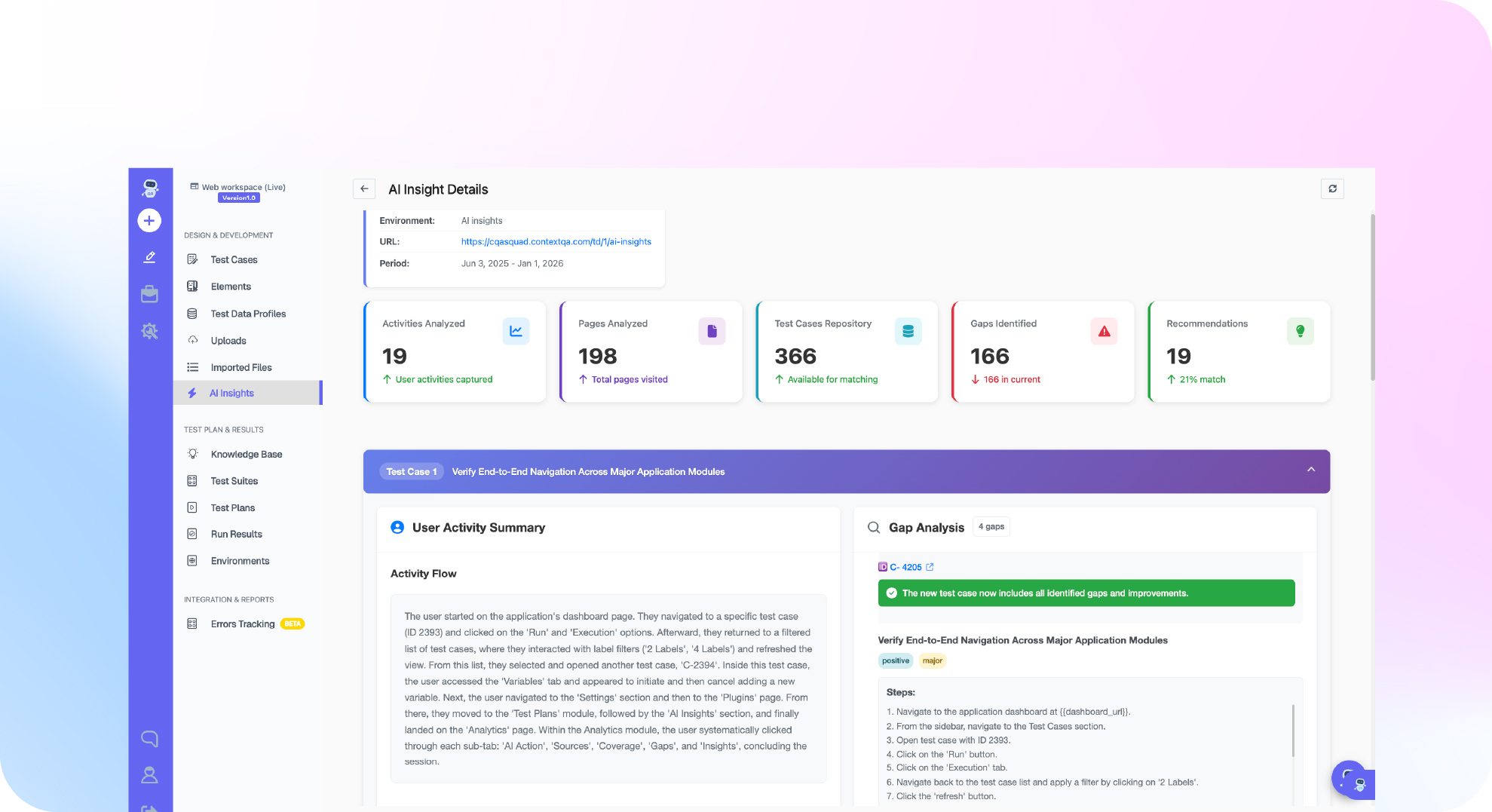
ContextQA, the autonomous quality engineer, addresses AI generated code technical debt by generating behavior tests from a ticket, Swagger spec, or code change. It runs those tests in parallel in your CI/CD pipeline and uses impact analysis to show which flows a pull request touches. The goal is replacing tests that mirror code with tests that check outcomes.
A Monday workflow:
- Generate in the IDE. From Claude Code, Cursor, or Codex, call the ContextQA MCP server on the diff the agent just wrote. It produces happy path, edge case, and failure state tests.
- Find gaps. Open the coverage assurance mind map to see which behaviors have no test.
- Gate the PR. Run the suite as a CI step and mark it as a required status check in your branch protection rules. Root cause analysis explains each failure.
- Own the code. Export to Playwright so tests live in your repo.
Behavior tests do not replace the rest of your pipeline. Keep mutation testing to expose shallow tests, static analysis for duplicated logic and inconsistent patterns, and dependency audits for vulnerable packages.
If AI generated code is piling up duplicated logic, untested branches, and shallow tests in your pull requests, see how ContextQA catches broken flows before merge. See how ContextQA does it or book a demo and bring your hardest case.
What should be on your checklist to do now?
Start with five governance moves this week: label AI assisted pull requests, gate merges on behavior coverage rather than line coverage, scan every PR for duplication and new dependencies, require a human reviewer who owns the module, and track debt signals weekly. Each item below is verifiable in your repo or CI logs.
- Publish a one page AI coding policy in
CONTRIBUTING.md: approved tools, data that must never go into prompts, and review rules. - Add a required
ai-assistedlabel to the PR template. - Add
CODEOWNERSentries so a module owner approves every AI assisted change. - Fail CI when coverage on changed lines drops below your threshold, for example
diff-cover coverage.xml --fail-under=80. - Run mutation testing on changed files weekly to catch tests that only mirror the code.
- Block clones above a set size with a duplication scanner in the PR pipeline.
- Require a written justification for every new entry in
package.jsonorrequirements.txt. - Require at least one negative path test for each new branch or error handler.
Bottom line
AI generated code technical debt grows quietly, but each type is detectable before merge if you test behavior instead of lines and enforce checks per pull request. On Monday, make one PR gate blocking, such as a duplication scan or diff coverage. Use the AI generated code testing checklist and weigh risk in is AI generated code safe.
Sources
The statistics in this article come from the primary research reports below. Each link points to the original publication, so you can check the methodology, sample size, and date before citing a number internally or in a planning document for your team.