
TL;DR: To evaluate AI coding tools before an org-wide rollout, run a time-boxed pilot on real teams and real repos, with a control group and a weighted scorecard that puts code quality, test results and security next to speed. Speed is the easy part to measure, and the easiest to overstate. In the UK government's trial across more than 50 public sector organisations, participants reported saving 56 minutes a day, yet telemetry showed an average acceptance rate of just 15.8% for suggested code lines.
We talk to engineering leaders every week who are under pressure to pick an AI coding assistant or agent and roll it out to hundreds of developers. Most pilots we hear about end with a survey that says developers feel faster. That is a weak basis for a decision that will shape your codebase for years. This guide is the pilot playbook we would want if we were in your seat.
Quick answers
How long should an AI coding tool pilot run?
Plan for 8 to 12 weeks. The first two weeks are a learning curve and should not count toward the result, and you need enough merged work afterward to see defects escape to production.
What should we measure in an AI coding tool pilot?
Measure output quality and defect rate, test pass rate of generated code, security findings, review burden, developer experience, data governance and cost. Weight them in a scorecard agreed before the pilot starts.
Do we need a control group?
Yes. Without a matched team that keeps working the old way, you cannot separate the effect of the tool from seasonal workload, a new release train or simple novelty.
Why do most AI coding tool evaluations measure the wrong thing?
Most evaluations measure perceived speed because it is cheap to collect. Developers fill in a survey, report time saved, and the number goes into a slide. The problem is that perception and quality both drift once AI writes a share of the code.
That UK trial is a useful case study for any engineering leader. The findings report itself notes that respondents may have overestimated time saved due to optimism bias, and only 39% of users said they committed code the assistant suggested.
We are not saying the time savings were fake. We are saying a self-reported number and a code-level number tell different stories, and your rollout decision needs both.
The confidence trap
There is also a human factor. A survey of 319 knowledge workers by Microsoft Research and Carnegie Mellon found that higher confidence in GenAI is associated with less critical thinking. In a coding pilot, that shows up as lighter reviews of AI-written changes, exactly when reviews need to get harder.
If your teams are already wrestling with that tension, our piece on the perfection trap in QA teams adopting AI covers the cultural side. This post stays on the evaluation mechanics.

What hypothesis should an AI coding tool pilot test?
A good pilot tests one falsifiable hypothesis, written down before anyone gets a license. For example: teams using the tool will merge more work per engineer without raising escaped defects, security findings or review time per change. If you cannot write the sentence, you are running a demo, not a pilot.
Write the hypothesis with three parts:
- The expected gain. What gets better, and by roughly how much. Throughput, lead time for changes, or time to first working draft are common choices.
- The guardrails. What must not get worse. Defect rate, test pass rate, security findings and review burden are the usual four.
- The scope. Which kinds of work the tool is meant for. Greenfield services, test writing, refactoring and legacy maintenance behave very differently.
Be honest about the ceiling, too. Forrester's developer survey data shows that developers spend about 24% of their time coding. A tool that only speeds up typing cannot transform delivery on its own, so your hypothesis should name the part of the workflow you expect to change.
How do you pick teams and repos for the pilot?
Pick teams and repos that look like the organization you will roll out to, not the friendliest team you have. A pilot run only on a clean greenfield service by enthusiasts will overstate the benefit for everyone else.
A representative pilot usually covers:
- Two to four teams with different domains, such as a customer-facing web app, a backend service and a data or platform team.
- A mix of repo health. At least one repo with good test coverage and one older codebase with thin tests. AI output tends to look best where tests already catch mistakes.
- A mix of seniority. Junior and senior developers use these tools differently, so include both. Your senior engineers will carry the review load, so their experience matters as much as the juniors' speed.
- At least one regulated or sensitive area, if you have one, so data governance questions surface during the pilot rather than after rollout.
Exclude teams in the middle of a major migration or a launch crunch. Their numbers will be noisy no matter what tool they use.
What belongs on an AI coding tool scorecard?
A weighted scorecard turns a debate about opinions into a decision about evidence. Agree on the criteria, weights and pass thresholds with engineering, security, QA and finance before the pilot starts, then score each tool on a 1 to 5 scale. Here is the weighting we suggest as a starting point:
- Output quality and defect rate (25%). Escaped defects per 100 merged changes, rework within 30 days, and bugs traced to AI-written code. This carries the most weight because it is what your customers feel.
- Test pass rate of generated code (15%). First-run CI pass rate for changes that are mostly AI-written, compared with the team's baseline. Also track whether generated changes arrive with meaningful tests or none.
- Security findings (15%). New static analysis, dependency and secrets findings per change, by severity.
- Review burden (15%). Median change size, review time per change and the number of review rounds. Bigger changes that take longer to review can erase the authoring gain.
- Developer experience (10%). Survey scores on usefulness, trust and frustration, plus weekly active use from telemetry. Useful, but never decisive alone.
- Data governance and IP (10%). Where prompts and code go, retention terms, training opt-outs, licensing of suggestions and audit logging.
- Cost (10%). License and usage cost per active developer, plus admin and enablement time. Keep this to cost of ownership; the full return model is a separate exercise.
For the code-level criteria, it helps to give reviewers a shared standard. Our checklist for reviewing AI-generated code works well as the rubric for sampled reviews.
Want help setting up quality gates before your AI coding pilot starts? See how the ContextQA pilot program works.
How long should the pilot run, and how do you set up a control group?
Run the pilot for 8 to 12 weeks with a matched control group that does not get the tool. Two weeks of onboarding, six to eight weeks of measured work, and a short tail to catch defects that escape after release.
Duration
Shorter pilots mostly measure novelty. Developers try the tool on easy tasks first, and enthusiasm peaks early. Defects also lag: a bug merged in week three may not surface until week seven. If you can only afford four weeks, treat the result as directional and say so in the decision memo.
Control group design
Randomized or matched designs are the most credible way to separate the tool's effect from everything else going on in a quarter. If you cannot randomize individuals, randomize or match at the team level. You can apply that pattern at a small scale:
- Matched teams. Pair teams with similar domains, repo health and seniority mix. One gets the tool, one does not.
- Staggered rollout. If every team must eventually get access, roll it out in waves and compare early and late groups during the gap.
- Baseline period. Collect four to six weeks of pre-pilot data from both groups so you can compare change, not just absolute numbers.
- Same measurement for both. The control group gets the same CI checks, security scans and review sampling, or the comparison is meaningless.

How do you build quality checks into the pilot?
Build quality checks into the pipeline the pilot teams already use, so every AI-assisted change is measured automatically rather than by memory. The goal is a decision based on what shipped, not on how fast it felt.
Thoughtworks placed complacency with AI-generated code in the Hold ring of its Technology Radar across three editions and recommends reinforcing practices such as TDD and static analysis inside coding workflows. We agree, and a pilot is the cheapest place to prove those practices hold up.
Tag AI-assisted changes
Ask developers to label pull requests that are mostly AI-written, or use the tool's telemetry where it exists. Without tagging you can only compare teams, not types of change.
Gate on tests, not on vibes
Require that AI-assisted changes pass the same CI suite as everything else, and track first-run pass rate separately. Watch for generated tests that assert nothing useful. A rising pass rate with shrinking assertions is a warning, not a win.
Scan every change for security issues
Security deserves its own line on the scorecard. France's ANSSI and Germany's BSI jointly warned that AI coding assistants can also introduce new security risks, and they published recommendations for both managers and developers. Run your static analysis and dependency checks on every pilot change and compare finding rates with the control group. For a deeper treatment, see whether AI-generated code is safe to ship.
Sample reviews for depth
Pick a random sample of AI-assisted and human-written changes each week and have a senior engineer re-review them against a rubric. Record what the original review missed. This is the only way to measure the review fatigue that never shows up in cycle time.
Track escaped defects to the change
Link production incidents and bug tickets back to the pull request that introduced them. It is tedious work, but defect rate per 100 merged changes is the number your rollout decision will rest on.
What does a worked pilot look like?
Consider a hypothetical company with 40 engineers in four product teams. The numbers below are illustrative, not from a real customer, but they show how a pilot that looks like a clear win on speed can fail the scorecard.
Two teams, 20 engineers, get an AI coding agent. Two matched teams keep working as before. After a six-week baseline and a ten-week pilot (the first two weeks excluded), the results look like this:
- Throughput. Pilot teams merge 372 changes, up from 310 in the baseline period, a 20% increase. Control teams move from 300 to 309, up 3%.
- Change size and review. Median change size in the pilot grows from 180 to 260 lines. Review time per change rises from 35 to 48 minutes.
- Escaped defects. Pilot teams ship 16 escaped defects across 372 changes, 4.3 per 100. Control teams ship 9 across 309, 2.9 per 100.
- Tests. First-run CI pass rate on AI-tagged changes is 81%, against a team baseline of 89%.
- Security. New medium or higher static analysis findings: 9 in the pilot group, 4 in the control group.
- Developer experience. 85% of pilot developers want to keep the tool.
Scored against the weights above, the tool earns a 2 on quality, test pass rate, security and review burden, a 5 on developer experience, a 4 on governance and a 3 on cost. That works out to 2.6 out of 5 against a pass threshold of 3.5.
A survey-only pilot would have shipped this tool to everyone. With the scorecard, the decision becomes a conditional extension: four more weeks with a cap on change size, mandatory tests for AI-written code and a security scan as a merge gate, then score again.
What go/no-go criteria should decide the rollout?
Set go/no-go criteria before the pilot starts and publish them to the pilot teams. A go needs a gain on the expected outcome and no guardrail breached. Anything else is a no-go or a conditional extension with named fixes.
A practical set of criteria:
- Go: weighted score of 3.5 or higher, throughput gain over control, escaped defect rate within 10% of control, no rise in high-severity security findings, and governance sign-off from security and legal.
- Conditional go: gain is real but one guardrail is breached. Extend the pilot with specific mitigations and a fixed re-score date.
- No-go: no measurable gain over control, or two or more guardrails breached, or an unresolved data governance concern.
- Rollout plan: even on a go, expand in waves with the same dashboards running, so a quality slide in month three gets caught early.
If your company aligns its AI governance to ISO/IEC 42001, the international standard for AI management systems, keep the pilot plan, scorecard and decision memo as part of that record. Auditors and your own security team will ask how the tool was assessed.
One boundary worth stating. This playbook is for AI coding assistants and agents. If you are also choosing a test automation platform, the criteria differ, and our AI testing platform buyer's guide covers that decision.
How does ContextQA help during an AI coding tool pilot?
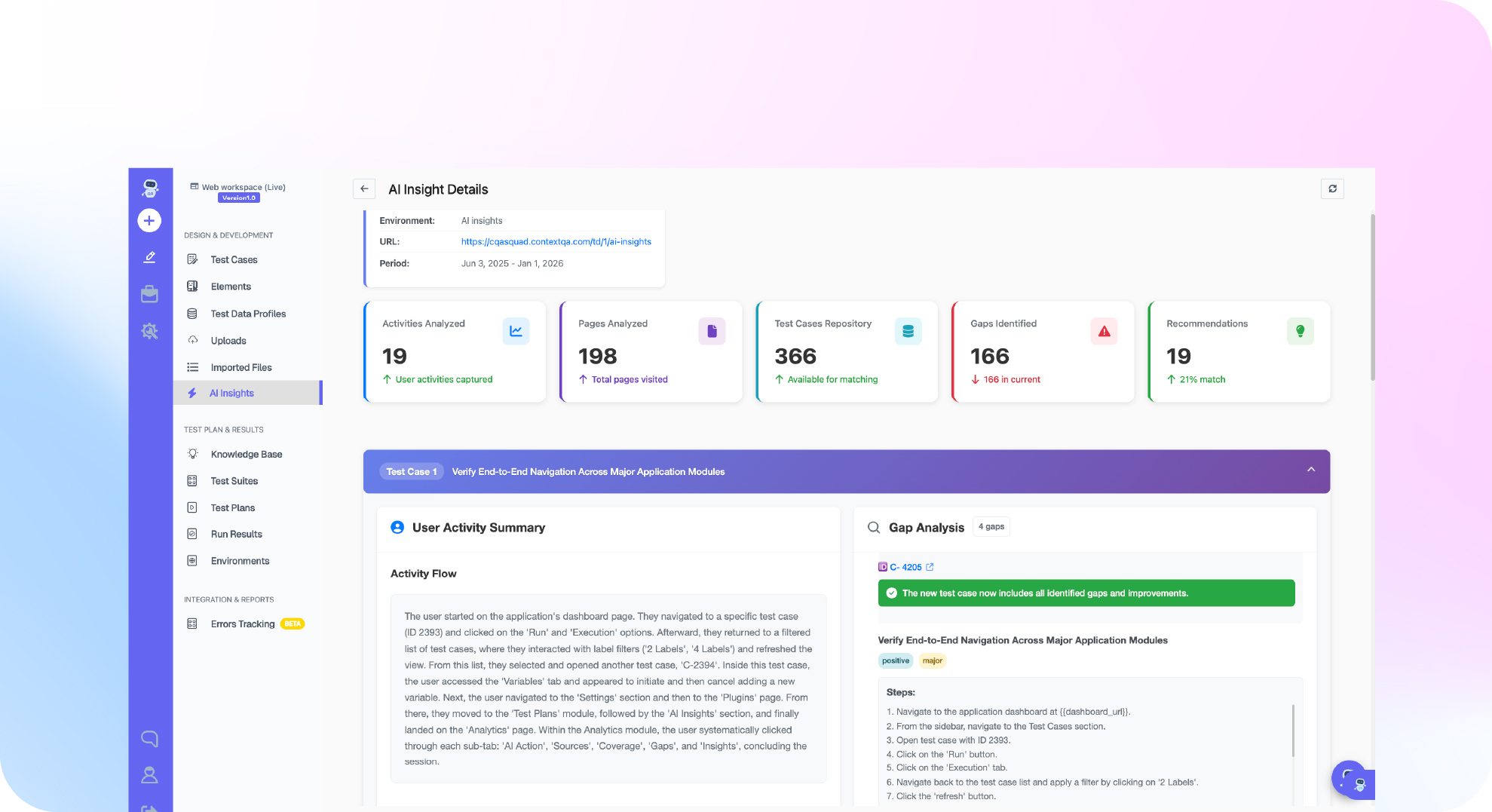
ContextQA gives pilot teams an independent quality signal on what the AI-assisted code actually does in the running application. Our platform is an AI test automation platform, so it sits next to whichever coding tool you are evaluating rather than competing with it.
- Coverage of real user flows. ContextQA generates tests for real user flows across web, mobile and API, so both pilot and control teams run against the same regression suite.
- Self-healing tests. Tests adapt to UI changes, which keeps the regression signal stable while AI-assisted changes land quickly.
- Root cause analysis. Our root cause analysis looks at visual, DOM, network, code and data layers in parallel and explains a failure down to the file and line with a fix suggestion. That makes it far easier to trace escaped defects back to the change that caused them.
- Before and after reporting. The 12-week pilot program includes an efficiency report comparing coverage, regression time and effort, which maps cleanly onto a scorecard review.
If procurement needs a formal process for the testing side, our test automation RFP guide lists the questions to send vendors.
Running an AI coding pilot this quarter? Book a demo and we will show you how to set up quality gates for pilot and control teams.
Bottom line
To evaluate AI coding tools well, treat the pilot as an experiment: one hypothesis, representative teams, a control group, a weighted scorecard and quality checks wired into CI. Perceived speed belongs on the scorecard, but it should never be the whole scorecard.
The organizations that get the most from AI coding tools will be the ones that can prove the code still works. Build that proof into the pilot and the rollout decision gets much easier to defend.
Sources
- AI coding assistant trial: UK public sector findings report, GOV.UK (Department for Science, Innovation and Technology), https://www.gov.uk/government/publications/ai-coding-assistant-trial/ai-coding-assistant-trial-uk-public-sector-findings-report. Cited for 56 minutes saved per day (self-reported), the 15.8% average acceptance rate for suggested code lines, possible optimism bias and 39% of users committing suggested code.
- The Impact of Generative AI on Critical Thinking, Microsoft Research and Carnegie Mellon University (CHI 2025), https://www.microsoft.com/en-us/research/publication/the-impact-of-generative-ai-on-critical-thinking-self-reported-reductions-in-cognitive-effort-and-confidence-effects-from-a-survey-of-knowledge-workers/. Cited for the survey of 319 knowledge workers linking higher confidence in GenAI with less critical thinking.
- Predictions 2025: GenAI Reality Bites Back For Software Developers, Forrester, https://www.forrester.com/blogs/predictions-2025-software-development/. Cited for developers spending about 24% of their time coding.
- Complacency with AI-generated code, Thoughtworks Technology Radar, https://www.thoughtworks.com/radar/techniques/complacency-with-ai-generated-code. Cited for the Hold ring placement across three editions and the recommendation to reinforce TDD and static analysis.
- AI Coding Assistants, ANSSI (French National Agency for the Security of Information Systems) and BSI (German Federal Office for Information Security), https://cyber.gouv.fr/en/publications/jointly-led-international-publications/ai-coding-assistants/. Cited for the joint warning that AI coding assistants can introduce new security risks and for recommendations aimed at managers and developers.