
TL;DR: An Oracle application testing suite is a reusable set of browser and API regression tests that checks whole business processes from start to finish, such as procure to pay, record to report, and order to cash. Oracle Fusion Cloud applications get scheduled vendor updates you do not control. Each release therefore needs a regression run against the real roles, data, and UI variant your team uses. Start with procurement and journals, and check the posted records, not just whether a job was submitted. ContextQA, the autonomous quality engineer, records and runs these suites.
A useful Oracle application testing suite proves that a requisition becomes a matched payable. Many teams instead run brittle scripts that break with each vendor update and check screens, not outcomes. This guide covers how to scope Oracle processes, check the execution surface, and build reusable browser and API regression tests in ContextQA that produce release evidence you can verify.
Quick answers
What should an Oracle regression suite cover first? Start with three processes. Procure to pay runs from an approved requisition to a matched payable. Record to report covers a balanced journal that posts and reconciles. Order to cash runs from fulfillment to the handoff to receivables. Get one process passing with real business assertions before you add modules. A test that only confirms a job was submitted cannot sign off a release.
How do I keep Oracle regression tests stable across updates? Parameterize the product, release, roles, and test data. Store environment specific values in environment data. Move login and approval steps into reusable step groups so one fix covers every test. ContextQA's AI based self healing repairs broken selectors and locators when the UI changes. Run the suite nightly against staging.
Does Oracle Fusion browser coverage also cover ADFDI, E-Business Suite, or Forms? No. Each interface needs its own proof. Passing Fusion browser tests say nothing about the desktop spreadsheet integration (ADFDI) or about E-Business Suite and Forms screens. Keep a coverage register of tested, untested, and unavailable surfaces so release sign off never assumes coverage that does not exist.
What is an Oracle application testing suite and when do you need it?
An Oracle application testing suite is a reusable set of automated tests for Oracle business processes such as procure to pay, record to report, and order to cash. It runs after every vendor update, patch, or configuration change. You need one when manual regression can no longer finish inside a release window.
A good suite asserts business outcomes, such as a matched payable or a balanced, posted journal, never a submitted job alone. Each test takes the product, release, user role, and test data as parameters, because a suite tied to one tester's account breaks on the first rerun.
When you evaluate tooling, check which interfaces it can actually run against:
- Oracle Cloud ERP (Fusion): browser screens, authorized REST or SOAP services, and file based imports. For imports, assert that the job completed, which rows were rejected, and which records were saved.
- Oracle E-Business Suite and Forms: list the exact interface and prove a test works on it before you reuse a Fusion recipe.
- Desktop spreadsheet integration (ADFDI): validate it on its own. Passing browser tests do not show that the desktop add-in is supported.
ContextQA's Oracle testing path follows this order and keeps every untested surface in a coverage register.
What do you need before you start?
Before you build Oracle regression tests, you need a named Oracle product and module, a nonproduction environment on the current update, approved test identities for each role, reusable test data, and a confirmed interface. You also need a ContextQA workspace with that environment's base URL configured, plus a process owner who signs off on expected outcomes.
What you prepare depends on where you start:
- Legacy record and playback suites: many scripts were built for older Oracle UI variants. Check which ones still run on Fusion browser screens before you migrate them.
- Open source browser frameworks: your team owns the locators, waits, and grid infrastructure, and every Fusion update adds maintenance work.
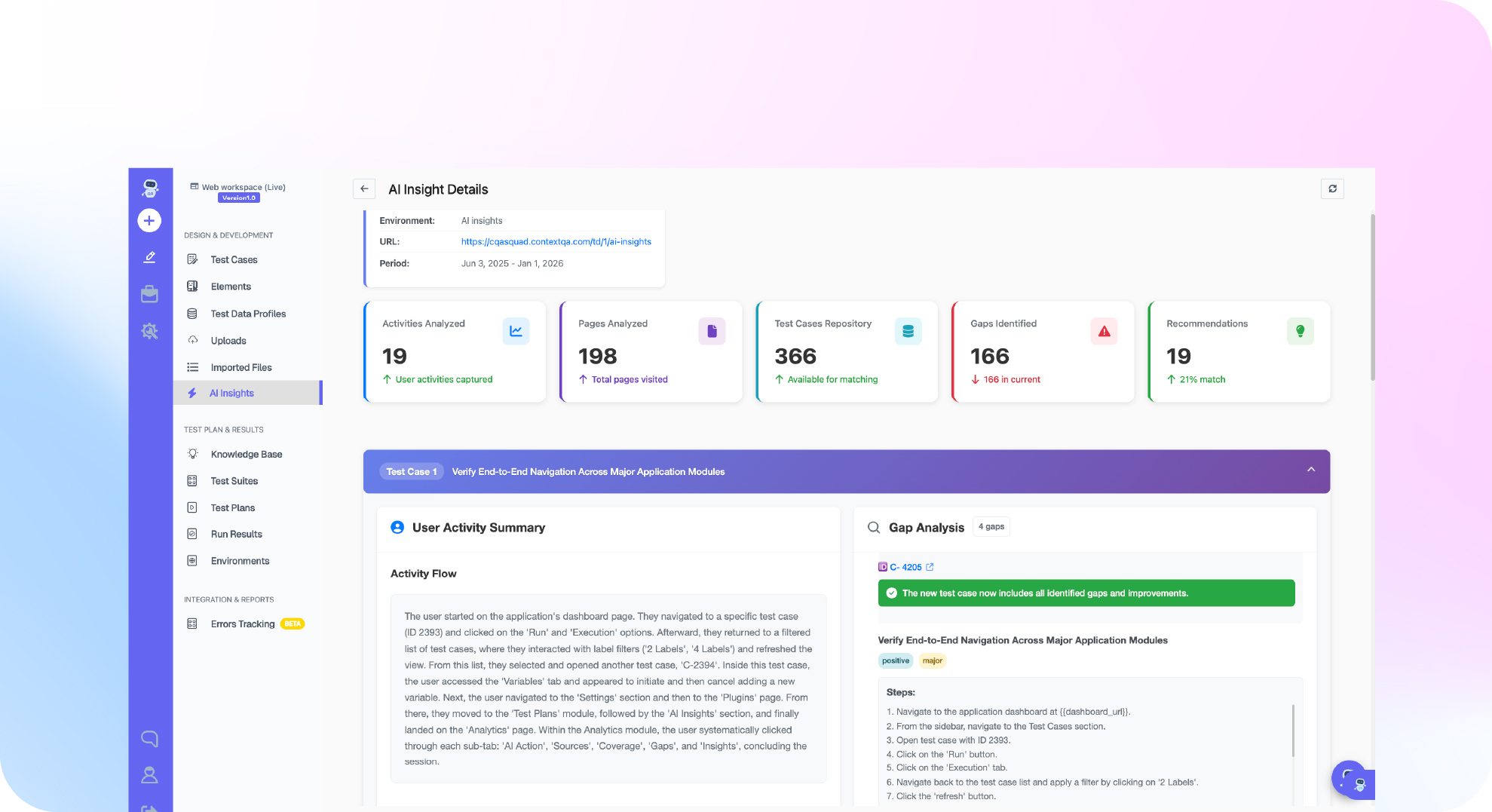
- ContextQA platform: record Fusion workflows with the no code recorder and call authorized REST or SOAP services. Self healing repairs broken locators after an update. ADFDI still needs separate validation.
Start with tests that already pass when run alone. That way the first suite failure is a real regression, not a setup problem (regression suite tutorial).

How do you build an Oracle regression suite step by step?
To build an Oracle regression suite in ContextQA, scope one business process and confirm ContextQA can run on its interface. Record the process with the no code recorder, parameterize the roles and data, and group the passing tests into a scheduled regression plan. Every run produces execution evidence your team reviews before release.
- Scope the process. Name the Oracle product, module, release, user roles, and expected outcome, for example an approved requisition through to a matched payable (Oracle testing path).
- Check the interface first. Record a Fusion browser screen. ADFDI and E-Business Suite Forms need their own proof.
- Record and assert. Build steps in the no code recorder. Assert on the saved business record, not on whether the job was submitted.
- Parameterize. Move roles and inputs into test data and environment data. Put login and approval steps in step groups so other tests reuse them.
- Schedule. Create a suite such as
Regression_P2P. Build a test plan that targets one browser and a staging environment, then schedule it nightly with Slack alerts (tutorial). - Export if needed. Code export writes the tests out as Playwright code that runs in your own pipeline:
npx playwright test --project=chromium --reporter=html
What are the most common mistakes?
Four mistakes recur: reusing Fusion coverage on other Oracle products without proof, passing a test because a job was submitted, comparing tools on license price alone, and adding tests to CI/CD before each business process passes reliably on its own.
- Reusing a Fusion recipe on other products: E-Business Suite (EBS), Oracle Forms, PeopleSoft, and Siebel each expose a different interface. The Oracle testing path says to prove the exact interface before you reuse a recipe.
- Asserting on job submission: a submitted import is not a result. Assert on what was saved: the matched payable, the balanced journal, the rejected rows.
- Comparing license cost only: open source frameworks are free to license, but your team maintains the locators and browser infrastructure. Count those hours next to any quoted price.
- Scheduling flaky tests into pipelines: run each test alone first, then group them into a suite and trigger it from Jenkins or GitHub Actions (regression suite tutorial).
How do you know it is working?
Your Oracle regression suite is working when nightly runs stay green on unchanged builds, every red run traces to a real regression or a known environment issue, and each test checks a business outcome such as a posted journal.
Watch flakiness first. Google reported that about 1.5% of all its test runs gave a flaky result, and almost 16% of its tests showed some flakiness (Google Testing Blog, 2016). Track these signals:
- Clean baseline: only add tests that pass on their own, so the first failure in a scheduled regression plan is a real regression.
- Triage rate: sort every failure posted to Slack as a product bug, a data collision, or a flaky test.
- Business evidence: check the record the process produces, as the Oracle path recommends.
- Coverage register: list the interfaces you have not tested yet, such as ADFDI.
Load testing measures response time and throughput under concurrent users, so report it separately from functional pass rates. ContextQA offers performance testing as a separate capability.
How do you automate Oracle regression testing with ContextQA?
To automate Oracle regression testing with ContextQA, record one Oracle Fusion browser workflow, such as a requisition and its approval, and assert on the records it creates. Group the passing tests into a regression suite. Then run it on a schedule, from CI/CD, or from an AI coding assistant through the ContextQA MCP server.
- Validate the surface. Record a typical Fusion screen, approval, and assertion. The Oracle testing path does not claim a native Oracle connector, so prove every other interface separately.
- Build the suite. Go to Test Development > Test Suites > + Create Test Suite and name it, for example
Regression_Oracle_P2P. - Route failures. Schedule the test plan nightly and send failures to Slack, or trigger it from Jenkins or GitHub Actions.
When you compare tools, check what happens after the UI changes and how easily you can leave. ContextQA self heals broken locators and exports tests to Playwright code.
If your Oracle regression still depends on scripts that break with every vendor update, book a demo to see how the ContextQA enterprise apps testing platform records, self heals, and reruns Oracle workflows.

What should you do right now?
This week, pick one Oracle process, such as procure to pay or record to report, prove ContextQA can drive its exact interface, and turn three passing tests into a scheduled regression suite.
- Write down the Oracle product, release, module, and target environment.
- Pick one P0 process from the Oracle testing path.
- Record the workflow on your actual Fusion UI variant, including one approval step.
- Assert the business record, such as a matched payable or a posted journal.
- List EBS, Forms, and ADFDI surfaces in a coverage register until each one is proven.
- Schedule a nightly test plan against staging, with Slack failure alerts.
Bottom line
An Oracle test suite you can trust starts small: one scoped business process, approved test identities, parameterized data, and assertions a process owner signs off on. Prove each execution surface, log the untested ones, then schedule the passing tests against staging with Slack alerts. The same patterns apply to SAP and Salesforce. See our enterprise application testing guide.
Sources
The external statistic comes from the primary source listed first. ContextQA workflow steps, settings, and screen names come from the learning docs listed after it.