
TL;DR: No, AI will not replace QA engineers, but it is changing what their job involves. AI agents now handle much of the test writing, selector maintenance and failure triage. Risk judgment, test strategy and accountability for releases stay with people. The U.S. Bureau of Labor Statistics projects 15 percent employment growth from 2024 to 2034 for software developers, quality assurance analysts and testers combined (BLS Occupational Outlook Handbook, 2025). ContextQA, the autonomous quality engineer, takes on the repetitive work so QA teams can focus on deciding what quality means.
Will AI replace QA engineers? The honest answer is no, but it will take over much of the work they do today. This guide covers which tasks move to agents, which skills become more valuable, and how to reorganize your QA team starting Monday.
Quick answers
Will AI replace QA engineers? No. AI is taking over much of the work of writing tests, fixing them when the UI changes and triaging failures, but it does not replace the people who own quality. Deciding which risks matter, setting test strategy and approving a release stay with people. The job moves toward designing coverage, reviewing AI output and making release calls.
Which QA tasks can I safely hand to an AI agent today, and which should stay with my team? Hand agents the repetitive work: drafting tests from tickets, specs or recorded flows, fixing broken selectors after UI changes, running suites in parallel across browsers and devices, and sorting failures with evidence attached. Keep risk prioritization, exploratory testing, sign off on test data and compliance scope, and the final release decision with your team. The agent does the work. A named person owns the outcome.
How should an engineering manager reorganize a QA team when AI handles test writing and maintenance? Move people from writing and fixing scripts into three roles. Quality strategists own risk and coverage for each product area. Automation reviewers check AI generated tests before they enter CI/CD. Specialists cover enterprise apps, APIs or AI agent behavior. Give each CI gate a named owner, and track flaky test count, coverage gaps and time to detect instead of test case counts.
Will AI replace QA engineers by 2030? What the labor data says
No credible labor data points to QA engineering disappearing by 2030. The U.S. Bureau of Labor Statistics projects its combined developer and tester occupation to grow much faster than average through 2034. The World Economic Forum expects technology roles to keep growing while the skills inside them change. The job is shifting. It is not disappearing.
- Growth projection: BLS projects 15 percent employment growth from 2024 to 2034 for software developers, quality assurance analysts and testers (BLS, 2025).
- Skills churn: Employers expect 39 percent of workers' core skills to change by 2030 (WEF Future of Jobs Report, 2025).
- Adoption: 76 percent of respondents were using or planning to use AI tools in their development process in 2024 (Stack Overflow Developer Survey, 2024).
Which QA tasks move to AI agents, and which stay with people?
Agents take the repetitive, high volume tasks first: drafting tests, repairing broken locators, rerunning suites and sorting failures with evidence attached. People keep the decisions an agent cannot be held accountable for: which risks block a release, what coverage a regulated flow needs, and who answers for a defect that reaches production.
- Agents write the tests. ContextQA builds a suite from a flow, ticket, Figma file or Swagger spec, covering happy paths, edge cases and failure states.
- Agents maintain the tests. AI based self healing repairs broken selectors and locators when the UI changes, so nobody spends a sprint rewriting XPath.
- Agents and people share triage. Root cause analysis narrows down why a test failed. An engineer still decides whether the failure is a real bug, a flaky test or an intended change.
- People own strategy and sign off. Choosing coverage, setting release criteria and answering for an escaped defect stay with people.
Skills that gain value as agents absorb the scripting:
- Risk analysis: knowing which billing rule or permission edge case caused last quarter's escalation.
- Review of generated tests: spotting assertions that pass while missing the business logic.
- Pipeline ownership: designing what runs on each pull request versus on release.
- Domain depth: Salesforce, SAP and ERP processes, plus AI agent testing for guardrails and tool calls.

Why does this matter for engineering leaders right now?
Waiting has a cost: risk that nobody owns. When agents write and repair tests but nobody is named to review them, generated suites can pass while missing the business rules that matter. Leaders who decide who reviews agent output and who signs off each release area keep their release speed without losing accountability.
The tradeoffs to decide on explicitly:
- Speed versus review load: Generated tests arrive faster than people can read them. Budget reviewer time, or coverage grows without anyone understanding it.
- Healing versus masking change: A healed locator keeps a test green. Review healed steps at first, because an intended UI change and a regression can look the same to a selector.
- Headcount versus capacity: Treat agents as added capacity. Cutting reviewers before the pilot proves itself moves risk onto production.
Something to do on Monday: add up the hours your team spent last sprint on locator fixes and flaky reruns. That work moves to agents first.
How does the shift play out in a real pipeline?
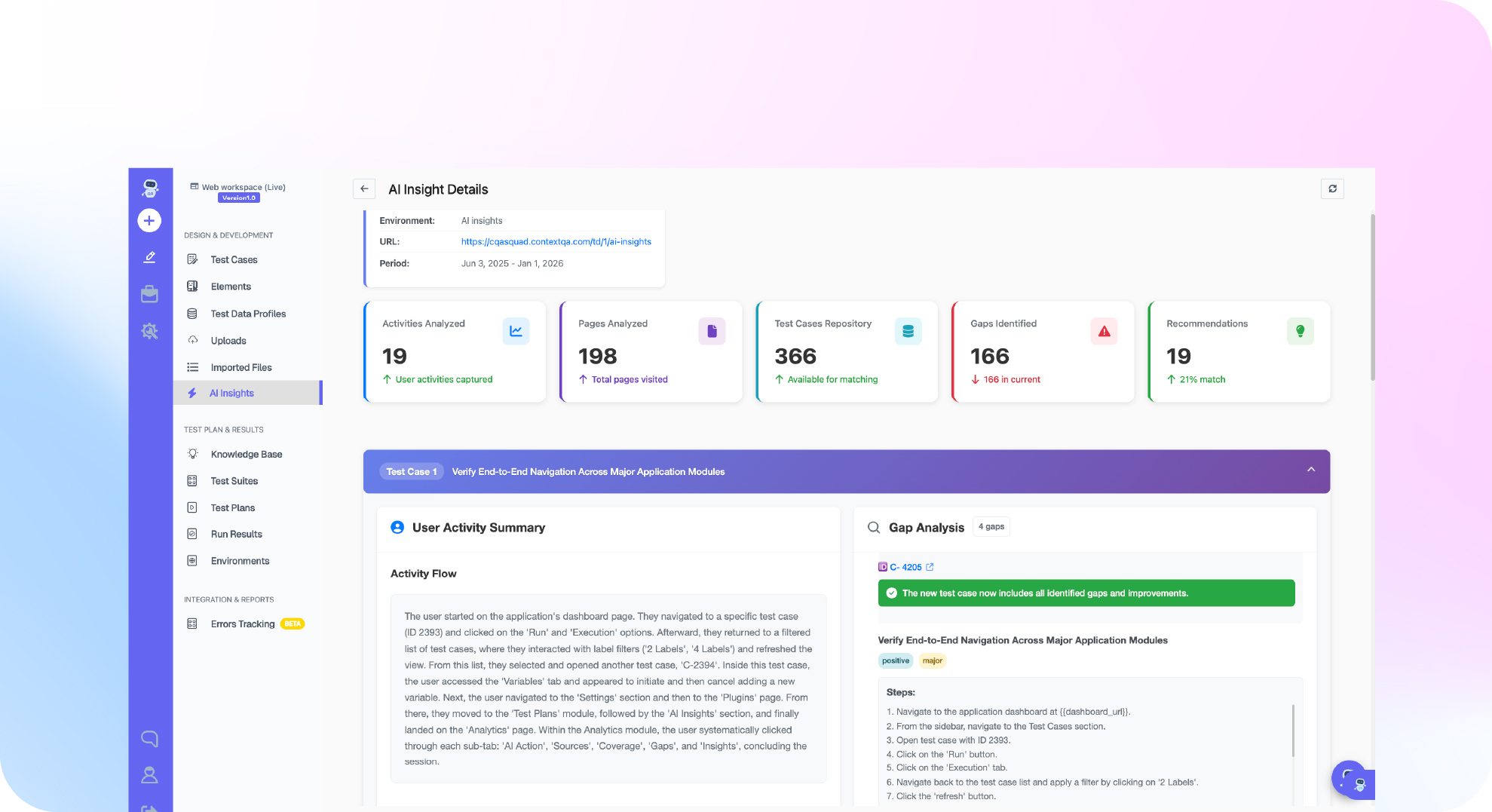
In a real pipeline, AI takes over individual tasks inside the QA workflow, one at a time. A tester records a flow, the recorder turns it into editable steps, self healing keeps locators working, a CI job runs the plan, and a person reviews each failure and owns the release decision.
- Capture the flow. A tester records a workflow with the ContextQA Recorder Chrome extension. Each click, text entry and navigation becomes an editable step, with no code required.
- Review against risk. AI covers the paths it can see in the UI. Only a person knows which flows carry revenue or compliance risk.
- Let healing absorb UI churn. Self healing repairs broken selectors, the maintenance work hand written scripts never escaped.
- Gate the release. The pipeline starts a test plan, keeps the returned run ID, checks its status with a bounded timeout, and stops the release on any result other than success (ContextQA docs).
- Judge the failure. Each run captures screenshots, video and network logs. A human decides whether a failure is a defect or an intended change.
Exploratory and usability testing still depend on human judgment.
Which approach fits your team?
The right approach depends on where your team spends its test effort today. If script maintenance eats most of the week, hand authoring and repair to an agent. If your frameworks are mature, start with triage and CI gates. Either way, people keep ownership of risk decisions, coverage strategy and release sign off.
- Manual heavy QA team: Testers capture workflows with the no code recorder, and self healing handles locator breakage. Skill to grow: risk based test charters and reviewing steps for business logic gaps.
- Team with a large scripted suite: Keep your code. Code export to Playwright means no lock in. Skill to grow: test architecture and reviewing AI generated code.
- Engineering leaders who own releases: Run a small test plan on each pull request and save full regression for release or scheduled runs (docs). Skill to grow: acting on flaky test count and MTTD (mean time to detect) trends.
- Enterprise app teams: Test Salesforce Lightning and Classic, or SAP Fiori, S/4HANA and SAP GUI workflows end to end. Skill to grow: knowledge of the business processes those apps run.
How does ContextQA split the work between agents and people?
ContextQA, the autonomous quality engineer, takes on test creation, self healing maintenance and failure triage across web, mobile, API and enterprise apps. Your team keeps risk calls, test strategy and release sign off. You get more automation capacity without rewriting your process, because ContextQA works from your IDE, runs in your CI system and exports to Playwright.
- Authoring: Testers record flows with the no code recorder. Engineers generate tests from Claude Code or Cursor through the MCP server, which exposes 50 testing tools in plain English. API checks chain tokens between requests without code, as shown in the API testing tutorial.
- Execution: One suite runs in parallel across Chrome, Safari, Edge, Firefox, iOS and Android, triggered from Jenkins, GitHub Actions or other CI/CD tools.
- Maintenance and triage: Self healing and root cause analysis cut down the repair and sorting work.
- Exit path: Playwright export keeps your tests portable.
ContextQA publishes no headcount reduction figure. Track self healing rate, flaky test count, MTTD and coverage gaps in your own workspace, and use that data to decide who moves into risk analysis and coverage strategy.
If your QA team spends more hours fixing broken selectors and triaging flaky failures than judging release risk, book a demo to see how ContextQA handles that work.

What should you do now? A checklist
Start this week by measuring where QA hours go, then pilot AI on one regression suite while people keep ownership of risk calls. Hand test writing, selector maintenance and first pass triage to agents. Keep strategy and release sign off with people, and make the test plan a required CI check only after the pilot proves itself.
- Log one sprint of QA hours, split into authoring, maintenance, triage and exploratory work.
- Pick one frequently changing, flaky regression suite as the pilot and record its core flows.
- Track self healing rate, flaky test count and MTTD from the engineering manager metrics.
- Review every self healed locator for one week before trusting them.
- Write a risk register that names who signs off each release area.
- Test the pass, failure, timeout and expired token paths before making a test plan a required CI check.
- Move one tester toward exploratory and AI agent testing.
Bottom line
AI will not replace QA engineers, but it will replace the slowest parts of the job: writing tests, repairing selectors and first pass triage. People still decide acceptable risk, set test strategy and own each release. Treat an autonomous quality engineer as added capacity, move testers toward risk analysis and review, and start with one high maintenance suite. For a rollout plan, see the guide to AI for QA testing.
Sources
Labor and adoption figures come from the primary sources below. Product workflow details come from the linked ContextQA documentation.