
TL;DR: Teams evaluating a Leapwork replacement should check three things: how much upkeep large visual flows need, how license cost grows with users and runners, and whether tests can be exported as code. The alternatives fall into three groups: enterprise platforms, low code suites and code frameworks like Playwright. ContextQA, the autonomous quality engineer, builds self healing tests from plain English and exports them to Playwright. Shortlist only the tools that meet your must haves, then run the same pilot workflow on each one.
Teams comparing leapwork alternatives usually want answers to the same questions. How much maintenance does a tool need as suites grow? How does its pricing scale with usage? Can engineers keep the tests in their repository? This guide covers what Leapwork does well and why teams switch. It then compares six options by who each one fits, its pricing model and its main tradeoff.
Quick answers
Why do teams switch away from Leapwork? Reasons vary by team. Common ones are maintenance effort on large flows, how cost scales at your usage, a need to keep tests as code, or a need to cover APIs, databases or AI agents. Write down the one constraint your current setup cannot meet, then test every replacement against it using the same workflow.
How do I evaluate replacements without a long vendor bake off? Start with a list of dealbreakers: target coverage, private network access, SSO and roles, test data reset, CI failure behavior and exportability. Drop any tool that fails one. On the tools that remain, run one regression flow with a deliberately planted bug. Then compare the evidence each tool produces, as the ContextQA comparison guide describes.
Can non technical testers keep authoring tests after the move? Yes, as long as the replacement has a genuine no code authoring path and isn't just a code framework with a recorder added on. ContextQA has a no code UI, a no code recorder and plain English steps, plus Playwright export for engineers. During the pilot, have a tester with no coding background build and maintain one real flow.
What are the main Leapwork alternatives?
The Leapwork alternatives worth shortlisting keep visual, no code authoring and close the gap that made you start looking. That gap might be cost at your scale, a need to keep tests as code, or new targets like AI agents. Six options cover most shortlists: ContextQA, Tricentis Tosca, UiPath Test Suite, Katalon, mabl and Playwright.
Leapwork earns its place. Its flowchart builder lets testers who don't code automate web, desktop and packaged applications. The visual model also makes a flow readable to business reviewers. If those strengths still cover your targets and the cost works, staying may be the right call.
The useful alternatives differ in three ways:
- Who writes the tests: testers in a no code UI, engineers in code, or both.
- Who maintains them when the UI changes: the team by hand, or the tool through self healing, where broken locators get repaired automatically.
- Whether tests can leave the tool as code: this sets your exit cost for years.
Before you switch, write down your reason in one sentence. It might be cost as your suite grows, a need to keep tests as code, or a missing test target. Then remove any option that fails a requirement you can't compromise on. A tool that fails one of those should not win on features it has elsewhere.

How did we evaluate them?
We judged each option on six criteria: what it can test, who writes the tests, how it handles UI change, how it fits into CI, what evidence a run leaves behind, and whether you can take the tests with you if you leave. We removed any option that failed a required constraint, however many other features it had.
These pass conditions follow the ContextQA decision guide. Write them down before you look at any vendor, then run the same task on every tool still on the list.
Self healing is the hardest criterion to check. A repaired locator can quietly weaken a business assertion. For example, the healed step still clicks "Submit," but the check on the order total is gone. Run this experiment on every shortlisted tool:
- Pick one checkout or approval flow that has a business assertion, such as an order total.
- Rename one button label or element ID in a staging build.
- Run the suite and open the step the tool repaired.
- Confirm the assertion still checks the same value. Then plant a real bug in the total and confirm the run fails.
For CI, check that pass, fail, timeout and cancellation each produce a distinct pipeline result. In a Playwright baseline, npx playwright test --retries=0 makes a failure show up immediately instead of being hidden by retries. npx playwright show-trace trace.zip opens the trace so you can judge how complete the evidence is.
Open source frameworks have no license fee. The cost moves elsewhere: your team owns the test runner, fixtures, locator upkeep and evidence pipeline.
How do the options compare?
The six options fall into three groups. Enterprise platforms with depth in packaged apps: ContextQA, Tricentis Tosca and UiPath Test Suite. Low code suites for web and mobile teams: Katalon and mabl. A framework your team owns in code: Playwright. Choose based on the targets you must cover and on who will maintain the tests after the pilot.
| Option | Best for | Pricing model | Notable tradeoff |
|---|---|---|---|
| ContextQA | Enterprise web, mobile, API, Salesforce, SAP | Demo and quote | No published self serve price |
| Tricentis Tosca | Model based SAP and packaged apps | Check vendor site | More training and setup |
| UiPath Test Suite | Teams already on UiPath RPA | Check vendor site | Heavy if you only need testing |
| Katalon | Mixed no code and scripted teams | Check vendor site | Complex logic falls back to scripting |
| mabl | Low code SaaS web and API | Check vendor site | Verify mobile and ERP depth |
| Playwright | Code first engineering teams | Free, Apache 2.0 | You own runner, fixtures, evidence |
We list a pricing model only where we confirmed it at the primary source. Vendors change their plans often, so check each commercial vendor's current pricing page and note the date before your shortlist meeting.
ContextQA
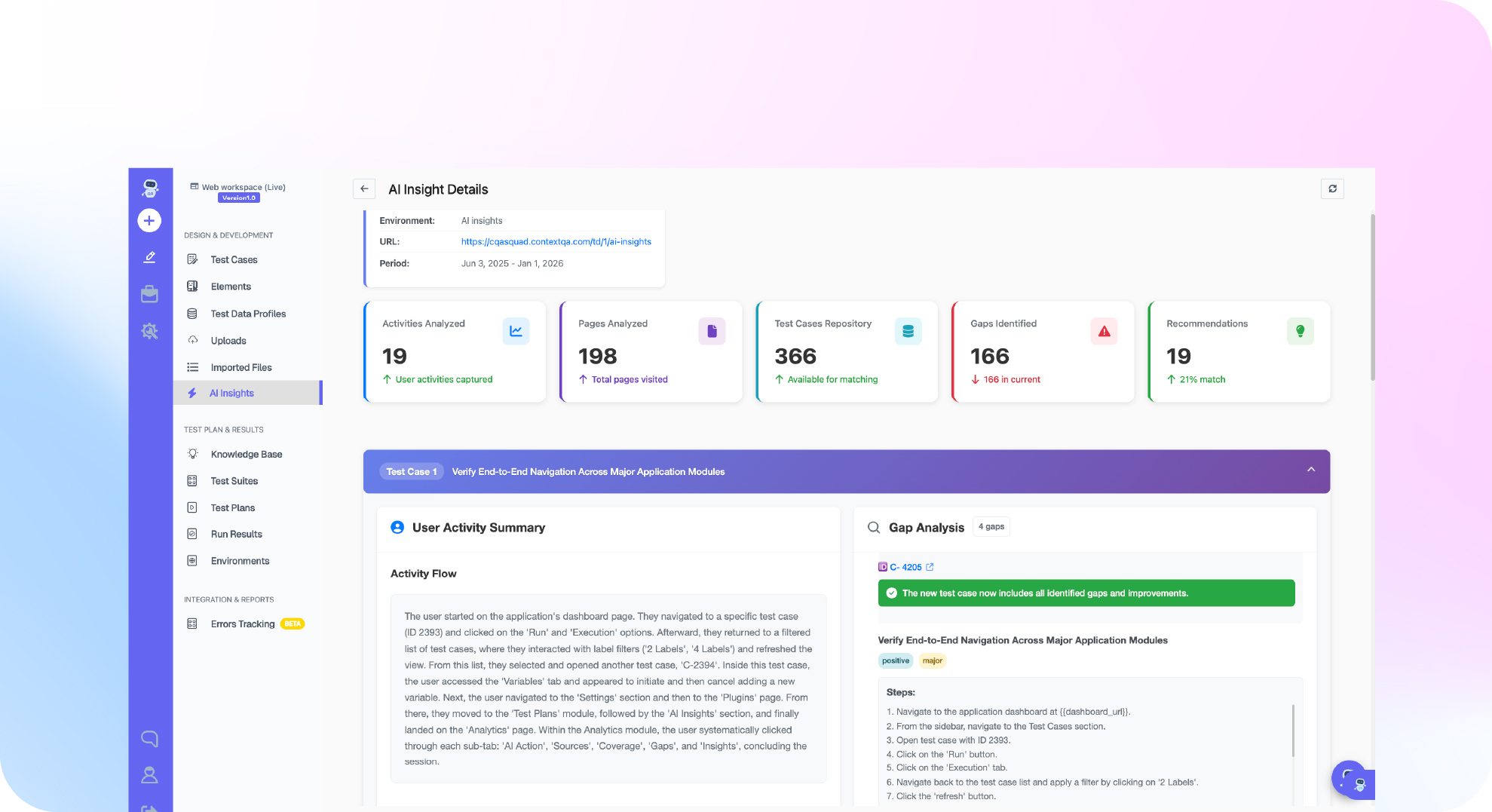
An autonomous quality engineer that creates, runs and maintains web, mobile, API, Salesforce and SAP tests from plain English (Introduction to ContextQA). It fits enterprise QA teams that want no code authoring without getting locked in. Self healing repairs broken locators. Every run records screenshots, HAR logs (a log of each network request), console entries, video and a Playwright trace. Tests export to Playwright, and the MCP server lets you drive tests from Cursor or Claude Code. The docs don't list Windows desktop apps, so confirm desktop coverage in a demo.
Tricentis Tosca
A model based platform that builds tests from reusable models of the application. It fits companies that run mostly on SAP and other packaged apps. Expect a heavier setup and trained specialists to maintain the models.
UiPath Test Suite
Testing built on UiPath's robotic process automation (RPA) platform, reusing automation assets across desktop, Citrix and SAP. It is most useful if you already run UiPath bots.
Katalon
A low code studio on top of Selenium and Appium, with Groovy scripting when the recorder runs out. It fits teams with mixed skills. Large suites still need engineers who are comfortable with code.
mabl
Cloud low code testing for web and API flows, with automatic healing. It fits SaaS teams that ship often but is not built for SAP GUI or desktop apps.
Playwright
Microsoft's open source browser framework, with no license fee and a trace viewer. It fits teams where engineers own the tests. You own the infrastructure and the triage of flaky tests, and it does not cover desktop apps or SAP GUI.
If test maintenance is eating your sprint, book a demo to see how ContextQA's no code recorder and self healing tests keep an enterprise regression suite current as the UI changes.
Which one fits your team best?
The right replacement depends on who writes the tests and what they test. Enterprise teams testing Salesforce or SAP alongside web and mobile should shortlist ContextQA or Tricentis Tosca. Teams already running UiPath robots should look at UiPath Test Suite. Teams that want full code ownership should pick Playwright. SaaS web teams should look at mabl.
Software agencies have three extra checks:
- Separate client workspaces: each client's data and credentials stay apart. Ask the vendor how access is scoped and revoked, using the vendor security evidence checklist.
- Testers who don't code can still build tests: ContextQA's no code recorder covers this.
- Tests you can hand off: ContextQA exports tests to Playwright, so a client keeps the suite after the contract ends.
Engineering leaders can start the process on Monday:
- Write the one sentence reason you are leaving and your dealbreakers.
- Cut the shortlist to the tools that pass all of them.
- Pick one regression flow and run it on each tool with a planted bug and a renamed element.
- Compare the evidence, the hours spent fixing failures and the CI behavior, then decide to pilot, stay with your current tool or narrow the scope.

Bottom line
You don't need the best Leapwork replacement in general. You need the one that still holds up under your constraints after a pilot on your own workflow. Start with the requirements you won't bend on: coverage, deployment, identity and portability. Then run each shortlisted tool through the same flow and compare the evidence each one produces.
If you're also comparing other no code tools, run the same pilot method on each one. To see how an autonomous quality engineer fits into an existing pipeline, book a demo.
Sources
This comparison uses ContextQA's public documentation for every ContextQA capability and each vendor's own website for the other tools. Playwright's license comes from its official repository. We published no pricing model for a commercial vendor unless we confirmed it at that vendor's primary source.