
TL;DR: The implementation phase in the SDLC is the stage where developers turn approved designs into working code, commit it to version control, and integrate it through CI/CD pipelines. It covers coding, code review, unit testing, and builds that feed later test and deployment stages. Defects caught here are cheaper to fix than those found in production, because the change is small and the context is fresh. Teams shorten feedback loops by running automated tests on every commit. ContextQA, the autonomous quality engineer, can generate and run those tests from the IDE through its MCP server.
The implementation phase in SDLC is where designs become working code, and where untested commits, flaky tests, and late defects pile up before release. This guide covers the core tasks, which tests belong in each step, and how to wire unit, integration, and end to end checks into your CI/CD pipeline.
Quick answers
What tasks happen during the implementation phase in SDLC? In the implementation phase, developers turn the approved design into working code, following coding standards and the team's branching strategy. Typical tasks include writing feature code, peer code review, writing unit tests, merging through pull requests, and running builds in the CI/CD pipeline on every commit. QA engineers usually write automated tests from tickets and specs in parallel, so suites are ready when features land.
What testing should run during the implementation phase instead of waiting for the testing phase? Unit tests, static analysis, and fast integration or API tests should run on every pull request, because defects cost less to fix while the code is fresh in the developer's mind. Many teams also run a small end to end smoke suite against a preview environment before merge. Full regression, performance, and cross browser runs usually stay in a nightly job so pull request feedback stays fast.
How do you keep automated tests from breaking constantly while features are still being implemented? Tests break during implementation because selectors, flows, and API contracts change daily, which produces flaky failures teams learn to ignore. Use dedicated test IDs as locators, test against a Swagger or OpenAPI contract, and quarantine flaky tests instead of letting them block merges. ContextQA can also generate tests from tickets, self heal them when the UI changes, and export them to Playwright code.
What is the implementation phase in SDLC?
The implementation phase in SDLC is the stage where developers turn the approved design into working, version controlled code. It is usually the longest and most hands on phase, delivered in small increments that are built, reviewed, and tested continuously. Each defect introduced here is either caught by fast feedback or carried into costlier stages.
Key activities during implementation:
- Coding to spec: Developers build features against user stories, API contracts, and design files on short lived feature branches.
- Code review: Pull requests go through peer review, linting, and static analysis before merge.
- Unit and integration testing: Developers write tests alongside the code, and CI runs them on every push, for example
npm testorpytest. - Build and integration: CI (continuous integration) compiles, packages, and merges changes into a shared
mainbranch.
What does the implementation phase produce?
Implementation produces merge ready commits, passing unit tests, build artifacts, and deployable releases. The testing phase then verifies that output against requirements, although modern pipelines run both in parallel, so verification starts on the first commit rather than after the last one.
- Version control: Every change lands on a short lived Git branch. Squash merges or
git rebasekeepmainreleasable. - Code reviews: Branch protection rules require at least one approving reviewer and a green build before merge.
- Continuous integration: Each push triggers a pipeline that runs
npm ci, linting, and unit tests, and fails fast on the first broken check. - Automated test hooks: End to end and API suites run against each build, so regressions surface before formal testing begins. With the ContextQA MCP server, developers can generate and run these tests from Cursor or Claude Code.
- Release packaging: Builds produce tagged, immutable artifacts, such as container images, that the deployment phase promotes unchanged. Updated API specs and release notes tell the testing phase what changed.
Why does implementation matter in 2026?
Implementation matters in 2026 because it is where code volume grows fastest and where new defects enter the codebase, increasingly written by AI coding assistants. The gap between how fast teams write code and how fast they verify it decides whether a release ships clean or ships regressions.
- AI adoption: 76% of developers were using or planning to use AI tools in their development process, per the Stack Overflow Developer Survey 2024.
- Stability cost: A 25% increase in AI adoption correlated with an estimated 7.2% drop in delivery stability, per the DORA Accelerate State of DevOps Report 2024.
How the phase differs by model:
- Waterfall: Implementation is one long block. QA waits for a separate test phase, so defects surface late.
- Agile: Implementation repeats every sprint. Testers write acceptance tests alongside stories.
- DevOps: Implementation is continuous. Every merge triggers automated suites in CI/CD.
In every model, QA should shift left, which means testing earlier in the cycle: generate tests from the ticket, run them on each pull request, and use self healing tests so UI changes do not break the suite.
How does implementation work step by step?
Implementation follows a repeatable loop: pick up a ticket, code on a short lived branch, pass static analysis and automated tests in CI/CD, and merge after peer review. The output is a versioned build ready for formal testing and release, with every change traceable to a ticket.
- Pull scoped work. Engineers take tickets from Jira or a similar tracker. Acceptance criteria on each ticket become test cases later.
- Branch and code. Work happens on a short lived branch (
git checkout -b feature/login-retry) so each diff stays reviewable. - Run static analysis. Linters and analyzers wired into a
pre-commithook catch type errors and insecure patterns before code is pushed. - Test in CI. Every push triggers unit, API, and UI tests, and a failing check blocks the merge.
- Review and merge. A second engineer approves, and the build is promoted to the test environment.
Common risks: scope creep, merge conflicts from long lived branches, and flaky tests that teach teams to ignore red builds. Freeze acceptance criteria per sprint, merge daily, and quarantine flaky tests with a named owner and a fix deadline.
Which approach fits your team?
Choose the approach that matches your release cadence. Teams shipping quarterly can test after coding finishes, teams deploying weekly or daily need tests written alongside the code, and teams working in AI coding agents can generate and run tests from the IDE.
- Test after coding: Fits regulated products with long release cycles. Exit criteria: features complete, code review approved, unit tests green. Track defect density (defects per thousand lines of code) found later in QA.
- Test alongside coding (TDD or embedded QA): Fits teams on continuous delivery. Exit criteria add a per module code coverage floor your team agrees on and a passing CI run on every pull request. Track lead time for changes, meaning time from commit to production.
- AI generated tests in the IDE: Fits teams using Cursor, Claude Code, or Codex. The ContextQA MCP server lets the agent create and run tests before a pull request opens, and code export keeps them as Playwright files. Exit criteria: the generated suite passes in CI and every self healing change has been reviewed.
Whichever you pick, do not hand code to testing until it meets written exit criteria.
How does ContextQA handle implementation?
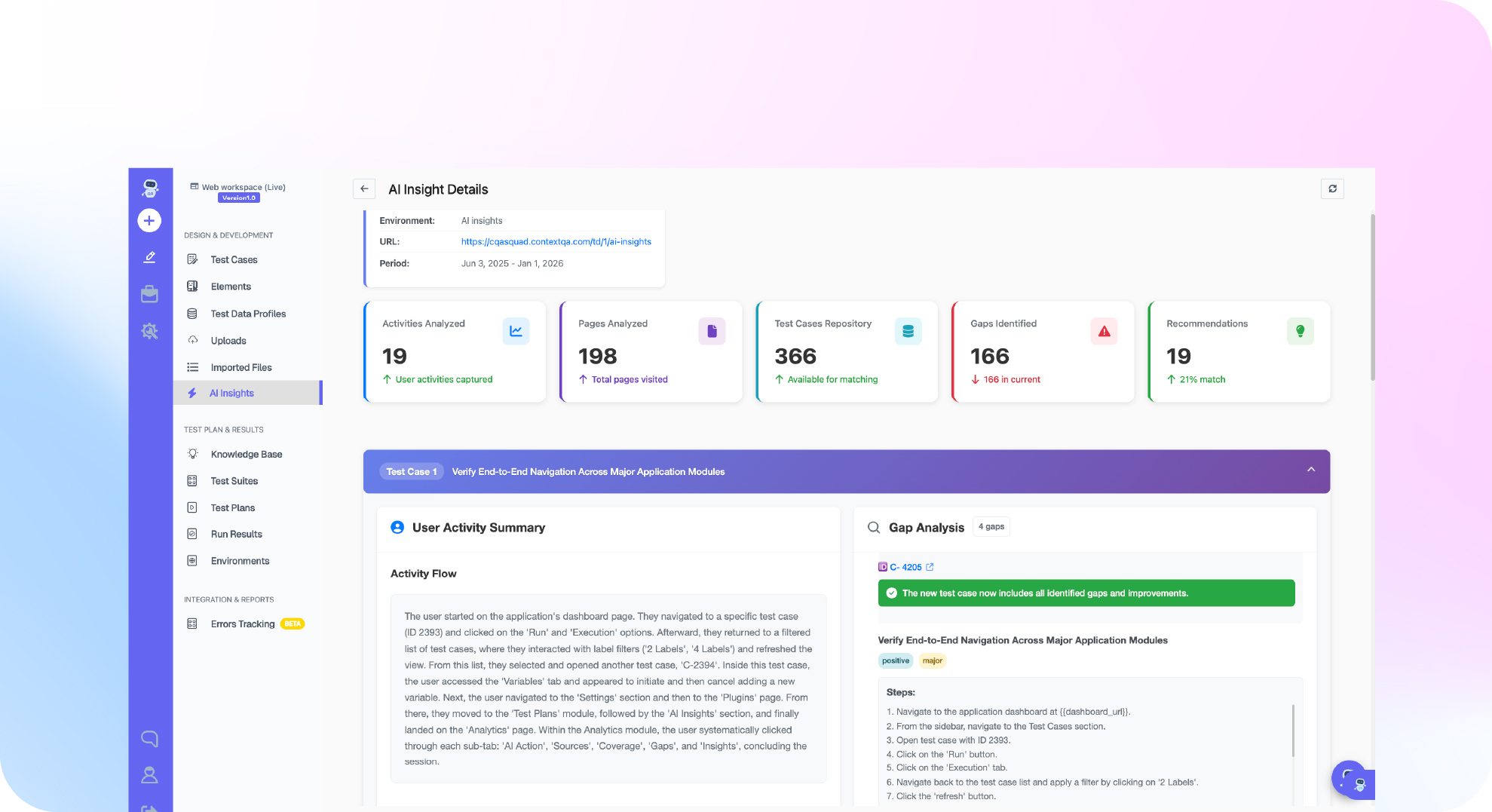
ContextQA moves test creation into implementation. Point it at a ticket, Figma file, Swagger spec, or code change, and it builds a suite covering happy paths, edge cases, and failure states. Tests run in CI/CD, self heal when the UI changes, and export to Playwright, so the team keeps ownership of the code.
A typical workflow looks like this:
- From Cursor, Claude Code, or Codex, call the ContextQA MCP server to generate tests for the current branch.
- Add a step in Jenkins, GitHub Actions, or another CI tool that runs the suite in parallel across Chrome, Safari, Edge, Firefox, iOS, and Android on each pull request.
- Triage failures with root cause analysis and impact analysis before merge.
- Export to Playwright when the team wants tests versioned in the repo.
Testers without coding skills can contribute through the no code test recorder while developers work from the IDE.
If tests break every time code lands during implementation, see how ContextQA generates, runs, and self heals tests in your CI pipeline so tests keep pace with every merge. Book a demo and bring your hardest case.
What should be on your do this now checklist?
Your implementation checklist should lock in testability before code merges. Each item below is verifiable, so a QA lead can audit the whole list in one sprint review.
- Link every story to acceptance criteria written during the design phase.
- Store the API contract (
openapi.yaml) in the repo and lint it in CI. - Require unit tests in the same pull request as the feature code.
- Add stable
data-testidattributes to new interactive UI elements. - Block merges when
npm testorpytestexits nonzero. - Run smoke tests on every preview deployment.
- Tag tests by flow (
@checkout,@login) for selective runs. - Quarantine any test that fails, then passes on retry.
- Keep generated tests as Playwright code in version control.
- Hand the testing phase a list of untested paths.
Bottom line
The implementation phase in SDLC is where design becomes working code, and the cheapest point to catch a defect is before the change merges. Pair every feature branch with unit tests, run API and end to end checks in CI on each pull request, and treat flaky tests as bugs. For more, see the ContextQA MCP server.
Sources
Each statistic in this article links directly to the primary research page where the data appears.