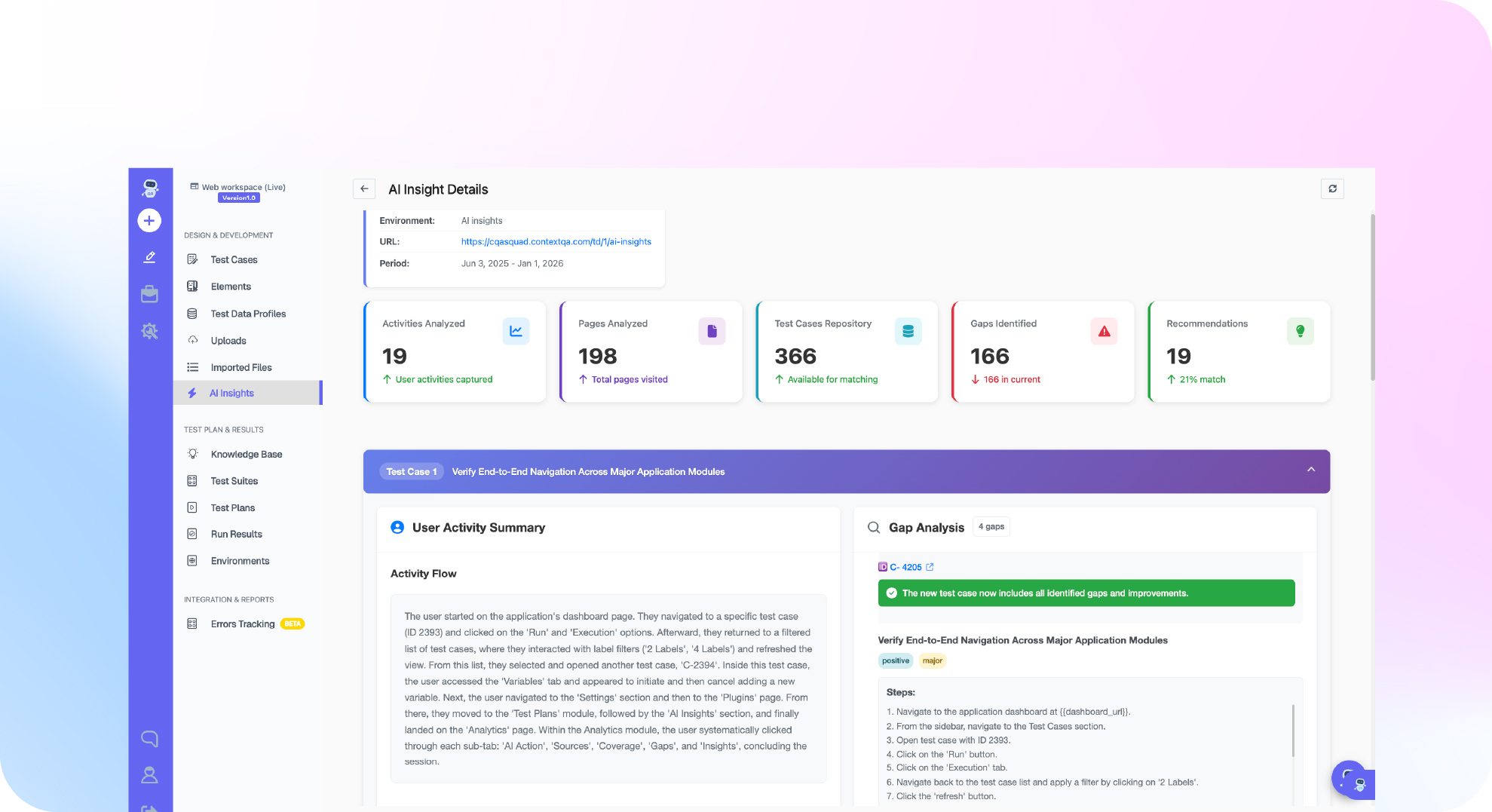

TL;DR: Testing software used by AI agents means verifying that an agent, not a human, can discover, call, and recover from your product's behavior. Validate API contracts against the spec, assert that error messages name the failing field and the fix, test scoped agent credentials and 429 responses with Retry-After headers, and check MCP tool descriptions for unambiguous selection. Then run end to end tests that drive the product through a real agent. ContextQA, the autonomous quality engineer, can do this from your CI pipeline.
If your team is asking how to test software used by ai agents, start here. Agents call your APIs, MCP servers, and web flows, and they fail differently than humans do. This guide covers each surface an agent touches and what to change on Monday.
Quick answers
What should we test first when AI agents start calling our APIs? Start with contract clarity and error responses, because agents read your schema and error bodies literally. Confirm every OpenAPI endpoint has typed parameters, enum values, and examples. Then assert every 4xx returns a machine readable code, a plain message, and the fix. A bare Bad Request makes an agent retry blindly or give up.
How do we test authentication and rate limits for agent traffic without breaking human users? Create dedicated agent identities with scoped tokens. Test that each token reaches only what its scope allows and that expired tokens return a 401 with refresh instructions. Run a burst test past the quota and assert a 429 with a Retry-After header. Keep agent credential tests separate from human session tests so bot limits never throttle logged in users.
How do we run end to end tests that drive our product through an actual AI agent? Give a real agent a natural language task, such as creating an invoice through your MCP server, and assert on final database or UI state, not the agent's wording. Repeat each scenario several times and track pass rate, tool call sequence, and hallucinated parameters. ContextQA's AI agent testing checks responses, guardrails, and tool calls alongside web, API, and database tests.
What is software testing for AI agents, and when do you need it?
Software testing for AI agents verifies that your APIs, MCP servers, and web apps behave correctly when the caller is an autonomous agent instead of a person. Agents read contracts literally, retry on ambiguous errors, and chain calls without human judgment. You need it once agents call your product directly, through your own MCP server or a customer's coding assistant.
This differs from agent evaluation. LLM evaluation frameworks score your own agent's outputs. Testing for agent users checks what your product returns to an agent.
- Evaluation frameworks (hosted tracing platforms, open source assertion libraries): grade model responses against datasets for answer quality, hallucinations, and prompt regressions.
- Agent user testing: checks contract clarity, actionable error messages, agent auth scopes, rate limit headers, and MCP (Model Context Protocol) tool descriptions.
Run both. Eval suites gate prompt changes, while end to end tests drive the real product through an agent in CI. The ContextQA MCP server supports the second loop from Cursor, Claude Code, or Codex.
What do you need before you start?
Before you test software used by AI agents, you need four things: a machine readable API contract, a dedicated agent identity with scoped credentials, a golden set of agent tasks with expected outcomes, and a scoring method that tolerates nondeterministic output. Without these, agent tests become flaky tests nobody trusts.
- Contract source: An
openapi.yamlor MCP tool manifest with typed parameters and documented error codes. A vague field causes a wrong call. - Agent credentials: One OAuth client per agent, with production scopes and rate limits. Shared human logins hide auth bugs.
- Golden set: Real tasks from support tickets and logs, each paired with an expected end state: a database row, an API response, or a refused action. Version it as
golden_tasks.jsonland add every production failure. - Scoring approach: Assert on final state and tool calls, not wording. Run each task several times and track pass rate per task. A falling rate is a regression; one failed run is noise.
Bottom line: build the golden set and state based scoring first, because every later agent test depends on both.

Can you walk me through how to test software used by ai agents step by step?
To test software used by AI agents, treat the agent as a user with no eyes. Verify that contracts are machine readable, errors tell the agent what to do next, auth and rate limits behave predictably, and MCP tool descriptions are unambiguous. Then run end to end tests through a real agent.
- Lint the contract. Fail CI when an OpenAPI operation lacks a
description, an example, or a typed error schema. - Assert actionable errors. Every 4xx response should return a stable
code, the failing field, and a fix hint.
import { test, expect } from '@playwright/test';
test('validation error is agent actionable', async ({ request }) => {
const res = await request.post('/api/v1/orders', { data: { qty: -1 } });
expect(res.status()).toBe(422);
const { error } = await res.json();
expect(error.code).toBe('INVALID_QUANTITY');
expect(error.field).toBe('qty');
expect(error.hint).toMatch(/positive integer/);
});
- Test agent auth and limits. Use scoped tokens. Assert that a
401explains how to refresh and that a429includesRetry-After. - Sandbox tool calls. Stub payment and email APIs, then assert call counts and arguments so agent retries cause no real side effects.
- Review MCP tool descriptions. Give each tool one purpose, typed parameters, and documented failure behavior.
- Run agent driven end to end tests. Give an agent a task, then assert the final database state. ContextQA's AI agent testing checks tool calls and guardrails.
What are the most common mistakes?
The most common mistakes are validating only the human UI, returning errors an agent cannot act on, skipping prompt injection and guardrail tests, and scoring runs as pass or fail. Each hides failures that only appear when an agent is the user.
- Testing the UI, not the contract: A vague
descriptionfield sends the agent to the wrong tool, even when every endpoint passes its unit tests. - Opaque errors: A bare
400or500gives the agent nothing to correct. Return the failing field and the reason. On429, includeRetry-After. - No adversarial suite: Red teaming means attacking your own system on purpose. Plant injected instructions in user input, tool output, and retrieved documents, then assert that guardrails block unauthorized tool calls.
- Binary metrics: Agent behavior varies between runs. Track task success rate, step accuracy, p95 latency, and token cost per completed task.
Bottom line: test the agent's full path from contract to outcome, and score it on success, safety, latency, and cost.
How do you know it is working?
You know agent support is working when three numbers improve together across releases: the share of agent tasks completed end to end without human help, the share of 4xx errors an agent corrects on its next call, and the count of wrong or redundant tool calls per task.
The volume behind these numbers is growing. Gartner predicts that 33% of enterprise software applications will include agentic AI by 2028, up from less than 1% in 2024 (Gartner, 2024).
Simulate full workflows. Script a goal, let an agent drive your API or MCP server through every step, and record the trace. For multi agent workflows, assert on each handoff.
Gate CI/CD and watch production. Run a fixed eval set on every pull request and fail the build when task success drops below baseline. In production, tag agent traffic with a header such as X-Agent-Client and emit an OpenTelemetry span per tool call. Alert when retry loops or 429 rates climb.
How do you automate testing of software used by AI agents with ContextQA?
ContextQA automates testing for agent users by generating suites from your API spec, testing AI agent behavior directly, and running everything in CI/CD. Point it at a Swagger spec or code change and it creates happy path, edge case, and failure tests, self heals them, and exports to Playwright so nothing is locked in.
- From Claude Code, Cursor, or Codex, call the ContextQA MCP server to generate contract and error path tests against your
openapi.yamlwithout leaving the IDE. - Use AI agent testing to check whether the agent picked the right tool, sent valid arguments, and stayed inside policy.
- Run suites in parallel in your pipeline and use root cause analysis when a tool call fails.
- Use code export to keep Playwright tests in your own repo.
For engineering leaders, the tradeoff is build versus maintain: an in house harness needs updates every time a tool schema changes.
If AI agents now call your APIs and MCP tools, see how ContextQA, the autonomous quality engineer, tests contracts, error messages, auth, and agent driven end to end flows. See how ContextQA does it or book a demo and bring your hardest case.

What should be on your do now checklist?
Your do now checklist should cover the six surfaces an agent touches: API contracts, error messages, agent auth, rate limits, MCP tool descriptions, and agent driven end to end runs. Each item is verifiable in a pull request or CI run, so you can assign owners Monday and check progress Friday.
- Lint
openapi.yamlin CI and fail builds on any operation missingdescriptionorexample. - Assert every 4xx body returns a machine readable
code, the failing field, and a next step. - Issue scoped, short lived agent tokens and test that expired tokens return
401with a refresh hint. - Assert every
429includesRetry-After, and confirm your agent client waits for it. - Review each MCP tool
descriptionandinputSchemafor ambiguous verbs and undocumented side effects. - Add one end to end test per critical flow in which an agent, not a script, completes the task.
- Tag agent traffic in logs so agent failures appear on their own dashboard.
Bottom line
Treat the agent as a first class client. Lock down API contracts, write errors an agent can act on, scope tokens per agent, publish rate limits in headers, and review MCP tool descriptions like code. Then prove it by driving real workflows through an agent in CI. On Monday, audit one high traffic endpoint and use MCP for test automation to add an agent driven test.
Sources
Product capability claims link to ContextQA platform pages in the text.