
TL;DR: The main types of API testing are functional, contract, integration, load and performance, security, and negative or fuzz testing, plus smoke checks on every deploy. Run functional and contract tests on every commit and pull request, integration and fuzz tests nightly, and load and security tests before release. Cloudflare's 2024 API Security and Management Report found that API calls make up 57% of dynamic internet traffic. ContextQA, the autonomous quality engineer, generates API tests from Swagger or OpenAPI specs and runs them in CI. Each step records the request, the response and the result.
Each of the types of API testing proves something different about the same endpoint, and the gaps show up later as production incidents. For each type, this guide covers what it proves, a sample request and assertion, the pipeline stage where it runs, and the mistake that lets regressions through.
Quick answers
Which API test type should we invest in first with almost no coverage? Start with smoke checks and functional tests on your most important endpoints. A smoke check confirms that a key endpoint returns 200 after every deploy. Functional tests check status codes, required fields and error responses on each pull request. Once those run reliably in CI, add contract tests, then load and security runs.
Which tests run on every pull request, and which run nightly or before release? Sort tests by how long they take and how repeatable they are. Functional assertions, contract verification and negative input validation belong on every pull request. Load runs, broad fuzzing and full security scans belong in nightly or pre release stages. Blocking merges on slow suites holds developers up and produces flaky failures.
Do we need a separate tool for each type? Not for most of them. Functional, integration, negative and smoke tests can live in one platform. In the ContextQA platform, teams build REST tests with status and payload validation or generate them from Swagger or OpenAPI, pass tokens between requests, and run suites in CI with evidence for each step. High concurrency load tests and deep security scans often still need a specialist tool.
What are the types of API testing?
API testing sends requests straight to an application's interface and checks the responses, with no UI involved. The main types are functional, contract, integration, load and performance, security, and negative or fuzz testing, plus smoke checks on deploy. Each proves something different about the same endpoint and belongs at a different pipeline stage.
- Functional: proves the endpoint returns correct data.
GET /users/42expects200and a non emptyemail. Runs on every commit. Common mistake: asserting only the status code. - Contract: proves the response still matches the fields consumers read. Compare the
GET /users/42response to the agreed schema. Runs on pull requests. Common mistake: validating against the provider's own spec instead of what consumers actually use. - Integration: proves services work together.
POST /ordersand thenGET /orders/{id}against real storage. Runs nightly on staging. Common mistake: mocking every dependency, so nothing real gets integrated. - Load and performance: proves latency and error rate hold under concurrent traffic. Send traffic to
GET /searchat the target concurrency and assert that p95 latency (the 95th percentile response time) stays within budget. Runs nightly or pre release. Common mistake: testing on staging hardware that is nothing like production. - Security: proves authorization holds. Request
GET /users/43with user 42's token and expect403or404. Runs pre release, plus targeted pull request checks. Common mistake: testing login but not object level access. - Negative and fuzz: proves bad input fails safely.
POST /userswith{"email": 12}expects400, never500. Targeted cases run on pull requests and broad fuzzing runs nightly. Common mistake: accepting any4xxwithout checking the error body. - Smoke: proves the deploy is alive.
GET /healthand login both return200. Runs on every deploy. Common mistake: letting the smoke suite grow into a slow regression suite.
The protocol changes the assertions, not the list of types. SOAP tests validate XML envelopes against the WSDL, the XML file that describes the service's operations, and assert on soap:Fault. GraphQL tests must inspect the errors array, because a failed query can still return 200 OK.
What does API testing catch that UI tests miss?
API tests catch failures at the service layer. They run faster than browser tests and point to the specific endpoint that broke, not just a broken page. Taken together, the layers show that a service returns correct data, keeps its contract, works with its dependencies, holds up under load, rejects attacks and responds after each deploy.
- Logic regressions, early: functional checks run on every commit, even before a frontend exists.
- A healthy test pyramid: API tests cover most business logic, leaving UI tests for rendering and navigation.
- Protected consumers: contract checks flag a renamed or removed field before merge.
- Real data chaining: a login call captures a token that later steps reuse, as shown in the ContextQA API testing tutorial.

Why does API test coverage matter in 2026?
APIs now carry most of the traffic and business logic in modern software, and no single test type can prove everything an API has to do. Functional checks show that the logic works. Contract, performance and security tests catch breaking schema changes, slow endpoints and exposed data. Each one fails in a different way and runs at a different stage.
Contract testing is the type teams skip most often. In consumer driven contract testing, each consumer publishes the fields it actually reads, and the provider's pull request is checked against that file. A renamed user_id then fails before merge instead of in production.
How does an API test work?
Every API test follows the same loop: send a request, capture the response, and assert something specific about it. The types differ in what they assert, such as a field, a schema, a latency budget or an authorization rule. They also differ in where they run in the pipeline, from the first commit through pre release.
Here is a small REST example of a functional check that reuses a token:
POST /auth/token
Content-Type: application/json
{"username": "qa_user", "password": "{{QA_PASSWORD}}"}
# store response as auth, then:
GET /users/42
Authorization: Bearer {{auth.access_token}}
# assert: status == 200, result.email is not empty
- Define the request. Set the method, URL, headers and body. Read secrets from environment variables.
- Assert the response. Check the status code, then a field such as
result.email, then the full structure, so a dropped field fails the test. - Chain state. Store a token or a created ID and pass it to the next call.
- Attack the edges. Map security cases to the OWASP API Security Top 10 (2023): request another user's object ID, strip the token and send oversized payloads.
- Gate in CI/CD. Run smoke and functional checks on every pull request, and load and fuzz suites nightly.
Which approach fits your team?
Choose based on where your risk sits. A team with strong SDETs and only a few services does well with a code first framework. In a microservices setup, put contract tests on every service boundary. A SaaS team with a large OpenAPI spec and a small QA team gets the most from AI generation that turns the spec into CI tests.
| Approach | Best for | Pricing model | Tradeoff |
|---|---|---|---|
| Code first frameworks | SDET heavy teams, few services | Open source, paid in engineer time | Every endpoint change means a code edit |
| Collection tools | Exploratory checks, shared requests | Free tier plus per user plans | Collections drift from the spec |
| Consumer driven contract testing | Many teams, many services | Open source, hosted broker often paid | Proves compatibility, not business logic |
| AI generation from OpenAPI (ContextQA platform) | SaaS and enterprise teams with large specs | Demo and quote | Generated assertions still need review |
To judge the return on AI generation, track maintenance hours and how many endpoint and status pairs you cover. The raw number of tests tells you little.
How does ContextQA handle API testing?
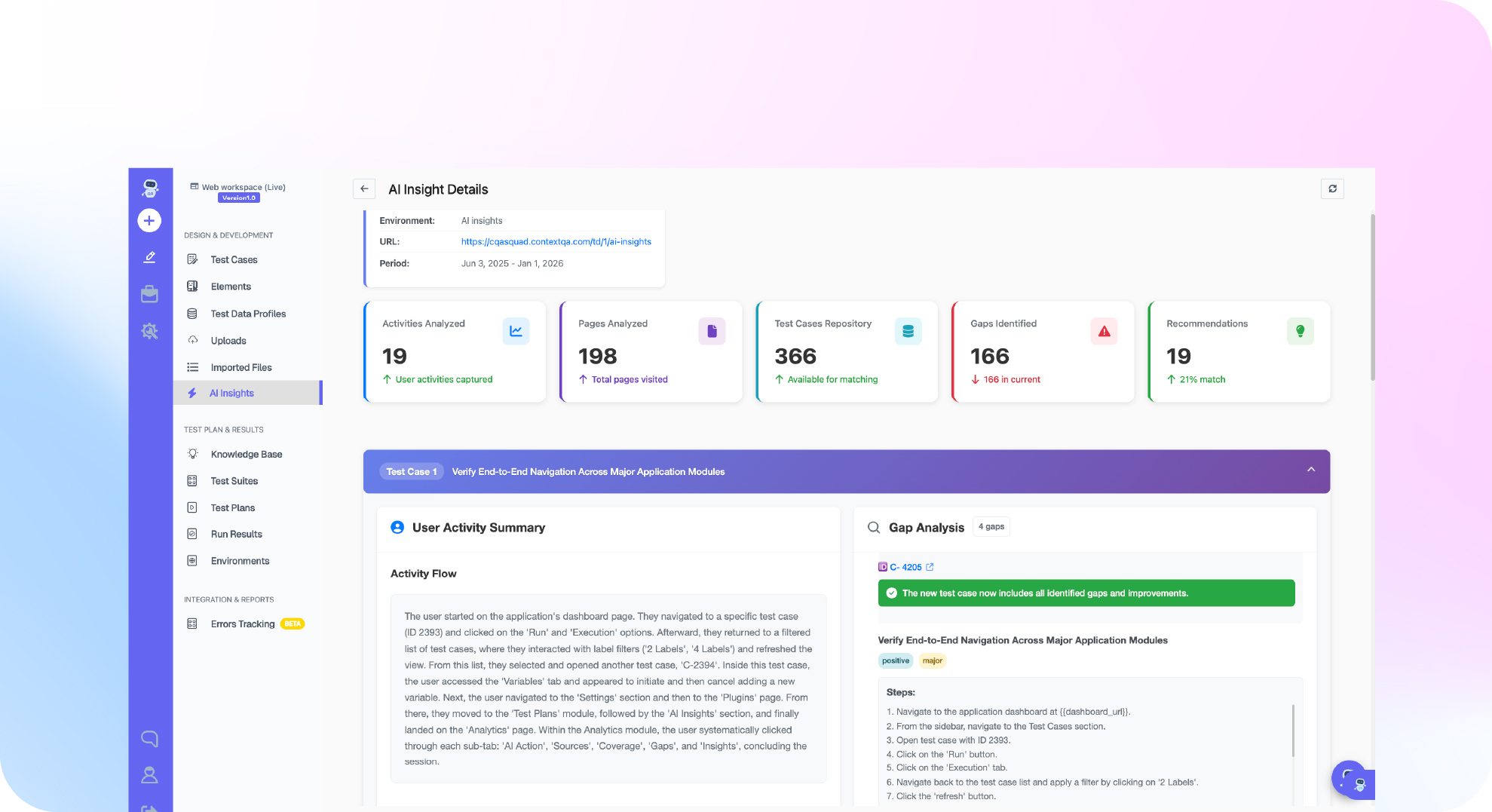
ContextQA runs functional, contract style and integration API tests in the same no code editor it uses for UI tests. You build REST steps for any HTTP method and assert on status codes, payload fields and full response structure. Values can pass from one call to the next. You can also generate coverage from Swagger or OpenAPI and run it in CI with evidence for each step.
Here is how each type maps to the documented workflow:
- Functional: payload validation checks a field by JSON path, such as
result.email, and asserts a status code such as200or401. - Contract style: structure validation compares the whole response to an expected shape, catching fields added or removed between versions.
- Integration: Store response saves a response under a variable name for a later API or UI step.
- Smoke in CI: suites run from Jenkins or GitHub Actions, with request and response logs, timing, and pass or fail for each step.
- Unstable dependencies: mock API testing records live responses and replays them on later runs.
- Load and security: the ContextQA solutions cover performance and security testing. Match tooling to the concurrency and scan depth your release needs.
If contract, negative and security gaps keep slipping past your functional API checks, book a demo to see ContextQA generate tests from OpenAPI and run them in CI.

What should you do now? A checklist
Start by giving each API test type a pipeline stage you already run. Functional and contract checks go on every pull request. Integration and negative tests run nightly. Load and security tests run before release, and a smoke check runs on every deploy. Then give each stage an owner and decide which failures block a merge or a release.
- List every endpoint and mark which test types cover it today.
- Add a status assertion and a payload assertion to each functional test.
- Run contract checks on every pull request that changes a schema.
- Generate baseline coverage from your OpenAPI spec (ContextQA docs).
- Add a
401case and a malformed body case to each authenticated endpoint. - Keep load tests off pull requests and run them nightly against staging.
- Block each deploy on a smoke check of the health and login endpoints.
Bottom line
No single API test proves everything. Put functional and contract checks on pull requests, integration and negative tests nightly, load and security testing before release, and smoke checks on deploy. On Monday, compare your suite against that list and fill the cheapest gap first. For the wider picture, read our guide to types of software testing.
Sources
The statistic and security taxonomy come from these primary sources. The ContextQA documentation is the basis for every product workflow described.
- Cloudflare, 2024 API Security and Management Report (2024)
- OWASP, API Security Top 10 (2023)
- ContextQA, API Testing Overview