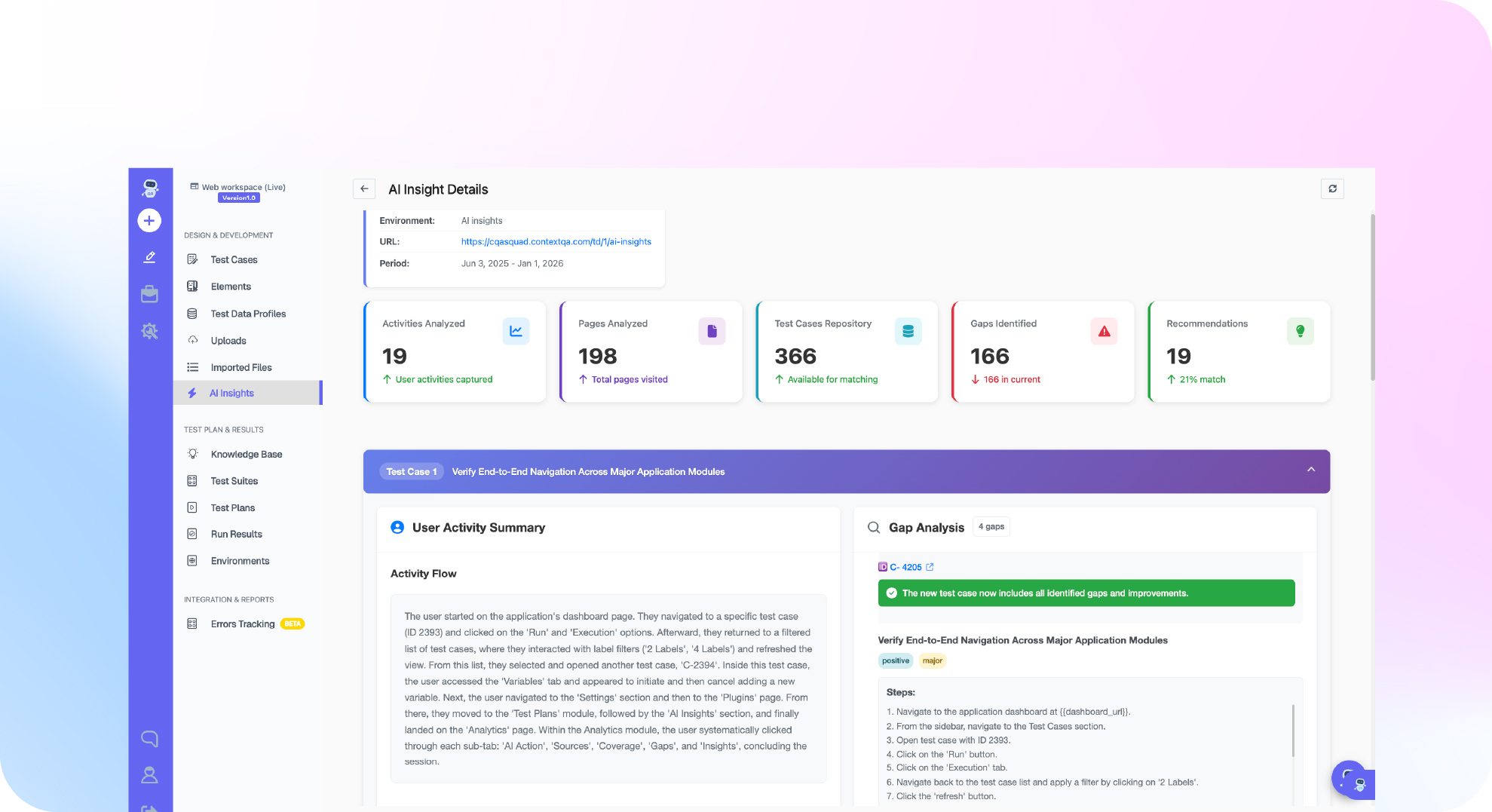

TL;DR: The software testing life cycle (STLC) has seven steps: requirement analysis, test planning, test case design, test environment setup, test execution, defect reporting and tracking, and test closure. Each step has entry criteria, exit criteria and a deliverable. Many teams merge or rename steps. Skipping steps gets expensive: CISQ estimated that poor software quality cost US organizations $2.41 trillion in 2022 (CISQ, 2022). ContextQA, the autonomous quality engineer, generates test cases from Jira tickets, runs them in CI and records evidence for each run.
The 7 steps of software testing are requirement analysis, test planning, test case design, test environment setup, test execution, defect reporting and tracking, and test closure. Teams name and merge these steps differently, and when they do, release gates blur. This guide gives each step its criteria, its deliverable and one common mistake. It then maps the steps onto a pull request workflow and shows where AI helps.
Quick answers
What are the 7 steps of software testing, in order? Requirement analysis, test planning, test case design, test environment setup, test execution, defect reporting and tracking, and test closure. No official standard fixes these names, so some teams merge planning and design or rename steps. What matters is that each step has clear entry and exit criteria and produces a deliverable the next step can use.
How do the testing steps map onto a pull request workflow? Requirements come from the Jira ticket linked to the PR. Cases are generated or updated for the changed behavior, a preview or staging build provides the environment, and CI runs the suite on every push. Failures attach screenshots, logs and failing steps to the PR. Closure is the merge or release decision based on that evidence.
Which steps can AI automate, and where should humans stay in charge? AI can draft test cases from tickets or plain English, repair locators when the UI changes, and run suites in parallel in CI. Humans should own requirement analysis, acceptance criteria, risk based planning and the release decision. Treat generated cases and failure summaries as proposals to review, not as proof of coverage.
What are the 7 steps of software testing?
The STLC is the sequence of phases a change passes through on its way to a release decision: requirement analysis, test planning, test case design, test environment setup, test execution, defect reporting and tracking, and test closure. Each phase has entry criteria, exit criteria and a deliverable that tell the team when one phase is done and the next can start.
That gating is the point. When a team skips requirement analysis, nothing fails right away. The gap shows up weeks later, when the suite passes and a customer finds the missing acceptance criterion in production.
No single version of the STLC is official. Many teams fold environment setup into planning. The whole cycle also runs inside the wider software development life cycle rather than replacing it. Our 7 phases of the SDLC guide covers that outer cycle.
What does each testing step require and produce?
Each step needs an entry condition you can check, an exit condition and a deliverable. Without them, a release owner cannot tell which evidence exists and which is missing. The list below gives the minimum for each step and the mistake that most often breaks it, so you can audit your own process one phase at a time.
- Requirement analysis. Entry: a ticket with acceptance criteria. Exit: every criterion is testable or flagged. Deliverable: a requirement traceability list. Mistake: accepting "works as expected" as a criterion.
- Test planning. Entry: analyzed requirements. Exit: scope, exclusions, owners and test levels (unit, integration, system, acceptance) are agreed. Deliverable: the test plan. Mistake: confusing the plan with the organization's test strategy, which sets standing rules for risk and automation.
- Test case design. Entry: an approved plan. Exit: every criterion maps to at least one case with data and an expected result. Deliverable: reviewed cases. Mistake: guessing at cases instead of using boundary value analysis, equivalence partitioning or decision tables.
- Test environment setup. Entry: a deployable build. Exit: the build, test accounts and seeded data are pinned and verified. Deliverable: a ready environment. Mistake: shared staging data that drifts, so a test passes while checking the wrong record.
- Test execution. Entry: a ready environment. Exit: critical paths pass on the candidate build. Deliverable: run results. Mistake: rerunning flaky tests until they go green.
- Defect reporting and tracking. Entry: a failed or blocked case. Exit: every defect has reproduction steps, logs, screenshots and an owner. Deliverable: defect tickets. Mistake: tickets that say "failed in CI" with no evidence.
- Test closure. Entry: execution complete. Exit: coverage, open defects and the release decision are recorded. Deliverable: a closure report. Mistake: skipping the review of escaped defects.

Why does a defined testing life cycle matter in 2026?
Code now arrives faster than teams can review it, and much of it is written with AI help. A defined lifecycle gives each pull request a clear path from requirement to release decision. In the 2025 Stack Overflow Developer Survey, 84% of respondents used or planned to use AI tools, and 46% distrusted the accuracy of AI output (Stack Overflow, 2025).
Two weak points show up first under that load. Environment setup and test data management break down when staging data drifts. The line between manual and automated work also blurs.
Automation suits execution and regression. Requirement analysis, planning, exploratory testing and closure still need human judgment. AI can draft that work, but a person should approve it.
How do the testing steps map onto a pull request workflow?
In a team that merges daily, the seven steps shrink from weeks to hours. The requirement arrives as a Jira ticket, cases are drafted from it, CI runs them against the PR build, and a failure returns evidence and a defect ticket. The gates stay the same and only the speed changes, so written criteria matter more than before.
A typical mapping:
- The Jira ticket's acceptance criteria are the input to requirement analysis.
- The PR description and labels record scope, which serves as a lightweight test plan.
- New or updated cases are committed or generated for the changed behavior.
- A preview environment or pinned staging build is the test environment.
- Jenkins or GitHub Actions runs Playwright, Cypress, JUnit or
pytestsuites on every push. - Failed runs post screenshots, logs and a ticket link back to the PR.
- The reviewer's approval, backed by that evidence, is test closure.
Our guides on test scenarios and test cases cover the design step in more depth.
Which testing approach fits your team best?
The right approach depends on how often you release and who owns quality. Teams that ship quarterly can run the seven steps as gated phases, one after another. Teams that merge daily have to fit them into each pull request, with automation running in CI and AI drafting cases that a person reviews before they count as coverage.
| Approach | Best for | Cost model | Notable tradeoff |
|---|---|---|---|
| Phased manual STLC | Regulated or quarterly releases | Tester hours per cycle | Defects surface late |
| Scripted automation in CI | Teams with SDET capacity | Engineering time plus CI minutes | Locator upkeep and flaky tests |
| AI platform, such as ContextQA | Ticket driven enterprise teams | Quote after a demo | Generated cases still need review |
Whichever approach you pick, track four measures across similar changes: escaped defects, flaky test rate, time to actionable evidence and verified requirement coverage.
How does ContextQA handle the software testing life cycle?
ContextQA, the autonomous quality engineer, automates the middle of the STLC and leaves decisions to people. It generates test cases from a Jira ticket, plain English, a Figma file or a Swagger spec, runs them in CI across browsers and devices, and attaches evidence to failures. Requirement sign off, test planning and release closure stay with your team.
- Design: Cases can be generated and reviewed from tickets, and testers without coding skills can use the no code recorder.
- Environment setup: Configure targets under Environment & Data → Environments. A
type: Databaseenvironment lets database steps run SQL and confirm that a UI action wrote the right record. - Execution: Developers can generate and run tests from Claude Code or Cursor through the MCP server before opening a PR. Jenkins or GitHub Actions then runs the suite, and impact analysis narrows down which regressions to run.
- Defect reporting: Self healing repairs broken locators, and root cause analysis points to the likely cause. Results go to Jira, Slack or GitHub.
- No lock in: You can export tests to Playwright.
The AI agent step guide recommends keeping deterministic assertions explicit. A person should still approve the release.
If your testing life cycle stalls between Jira requirements and CI evidence, book a demo to see ContextQA generate test cases from tickets and attach evidence when a run fails.

What should you do on Monday? A checklist
Write down how your team runs the testing life cycle today, including any steps you merge. Give each step one entry criterion, one exit criterion and one deliverable. Then map those steps onto your pull request workflow, automate the repeatable ones and keep a named human owner on every release decision.
- List your steps and name one owner for each.
- Publish entry and exit criteria where the team can see them.
- Block sprint entry for tickets with no acceptance criteria.
- Link every test case to the requirement it covers.
- Review generated test cases before they join regression.
- Pin environments and seed data to the build under test.
- Add database checks that confirm UI actions wrote the correct rows.
- Run the impacted suite in CI on every pull request.
- Attach screenshots, logs and reproduction steps to every failure ticket.
- Quarantine flaky tests, each with an owner and a fix date.
- Record escaped defects and coverage gaps in a closure review.
Bottom line
The seven testing steps are useful only when each one has clear entry and exit criteria and a deliverable the next step can use. Names and merges vary by team. Every pull request should move from a Jira requirement to designed cases, CI execution and evidence a reviewer trusts. AI speeds up generation and execution, but people own risk calls and releases. See the types of software testing to choose test levels.
Sources
Check each report's methodology section before you reuse its figures internally.