
TL;DR: The best no-code test automation tools in 2026 are ContextQA, Katalon, mabl, testRigor, Testsigma, ACCELQ, Leapwork and Virtuoso QA. They all let people build tests without writing scripts, but they differ in how tests are created (recording, plain English, visual flows or AI generation), which applications they cover, how they repair tests when the UI changes, and how they price. Pick two or three that match your stack, then run the same five real journeys through each before you buy.
No-code test automation tools promise that testers, analysts and developers can automate checks without maintaining Selenium or Playwright scripts. In 2026 almost every vendor in this space also adds AI: generating tests from requirements, healing broken locators and explaining failures. That makes the category easier to enter and harder to compare, because the marketing sounds the same.
This guide compares eight codeless test automation tools on the points that decide whether a team is still using the tool a year later: test creation, application coverage, maintenance, CI fit and pricing model. Vendor facts come from each vendor's own website as of November 2026. Check the current pages before you rely on a specific feature or price.
Quick answers
What is the best no-code test automation tool? There is no single best tool for every team. ContextQA suits teams that want plain-English and recorded tests with reviewed self-healing across web, mobile, API and enterprise apps. Katalon suits teams that want a free entry point and a path to full code. ACCELQ and Leapwork suit large enterprise application estates.
Are no-code test automation tools reliable enough for CI/CD? Yes, when the tool runs headless in your pipeline, reports a clear pass or fail, and keeps the business assertion intact when it heals a test. Test that behavior in a pilot instead of trusting a demo.
Is there a free no-code test automation tool? Katalon offers a free plan for local recording and execution, and testRigor, Virtuoso QA, ACCELQ and mabl offer free starts or trials. Most enterprise plans are quote based.
How we compared the tools
We looked at five things that matter after the first demo:
- Test creation: recording, plain English, visual flow building or AI generation from requirements.
- Coverage: web, mobile, API, desktop and packaged apps such as Salesforce and SAP.
- Maintenance: how the tool repairs a test when a locator changes, and whether a person can review that repair.
- Pipeline fit: CI/CD integrations and how results are reported.
- Pricing model: free plan, published price or quote.
| Tool | How you create tests | Coverage | Pricing model |
|---|---|---|---|
| ContextQA | AI assistance, file import, Record & Play, or manual steps in plain English | Web, mobile, API, Salesforce, SAP, AI agents | Quote, scoped pilot available |
| Katalon | No-code recording, low-code, or full code in Katalon Studio | Web, mobile, API, desktop | Free plan; Professional from $1,800 per seat per year |
| mabl | Low-code authoring with AI agents and auto-heal | Web, mobile, API, AI apps | Credit based quote, free trial |
| testRigor | Plain English instructions, generative AI | Web, mobile, desktop, mainframe | Free start available |
| Testsigma | AI agents generate tests from stories, Jira or Figma, or plain English | Web, mobile, API, Salesforce | See vendor pricing page |
| ACCELQ | Codeless record and playback with business process modeling | Web, mobile, API, desktop, ERP, mainframe | Free trial available |
| Leapwork | Visual workflows plus agentic test building | Enterprise apps incl. SAP, Salesforce, Oracle, Microsoft | Demo on request |
| Virtuoso QA | Tests written in natural language, generated from requirements | Enterprise web applications | Free trial available |
What are the best no-code test automation tools in 2026?
1. ContextQA
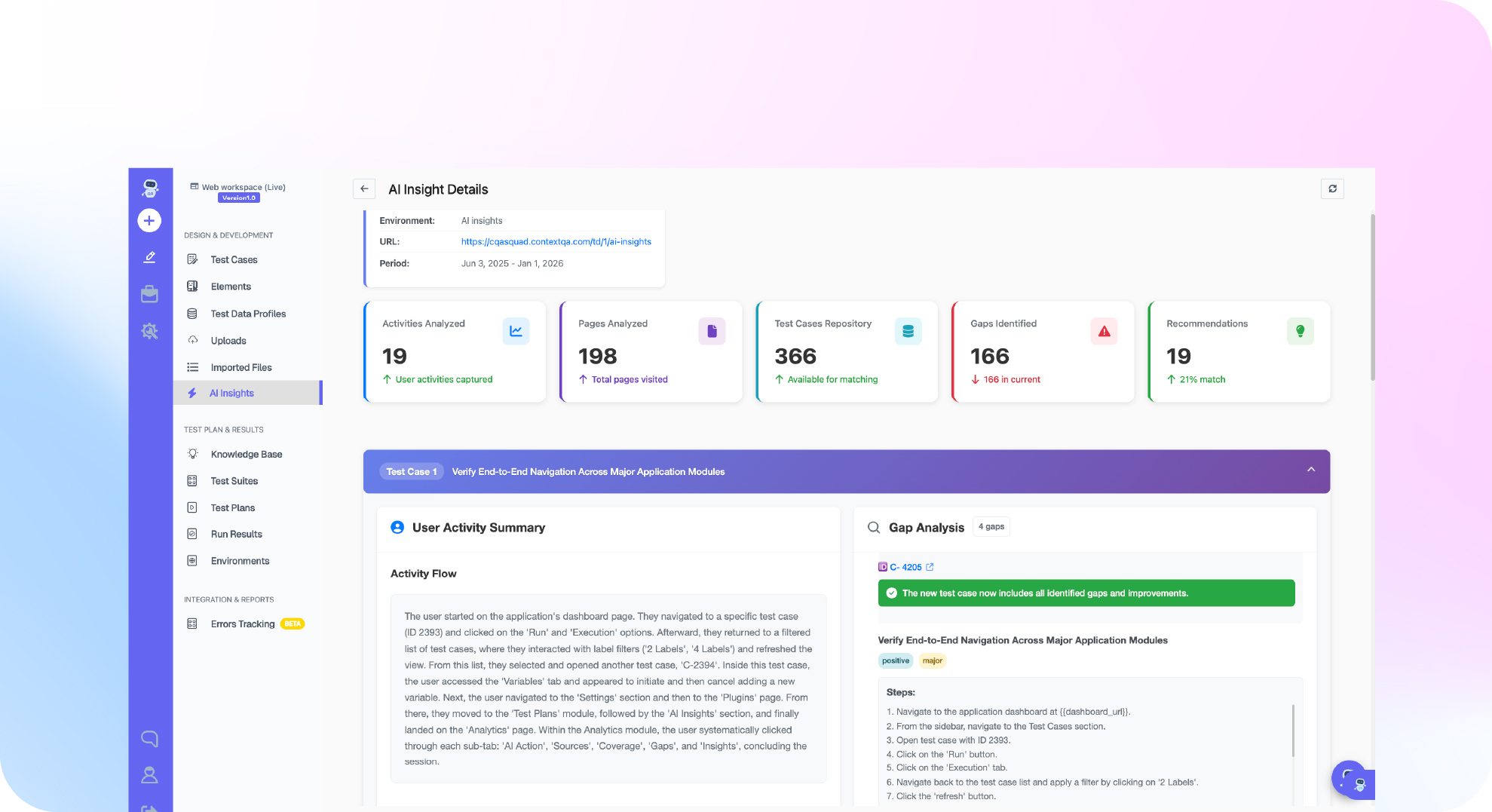
ContextQA is an AI-powered test automation platform where you describe what to test in plain English and the platform generates the steps, runs them in real browsers, captures evidence and self-heals tests when the UI changes, according to its introduction guide.
Its test creation dialog offers four methods: AI Assistance, Import Files, Record & Play, and Create manually (creating test cases). That mix matters for no-code teams, because manual testers can record a flow while analysts describe one in plain English.
Self-healing is reviewable. An organization setting called Auto approve with auto heal controls whether repairs are accepted automatically, each test case can override it, and the documentation stresses that a repair must preserve the business assertion (AI self-healing tests). For a deeper look at the approach, see our guide to self-healing test automation.
ContextQA covers web, mobile and API testing, packaged apps such as Salesforce and SAP, and AI agent testing. It integrates with CI/CD tools such as Jenkins, and tests can be exported as a Playwright project if you later want code (export and portability). Pricing is quote based, and most teams start with a scoped pilot on their own app (pricing).
Best for: teams that want plain-English and recorded tests across web, mobile, API and enterprise apps, with a human review step on every automatic repair.
2. Katalon
Katalon lets you author web, mobile, API and desktop tests with no-code, low-code or full code in Katalon Studio, and adds TestOps for test management and TestCloud for parallel execution. Its pricing page lists a free plan for local record and playback, a Professional plan at $1,800 per seat per year (about $150 per seat per month, billed annually), and a custom Enterprise plan.
Best for: teams that want a free starting point and a gradual path from recording to scripting. Compare options in our Katalon alternatives guide.
3. mabl
mabl positions itself as agentic testing for web, mobile and API, plus validation of AI apps with dynamic outputs. It highlights auto-heal and says it was named a Challenger in the 2026 Gartner Magic Quadrant for Agentic Software Quality Assurance Platforms. Its pricing is credit based: cloud test runs consume credits, with unlimited cloud concurrency and a free trial.
Best for: SaaS teams that want low-code tests running in the cloud on every commit. See also our mabl alternatives.
4. testRigor
testRigor builds tests from free-flowing plain English, translating high-level instructions such as "purchase a Kindle" into concrete steps you can correct. It covers web, mobile, desktop and mainframe testing, and tests can also be generated through Claude Code using MCP. A free start is available.
Best for: teams where manual testers write the tests and English readability matters most. Compare in our testRigor alternatives post.
5. Testsigma
Testsigma uses AI agents to create automated tests for web, mobile, API and Salesforce from user stories, Jira or Figma, or from tests written in plain English. Tests run and self-heal as the app changes, and the platform reports coverage and release confidence.
Best for: teams that want test generation tied to requirements in Jira. See our Testsigma alternatives comparison.

6. ACCELQ
ACCELQ is a codeless platform with record and playback across web, desktop, cloud ERP apps and mainframe, codeless mobile on real devices, and codeless API testing for REST, SOAP, Kafka and message queues. It includes integrated test management and has dedicated support for Salesforce, Workday, Oracle, ServiceNow, Dynamics, Pega and SAP. A free trial is available.
Best for: enterprises automating business processes across many packaged applications. Read our ACCELQ competitors comparison.
7. Leapwork
Leapwork describes itself as a continuous validation platform that is agentic, application agnostic and deterministic by design. Teams build tests as visual workflows, and the product line includes Leapwork Flow, Leapwork Go and Leapwork Play, which adds AI-native Playwright testing. Its use cases center on enterprise systems such as SAP, Salesforce, Oracle and Microsoft.
Best for: enterprise teams that want visual, flowchart-style tests and governance. See our Leapwork alternatives.
8. Virtuoso QA
Virtuoso QA lets teams write a test the way they would describe it, with no locators and no code, and generate test journeys from requirements. Its agentic layer, Touchstone, coordinates around thirty specialized agents that build, run and maintain tests, sort failures into real bugs or flaky tests, and capture release evidence. A free trial is available.
Best for: enterprise application teams that want requirement-driven, natural-language tests. Compare in Virtuoso vs ContextQA.
Want to see plain-English tests and reviewed self-healing on your own app? Book a ContextQA demo and bring three real user journeys.
Which no-code testing tool fits your team?
| Your situation | Tools to shortlist first | Why |
|---|---|---|
| Manual testers moving into automation | testRigor, ContextQA, Virtuoso QA | Tests read like plain English, so the people who know the flows can own them |
| Small team, tight budget | Katalon | Free plan for local recording, with a path to code later |
| SaaS team shipping daily | mabl, ContextQA | Cloud runs in CI on every commit with auto-healing |
| Salesforce, SAP or other packaged apps | ACCELQ, Leapwork, ContextQA | Built-in support for enterprise application flows |
| Requirements live in Jira or Figma | Testsigma, Virtuoso QA | Tests generated from user stories and requirements |
| Testing AI agents as well as UI | ContextQA, mabl | Both cover AI app or agent validation alongside functional tests |
What should you check before choosing a codeless tool?
Most failed rollouts come from a gap between the demo and real applications. Before you sign, run a short pilot that covers these points:
- Five real journeys, not sample apps. Include a login, a multi-step form, a dynamic table and one flow that crosses two systems.
- A deliberate UI change. Rename a button or move a field, rerun, and inspect how the tool repairs the test and whether the assertion still checks the right outcome.
- CI run. Trigger the suite from your pipeline and confirm the pass or fail status and evidence reach the team without manual steps.
- Ownership. Ask a tester who was not in the demo to build one test alone. Time it.
- Exit path. Ask how tests can be exported if you change tools later.
Teams comparing broader approaches can also read how to choose low-code test automation tools and record vs model your flows for no-code end-to-end testing.
No-code vs low-code test automation: what is the difference?
No-code tools let people build complete tests without writing any code, through recording, visual flows or plain English. Low-code tools do most of the work visually but expect some scripting for complex logic. Many tools now sit in between: Katalon offers no-code, low-code and full code in one product, and ContextQA can export tests as a Playwright project. If your team has no automation engineers, weight the no-code end of that range more heavily.
Bottom line
The best no-code test automation tool is the one your team still trusts after six months of UI changes. Shortlist by test creation style and application coverage, then prove maintenance and CI behavior in a pilot on your own app. If plain-English tests, reviewed self-healing and coverage from web to Salesforce and AI agents match your needs, put ContextQA on that shortlist.
See ContextQA on your own app
Bring three real journeys and see them built, run and healed in one session. Book a demo, or read more about self-healing test automation.