
TL;DR: The seven phases of DevOps most often listed are continuous development, continuous integration, continuous testing, continuous deployment, continuous feedback, continuous monitoring and continuous operations. Some sources use an eight stage loop instead: plan, code, build, test, release, deploy, operate, monitor. Each phase needs a test or check. Unit and contract tests run on every commit, targeted regression runs on each pull request, smoke checks run after deploy, and incidents become new tests. Ship by ContextQA, the autonomous quality engineer, runs the pull request regression step before merge.
Many teams can name the 7 phases of DevOps but still run one slow regression suite at the end and call it continuous testing. This guide gives each phase an owner and a check. It also shows where the pull request gate sits in GitHub Actions.
Quick answers
What are the seven DevOps phases, and which tests belong in each? The phases are continuous development, integration, testing, deployment, feedback, monitoring and operations. Unit tests and static checks run in development. Unit and contract tests run on every commit in integration. Targeted regression runs on each pull request, and smoke checks run after deploy. In feedback, monitoring and operations, production incidents become new regression tests.
Who owns testing in each phase of DevOps if we do not have a dedicated QA team for every stage? Developers own unit and contract tests. QA leads or SDETs own the regression suite and the pull request gate. Platform, DevOps or SRE engineers own post deploy smoke checks and monitoring alerts. An engineering manager names one release owner who reviews the evidence and decides whether a change ships.
Where should a pull request regression check sit in a GitHub Actions pipeline? Put it in a workflow triggered by on: pull_request, after the build and unit test jobs pass and before merge. Make it a required status check so a failure blocks the merge, and run only the regressions for journeys the change affects. Ship by ContextQA runs impact analysis on every pull request, then the targeted regressions before merge.
What are the 7 phases of DevOps?
The 7 phases of DevOps, often called the 7 Cs, are continuous development, continuous integration, continuous testing, continuous deployment, continuous feedback, continuous monitoring and continuous operations. They form one loop, not a chain of handoffs, and production signals flow back to planning.
Some sources use eight names for the same loop:
- Plan and code are continuous development.
- Build is continuous integration.
- Test is continuous testing.
- Release and deploy are continuous deployment.
- Operate and monitor are continuous operations and continuous monitoring.
The eight stage list has no separate feedback step, so add one explicitly or incidents never become regression tests. Pick one set of names and use it in job names, dashboards and ownership docs.
What can the DevOps phases do for a team?
The DevOps phases give everyone a shared map: where work happens, who owns it, and which check proves it is ready to move on. Quality becomes a series of small checks instead of one gate at the end, so each defect shows up on the commit or pull request that caused it.
- A tool per phase: for example, Jira for planning, GitHub Actions or Jenkins for integration, Kubernetes for deployment and Datadog for monitoring.
- Shorter feedback loops: Ship can reproduce a reported bug from the ticket and point to its likely root cause before anyone writes a fix.

Why do the DevOps phases matter in 2026?
The phases matter in 2026 because AI coding tools have raised the volume of change faster than teams have raised their capacity to verify it. The DORA 2024 Accelerate State of DevOps Report estimates that every 25% increase in AI adoption is associated with a 7.2% drop in delivery stability. Named phases give every handoff a check and an owner.
DevOps phases vs SDLC vs Agile:
- The SDLC (software development life cycle) covers what gets built, from requirements to release.
- Agile covers how the team plans and iterates in sprints.
- DevOps phases cover how each change moves from commit to production and back as feedback.
For a SaaS startup or small team, start with three checks:
- Unit and contract tests on every commit. A contract test confirms an API still matches what its consumers expect.
- A targeted regression on every pull request.
- A smoke check after each deploy.
Then route monitoring alerts into tickets and turn each incident into a regression test.
How does the DevOps loop work, phase by phase?
Each phase hands a verified build to the next, and each has a check that stops a bad change. What the team learns in production shapes the next change.
- Continuous development. Developers work on short lived branches and own the unit tests that run before every push.
- Continuous integration. GitHub Actions or Jenkins builds each commit and runs unit and contract tests. Track lead time for changes here.
- Continuous testing. Each pull request runs a targeted regression of the journeys it touches. Ship by ContextQA uses impact analysis to pick those journeys before merge.
- Continuous deployment. Release automation ships approved builds, and smoke checks confirm the deployed version works. Track deployment frequency and change failure rate.
- Continuous feedback. Test results and bug reports go back to the team. Ship reproduces bugs reported in Jira, Linear or Slack and attaches the evidence.
- Continuous monitoring. SRE teams watch logs, traces and alerts. Mean time to restore service (MTTR) measures recovery speed.
- Continuous operations. Platform owners keep infrastructure available. Each incident becomes a new regression test.
Where the pull request check sits in GitHub Actions
Build and unit tests run first, then targeted regression runs against the deployed PR build.
name: pr-checks
on:
pull_request:
branches: [main]
jobs:
build-and-unit:
runs-on: ubuntu-latest
steps:
- uses: actions/checkout@v4
- run: npm ci
- run: npm test
- run: npm run test:contract
targeted-regression:
needs: build-and-unit
runs-on: ubuntu-latest
steps:
- uses: actions/checkout@v4
with:
ref: ${{ github.event.pull_request.head.sha }}
- run: ./scripts/deploy-preview.sh "${{ github.event.pull_request.head.sha }}"
- run: npm run test:regression -- --grep "@checkout"
Make targeted-regression a required status check on main. The job deploys github.event.pull_request.head.sha, so each run tests the exact candidate commit. On a pull_request event, github.sha and the default actions/checkout ref point to a temporary merge commit, not the PR head.
Which approach fits your team best?
The right approach depends on where your releases break today. A monthly release with few changes may only need a regression gate before release. A team merging many pull requests a day needs targeted regression on each pull request, smoke checks after deploy, and incident feedback that produces new tests.
| Approach | Best for | Cost model | Notable tradeoff |
|---|---|---|---|
| Regression gate before release | Monthly releases with few changes | QA team time | Bugs surface after merge |
| In house pull request checks | Teams with spare SDET capacity | Engineering time to build and maintain | Your team owns test selection and flaky test upkeep |
| Ship by ContextQA on every pull request | Product teams that ship daily | Self serve, from $49 a month (Ship pricing) | Needs a reachable PR build and comparable test data |
Leaders usually hit three problems: slow suites that block merges, flaky tests nobody owns, and incidents that never become tests. Name an owner per phase, make the pull request check required, and require a regression test before any incident closes.
How does Ship by ContextQA cover the DevOps phases?
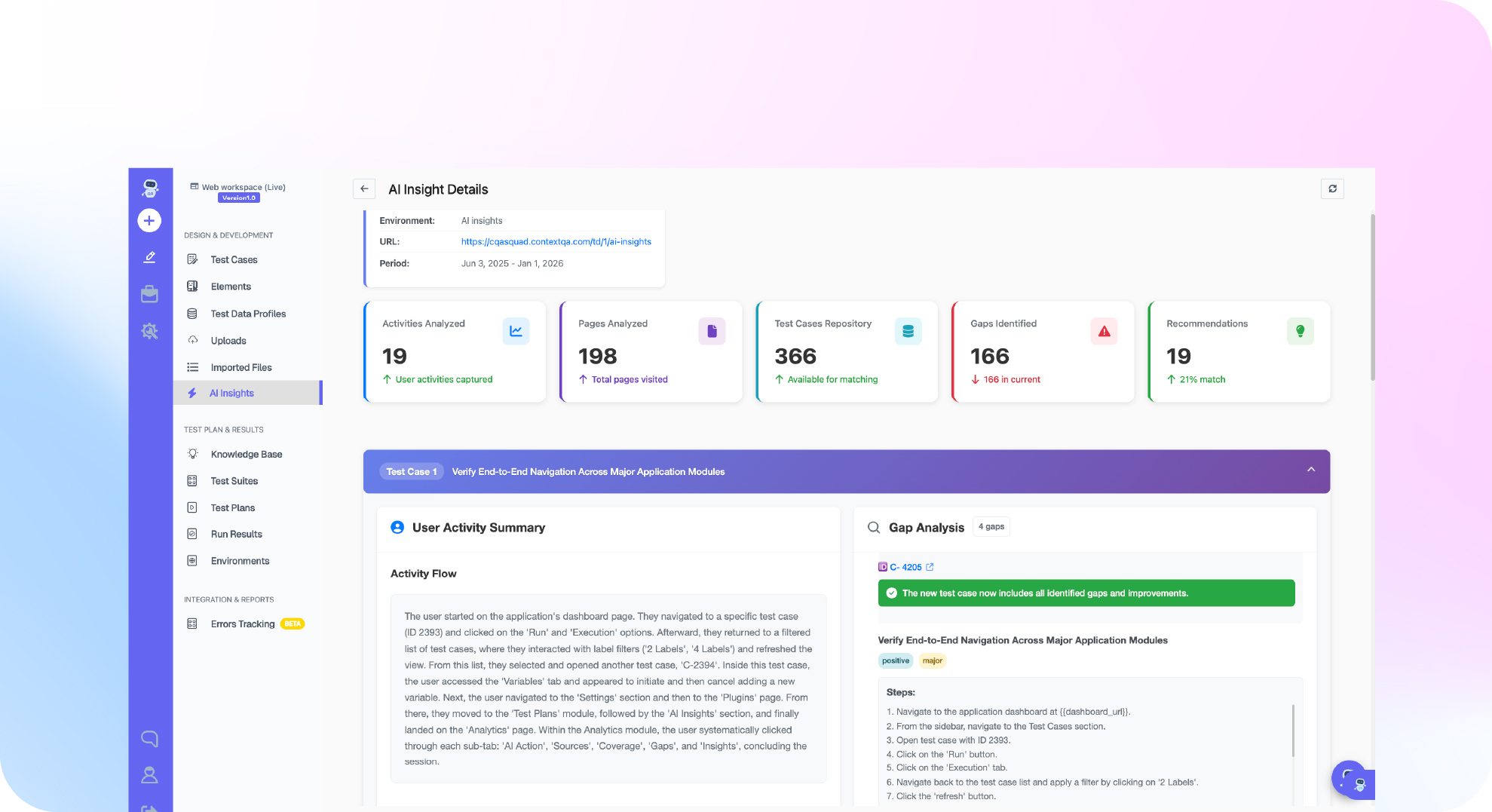
Ship, the ContextQA autonomous quality engineer, covers continuous integration, testing and feedback. It tests every pull request with impact analysis and targeted regressions before merge, and it reproduces bugs reported in Jira, Linear, Slack or a service desk, finds the likely root cause and hands engineers the evidence.
- Integration and testing: Open Settings → Analysis Settings (PR Impact Analysis in older interfaces) and choose when tests run and which environment holds the pull request build. Watch the URL preflight warning: a hardcoded address keeps testing the base deployment. See Test AI-Generated Code Before Merge and, to keep coverage current, the PR impact lab.
- Feedback: Ship reproduces reported bugs and hands engineers the evidence. For each bug, your team records whether it reproduced, did not reproduce under the tested conditions, or could not be determined, so you can verify the fix on the next pull request.
- Deployment, monitoring and operations: Post deploy smoke checks and alerting stay in your existing pipeline and observability tools.
DevSecOps: Ship does not list security scanning, so run SAST (static code analysis), dependency scans and secret scans as separate CI jobs. Enterprise teams that need security testing can review the ContextQA platform through a demo.
Not sure which tests belong on each pull request? Get started free with Ship, no credit card needed, or book a demo to walk through impact analysis and targeted regressions on your own repository.

What should you do on Monday? A checklist
Start with one service. Give each of the seven DevOps phases a named owner and one automated check, closing gaps in this order: commit checks, pull request regression, post deploy smoke checks, then incident feedback.
- List every phase on one page with its named owner.
- Run unit and contract tests on every commit.
- Make the pull request regression job a required status check on
main. - Tag regression tests by user journey so each pull request runs only what its change affects.
- Record the commit SHA in every test run.
- After each deploy, smoke test production with a synthetic account.
- Quarantine flaky tests, each with an owner and a fix date.
- Turn every production incident into a regression test before closing the ticket.
- Try Ship on one repository, then score it after 30 days with the pilot scorecard.
Bottom line
The seven DevOps phases pay off only when each one has a specific check and a named owner: unit and contract tests on every commit, targeted regression on every pull request, smoke checks after deploy, and incidents turned into new tests. On Monday, find one phase with no check and add one. For the planning side, read the 7 phases of the software development life cycle.
Sources
The delivery stability statistic comes from DORA's 2024 report. Workflow details come from the ContextQA learning docs. Ship pricing was checked in November 2026.