
TL;DR: Chatbot quality assurance is the practice of proving that a chatbot understands requests, gives grounded and safe answers, hands off to a human when it should, and actually completes the tasks it promises. Good chatbot QA scores each of those separately, runs a fixed regression set before every release, and keeps checking live conversations afterwards. The step most teams skip is verifying the outcome in the backend system, not just reading the reply.
Definition: Chatbot quality assurance (chatbot QA) is the set of tests, metrics and review steps that confirm a conversational AI system meets its requirements for accuracy, safety, task completion and user experience before and after release. It covers rule-based bots, LLM chatbots and tool-using AI agents that talk to customers in text.
Why chatbot quality assurance matters
A chatbot speaks for your company, and courts treat it that way. In Moffatt v. Air Canada (2024), a Canadian tribunal held the airline responsible for wrong refund advice its website chatbot gave a customer, and rejected the argument that the chatbot was a separate entity responsible for its own actions (American Bar Association summary). The tribunal found the airline did not take reasonable care to make sure its chatbot was accurate.
That is the core job of chatbot QA: make sure every answer the bot gives is one the company is willing to stand behind.
LLM chatbots make this harder than classic software testing for three reasons:
- The same question gets different answers. You cannot assert one exact output, so you score answers against rules and rubrics.
- Conversations carry state. A bot can answer turn one correctly and forget a corrected detail by turn four.
- The answer is not the outcome. A bot can say "your refund is processed" while nothing happened in the billing system.
For the testing techniques themselves, see our chatbot testing guide. This guide focuses on the quality system around them: what to measure, when to block a release and how to keep quality from drifting.
The 12 metrics for chatbot quality assurance
Score each conversation on separate criteria so one good number cannot hide a bad one. These are the criteria ContextQA offers for text agents, grouped by what they protect (metrics and judges).
| Group | Metric | What it checks |
|---|---|---|
| Understanding | Intent recognition | The bot identified what the user wanted |
| Understanding | Entity extraction | Names, dates, order numbers and amounts were captured correctly |
| Understanding | Multi-turn context | Corrections and earlier details are carried through the conversation |
| Answer quality | Response relevance | The reply addresses the question that was asked |
| Answer quality | Groundedness | The answer is supported by your approved sources |
| Answer quality | Knowledge base answer accuracy | Facts match the knowledge base exactly |
| Answer quality | Hallucination | The bot did not invent policies, prices or steps |
| Safety | Safety and toxicity | No harmful, offensive or policy breaking content |
| Handoff | Escalation accuracy | The bot hands off to a human when the rules say it must |
| Handoff | Fallback handling | Unknown requests get a useful fallback, not a loop |
| Outcome | Task completion | The task the user asked for was finished |
| Experience | Response latency | Replies arrive fast enough to keep the user engaged |
Use deterministic checks for anything exact, such as an order number format or a price, and an LLM judge with written pass, partial and fail rules for anything that needs judgment, such as tone or relevance. Decide in advance which failures are critical. A wrong refund amount should fail the test outright, not lower an average score.
A six step chatbot QA process
1. Write requirements the bot can be tested against
List the intents the bot must handle, the facts it may state, the actions it may take and the situations where it must hand off. Each line becomes a test. Vague goals such as "be helpful" cannot be scored.
2. Build a test set from real conversations
Start with 50 to 100 real conversations, anonymized, and have a person mark each one pass or fail with a reason. Add synthetic cases for edge conditions: corrected details, two questions in one message, angry users, off-topic requests and attempts to make the bot break its rules. Keep part of this set aside and never use it to tune prompts, so your scores stay honest.
3. Score with judges you have checked
Run the test set through your automated judges and compare their verdicts with the human ones. If the judge disagrees with your reviewers on more than a small share of cases, fix the rubric before you trust it. An inaccurate judge produces confident noise.
4. Verify outcomes in the backend
For every conversation that should change something, such as a booking, refund, ticket or account update, check the system of record after the chat ends. ContextQA does this with a read-only Verifier that compares what the agent claimed with the real backend state (verify tool actions). Our guide to testing AI agent responses, guardrails and tool calls covers this layer in more depth.
5. Red team the guardrails
Try to make the bot reveal personal data, ignore its instructions, give advice it must not give or promise things the business does not offer. Run these cases every release, because a prompt change that improves one answer can open a hole somewhere else.
6. Gate releases and monitor production
Run the full regression set on every prompt, model or knowledge base change, and block the release if a critical metric fails. After launch, sample live conversations every week, score them with the same criteria and add every real failure to the regression set so it can never come back silently.

Release gates that work
A release gate turns QA results into a clear yes or no. Keep it short enough that people respect it.
| Check | Rule | Why it blocks a release |
|---|---|---|
| Critical facts | Zero failures on prices, policies, legal and medical answers | One wrong answer can create liability |
| Task completion | Every action test confirmed in the backend | A claimed success with no record is a silent failure |
| Escalation | Every must-escalate case hands off correctly | Missed handoffs leave users stuck |
| Safety | Zero failures on the red team set | Guardrail gaps are exploited fast |
| Regression | No drop against the last approved run on the held-out set | Catches quality lost to a prompt or model change |
Chatbot QA tools in 2026
Chatbot QA software falls into four groups. Most teams use more than one.
- Open source evaluation frameworks such as DeepEval and Promptfoo let engineers write scored tests in code and run them in CI. They are flexible but you build and maintain the test sets, judges and reports yourself.
- Conversation simulation platforms such as Cekura and Bluejay generate simulated users, run many conversations and score them, for voice and chat agents. See our comparison of Cekura alternatives for this group.
- Builder platform testing inside tools such as Vapi and Retell checks agents built on those platforms, usually with mocked tool results.
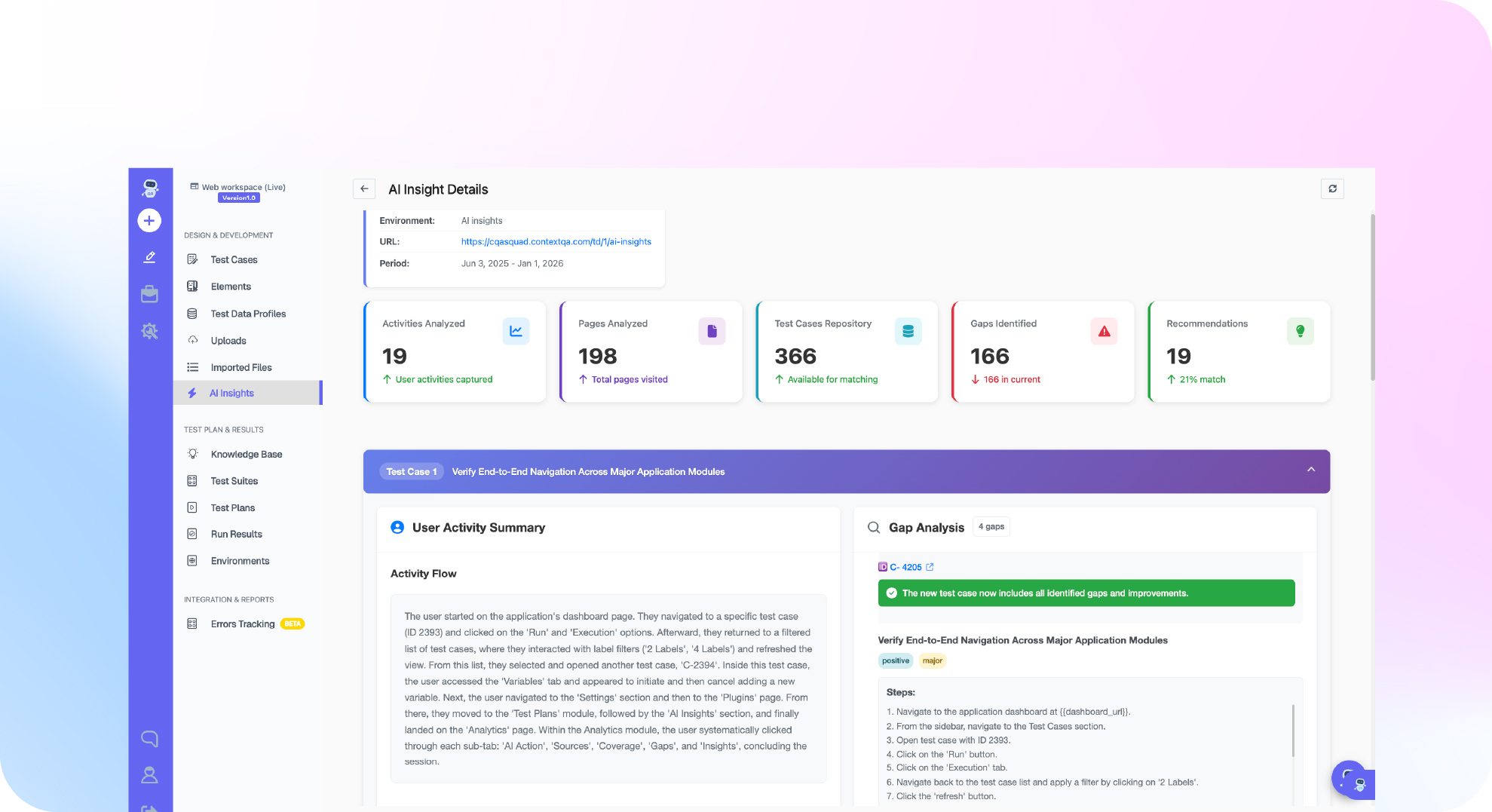
- End to end QA platforms such as ContextQA connect to the deployed bot, score conversations with deterministic checks and LLM judges, verify backend outcomes and keep chatbot tests next to web, mobile and API regression. ContextQA connects to Salesforce AgentForce, AWS Bedrock, Amazon Lex, Snowflake Cortex agents and custom HTTP endpoints (connect agents), and supports evaluation, determinism, red team and load runs.
For a fuller list, read our guides to the best AI agent testing tools and AI agent evaluation tools compared.
Common chatbot QA mistakes
- Testing only the happy path. Real users correct themselves, change topic and ask two things at once.
- Trusting one overall score. An average of 90 percent can hide a bot that gets every refund amount wrong.
- Reading replies instead of checking systems. "Your order is cancelled" is not proof the order was cancelled.
- Tuning on the test set. If you adjust prompts until the test set passes, the scores no longer predict production.
- Stopping at launch. Model updates, new knowledge base content and new user behavior change quality after release.
Want to see this on your own bot? Book a ContextQA demo and bring 20 real conversations. We will score them, show where an automated judge disagrees with your team and verify one backend outcome.
Bottom line
Chatbot quality assurance is not a single test run. It is a short list of metrics scored separately, a regression set built from real conversations, judges checked against human reviewers, outcomes verified in the backend, and a release gate the team respects. Start with 50 real conversations and the five gate checks above, then grow the set from every failure you find in production. For a deeper look at evaluation design, see our guide to human adjudication in AI agent evaluation.