
TL;DR: The best AI agent testing tools in 2026 are Maxim AI, Cekura, Confident AI DeepEval, LangSmith, Langfuse, Arize Phoenix, Promptfoo, Giskard and Galileo, plus ContextQA, our own product, which we cover in a clearly labelled section rather than ranking it. They do different jobs. ContextQA tests a deployed agent end to end from the outside, Maxim AI and Cekura simulate conversations, DeepEval, LangSmith, Langfuse and Phoenix evaluate from inside your code, Promptfoo and Giskard red team, and Galileo guards agents at runtime. Pick by job first, then by price.
An AI agent is not a chatbot with a nicer prompt. It reads policies, calls tools, changes records and hands customers to humans. A wrong answer is a bad experience, but a wrong tool call can refund the wrong order or expose personal data. That is why testing an agent takes more than scoring its text.
Most "best tools" lists mix every product with the word "eval" into one ranking. That makes them hard to use, because a tracing library and a red teaming scanner do not compete with each other. This guide groups ten AI agent testing tools by the job they do, compares them in one table, and ends with a fit guide and a pilot checklist. Vendor facts come from each vendor's own website in November 2026.
Quick answers
What is the best AI agent testing tool?
There is no single best tool for every team. DeepEval or Langfuse fit teams that own the agent's code and want open source evals. Maxim AI and Cekura fit teams that want simulated conversations. Promptfoo and Giskard fit teams whose first worry is security. ContextQA, our own product, is built for teams that need to test a deployed agent end to end without an SDK or code access.
Are AI agent testing tools the same as LLM evaluation tools?
No. Evaluation tools score model outputs, usually from inside your code. Agent testing also checks multi-turn conversations, tool calls with their arguments, guardrails and the business outcome in the systems the agent touches. Many teams use both. Our AI agent evaluation tools comparison covers the eval side in depth.
Can you test an AI agent without access to its code?
Yes. Black box tools test the agent through the same channels a customer uses, such as chat, voice or an API. ContextQA and Giskard both work this way, which matters for agents hosted on platforms such as Salesforce Agentforce or Amazon Bedrock.
The five jobs of AI agent testing
Before you compare vendors, decide which of these jobs you need done. Most teams need two or three.
- End to end agent testing: run realistic scenarios against the deployed agent and verify replies, tool calls, guardrails and the resulting system state.
- Conversation simulation: generate many multi-turn conversations with synthetic users or callers to find failures at scale.
- Code level evaluation and tracing: score outputs and traces with metrics such as faithfulness or tool correctness, inside your codebase and CI.
- Red teaming and security: attack the agent with prompt injection, jailbreaks and data exfiltration attempts.
- Runtime guardrails and monitoring: check behavior in production and block or flag bad responses as they happen.
How we compared the tools
We built this list in November 2026 from each vendor's public website and documentation. We did not benchmark the tools against each other. We judged each one on six points:
- Job: which of the five jobs above the tool is built for.
- Access needed: SDK, tracing hooks or code access, versus testing from the outside.
- Tool call depth: whether it can check that the agent called the right tool with the right arguments.
- Channels: text only, or also voice and other inputs.
- Pipeline fit: whether a run can gate a release in CI/CD.
- Pricing model: open source, free start or quote.
| Tool | Main job | Access needed | Channels | Pricing model |
|---|---|---|---|---|
| ContextQA | End to end agent testing | None: black box, no SDK | Text, voice, files, images | Quote, scoped pilot |
| Maxim AI | Simulation and evaluation | SDK (Python, TypeScript, Java, Go) | Text, integrates with LiveKit | Free start, pricing page |
| Cekura | Voice and chat agent QA | Connects to voice platforms | Voice, chat | See vendor site |
| Confident AI DeepEval | Code level evaluation | Python code | Text | Open source, hosted plans |
| LangSmith | Tracing and evaluation | SDK or tracing | Text | Pricing page |
| Langfuse | Tracing, evals, prompts | SDK or tracing | Text | Open source (MIT), cloud plans |
| Arize Phoenix | Tracing and evals | OpenTelemetry tracing | Text | Open source, self hostable |
| Promptfoo | Red teaming and evals | Config file and CLI | Text | Open source, enterprise plans |
| Giskard | Red teaming and security | Black box, API endpoint | Text | Open source version, Hub |
| Galileo | Evals and runtime guardrails | SDK | Text | Pricing page |
End to end agent testing
ContextQA (our product)
Disclosure: ContextQA is our own product, so we have not given it a rank in this list. The ranked tools below are ordered within each job by the criteria above. Judge ContextQA in the same pilot as the others.
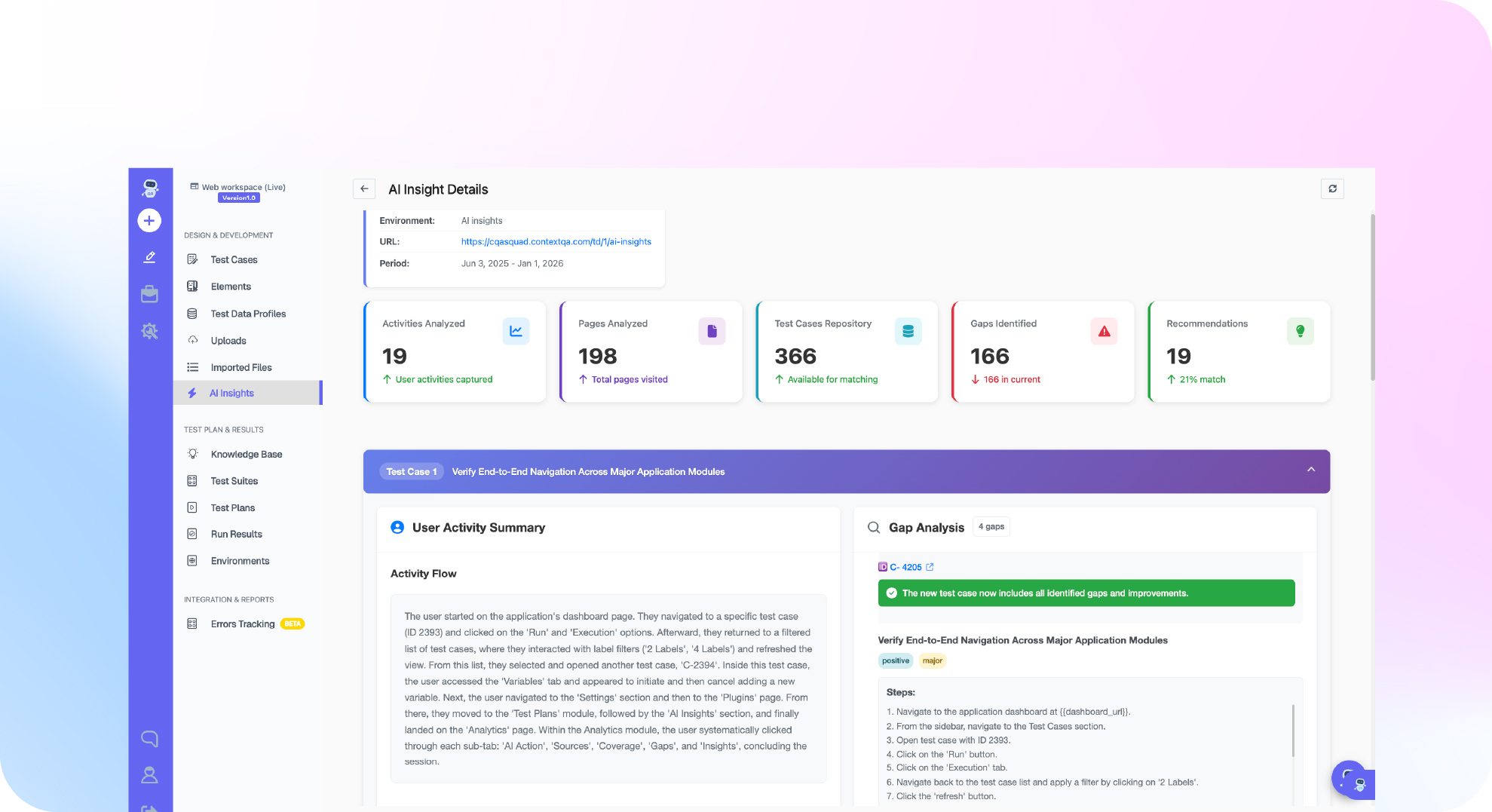
ContextQA (our own product) tests AI agents from the outside, the way a customer or caller meets them. It needs no SDK, instrumentation, code access or privileged hooks, so it works on agents built on Salesforce Agentforce, Amazon Bedrock, Azure AI Foundry, Snowflake Cortex, Intercom Fin and custom stacks.
It generates test scenarios from your uploaded docs, system prompts, policy files, conversation logs or a plain language description of how the agent should behave. Each reply is scored for accuracy, tone and policy adherence, using AI judgment plus deterministic checks against a source of truth.
Three things set it apart from eval tools:
- Tool calls and outcomes: it checks that the right tool ran with the right arguments, and verifies the outcome in the backend through API calls, SOQL queries and database state checks.
- Guardrails: it generates hallucination traps with known answers, jailbreak attempts and adversarial prompts, and scans replies for leaked PII and unauthorized actions.
- Regression after change: it reruns the full scenario suite on each model upgrade, prompt change or retraining, and flags drift before rollout.
It also covers multi-turn conversations of 20 or more turns, voice, file and image inputs, and load tests with concurrent sessions. Results integrate with Jenkins, GitHub Actions, Jira and Slack. Pricing is quote based, and most teams start with a scoped pilot (pricing).
Limits: because it tests from the outside, it does not show traces of your agent's internal code. Pair it with a tracing tool if you need that view.
Best for: teams that must test agents they cannot instrument, and teams that need proof of the business outcome, not only a good reply. See how to test AI agent responses, guardrails and tool calls for the method.
Conversation simulation
1. Maxim AI
Maxim AI simulates multi-turn conversations across scenarios and user personas, scaling to thousands of test cases. It pairs simulation with prebuilt or custom evaluators, human review, dashboards and CI/CD automations. SDKs are available in Python, TypeScript, Java and Go, and you can get started free.
Best for: engineering teams that want simulation, evaluation and observability in one platform and are comfortable adding an SDK.
2. Cekura
Cekura is a QA platform for voice and chat agents. Before launch it runs simulated conversations, including adversarial tests for jailbreaks and PII leaks. After launch it monitors live calls for drift and can replay issues in simulation. It lists Vapi, Retell AI, ElevenLabs, LiveKit, Pipecat and Cartesia among its partners. Hamming is a close alternative focused on large volumes of simulated calls.
Best for: teams shipping voice agents on a voice AI platform. Our voice agent evaluation guide compares the voice tools in more detail.

Code level evaluation and tracing
These tools run inside your codebase or pipeline. They are excellent for development speed, but they need code access, and you write and maintain the datasets and metrics yourself. For a full breakdown, read our LLM testing tools and frameworks guide.
3. Confident AI DeepEval
DeepEval is an open source Python framework that makes LLM evaluation run like unit tests with pytest. Confident AI, the team behind it, offers a hosted platform on top. For agents, it covers tool selection, tool arguments and full agent trajectories, and Confident AI adds multi-turn simulation.
Best for: Python teams that want evals in CI with the deepeval test run command.
4. LangSmith
LangSmith is LangChain's platform for tracing, datasets and evaluation. It shows every tool call in an agent run as a timed step, which makes multi-step failures much easier to debug.
Best for: teams already building on LangChain or LangGraph.
5. Langfuse
Langfuse is an open source platform for tracing, evaluation, datasets, experiments and prompt management. Evaluations can use LLM as a judge, heuristic functions or human review. It is MIT licensed and can be self hosted with Docker Compose, Kubernetes or Terraform templates, or used as Langfuse Cloud.
Best for: teams that want an open source, self hostable alternative to LangSmith that is not tied to one framework.
6. Arize Phoenix
Arize Phoenix is open source tracing and evaluation built on OpenTelemetry, and it can be self hosted. Open trace standards reduce lock in, which helps in data residency reviews.
Best for: teams that need self hosted observability. It leans toward debugging and monitoring more than pre-release test suites.
Red teaming and security
7. Promptfoo
Promptfoo is an open source CLI for evals and red teaming, configured through a YAML file. Its red teaming simulates users to find prompt injections, jailbreaks, PII leaks and insecure agent tool use, and it runs in CI with a single redteam run command. OpenAI announced in March 2026 that it is acquiring Promptfoo and said the open source project will continue.
Best for: engineering teams that want security tests in the pipeline. See our prompt injection testing guide for the attack types to cover.
8. Giskard
Giskard offers continuous red teaming and security testing for LLM agents through the Giskard Hub, plus an open source version and runtime guardrails. It tests for prompt injection, data disclosure and sycophancy, and for quality issues such as hallucinations, contradictions and wrong refusals. It works black box, so it only needs the agent's API endpoint.
Best for: security and risk teams that want ongoing red teaming without access to the agent's code.
Runtime guardrails and monitoring
9. Galileo
Galileo combines evaluation with runtime guardrails, so it can flag or block problems while the agent is live, not only before release. It requires SDK integration.
Best for: teams that want production hallucination monitoring and guardrails in the same tool as their evals.
Which AI agent testing tool fits your team?
Start from who owns agent quality and how much of the agent you can reach.
- You own the code and want to move fast: start with DeepEval or Langfuse in CI, and add Promptfoo for security tests. You will maintain the datasets and metrics yourself.
- You build on LangChain or LangGraph: LangSmith keeps tracing, datasets and evaluators in one place.
- You ship voice agents: use Cekura or Hamming for call simulation, and an end to end tool to confirm the backend outcome of each call.
- Your agent runs on a vendor platform you cannot instrument: use ContextQA for end to end tests and Giskard for ongoing red teaming. Both work from the outside.
- You need to prove business outcomes before release: tests must check the systems the agent changes, not only its words. Read business outcome testing for AI agents.
If you already run evals, you are not done. Evals tell you whether answers look right. They rarely tell you whether the refund was issued, the ticket was routed or the record was updated. Our post on end to end testing when you already have LLM evals explains how the layers fit together.
How to run a fair pilot
Demos are built to pass. Run every shortlisted tool through the same test instead.
- Pick three real agent flows: one happy path, one policy edge case and one that ends with a tool call that changes data.
- Write the expected outcome for each flow, including the system state after the conversation.
- Add five attack prompts: two prompt injections, one jailbreak, one PII request and one off-topic request.
- Run each tool on all of the above and record what it caught, what it missed and how long setup took.
- Change the model or the prompt and run again. A good tool shows you exactly what drifted.
- Check how results reach your pipeline, and whether a failure can block a release.
Then compare pricing. A tool that catches the failure that matters is cheaper than one that does not, at any price.
If your agent's tool calls, guardrails and outcomes still lack a repeatable check before release, book a ContextQA demo and bring one real flow to test.
Bottom line
The best AI agent testing tools in 2026 do not compete on one leaderboard. Evaluation frameworks check outputs from inside your code, simulation platforms generate conversations at scale, red teaming tools attack the agent, guardrail tools watch it in production, and end to end platforms prove the agent did the right thing in your real systems. Choose the jobs you need, shortlist one tool per job, and pilot them on your own flows. For the difference between the two terms people mix up most, see agentic testing vs AI agent testing.
Sources
Compiled from vendor websites and documentation in November 2026. We did not benchmark any tool. Features and pricing change often, so recheck each vendor page before you buy.