
TL;DR: Traditional test automation relies on script based frameworks like Selenium or Playwright, or on model based suites, where engineers write and repair every locator and assertion. AI testing tools generate tests from tickets, flows, or specs, self heal broken selectors, and explain failures. That shifts effort from maintenance to review, and maintenance is where large scripted suites tend to stall. Scripts suit stable, code owned suites. ContextQA, the autonomous quality engineer, fits enterprise apps like SAP and Salesforce, where UI churn breaks scripts.
Choosing between ai testing tools vs traditional test automation is now a budget and risk decision, not a tooling preference. Script based frameworks give you control but consume maintenance hours. AI platforms promise self healing and faster authoring but raise governance questions. This guide compares both and shows when each fits.
Quick answers
What is the practical difference between AI testing tools and traditional test automation for an enterprise team? Traditional test automation means engineers write and maintain scripts or model based suites by hand, so speed depends on coding skill and headcount. AI testing platforms generate tests from tickets, flows, specs, or code changes and repair broken locators when the UI changes. The tradeoff is line by line control versus shifting effort toward reviewing generated coverage and failures.
Will moving to an AI testing platform lock us out of our existing Playwright or Selenium investment? It should not, but verify export before you buy. ContextQA exports tests to Playwright code, so generated suites can live in your repository. Start side by side: keep critical scripted suites in CI, pilot AI generated tests on one high maintenance flow, and compare maintenance effort and missed defects on the same failures.
How do AI testing tools fit into an existing CI/CD release gate compared to scripted suites? The pattern matches a scripted suite: the pipeline triggers a run, waits with a bounded timeout, and blocks the release on any non success result. In ContextQA, a test plan fills that role with Jenkins, GitHub Actions, and other CI/CD tools (For Engineering Managers). Validate the pass, failure, timeout, and expired token paths first.
What is the short answer on AI testing tools vs traditional test automation?
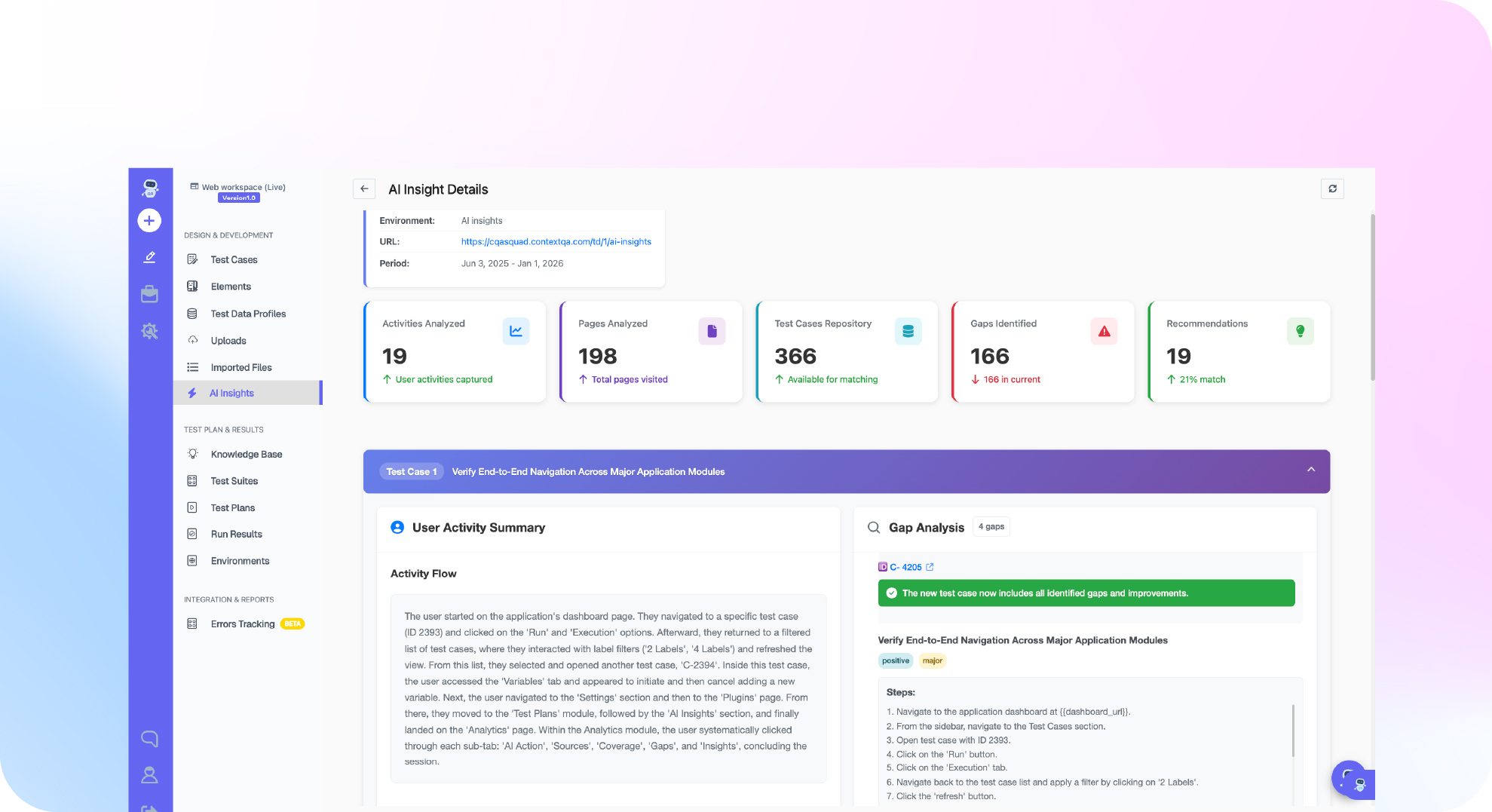
AI testing tools generate, run, and repair tests from intent such as a ticket, a user flow, or an API spec, while traditional test automation executes scripts or models that engineers write and maintain by hand. AI platforms shift effort from locator upkeep to reviewing generated coverage. That matters because maintenance, not authoring, often stalls large regression suites.
The key differences show up in four places:
- Authoring: Script frameworks need coding skill, and model based suites need someone to build and update the model. ContextQA generates test cases from Jira acceptance criteria (For Product Managers) and also offers a no code recorder.
- Reuse: Both approaches support modular steps. In ContextQA, a step group such as
SG_Loginis updated once, and every test case that uses it picks up the change. - Maintenance: Scripted locators fail when the UI changes. Self healing repairs broken selectors and locators automatically.
- Exit path: Code export to Playwright keeps generated tests portable.
Self healing fixes locator drift, but it does not decide whether changed behavior is correct. Review healing events instead of trusting them blindly; the engineering manager view tracks self healing rate alongside flaky test count.
How do AI testing tools and traditional test automation compare?
Traditional test automation with Selenium or Playwright gives engineers full control through code, but every UI change becomes manual script repair. AI testing tools generate tests from flows, tickets, or specs, repair broken locators automatically, and let non coders author. The tradeoff is lower maintenance and wider authorship in exchange for depending on a platform's models and governance controls.
- Authoring: Framework scripts need SDET time for each test. AI platforms generate cases from tickets or specs (ticket to test), and ContextQA adds a no code recorder.
- Maintenance cost: With a framework, the cost is engineer hours spent fixing selectors after UI changes. ContextQA self healing repairs selectors automatically.
- Enterprise apps: Hand scripting SAP Fiori or Salesforce Lightning is slow. ContextQA covers enterprise app workflows end to end, including SAP Fiori, S/4HANA, and SAP GUI on the Enterprise plan.
- CI/CD: Both run in pipelines. A ContextQA test plan acts as a release gate with a run ID and a bounded timeout.
- Governance: Scripts are governed by code review. A platform needs review of generated assertions and healing events, plus controls such as masking sensitive environment data.
- Skills: Frameworks need coders. Platforms let manual testers author while SDETs focus on strategy and review.
- Cost model: Open source has no license fee but carries authoring, repair, and grid infrastructure hours. ContextQA pricing comes through a demo and quote.
- Lock in: Open source code is portable. Ask whether AI generated tests export. ContextQA exports Playwright code.
Score every shortlisted tool on the same task against your own app, not on vendor demos.

When should you choose AI testing tools?
Choose an AI testing platform when UI churn keeps breaking scripted selectors, when Salesforce or SAP workflows sit inside your critical paths, or when testers without coding skills need to author coverage. Stay with scripted frameworks when your suite is stable, your team is code first, and maintenance already costs very little.
These signals point toward AI tooling, along with the limits you should plan for:
- Maintenance dominates the sprint: If engineers spend more time repairing locators than writing tests, self healing targets that cost directly.
- Requirements arrive as tickets: Generating test cases from Jira acceptance criteria shortens the path from spec to coverage (For Product Managers).
- You can staff a review step: Generated tests can assert the wrong thing or pass for the wrong reason. Seed a known defect and confirm the test fails before you trust it (evaluation guide).
- ROI is measured, not assumed: Compare your own hours spent on script repair and triage against the platform quote. No vendor figure replaces your baseline.
When should you choose traditional test automation?
Choose traditional test automation when your UI is stable, your engineers already write and review test code as part of normal development, and most coverage sits in web and API layers your team controls. Script based frameworks such as Playwright or Selenium give you full control, open source licensing, and tests versioned alongside the application code.
Traditional frameworks are the right call in these situations:
- Stable UI and a strong SDET bench: If selectors rarely change and SDETs (software development engineers in test) own the suite, locator maintenance stays manageable, and self healing adds less value.
- Predictable total cost of ownership: Count the engineer hours spent authoring tests, repairing locators, and running browser grid infrastructure before you compare against a platform quote.
- Low level control: Custom network mocking, bespoke fixtures, and in code assertions on internal state are often easier to express directly in a framework.
- A hybrid pipeline instead of a migration: Keep existing suites in CI and add a ContextQA test plan as a separate stage. That stage starts the plan, polls its run ID with a bounded timeout, and stops the release on any non success result (engineering manager guide).
How do you move between them?
Move incrementally. Keep your script based suite as the system of record, pilot an AI testing platform on one high maintenance flow, and run both in CI side by side. Expand only when the pilot meets criteria you set in advance. Check lock in, data exposure, and explainability before a broad rollout, not after it.
- Pick one painful flow. Choose the suite where selector churn or enterprise UI changes, such as Salesforce or SAP Fiori, cost the most repair time. Write success, revise, and stop criteria using a bounded experiment template.
- Seed a real failure. Plant a defect or weaken a prerequisite, then confirm the generated assertion fails for the right reason. Root cause analysis should explain each failure in readable terms.
- Rebuild shared steps once. In Test Cases, switch the list to Step Groups, select New Step Group, and use Add Step to build login and setup as a reusable sequence (step groups tutorial).
- Gate in CI beside the old suite. Run a ContextQA test plan as a pipeline stage. Validate the pass, failure, timeout, and expired token paths before you make it required (engineering manager guide).
- Close the risk checklist. Confirm that Playwright code export gives you an exit path and that sensitive environment data is masked. Then pick a deployment model your compliance team accepts: cloud SaaS, your own cloud, self hosted, or on premises.
- Decide per suite. Keep scripts for stable, developer owned code level tests. Shift to the platform where maintenance load, enterprise app coverage, or authoring by testers who do not code dominates.
If script maintenance and enterprise app coverage are stalling your release pipeline, book a demo to see how ContextQA authors, self heals, and runs those tests.
Where does ContextQA fit?
ContextQA is an AI testing platform that works as an autonomous quality engineer. It generates, runs, and self heals tests across web, mobile, API, and enterprise apps such as Salesforce and SAP. Because it integrates with CI/CD and exports to Playwright code, it can sit alongside the test automation tools you already run instead of replacing them.
Here is how each step maps to a documented workflow:
- Authoring: Paste a Jira ticket URL and ContextQA generates test cases from the acceptance criteria (For Product Managers). Testers without coding skills can use the no code recorder.
- IDE: Run the same work from Claude Code or Cursor through the MCP server.
- CI/CD: The pipeline starts a test plan, keeps the run ID, polls status with a bounded timeout, and fails the release on any non success result (For Engineering Managers).
- Exit path: Playwright export keeps the tests portable.
Bottom line
Script based frameworks still fit teams with strong coding skills, stable UIs, and a need for full control. Model based suites suit regulated programs that value structured governance. AI testing platforms make sense when maintenance, enterprise app coverage, and authoring by non coders are the bottlenecks. ContextQA offers no code authoring, self healing, CI/CD integration, and Playwright export, so you keep a code path.
On Monday, pick one flaky regression suite, run a bounded pilot against it, and judge the results on your own failures.