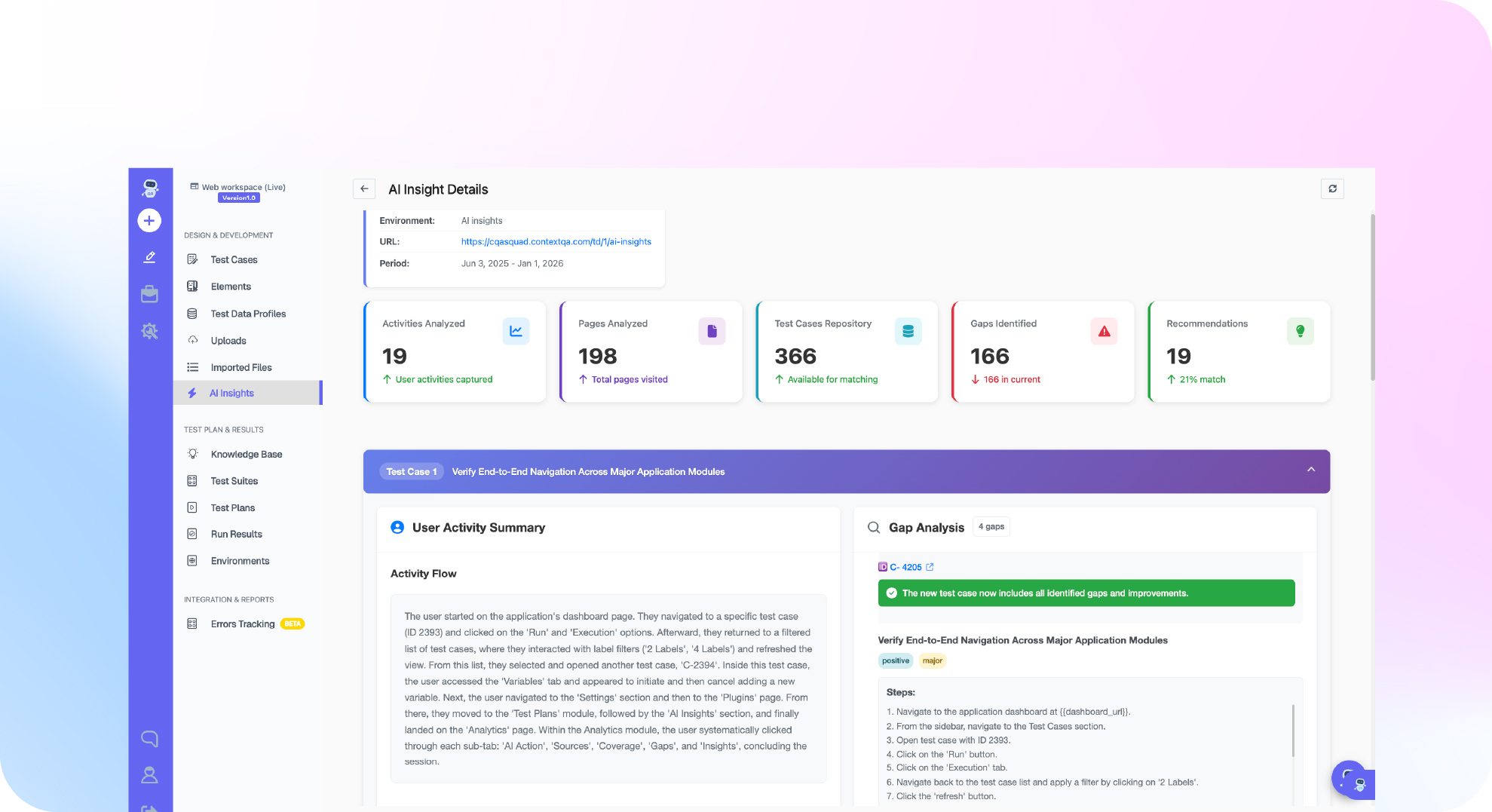

TL;DR: The SDLC planning phase is where a team defines scope, acceptance criteria, risks, owners, and the test strategy before anyone writes code. For QA, planning means agreeing which behaviors are release critical, what evidence proves them, and what triggers a rollback. ContextQA, the autonomous quality engineer, can generate test suites from the tickets, Figma files, or Swagger specs created during planning.
Most teams treat the SDLC planning phase as a scoping exercise for features, then bolt testing on after the first sprint. That leaves gaps in coverage, ownership, and release gates. This checklist gives you a test strategy template covering inventory, dependency classification, pilot selection, assertion and failure gates, CI/CD triggers, evidence retention, and rollback ownership, so every test decision is documented before code ships.
Quick answers
What should a test strategy cover during the SDLC planning phase? It should name in scope applications and environments, out of scope tests with reasons, release critical flows, and target browsers and devices. List dependencies such as fixtures, data factories, secrets, CI triggers, and retry policies, plus the evidence each gate requires. Close with named owners, acceptance gates, and a decision date.
Who should own testing decisions during planning? A business owner decides scope, a QA or migration owner runs the plan, and technical reviewers validate assertions and dependencies. Add security and release reviewers when work touches regulated data or production cutover. Record every name in a versioned charter and log scope changes as new dated decisions.
How do you define test acceptance criteria while planning? Write gates that check whether each critical test asserts the right behavior, not just whether it passes. Every release critical test needs one normal run and one controlled failure proving the assertion can fail. Use test counts only as a completeness check, because an assertion review is what proves coverage.
What is the SDLC planning phase?
The SDLC planning phase is the first stage of the software development life cycle, where a team decides what to build, why, for whom, and within which budget, schedule, and risk limits. It sets the baseline every later phase is measured against, so gaps here surface later as rework, slipped releases, and missing coverage.
Its main objectives are to define scope, confirm the project is feasible, and agree on a plan that stakeholders approve. The key activities and their deliverables:
- Scope statement: in scope features, out of scope items, and the reasons for each. Keep it versioned so scope changes become dated decisions.
- Requirements: business and functional requirements with acceptance criteria specific enough for QA to turn into assertions.
- Feasibility study: technical, financial, operational, and schedule checks, including whether test environments, test data, and target devices exist.
- Project plan: milestones, owners, estimates, a risk register, and release gates.
For QA leads, this is where the test strategy starts. It decides which flows are release critical, which environments CI needs, and what evidence a release must produce before it ships.
What can the planning phase do?
The planning phase turns a vague request into a scoped, costed, and testable project. It confirms the work is feasible, estimates time, budget, and people, defines acceptance criteria, and names risks and owners. For QA teams, this is where test scope, environments, and release gates get decided before anyone writes code.
In practice, planning produces these outputs:
- Technical feasibility: Confirm that the stack, integrations, and test environments exist. For example, check whether CI can reach SAP or Salesforce sandboxes. Spike unknowns before you commit to dates.
- Economic feasibility: Weigh build, licensing, and maintenance cost against expected value. Include the ongoing cost of keeping flaky tests green.
- Operational feasibility: Verify that the team can own the system after launch, including on-call, test data, access, and training.
- Story points: Size backlog items relative to each other, then convert to dates using measured team velocity.
- Three-point estimation: Apply
(O + 4M + P) / 6across optimistic, most likely, and pessimistic durations for risky work. - COCOMO: Model effort as
a × KLOC^bon large projects that have historical size data. - Acceptance gates: Record scope, evidence, and rollback triggers in a versioned charter, like the one in ContextQA's planning checklist.

Why does planning matter in 2026?
Planning is the cheapest point to remove risk, because scope, acceptance criteria, environments, and release gates are still decisions on a page, not code in a pipeline. The Consortium for Information & Software Quality estimated that poor software quality cost the US at least $2.41 trillion in 2022 (CISQ, 2022).
Risk assessment at this stage means listing what could block a release, then giving each risk an owner and a mitigation before sprint one. Typical entries include:
- An unstable third party sandbox.
- Missing test data for an SAP or Salesforce workflow.
- A shared staging database that other teams also use.
- A flaky suite that no one owns.
QA leads should own four planning outputs:
- Test strategy: which layers (unit, API, UI, end to end) cover which risks.
- Test plan: environments, browsers, devices, test data, and schedule.
- Release gates: the CI checks that block a merge or release, with named reviewers.
- Acceptance criteria: testable statements for each ticket, written before development starts.
The ContextQA planning and acceptance checklist applies the same discipline to test migrations, using a versioned charter with acceptance gates and a named rollback owner.
How does planning work in practice?
Planning turns a business goal into scoped, estimated, owned work before anyone writes code. Teams define scope, estimate effort, map risks, set release gates, and choose a cadence. Waterfall plans the full release once, Agile replans every sprint, and DevOps plans continuously around small, frequently deployed changes.
- Define scope and objectives. Capture requirements as epics and tickets in Jira, Azure DevOps, or Linear. Keep discovery notes and specs in Confluence or Productboard.
- Estimate and sequence work. Waterfall fixes a roadmap up front. Agile sizes stories during sprint planning. DevOps slices work small enough to ship behind feature flags.
- Assess risks and dependencies. List the environments, test data, third party services, and compliance constraints that could block a release.
- Define CI gates. Decide which test suites must pass in CI/CD before merge and before release, and name who triages each failure.
- Plan the release and rollback. Agree on cadence, rollback triggers, and owners. For test migrations, the ContextQA planning checklist provides a charter template covering acceptance gates and a named rollback owner.
Which approach fits your team best?
The right planning approach depends on team size and release risk. Startups need a one page charter and a short checklist. Agencies need written scope and change control to stop scope creep. Enterprise teams need versioned charters, dependency inventories, and explicit acceptance and rollback gates before any build work starts.
- SaaS startups (lightweight): Record the decision, owner, in scope items, out of scope items with reasons, and a decision date. The most common mistake is estimating before each requirement has a testable acceptance criterion. Without that criterion, the estimate covers work nobody has defined.
- Dev agencies (contract driven): Keep a fixed scope document with a dated change log. When scope moves, add a new dated decision instead of silently rewriting the baseline. This keeps scope creep visible and billable.
- Enterprise and regulated teams (gated): Inventory every dependency, including fixtures, secrets, environments, and CI triggers. Define acceptance gates and name a rollback trigger and owner. ContextQA's planning and acceptance checklist includes a copyable charter template built this way for test migrations.
Match planning depth to the cost of a wrong release, and version every scope change.
How does ContextQA handle the SDLC planning phase?
ContextQA supports the SDLC planning phase by generating test suites from planning artifacts, which you run once the build exists. Point the platform at a ticket, a Figma file, or a Swagger spec and it generates a suite covering happy paths, edge cases, and failure states, so acceptance criteria have matching scenarios while scope is still open.
Whichever SDLC model you run (waterfall, iterative, or agile), planning produces the same inputs: tickets, designs, and API contracts. ContextQA uses those inputs directly.
- Coverage review: Before a sprint commits, have a reviewer check the generated scenarios against your acceptance criteria. ContextQA also offers a coverage assurance mind map.
- Migration planning: The planning checklist provides a versioned charter, a pilot cohort, and rollback gates. Each wave must balance
source inventory = migrated + retained + replaced + retired + unresolved. - Buying decisions: The decision guides produce a vendor scorecard, a cost per release model, or a security evidence request, each with a named owner and date.
Does your planning still end without assertion, evidence, and rollback gates for every release critical test? Book a ContextQA demo to see how the platform generates self healing test suites from tickets, designs, and API specs.

What should you do now? A checklist
Treat planning as the point where test scope, ownership, and release gates get decided. Before design starts, record what must be tested, who owns it, which environments it needs, and what evidence proves a release is ready. The checklist below turns those decisions into actions a reviewer can verify.
Many teams describe five SDLC phases: planning, design, development, testing, and deployment. Planning sets scope and acceptance gates. The design phase then turns those gates into architecture, interfaces, and test hooks.
- Name a QA owner and a release approver in a versioned
qa-charter.md. - List in-scope environments, browsers, and devices, plus exclusions with a reason.
- Mark which user flows are release critical.
- Inventory existing suites, fixtures, data factories, and secret references.
- Map every requirement ticket to at least one planned assertion.
- Fix CI required-check names and retry policy before code exists.
- Define accepted evidence: screenshots, logs, traces, reports.
- Require one controlled failure per critical test to prove its assertion can fail.
- Assign a rollback trigger and owner.
- Give design reviewers a testability list: stable element IDs, API contracts, seeded data.
ContextQA's planning and acceptance checklist provides a charter template you can copy.
Bottom line
A test strategy written during the SDLC planning phase decides what gets tested, by whom, against which environments, and what evidence counts as a pass. Keep it as a versioned checklist: name owners, classify dependencies, define assertion and rollback gates, and reconcile every test asset before sprint one. Then carry it into the implementation phase in SDLC, where those gates become CI checks.
Sources
- CISQ, The Cost of Poor Software Quality in the US, 2022: source of the $2.41 trillion estimate.
- ContextQA Planning & Acceptance Checklist: charter template, reconciliation equation, and acceptance gates.
- ContextQA Planning & Decision Guides: scorecard, cost model, and security evidence guides.