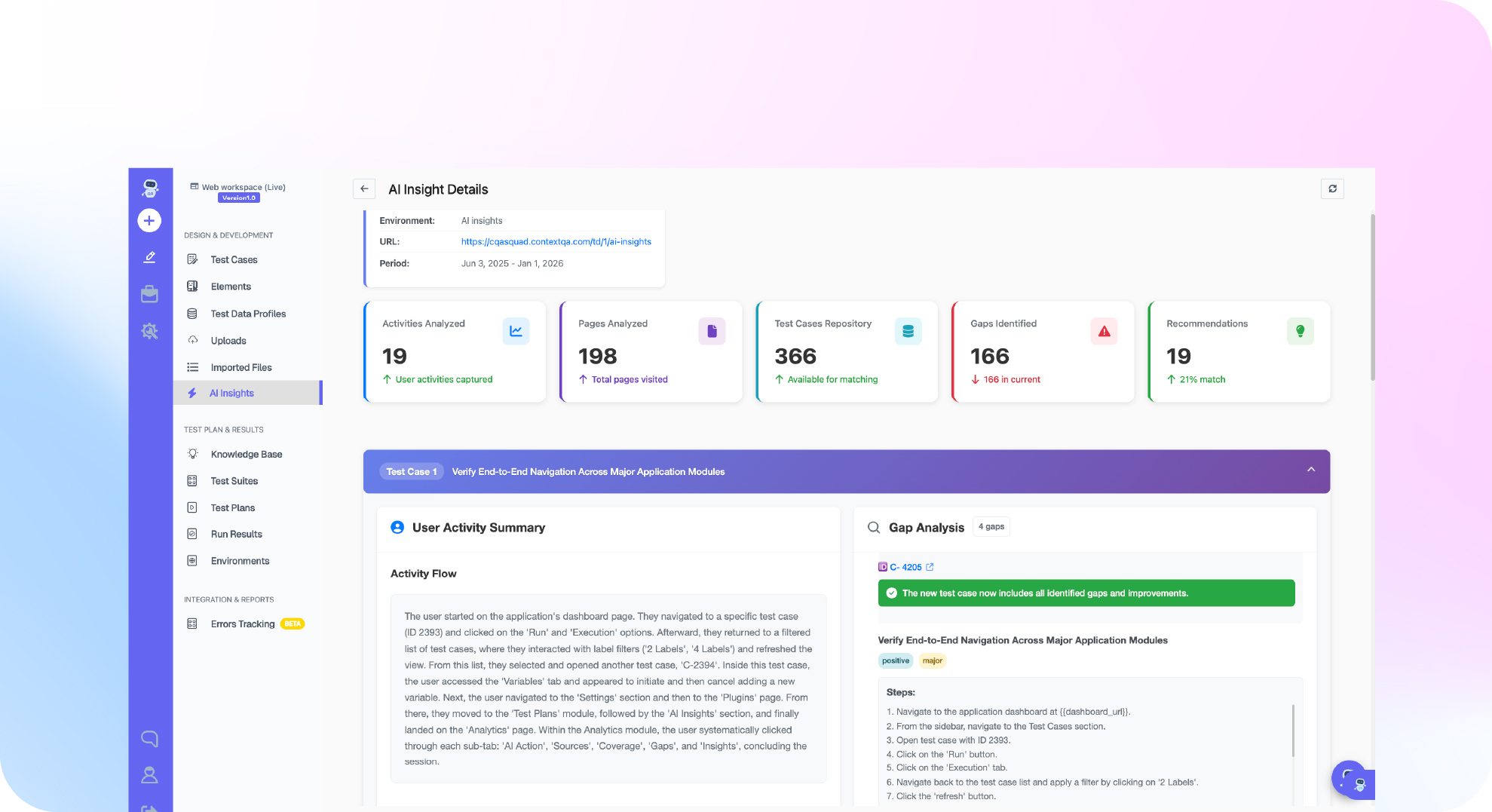

TL;DR: Self healing test automation repairs a broken locator at run time. Instead of failing on one stale selector, it finds the intended element through other signals: text, attributes, position, and surrounding DOM. Google reported that about 1.5% of its test runs produced flaky results (Google Testing Blog, 2016). ContextQA, the autonomous quality engineer, repairs broken selectors automatically. Tests should still fail when behavior changes, not just markup.
Self healing test automation repairs the selectors that break your suite after a UI change, without anyone editing test code. If a renamed class or a moved button turns your CI pipeline red every sprint, this guide covers why selectors break, how healing relocates the element, when a test should fail instead of heal, and how to review every healed step.
Quick answers
When should a test fail instead of self heal? A test should fail when behavior changed, not just the selector. Examples include a removed button, an action whose meaning changed ("Submit" became "Delete"), an element that moved into a different workflow step, or a weak match. Healing should repair locators for the same element and never hide a regression. Low confidence matches should fail and go to a human.
How does self healing find an element after its selector breaks? At authoring time, it stores several attributes per element: ID, name, text, classes, XPath, position, and surrounding DOM. When the primary locator misses, it compares those signals and the visual and DOM context against the current page. It then picks the closest candidate and updates the locator. In ContextQA, broken selectors are repaired automatically and the run continues.
How should engineering managers govern healed test steps so they do not hide bugs? Treat every healed step as a code change that needs review. Show the old locator, the new locator, and the match reason in the run report. Route that report to the test owner through Jira, Slack, or GitHub. Repeat heals on the same element signal unstable markup, which the frontend team should fix with stable test IDs.
What is flaky test detection, and how is it different from self healing? Flaky test detection is the diagnostic step: reproducing an intermittent failure, matching the evidence to a likely cause, and deciding whether it is a real bug, a test issue, an environment problem, or a flake. Self healing is the repair step for one specific cause, a broken locator, and runs automatically once a failure is already classified as a locator break rather than a behavior change. See ContextQA's flaky test detection guide for the full diagnostic workflow.
What is self healing test automation?
Self healing test automation detects when a locator no longer matches an element after a UI change, then repairs the step at run time instead of failing the test. Because it identifies elements by several signals at once, it cuts false failures and the maintenance hours spent chasing them.
A locator is the CSS selector or XPath expression a test step uses to find an element. Traditional scripts depend on exactly one locator, so a small markup change breaks the run even when the feature works. Selectors usually break for predictable reasons:
- Generated class names: CSS in JS and CSS module builds produce hashed classes such as
Button_primary__x7k2that change when the stylesheet's file path, name, or content changes, or when the build configuration changes. - Auto generated IDs: Component libraries emit IDs like
btn-3f9athat shift when render order changes. - DOM restructuring: A new wrapper
divinvalidates positional XPath such as/div[2]/form/button[1]. - Copy changes: Text based locators break when product renames "Checkout" to "Place order."
In the ContextQA platform, AI based self healing automatically repairs broken selectors and locators when the UI changes. For engineering leaders, the key point: a healed step proves the element was found, not that the feature works. Assertions still decide whether a release passes.
What can self healing tools do?
Self healing tools keep UI tests running when the interface changes underneath them. When a stored locator stops matching, the tool searches for the same element using other attributes and surrounding context. It updates the step and records the change, so a reviewer can accept or reject the repair.
In practice, that covers five jobs:
- Classify the failure: Separate "element not found" (
#submit-btnwas renamed) from "wrong result" (an assertion failed). Only the first is a healing candidate. - Fingerprint each element: Store
id,data-testid, visible text, ARIA role, and DOM position, so one renamed attribute does not orphan the step. - Rematch using context: Compare candidates against the stored signals and neighboring elements, then select the closest match.
- Log every repair: Record the old and new locator as a reviewable diff.
- Stay limited to locators: Healing repairs how a step finds an element, not behavior. A removed button or changed flow should still fail.

Why do self healing tests matter in 2026?
Self healing tests matter because frontend teams ship UI changes faster than QA can patch locators by hand. Every broken selector produces a red build that nobody trusts. Healing repairs the locator at run time, so cosmetic changes stop blocking the pipeline.
The cost of untrusted tests is documented. Google reported that almost 16% of its tests showed some level of flakiness, and about 1.5% of all test runs produced a flaky result (Google Testing Blog, 2016). Brittle locators produce the same symptom: a test fails while the feature works.
When you evaluate tools, skip vendor rankings and test four behaviors:
- Relocation signals: Does the tool combine several attributes with DOM and visual context, or rely on one fallback attribute?
- Reviewability: Is each healed step logged with its old and new locator?
- Fail versus heal rules: Does a removed button fail the test, or does the tool match a lookalike?
- Exit path: Do tests export to code such as Playwright?
How does self healing test automation work?
Self healing test automation stores several identifying attributes for each element when a test is created. When the primary locator fails at run time, the engine searches the current page for the closest match using those attributes plus DOM and visual context. A confident match repairs the locator. A weak match fails the test.
- Capture a fingerprint. Record
id,name, visible text, ARIA role, CSS classes, DOM position, and neighboring elements. - Detect the break. A
NoSuchElementExceptionin Selenium or a locator timeout in Playwright triggers healing instead of an immediate failure. - Score candidates. Rank elements by how many stored attributes and how much context still match.
- Heal or fail. Above a confidence threshold, use the new locator. Below it, fail the test.
- Log for review. Record old and new locators for an engineer to accept or reject.
Before and after walkthrough. Suppose the original checkout button looks like this:
<form id="checkout">
<button id="btn-3f9a" class="btn primary">Place order</button>
</form>
The test step is page.click('#btn-3f9a'). A redesign then ships this markup:
<form id="checkout">
<div class="actions">
<button data-testid="place-order" class="Button_primary__x7k2">Place order</button>
</div>
</form>
The ID is gone and the class changed, so the step misses. But the text, the button role, and the parent form still match, making it a confident heal to [data-testid="place-order"]. If the button text had become "Save draft," only the role and form would match, and the step should fail for a human to triage.
In open source, Selenium needs a third party plugin that wraps WebDriver and stores locator history. Recent Playwright releases ship Test Agents, including a healer agent that attempts to repair failing tests, and getByRole locators break less often to begin with.
Which approach fits your team?
Teams with a small, stable suite and strong SDETs can keep maintaining locators by hand. Teams whose UI ships weekly, and whose regression suite fails on cosmetic changes, should adopt healing with a mandatory review step, so repaired locators cut maintenance without hiding regressions.
- Hand maintained locators: Lowest tooling cost and full control. Every renamed class becomes a ticket, and the load grows with suite size.
- In house fallback locators: Your framework tries a second or third selector before failing. Your team owns the matching logic, logging, and review workflow indefinitely.
- Platform self healing: ContextQA AI based self healing repairs broken locators. Tests still run in Jenkins or GitHub Actions, and Playwright export limits lock in.
Recommendation: If broken selectors consume real sprint capacity, adopt healing and require review of healed steps. Count locator related failures per sprint before and after to measure the return.
How does ContextQA handle self healing?
ContextQA repairs broken selectors and locators automatically when the UI changes, so a renamed ID or a moved button does not stop the run. Healing happens inside the same platform that generates, executes, and analyzes tests, and one suite runs in parallel across Chrome, Safari, Edge, Firefox, iOS, and Android.
A typical pipeline looks like this:
- A Jenkins or GitHub Actions step triggers the suite on every build.
- When a locator no longer matches, AI based self healing repairs it, so a changed selector alone does not fail the build.
- Results post to Jira, Slack, or GitHub. The platform also offers a separate root cause analysis capability.
- Code export produces Playwright code, so engineers can inspect locators in a normal diff.
The main risk is a false positive. A healer can match the wrong element, such as a relabeled Cancel button standing in for a missing Submit. The test passes and the regression ships. Assert outcomes such as order status, URL, or database state, not only clicks, and treat every healed locator as a change to verify.
If UI changes keep breaking your selectors and stalling CI runs, book a demo to see how ContextQA self healing repairs broken locators automatically.
What should you do now?
Start by measuring how much time your team spends fixing broken locators, then pilot healing on one flaky suite with review gates in place. Self healing shifts the work from rewriting scripts to approving or rejecting healed steps, and that review belongs in your existing triage cadence.
- Tag every test failure from the last 30 days as a locator break, a timing issue, or a real defect.
- Choose the suite with the most locator breaks as your pilot.
- Add stable attributes such as
data-testidto critical elements. - List the assertions that must fail and never heal: prices, totals, permissions, and error text.
- Assign a named reviewer to approve healed steps before each release.
- Reject any heal that lands on a different element type or page region.
- Compare maintenance hours before and after the pilot using your own logs.
Bottom line
Selectors break because they encode one fragile attribute that the UI was always free to change. Self healing test automation locates the element again from multiple attributes plus visual and DOM context. That is only safe with clear fail rules and human review of every healed step. This Monday, pick one flaky suite, mark the steps that must never heal, and name a reviewer.
Sources
The flakiness statistic comes from the primary source below. ContextQA capability claims link to the platform pages that describe each feature, so you can verify them before evaluating the tool on your own application.